
GROUP DYNAMICS
Introduction to
Group Dynamics
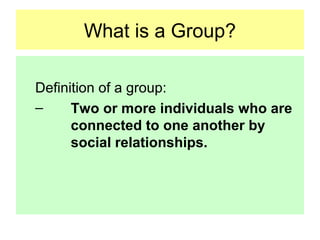
What is a Group?
Definition of a group:
– Two or more individuals who are
connected to one another by
social relationships.
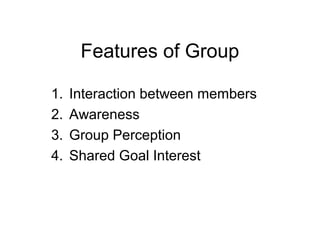
Features of Group
1. Interaction between members
2. Awareness
3. Group Perception
4. Shared Goal Interest
Types of groups
• Billions of groups in the world, but they
can be classified into basic categories,
or clusters
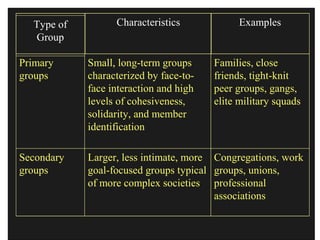
Congregations, work
groups, unions,
professional
associations
Larger, less intimate, more
goal-focused groups typical
of more complex societies
Secondary
groups
Families, close
friends, tight-knit
peer groups, gangs,
elite military squads
Small, long-term groups
characterized by face-to-
face interaction and high
levels of cohesiveness,
solidarity, and member
identification
Primary
groups
ExamplesCharacteristicsType of
Group
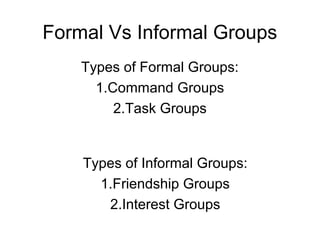
Formal Vs Informal Groups
Types of Formal Groups:
1.Command Groups
2.Task Groups
Types of Informal Groups:
1.Friendship Groups
2.Interest Groups
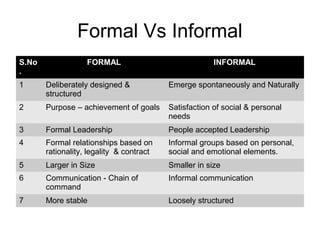
Formal Vs Informal
S.No
.
FORMAL INFORMAL
1 Deliberately designed &
structured
Emerge spontaneously and Naturally
2 Purpose – achievement of goals Satisfaction of social & personal
needs
3 Formal Leadership People accepted Leadership
4 Formal relationships based on
rationality, legality & contract
Informal groups based on personal,
social and emotional elements.
5 Larger in Size Smaller in size
6 Communication - Chain of
command
Informal communication
7 More stable Loosely structured
Reasons for Formation of
Informal Groups
1. Companionship
2. Sense of Identification
3. Source of Information
4. Job Satisfaction
5. Protection of Members
6. Outlet for Frustration
7. Perpetuation of Cultural Values
8. Generation of New Ideas
Problems Created by Informal
Groups
1. Negative attitude of Informal
Leaders
2. Conformity
3. Resistance to Change
4. Rumor
5. Role Conflict
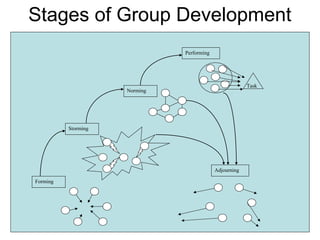
Stages of Group Development
Forming
Storming
Norming
Adjourning
Task
Performing
Theories of Group Formation
1. Propinquity Theory – spatial or
geographical nearness
2. Homans Theory – Activities, Interaction
and sentiments
3. Balance Theory – Newcomb
4. Exchange Theory – reward cost
relationship
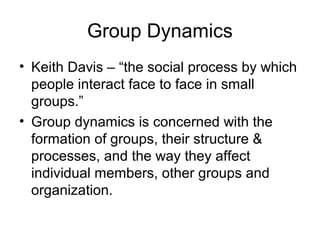
Group Dynamics
• Keith Davis – “the social process by which
people interact face to face in small
groups.”
• Group dynamics is concerned with the
formation of groups, their structure &
processes, and the way they affect
individual members, other groups and
organization.
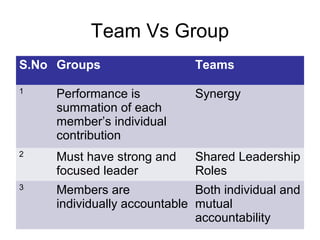
Team Vs Group
S.No Groups Teams
1
Performance is
summation of each
member’s individual
contribution
Synergy
2
Must have strong and
focused leader
Shared Leadership
Roles
3 Members are
individually accountable
Both individual and
mutual
accountability
• Thank you

Group discussion

  • 1.
  • 2.
  • 3.
    What is aGroup? Definition of a group: – Two or more individuals who are connected to one another by social relationships.
  • 4.
    Features of Group 1.Interaction between members 2. Awareness 3. Group Perception 4. Shared Goal Interest
  • 5.
    Types of groups •Billions of groups in the world, but they can be classified into basic categories, or clusters
  • 6.
    Congregations, work groups, unions, professional associations Larger,less intimate, more goal-focused groups typical of more complex societies Secondary groups Families, close friends, tight-knit peer groups, gangs, elite military squads Small, long-term groups characterized by face-to- face interaction and high levels of cohesiveness, solidarity, and member identification Primary groups ExamplesCharacteristicsType of Group
  • 7.
    Formal Vs InformalGroups Types of Formal Groups: 1.Command Groups 2.Task Groups Types of Informal Groups: 1.Friendship Groups 2.Interest Groups
  • 8.
    Formal Vs Informal S.No . FORMALINFORMAL 1 Deliberately designed & structured Emerge spontaneously and Naturally 2 Purpose – achievement of goals Satisfaction of social & personal needs 3 Formal Leadership People accepted Leadership 4 Formal relationships based on rationality, legality & contract Informal groups based on personal, social and emotional elements. 5 Larger in Size Smaller in size 6 Communication - Chain of command Informal communication 7 More stable Loosely structured
  • 9.
    Reasons for Formationof Informal Groups 1. Companionship 2. Sense of Identification 3. Source of Information 4. Job Satisfaction 5. Protection of Members 6. Outlet for Frustration 7. Perpetuation of Cultural Values 8. Generation of New Ideas
  • 10.
    Problems Created byInformal Groups 1. Negative attitude of Informal Leaders 2. Conformity 3. Resistance to Change 4. Rumor 5. Role Conflict
  • 11.
    Stages of GroupDevelopment Forming Storming Norming Adjourning Task Performing
  • 12.
    Theories of GroupFormation 1. Propinquity Theory – spatial or geographical nearness 2. Homans Theory – Activities, Interaction and sentiments 3. Balance Theory – Newcomb 4. Exchange Theory – reward cost relationship
  • 13.
    Group Dynamics • KeithDavis – “the social process by which people interact face to face in small groups.” • Group dynamics is concerned with the formation of groups, their structure & processes, and the way they affect individual members, other groups and organization.
  • 14.
    Team Vs Group S.NoGroups Teams 1 Performance is summation of each member’s individual contribution Synergy 2 Must have strong and focused leader Shared Leadership Roles 3 Members are individually accountable Both individual and mutual accountability
  • 15.