ATTITUDE AND
BEHAVIOUR
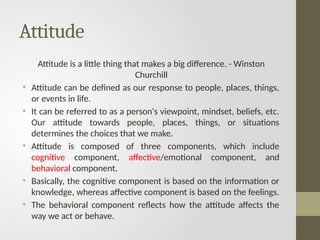
Attitude
Attitude is a little thing that makes a big difference. - Winston
Churchill
• Attitude can be defined as our response to people, places, things,
or events in life.
• It can be referred to as a person's viewpoint, mindset, beliefs, etc.
Our attitude towards people, places, things, or situations
determines the choices that we make.
• Attitude is composed of three components, which include
cognitive component, affective/emotional component, and
behavioral component.
• Basically, the cognitive component is based on the information or
knowledge, whereas affective component is based on the feelings.
• The behavioral component reflects how the attitude affects the
way we act or behave.
Types of Attitudes
Positive Attitude:
Individuals who have a positive attitude will pay attention to the good, rather
than bad in people, situations, events, etc. They will not consider a mistake or
failure as a hurdle, but as an opportunity. They learn from mistakes, and move
forward in life.
~ Confidence
~ Optimism
~ Cheerfulness/Happiness
~ Sincerity
~ Sense of responsibility
~ Flexibility
~ Determination
~ Reliability
~ Tolerance
~ Willingness to adapt
~ Humility
~ Diligence
Negative Attitude
People with a negative attitude ignore the good, and pay
attention to the bad in people, situations, events, etc. Also, they
are likely to complain about changes, rather than adapting to
the changing environment. Also, they might blame their failure
on others.
~ Anger
~ Hatred
~ Pessimism
~ Frustration
~ Doubt
~ Resentment
~ Jealousy
~ Inferiority
Neutral Attitude
People with a neutral attitude don't give enough importance to
situations or events. They ignore the problem, leaving it for
someone else to solve. Also, they don't feel the need to change.
Their traits include:
~ Complacence
~ Indifference
~ Detachment
~ Feeling of being disconnected
~ Unemotional
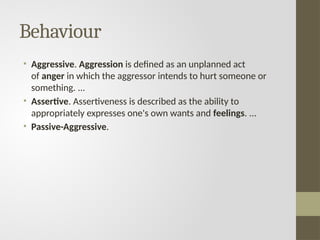
Behaviour
• Aggressive. Aggression is defined as an unplanned act
of anger in which the aggressor intends to hurt someone or
something. ...
• Assertive. Assertiveness is described as the ability to
appropriately expresses one's own wants and feelings. ...
• Passive-Aggressive.
ATTITUDE AND BEHAVIOUR, MEANING, DIFFERENCE

ATTITUDE AND BEHAVIOUR, MEANING, DIFFERENCE

  • 1.
  • 2.
    Attitude Attitude is alittle thing that makes a big difference. - Winston Churchill • Attitude can be defined as our response to people, places, things, or events in life. • It can be referred to as a person's viewpoint, mindset, beliefs, etc. Our attitude towards people, places, things, or situations determines the choices that we make. • Attitude is composed of three components, which include cognitive component, affective/emotional component, and behavioral component. • Basically, the cognitive component is based on the information or knowledge, whereas affective component is based on the feelings. • The behavioral component reflects how the attitude affects the way we act or behave.
  • 3.
    Types of Attitudes PositiveAttitude: Individuals who have a positive attitude will pay attention to the good, rather than bad in people, situations, events, etc. They will not consider a mistake or failure as a hurdle, but as an opportunity. They learn from mistakes, and move forward in life. ~ Confidence ~ Optimism ~ Cheerfulness/Happiness ~ Sincerity ~ Sense of responsibility ~ Flexibility ~ Determination ~ Reliability ~ Tolerance ~ Willingness to adapt ~ Humility ~ Diligence
  • 4.
    Negative Attitude People witha negative attitude ignore the good, and pay attention to the bad in people, situations, events, etc. Also, they are likely to complain about changes, rather than adapting to the changing environment. Also, they might blame their failure on others. ~ Anger ~ Hatred ~ Pessimism ~ Frustration ~ Doubt ~ Resentment ~ Jealousy ~ Inferiority
  • 5.
    Neutral Attitude People witha neutral attitude don't give enough importance to situations or events. They ignore the problem, leaving it for someone else to solve. Also, they don't feel the need to change. Their traits include: ~ Complacence ~ Indifference ~ Detachment ~ Feeling of being disconnected ~ Unemotional
  • 6.
    Behaviour • Aggressive. Aggressionis defined as an unplanned act of anger in which the aggressor intends to hurt someone or something. ... • Assertive. Assertiveness is described as the ability to appropriately expresses one's own wants and feelings. ... • Passive-Aggressive.