Yashwantrao Chavan Institute of Science, Satara
Department of Statistics
M.Sc.1 August 2017-2018
Seminar on
Applications of Statistics in
Psychology
Presented by,
Patil Pooja Rajaram
Roll No. 115
Content:
 Introduction
 What is psychology ?
 Importance of statistics in psychology?
 Uses
 Example
 Reference
Introduction:
Psychology is a science, which means that in order to
understand people’s thoughts and behaviors a basic
understanding of statistics is necessary. Most of the
psychology studies use inferential statistics , because statistics
allows us to make sense of and interpret a great ideal
information.
 What is Psychology?
A scientific study of human mind and its functions,
especially those affecting behavior in a given context
including all aspects of conscious and unconscious
experience as well as thought.
 What is Psychological statistics?
Psychological statistics is the application of
formulas,theorems and laws of statistics to psychology.
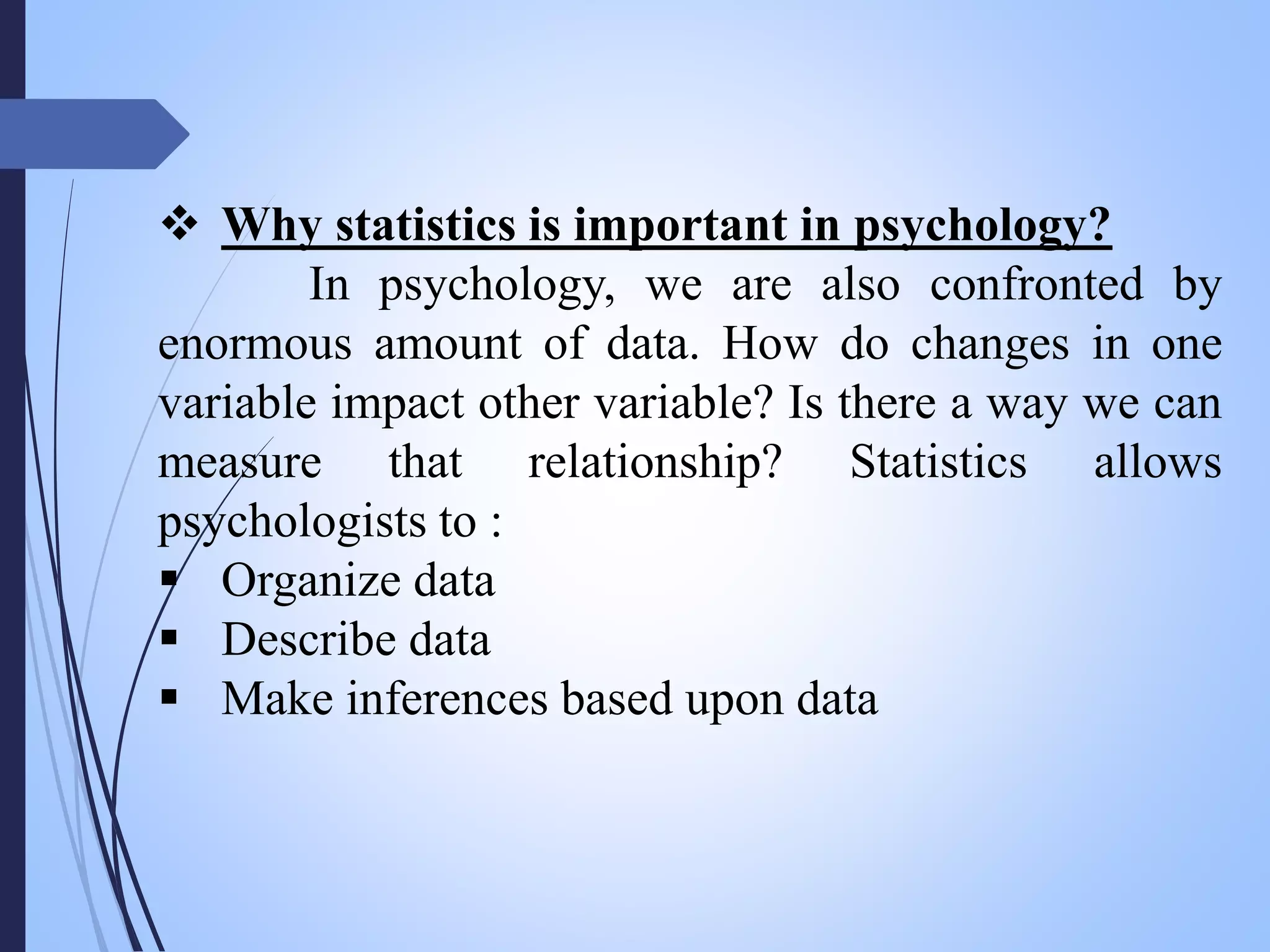
 Why statistics is important in psychology?
In psychology, we are also confronted by
enormous amount of data. How do changes in one
variable impact other variable? Is there a way we can
measure that relationship? Statistics allows
psychologists to :
 Organize data
 Describe data
 Make inferences based upon data
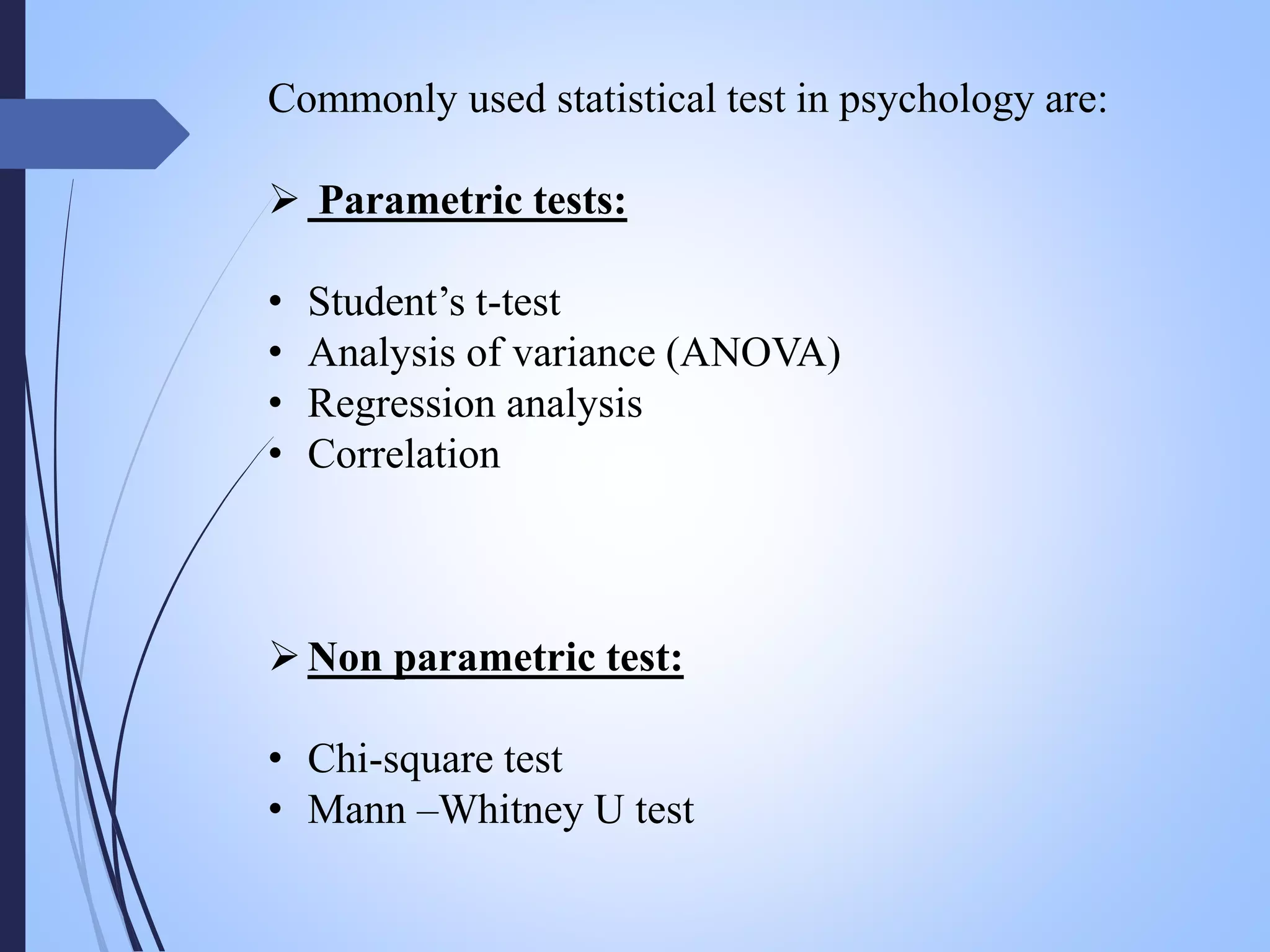
Commonly used statistical test in psychology are:
 Parametric tests:
• Student’s t-test
• Analysis of variance (ANOVA)
• Regression analysis
• Correlation
Non parametric test:
• Chi-square test
• Mann –Whitney U test
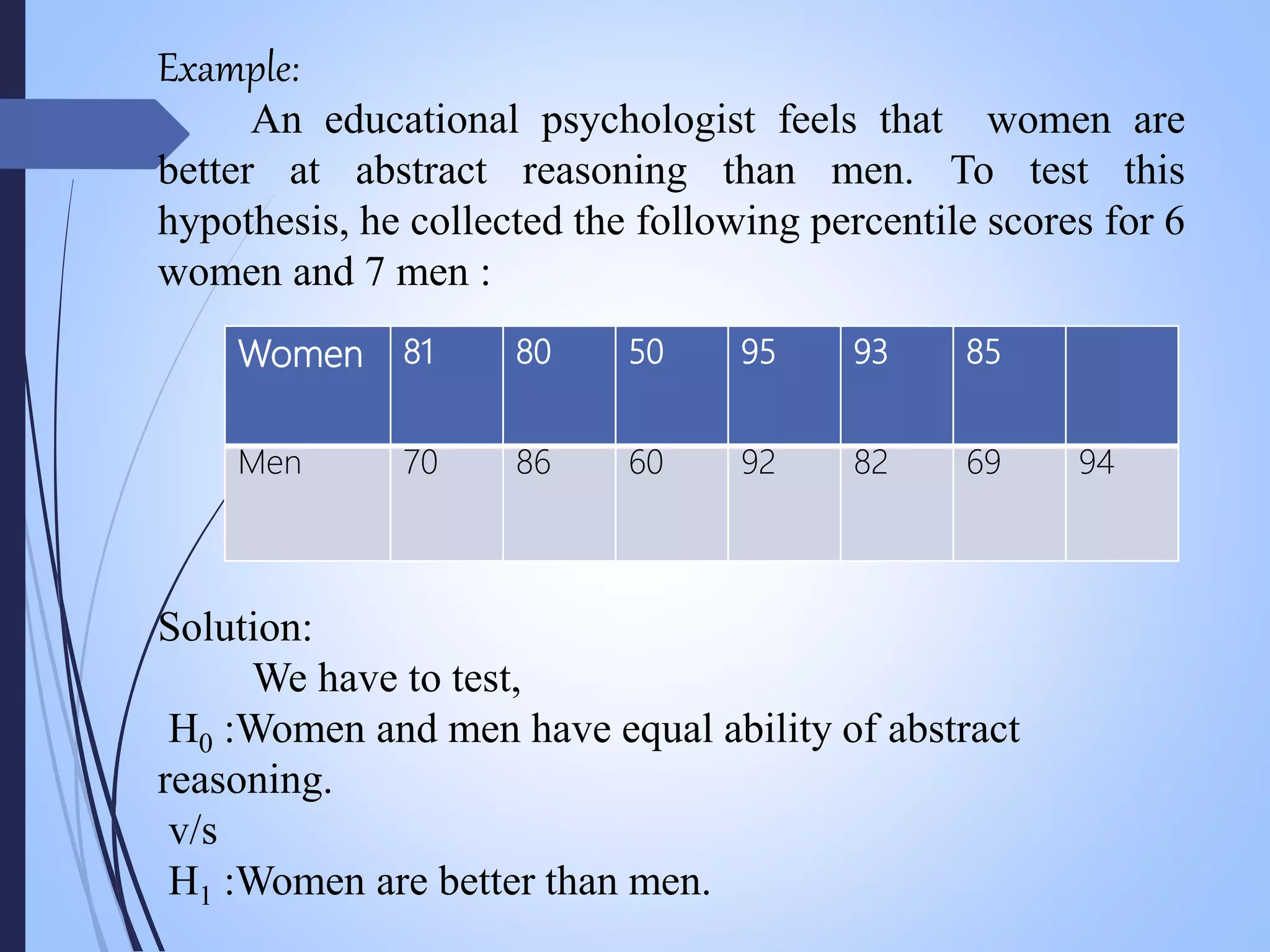
Example:
An educational psychologist feels that women are
better at abstract reasoning than men. To test this
hypothesis, he collected the following percentile scores for 6
women and 7 men :
Solution:
We have to test,
H0 :Women and men have equal ability of abstract
reasoning.
v/s
H1 :Women are better than men.
Women 81 80 50 95 93 85
Men 70 86 60 92 82 69 94
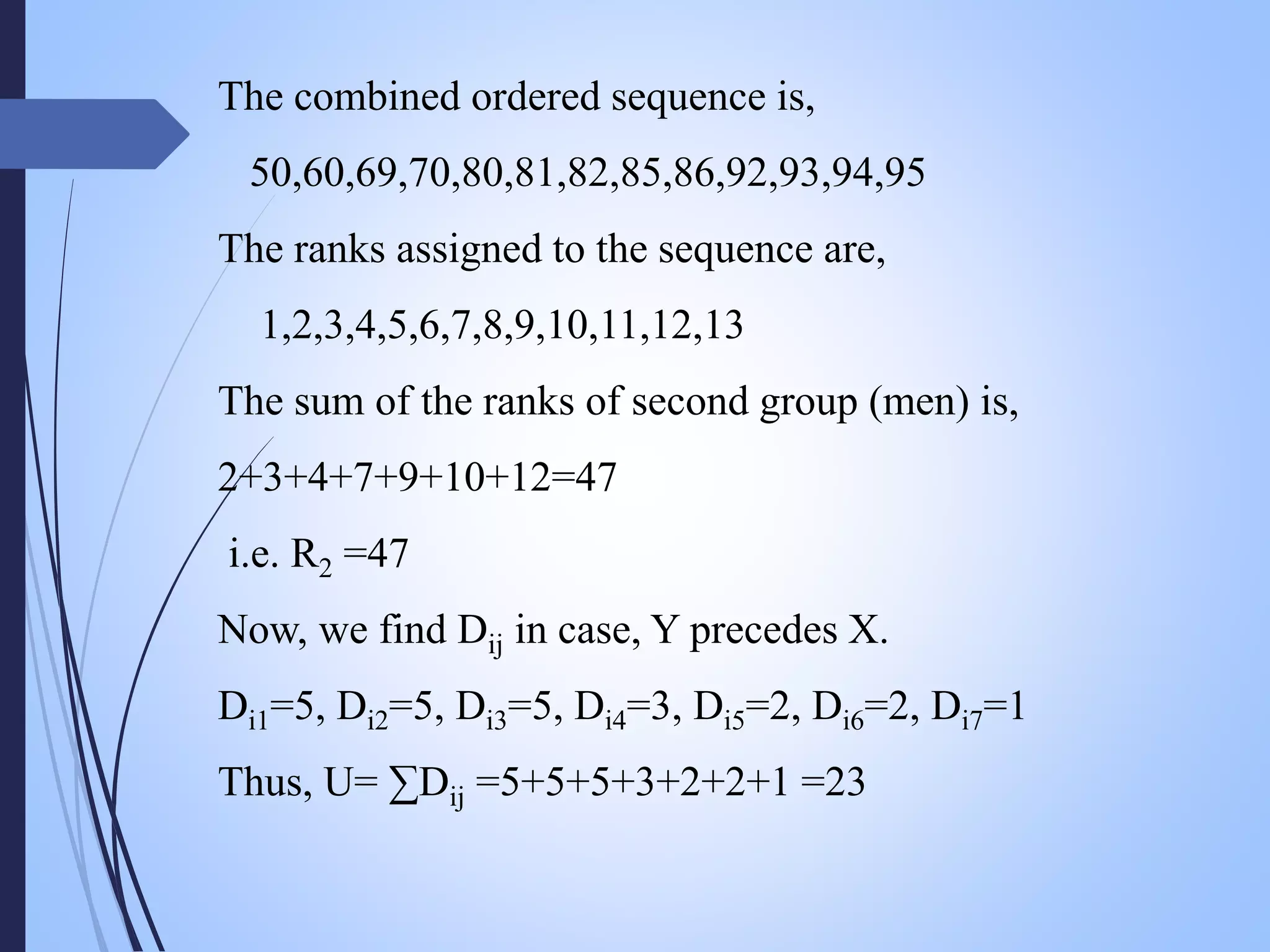
The combined ordered sequence is,
50,60,69,70,80,81,82,85,86,92,93,94,95
The ranks assigned to the sequence are,
1,2,3,4,5,6,7,8,9,10,11,12,13
The sum of the ranks of second group (men) is,
2+3+4+7+9+10+12=47
i.e. R2 =47
Now, we find Dij in case, Y precedes X.
Di1=5, Di2=5, Di3=5, Di4=3, Di5=2, Di6=2, Di7=1
Thus, U= ∑Dij =5+5+5+3+2+2+1 =23
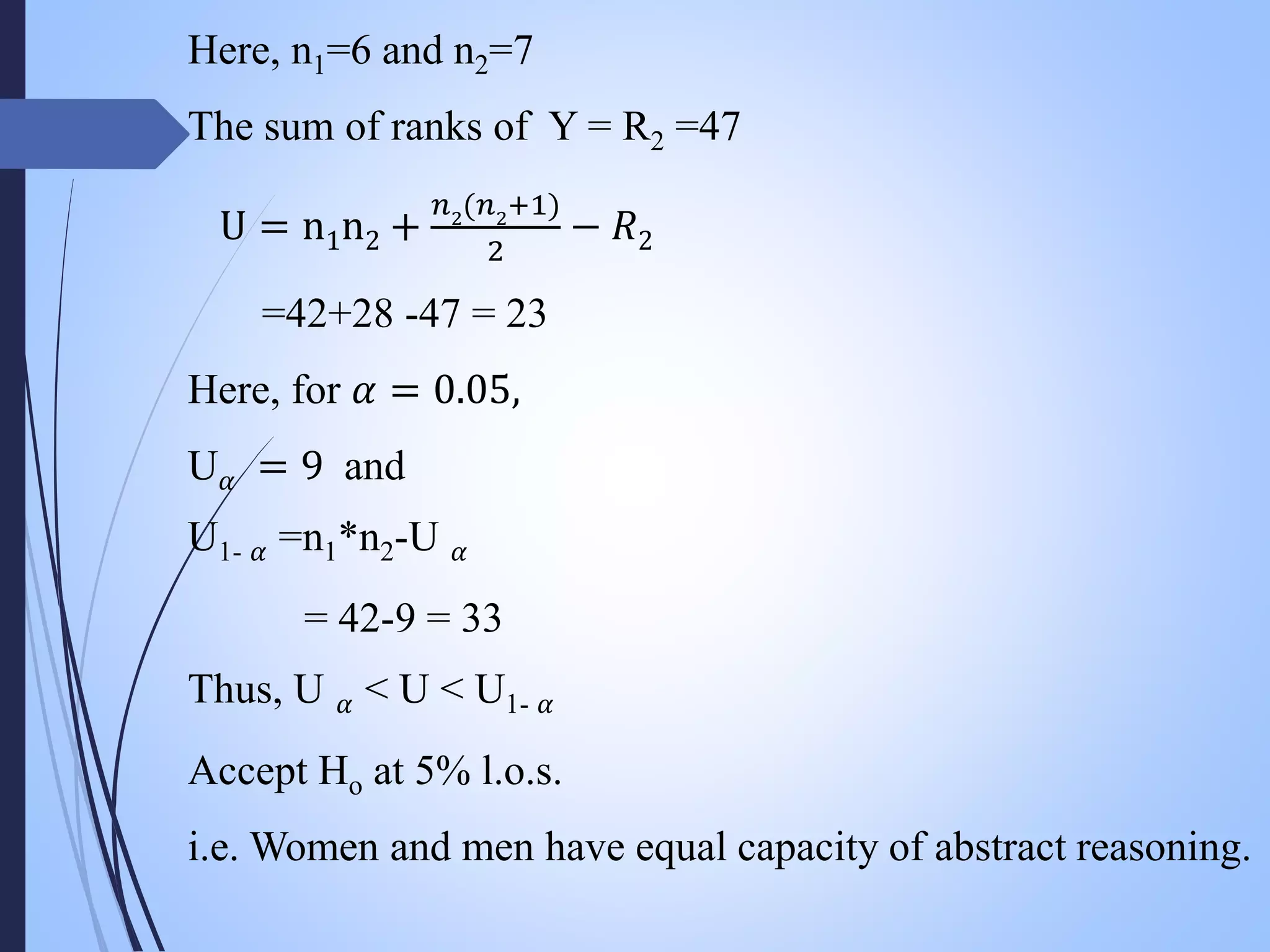
Here, n1=6 and n2=7
The sum of ranks of Y = R2 =47
U = n1n2 +
𝑛2
(𝑛2
+1)
2
− 𝑅2
=42+28 -47 = 23
Here, for 𝛼 = 0.05,
U 𝛼 = 9 and
U1- 𝛼 =n1*n2-U 𝛼
= 42-9 = 33
Thus, U 𝛼 < U < U1- 𝛼
Accept Ho at 5% l.o.s.
i.e. Women and men have equal capacity of abstract reasoning.
References :
 Google
 Programmed statistics by B. L. Agarwal
 Fundamentals of applied statistics
THANK
YOU ……

Applications of statistics in psychology

  • 1.
    Yashwantrao Chavan Instituteof Science, Satara Department of Statistics M.Sc.1 August 2017-2018 Seminar on Applications of Statistics in Psychology Presented by, Patil Pooja Rajaram Roll No. 115
  • 2.
    Content:  Introduction  Whatis psychology ?  Importance of statistics in psychology?  Uses  Example  Reference
  • 3.
    Introduction: Psychology is ascience, which means that in order to understand people’s thoughts and behaviors a basic understanding of statistics is necessary. Most of the psychology studies use inferential statistics , because statistics allows us to make sense of and interpret a great ideal information.
  • 4.
     What isPsychology? A scientific study of human mind and its functions, especially those affecting behavior in a given context including all aspects of conscious and unconscious experience as well as thought.  What is Psychological statistics? Psychological statistics is the application of formulas,theorems and laws of statistics to psychology.
  • 5.
     Why statisticsis important in psychology? In psychology, we are also confronted by enormous amount of data. How do changes in one variable impact other variable? Is there a way we can measure that relationship? Statistics allows psychologists to :  Organize data  Describe data  Make inferences based upon data
  • 6.
    Commonly used statisticaltest in psychology are:  Parametric tests: • Student’s t-test • Analysis of variance (ANOVA) • Regression analysis • Correlation Non parametric test: • Chi-square test • Mann –Whitney U test
  • 7.
    Example: An educational psychologistfeels that women are better at abstract reasoning than men. To test this hypothesis, he collected the following percentile scores for 6 women and 7 men : Solution: We have to test, H0 :Women and men have equal ability of abstract reasoning. v/s H1 :Women are better than men. Women 81 80 50 95 93 85 Men 70 86 60 92 82 69 94
  • 8.
    The combined orderedsequence is, 50,60,69,70,80,81,82,85,86,92,93,94,95 The ranks assigned to the sequence are, 1,2,3,4,5,6,7,8,9,10,11,12,13 The sum of the ranks of second group (men) is, 2+3+4+7+9+10+12=47 i.e. R2 =47 Now, we find Dij in case, Y precedes X. Di1=5, Di2=5, Di3=5, Di4=3, Di5=2, Di6=2, Di7=1 Thus, U= ∑Dij =5+5+5+3+2+2+1 =23
  • 9.
    Here, n1=6 andn2=7 The sum of ranks of Y = R2 =47 U = n1n2 + 𝑛2 (𝑛2 +1) 2 − 𝑅2 =42+28 -47 = 23 Here, for 𝛼 = 0.05, U 𝛼 = 9 and U1- 𝛼 =n1*n2-U 𝛼 = 42-9 = 33 Thus, U 𝛼 < U < U1- 𝛼 Accept Ho at 5% l.o.s. i.e. Women and men have equal capacity of abstract reasoning.
  • 10.
    References :  Google Programmed statistics by B. L. Agarwal  Fundamentals of applied statistics
  • 11.