PRESENTATION BY:
Ishfaq
Ahmad
TOPIC : ATTENTION DEFICIT HYPERACTIVITY
DISORDER
SUB TOPICS :
Introduction Diagnosis
Definition Differential Diagnosis
Characteristics Treatment
Epidemology Nursing Interventions
Etiology Follow Up
Types
Clinical Features
INTRODUCTION
• Attention deficit hyperactivity disorder (ADHD) is a condition that makes
it difficult for children to pay attention or control their behavior.
• ADHD often co occurs with other emotional,behavioural,launguage and
learning disorders.
• The Syndrome was First discovered by Heinrich Hoff in 1854.
DEFINITION
• Attention deficit hyperactivity disorder is a neurodevelopmental disorder
in children characterised by persistent pattern of inattention and/or
hyperactivity.
CHARACTERISTICS
• Neurobiological disorder.
• Marked by developmentally inappropriate inattention, impulsivity, and, in
some cases, hyperactivity.
• May progress to Conduct disorder.
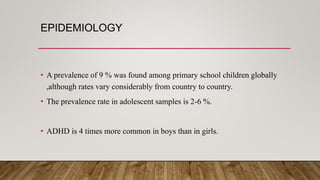
EPIDEMIOLOGY
• A prevalence of 9 % was found among primary school children globally
,although rates vary considerably from country to country.
• The prevalence rate in adolescent samples is 2-6 %.
• ADHD is 4 times more common in boys than in girls.
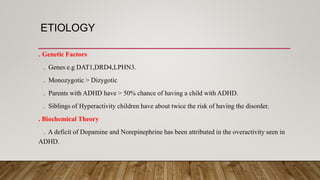
ETIOLOGY
. Genetic Factors
. Genes e.g DAT1,DRD4,LPHN3.
. Monozygotic > Dizygotic
. Parents with ADHD have > 50% chance of having a child with ADHD.
. Siblings of Hyperactivity children have about twice the risk of having the disorder.
. Biochemical Theory
. A deficit of Dopamine and Norepinephrine has been attributed in the overactivity seen in
ADHD.
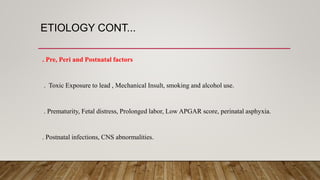
ETIOLOGY CONT...
. Pre, Peri and Postnatal factors
. Toxic Exposure to lead , Mechanical Insult, smoking and alcohol use.
. Prematurity, Fetal distress, Prolonged labor, Low APGAR score, perinatal asphyxia.
. Postnatal infections, CNS abnormalities.
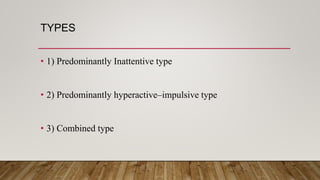
TYPES
• 1) Predominantly Inattentive type
• 2) Predominantly hyperactive–impulsive type
• 3) Combined type
1) INATTENTIVE TYPE
9 Symptoms
• 1. Fails close attention
• 2. Trouble holding attention
• 3. Not seem to listen
• 4. Not follow through on instructions
• 5. Trouble organizing
• 6. Avoids tasks that require mental effort
• 7. Loses things fir tasks and activities
• 8. Easily distracted
• 9. Forgetful in daily activities
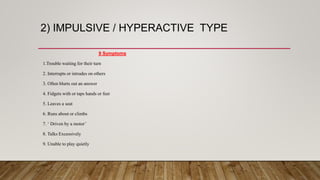
2) IMPULSIVE / HYPERACTIVE TYPE
9 Symptoms
1.Trouble waiting for their turn
2. Interrupts or intrudes on others
3. Often blurts out an answer
4. Fidgets with or taps hands or feet
5. Leaves a seat
6. Runs about or climbs
7. ‘ Driven by a motor’
8. Talks Excessively
9. Unable to play quietly
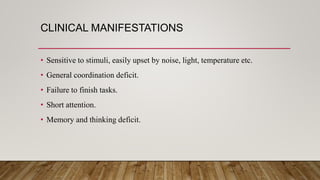
CLINICAL MANIFESTATIONS
• Sensitive to stimuli, easily upset by noise, light, temperature etc.
• General coordination deficit.
• Failure to finish tasks.
• Short attention.
• Memory and thinking deficit.
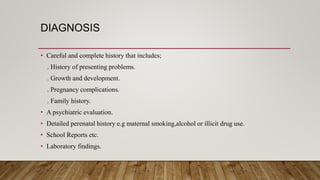
DIAGNOSIS
• Careful and complete history that includes;
. History of presenting problems.
. Growth and development.
. Pregnancy complications.
. Family history.
• A psychiatric evaluation.
• Detailed perenatal history e.g maternal smoking,alcohol or illicit drug use.
• School Reports etc.
• Laboratory findings.
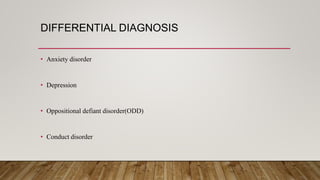
DIFFERENTIAL DIAGNOSIS
• Anxiety disorder
• Depression
• Oppositional defiant disorder(ODD)
• Conduct disorder
TRATMENT GOALS
• A child specific,individualised treatment programme should be developed for children.
• A goal of maximizing function to
. Improve relationship and performance at school,
. Decrease disruptive behaviours,
. Promote safety,
. Increase independence and
. Improve self esteem.
TREATMENT OPTIONS
• Medications
• Behaviour and psychotherapies
• Educational techniques
TREATMENT
• Pharmacotherapy.
• Stimulants:
.Methylphenidate 5mg BID
.Amphetamine 5MG OD/BID
.Dextroamphetamine 2.5mg BID
• Non stimulants:
.Antidepressants
.Antipsychycotics
TREATMENT CONT...
• Psychological therapies.
• Behaviour modification techniques
• CBT
• Social skills training.
• Parent behaviour management training.
NURSING INTERVENTION
• Develop a trusting relationship with the child.
• Remove objects from immediate area in which patient could injure self.
• Provide an environment that is from from distractions.
• Ask the patient to repeat instructions before beginning a task.
• Offer recognition for successful attempts and positive reinforcement .
• Help him learn how to take his turn, wait in line and follow rules.
• Explain and demonstrate positive parenting techniques to parents or caregivers.
• Ask the patient to repeat instructions before beginning a task.
• Coordinate overall treatment plan with schools, collateral personnel, the child and the
family.
FOLLOW UP
• Every 1-3 weeks during initial titration.
• Every 3-6 months thereafter.
• Consider stopping if patient is stable and doing well.Stop for 1-4 weeks then re-evalvate.
ADHD - Ishfaq  Ahmad SKIMS.pptx

ADHD - Ishfaq Ahmad SKIMS.pptx

  • 1.
  • 2.
    TOPIC : ATTENTIONDEFICIT HYPERACTIVITY DISORDER SUB TOPICS : Introduction Diagnosis Definition Differential Diagnosis Characteristics Treatment Epidemology Nursing Interventions Etiology Follow Up Types Clinical Features
  • 3.
    INTRODUCTION • Attention deficithyperactivity disorder (ADHD) is a condition that makes it difficult for children to pay attention or control their behavior. • ADHD often co occurs with other emotional,behavioural,launguage and learning disorders. • The Syndrome was First discovered by Heinrich Hoff in 1854.
  • 4.
    DEFINITION • Attention deficithyperactivity disorder is a neurodevelopmental disorder in children characterised by persistent pattern of inattention and/or hyperactivity.
  • 5.
    CHARACTERISTICS • Neurobiological disorder. •Marked by developmentally inappropriate inattention, impulsivity, and, in some cases, hyperactivity. • May progress to Conduct disorder.
  • 6.
    EPIDEMIOLOGY • A prevalenceof 9 % was found among primary school children globally ,although rates vary considerably from country to country. • The prevalence rate in adolescent samples is 2-6 %. • ADHD is 4 times more common in boys than in girls.
  • 7.
    ETIOLOGY . Genetic Factors .Genes e.g DAT1,DRD4,LPHN3. . Monozygotic > Dizygotic . Parents with ADHD have > 50% chance of having a child with ADHD. . Siblings of Hyperactivity children have about twice the risk of having the disorder. . Biochemical Theory . A deficit of Dopamine and Norepinephrine has been attributed in the overactivity seen in ADHD.
  • 8.
    ETIOLOGY CONT... . Pre,Peri and Postnatal factors . Toxic Exposure to lead , Mechanical Insult, smoking and alcohol use. . Prematurity, Fetal distress, Prolonged labor, Low APGAR score, perinatal asphyxia. . Postnatal infections, CNS abnormalities.
  • 9.
    TYPES • 1) PredominantlyInattentive type • 2) Predominantly hyperactive–impulsive type • 3) Combined type
  • 10.
    1) INATTENTIVE TYPE 9Symptoms • 1. Fails close attention • 2. Trouble holding attention • 3. Not seem to listen • 4. Not follow through on instructions • 5. Trouble organizing • 6. Avoids tasks that require mental effort • 7. Loses things fir tasks and activities • 8. Easily distracted • 9. Forgetful in daily activities
  • 11.
    2) IMPULSIVE /HYPERACTIVE TYPE 9 Symptoms 1.Trouble waiting for their turn 2. Interrupts or intrudes on others 3. Often blurts out an answer 4. Fidgets with or taps hands or feet 5. Leaves a seat 6. Runs about or climbs 7. ‘ Driven by a motor’ 8. Talks Excessively 9. Unable to play quietly
  • 12.
    CLINICAL MANIFESTATIONS • Sensitiveto stimuli, easily upset by noise, light, temperature etc. • General coordination deficit. • Failure to finish tasks. • Short attention. • Memory and thinking deficit.
  • 13.
    DIAGNOSIS • Careful andcomplete history that includes; . History of presenting problems. . Growth and development. . Pregnancy complications. . Family history. • A psychiatric evaluation. • Detailed perenatal history e.g maternal smoking,alcohol or illicit drug use. • School Reports etc. • Laboratory findings.
  • 14.
    DIFFERENTIAL DIAGNOSIS • Anxietydisorder • Depression • Oppositional defiant disorder(ODD) • Conduct disorder
  • 15.
    TRATMENT GOALS • Achild specific,individualised treatment programme should be developed for children. • A goal of maximizing function to . Improve relationship and performance at school, . Decrease disruptive behaviours, . Promote safety, . Increase independence and . Improve self esteem.
  • 16.
    TREATMENT OPTIONS • Medications •Behaviour and psychotherapies • Educational techniques
  • 17.
    TREATMENT • Pharmacotherapy. • Stimulants: .Methylphenidate5mg BID .Amphetamine 5MG OD/BID .Dextroamphetamine 2.5mg BID • Non stimulants: .Antidepressants .Antipsychycotics
  • 18.
    TREATMENT CONT... • Psychologicaltherapies. • Behaviour modification techniques • CBT • Social skills training. • Parent behaviour management training.
  • 19.
    NURSING INTERVENTION • Developa trusting relationship with the child. • Remove objects from immediate area in which patient could injure self. • Provide an environment that is from from distractions. • Ask the patient to repeat instructions before beginning a task. • Offer recognition for successful attempts and positive reinforcement . • Help him learn how to take his turn, wait in line and follow rules. • Explain and demonstrate positive parenting techniques to parents or caregivers.
  • 20.
    • Ask thepatient to repeat instructions before beginning a task. • Coordinate overall treatment plan with schools, collateral personnel, the child and the family.
  • 21.
    FOLLOW UP • Every1-3 weeks during initial titration. • Every 3-6 months thereafter. • Consider stopping if patient is stable and doing well.Stop for 1-4 weeks then re-evalvate.