















hjfjhfhk
ATTENTION DEFICIT
HYPERACTIVITY
DISORDER
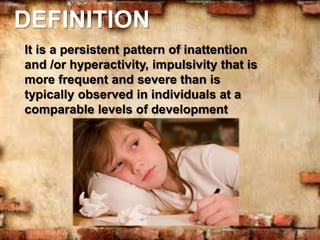
DEFINITION
It is a persistent pattern of inattention
and /or hyperactivity, impulsivity that is
more frequent and severe than is
typically observed in individuals at a
comparable levels of development
CHARACTERISTICS OF ADHD
• Neurobiological disorder
• Marked by developmentally
inappropriate, inattention,
impulsiveness and hyperactivity.
• May progress to conduct disorder.
EPIDEMIOLOGY
• 1.7 percent was found among primary
school children
• ADHD is four times more common in
boys
ETIOLOGICAL FACTORS
• Biological influences
-Genetic factors
-Biochemical theory
-Pre. peri and postnatal factors
• Environmental influences
• Psychosocial factors
Biological influences
• Genetic factors
- Greater concordance rate in
monozygotic than in dizygotic twins
- Siblings of hyperactive children have
twice risk of having the disorder
- Biological parents of children with the
disorder have a higher incidence
• Biochemical theory
• Pre. Peri and postnatal factors
Biological influences
• Biochemical theory
imbalance of brain chemicals
(neurotransmitters) that transmit
nerve impulses may be a factor in the
development of ADHD symptoms.
a deficit of dopamine and nor epinephrine
contribute to the over activity
Biological influences
• PRE, PERI AND POSTNATAL FACTORS
-prenatal toxic exposure, prenatal mechanical
insult
-prematurity
-fetal distress
-Precipitated or prolonged labor
-Perinatal asphyxia
-Low APGAR scores
-Postnatal infection
-CNS abnormalities resulting from trauma
-Poor nutrition, infections, and substance
abuse(including cigarette and alcohol use)
during pregnancy
Environmental influences
•Environmental lead
•Food addictives and
coloring
preservatives
Psychosocial Factors
• Prolonged emotional deprivation
• Stressful psychic events
• disruption of family equilibrium
• Maternal mental disorder
• Paternal criminality
• Low socioeconomic status
• Family history of alcoholism
• Hysterical and sociopath personality
• Parental history of hyperactivity
• Developmental learning disorder
RISK FACTORS
• Risk factors for ADHD that can occur in the
womb
Maternal stress,
Smoking during pregnancy
Low weight at birth.
Drug exposure in utero
Birth complication
Being male and having a family history of
ADHD increase the likelihood that an
individual is diagnosed with ADHD.
Socially, low family income and low
paternal education
TYPES
There are three kinds of ADHD:
• predominately inattentive type,
• predominately hyperactive/impulsive
type,
• combined (inattentive, hyperactive, and
impulsive) type
Predominately Inattentive Type
• This subtype is used if at least six
symptoms of inattention have persisted for
at least 6 months
Predominately
Hyperactive/Impulsive Type
• This subtype is used if at
least six symptomsof
hyperactivity – impulsivity
have persisted for at least 6
months
combined (inattentive, hyperactive, and
impulsive) type
• This subtype is used if at least six
symptoms of inattention and at least six
symptoms of hyperactivity – impulsivity
have persisted for at least 6 months
Symptoms of ADHD
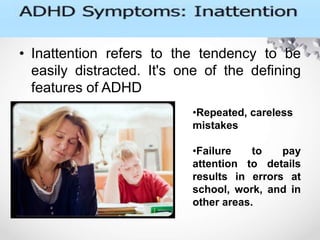
• Inattention refers to the tendency to be
easily distracted. It's one of the defining
features of ADHD
.
•Repeated, careless
mistakes
•Failure to pay
attention to details
results in errors at
school, work, and in
other areas.
•Have trouble
paying attention
to the task at
hand. Whether
related to
schoolwork or
play
•A child with
inattention may
become easily
bored and have
trouble focusing
on an activity.
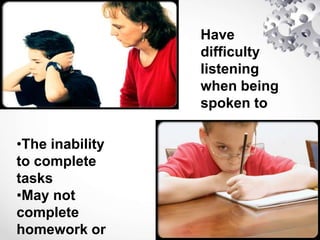
Have
difficulty
listening
when being
spoken to
•The inability
to complete
tasks
•May not
complete
homework or
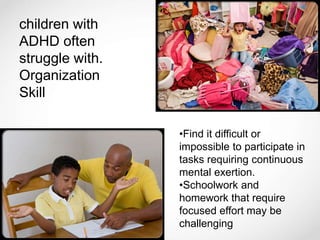
children with
ADHD often
struggle with.
Organization
Skill
•Find it difficult or
impossible to participate in
tasks requiring continuous
mental exertion.
•Schoolwork and
homework that require
focused effort may be
challenging
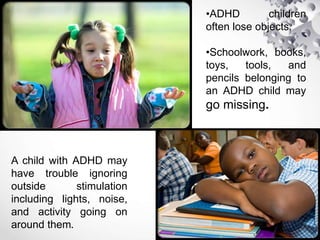
•ADHD children
often lose objects.
•Schoolwork, books,
toys, tools, and
pencils belonging to
an ADHD child may
go missing.
A child with ADHD may
have trouble ignoring
outside stimulation
including lights, noise,
and activity going on
around them.
A child with ADHD
may forget things
easily
• Hyperactivity is a feature of
ADHD that refers to an
abundance of physical energy
and too much activity
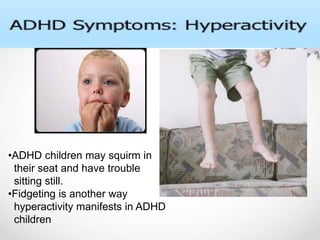
•ADHD children may squirm in
their seat and have trouble
sitting still.
•Fidgeting is another way
hyperactivity manifests in ADHD
children
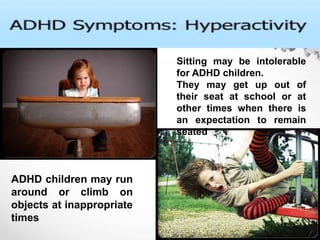
Sitting may be intolerable
for ADHD children.
They may get up out of
their seat at school or at
other times when there is
an expectation to remain
seated
ADHD children may run
around or climb on
objects at inappropriate
times
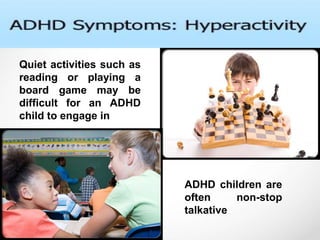
Quiet activities such as
reading or playing a
board game may be
difficult for an ADHD
child to engage in
ADHD children are
often non-stop
talkative
• Impulsivity is a defining
feature of ADHD that refers
to acting without regard to
consequences.
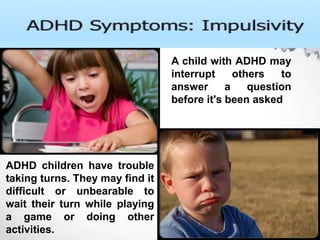
A child with ADHD may
interrupt others to
answer a question
before it's been asked
ADHD children have trouble
taking turns. They may find it
difficult or unbearable to
wait their turn while playing
a game or doing other
activities.
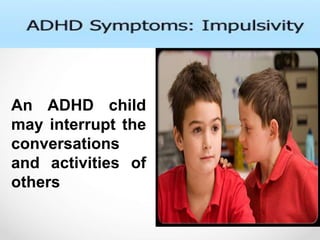
An ADHD child
may interrupt the
conversations
and activities of
others
DIAGNOSIS
• COMPLETE MEDICAL EVALUATION
• PSYCHIATRIC EVALUATION
• DETAILED PRENATAL HISTORY AND
EARLY DEVELOPMENTAL HIATORY
• DIRECT OBSERVATION
• TEACHER SCHOOL REPORT
• PARENT REPORT
TREATMENT
DRUGS
PSYCHOLOGICAL
THERAPIES
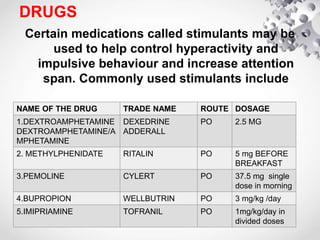
DRUGS
Certain medications called stimulants may be
used to help control hyperactivity and
impulsive behaviour and increase attention
span. Commonly used stimulants include
NAME OF THE DRUG TRADE NAME ROUTE DOSAGE
1.DEXTROAMPHETAMINE
DEXTROAMPHETAMINE/A
MPHETAMINE
DEXEDRINE
ADDERALL
PO 2.5 MG
2. METHYLPHENIDATE RITALIN PO 5 mg BEFORE
BREAKFAST
3.PEMOLINE CYLERT PO 37.5 mg single
dose in morning
4.BUPROPION WELLBUTRIN PO 3 mg/kg /day
5.IMIPRIAMINE TOFRANIL PO 1mg/kg/day in
divided doses
Behavior therapy
Family therapy
Group therapy
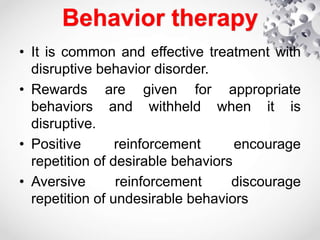
Behavior therapy
• It is common and effective treatment with
disruptive behavior disorder.
• Rewards are given for appropriate
behaviors and withheld when it is
disruptive.
• Positive reinforcement encourage
repetition of desirable behaviors
• Aversive reinforcement discourage
repetition of undesirable behaviors
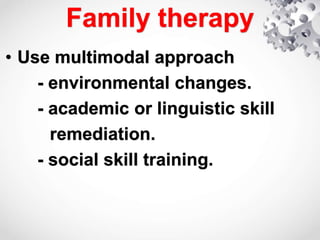
Family therapy
• Use multimodal approach
- environmental changes.
- academic or linguistic skill
remediation.
- social skill training.
Group therapy
• It provides children and adolescents with
the opportunity to interact with their peers.
• Appropriate social behavior often is
learned.
• Music therapy groups allow clients to
express feelings through music.
• Art /activity craft therapy allow clients to
express feelings through artistic means.
Nursing intervention
• Develop a trusting relationship with the child.
• Convey acceptance
• Ensure a safe environment.
• Provide an environment that is as free of
distraction.
• Establish child’s attention by calling his name
and maintain eye to eye contact.
• Ask to repeat the instruction before beginning
a task
Nursing intervention
• Establish goals that allow patient to
complete a part of the task.
• Provide assistance on one to one basis
and then gradually decrease it.
• Give Positive reinforcement and
immediate feedback for successful
attempts and acceptable behavior.
• Help him to learn how to take his turn, wait
in line and follow rules.
Nursing intervention
• Consider intellectual, emotional and
physical strengths and limitation of the
child.
• Give instructional materials in written and
verbal form with step by step.
• Demonstrate positive parenting techniques
to parents and care givers.
• Educate child and family on the use
psycho-stimulants.
• Coordinate overall treatment plan.
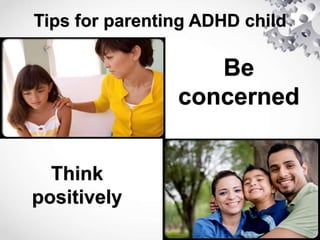
Tips for parenting ADHD child
Be
concerned
Think
positively
Define
Schedules
and
Routines
Set Clear
Rules and
Expectatio
ns
Give Clear
Instructions
Discipline,
Rewards, and
Consequences
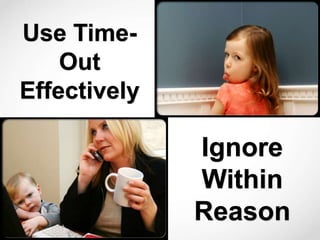
Use Time-
Out
Effectively
Ignore
Within
Reason
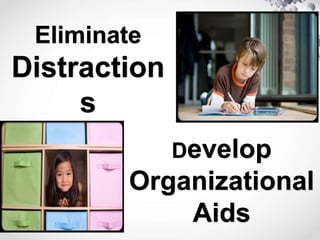
Develop
Organizational
Aids
Eliminate
Distraction
s
Set Small,
Attainable
Goals
Focus on One or
Two Challenging
Behaviors at a
Time
Find Areas in
Which the
Child Excels
or Succeeds
Promote a
Healthy
Lifestyle-Nutrition
Promote
a Healthy
Lifestyle-Exercise
Promote a
Healthy
Lifestyle- Sleep
Show Your
Uncondition
al Love
Take Care
of Yourself
ADMISSIONS
SLOT
NOW
ATTENTION DEFICIT HYPERACTIVITY DISORDER

ATTENTION DEFICIT HYPERACTIVITY DISORDER

  • 1.
  • 2.
  • 3.
    DEFINITION It is apersistent pattern of inattention and /or hyperactivity, impulsivity that is more frequent and severe than is typically observed in individuals at a comparable levels of development
  • 4.
    CHARACTERISTICS OF ADHD •Neurobiological disorder • Marked by developmentally inappropriate, inattention, impulsiveness and hyperactivity. • May progress to conduct disorder.
  • 5.
    EPIDEMIOLOGY • 1.7 percentwas found among primary school children • ADHD is four times more common in boys
  • 6.
    ETIOLOGICAL FACTORS • Biologicalinfluences -Genetic factors -Biochemical theory -Pre. peri and postnatal factors • Environmental influences • Psychosocial factors
  • 7.
    Biological influences • Geneticfactors - Greater concordance rate in monozygotic than in dizygotic twins - Siblings of hyperactive children have twice risk of having the disorder - Biological parents of children with the disorder have a higher incidence • Biochemical theory • Pre. Peri and postnatal factors
  • 8.
    Biological influences • Biochemicaltheory imbalance of brain chemicals (neurotransmitters) that transmit nerve impulses may be a factor in the development of ADHD symptoms. a deficit of dopamine and nor epinephrine contribute to the over activity
  • 9.
    Biological influences • PRE,PERI AND POSTNATAL FACTORS -prenatal toxic exposure, prenatal mechanical insult -prematurity -fetal distress -Precipitated or prolonged labor -Perinatal asphyxia -Low APGAR scores -Postnatal infection -CNS abnormalities resulting from trauma -Poor nutrition, infections, and substance abuse(including cigarette and alcohol use) during pregnancy
  • 10.
    Environmental influences •Environmental lead •Foodaddictives and coloring preservatives
  • 11.
    Psychosocial Factors • Prolongedemotional deprivation • Stressful psychic events • disruption of family equilibrium • Maternal mental disorder • Paternal criminality • Low socioeconomic status • Family history of alcoholism • Hysterical and sociopath personality • Parental history of hyperactivity • Developmental learning disorder
  • 12.
    RISK FACTORS • Riskfactors for ADHD that can occur in the womb Maternal stress, Smoking during pregnancy Low weight at birth. Drug exposure in utero Birth complication Being male and having a family history of ADHD increase the likelihood that an individual is diagnosed with ADHD. Socially, low family income and low paternal education
  • 13.
    TYPES There are threekinds of ADHD: • predominately inattentive type, • predominately hyperactive/impulsive type, • combined (inattentive, hyperactive, and impulsive) type
  • 14.
    Predominately Inattentive Type •This subtype is used if at least six symptoms of inattention have persisted for at least 6 months
  • 15.
    Predominately Hyperactive/Impulsive Type • Thissubtype is used if at least six symptomsof hyperactivity – impulsivity have persisted for at least 6 months
  • 16.
    combined (inattentive, hyperactive,and impulsive) type • This subtype is used if at least six symptoms of inattention and at least six symptoms of hyperactivity – impulsivity have persisted for at least 6 months
  • 17.
  • 18.
    • Inattention refersto the tendency to be easily distracted. It's one of the defining features of ADHD . •Repeated, careless mistakes •Failure to pay attention to details results in errors at school, work, and in other areas.
  • 19.
    •Have trouble paying attention tothe task at hand. Whether related to schoolwork or play •A child with inattention may become easily bored and have trouble focusing on an activity.
  • 20.
    Have difficulty listening when being spoken to •Theinability to complete tasks •May not complete homework or
  • 21.
    children with ADHD often strugglewith. Organization Skill •Find it difficult or impossible to participate in tasks requiring continuous mental exertion. •Schoolwork and homework that require focused effort may be challenging
  • 22.
    •ADHD children often loseobjects. •Schoolwork, books, toys, tools, and pencils belonging to an ADHD child may go missing. A child with ADHD may have trouble ignoring outside stimulation including lights, noise, and activity going on around them.
  • 23.
    A child withADHD may forget things easily
  • 24.
    • Hyperactivity isa feature of ADHD that refers to an abundance of physical energy and too much activity
  • 25.
    •ADHD children maysquirm in their seat and have trouble sitting still. •Fidgeting is another way hyperactivity manifests in ADHD children
  • 26.
    Sitting may beintolerable for ADHD children. They may get up out of their seat at school or at other times when there is an expectation to remain seated ADHD children may run around or climb on objects at inappropriate times
  • 27.
    Quiet activities suchas reading or playing a board game may be difficult for an ADHD child to engage in ADHD children are often non-stop talkative
  • 28.
    • Impulsivity isa defining feature of ADHD that refers to acting without regard to consequences.
  • 29.
    A child withADHD may interrupt others to answer a question before it's been asked ADHD children have trouble taking turns. They may find it difficult or unbearable to wait their turn while playing a game or doing other activities.
  • 30.
    An ADHD child mayinterrupt the conversations and activities of others
  • 31.
    DIAGNOSIS • COMPLETE MEDICALEVALUATION • PSYCHIATRIC EVALUATION • DETAILED PRENATAL HISTORY AND EARLY DEVELOPMENTAL HIATORY • DIRECT OBSERVATION • TEACHER SCHOOL REPORT • PARENT REPORT
  • 32.
  • 33.
    DRUGS Certain medications calledstimulants may be used to help control hyperactivity and impulsive behaviour and increase attention span. Commonly used stimulants include NAME OF THE DRUG TRADE NAME ROUTE DOSAGE 1.DEXTROAMPHETAMINE DEXTROAMPHETAMINE/A MPHETAMINE DEXEDRINE ADDERALL PO 2.5 MG 2. METHYLPHENIDATE RITALIN PO 5 mg BEFORE BREAKFAST 3.PEMOLINE CYLERT PO 37.5 mg single dose in morning 4.BUPROPION WELLBUTRIN PO 3 mg/kg /day 5.IMIPRIAMINE TOFRANIL PO 1mg/kg/day in divided doses
  • 34.
  • 35.
    Behavior therapy • Itis common and effective treatment with disruptive behavior disorder. • Rewards are given for appropriate behaviors and withheld when it is disruptive. • Positive reinforcement encourage repetition of desirable behaviors • Aversive reinforcement discourage repetition of undesirable behaviors
  • 36.
    Family therapy • Usemultimodal approach - environmental changes. - academic or linguistic skill remediation. - social skill training.
  • 37.
    Group therapy • Itprovides children and adolescents with the opportunity to interact with their peers. • Appropriate social behavior often is learned. • Music therapy groups allow clients to express feelings through music. • Art /activity craft therapy allow clients to express feelings through artistic means.
  • 38.
    Nursing intervention • Developa trusting relationship with the child. • Convey acceptance • Ensure a safe environment. • Provide an environment that is as free of distraction. • Establish child’s attention by calling his name and maintain eye to eye contact. • Ask to repeat the instruction before beginning a task
  • 39.
    Nursing intervention • Establishgoals that allow patient to complete a part of the task. • Provide assistance on one to one basis and then gradually decrease it. • Give Positive reinforcement and immediate feedback for successful attempts and acceptable behavior. • Help him to learn how to take his turn, wait in line and follow rules.
  • 40.
    Nursing intervention • Considerintellectual, emotional and physical strengths and limitation of the child. • Give instructional materials in written and verbal form with step by step. • Demonstrate positive parenting techniques to parents and care givers. • Educate child and family on the use psycho-stimulants. • Coordinate overall treatment plan.
  • 41.
    Tips for parentingADHD child Be concerned Think positively
  • 42.
  • 43.
  • 44.
  • 45.
  • 46.
    Set Small, Attainable Goals Focus onOne or Two Challenging Behaviors at a Time
  • 47.
    Find Areas in Whichthe Child Excels or Succeeds Promote a Healthy Lifestyle-Nutrition
  • 48.
  • 49.
  • 50.