AN UNUSUAL
PRESENTATION OF
COMMON DISORDER
Prof . Dr . G. Sundaramurthy’s unit,
Dr. A.Prakash, PG,
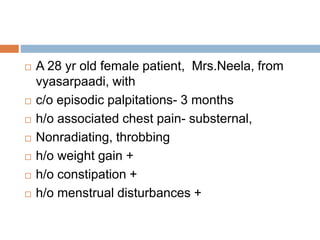
 A 28 yr old female patient, Mrs.Neela, from
vyasarpaadi, with
 c/o episodic palpitations- 3 months
 h/o associated chest pain- substernal,
 Nonradiating, throbbing
 h/o weight gain +
 h/o constipation +
 h/o menstrual disturbances +
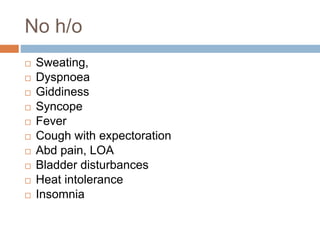
No h/o
 Sweating,
 Dyspnoea
 Giddiness
 Syncope
 Fever
 Cough with expectoration
 Abd pain, LOA
 Bladder disturbances
 Heat intolerance
 Insomnia
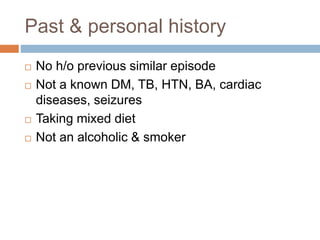
Past & personal history
 No h/o previous similar episode
 Not a known DM, TB, HTN, BA, cardiac
diseases, seizures
 Taking mixed diet
 Not an alcoholic & smoker
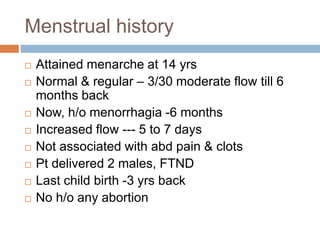
Menstrual history
 Attained menarche at 14 yrs
 Normal & regular – 3/30 moderate flow till 6
months back
 Now, h/o menorrhagia -6 months
 Increased flow --- 5 to 7 days
 Not associated with abd pain & clots
 Pt delivered 2 males, FTND
 Last child birth -3 yrs back
 No h/o any abortion
Family history & Rx history
 Not relevant
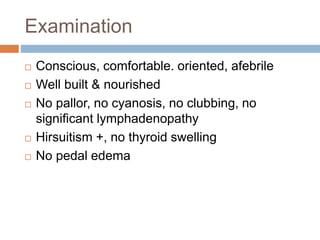
Examination
 Conscious, comfortable. oriented, afebrile
 Well built & nourished
 No pallor, no cyanosis, no clubbing, no
significant lymphadenopathy
 Hirsuitism +, no thyroid swelling
 No pedal edema
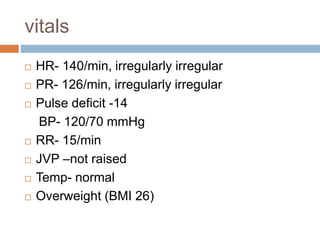
vitals
 HR- 140/min, irregularly irregular
 PR- 126/min, irregularly irregular
 Pulse deficit -14
BP- 120/70 mmHg
 RR- 15/min
 JVP –not raised
 Temp- normal
 Overweight (BMI 26)
Systemic examination
 CVS- S1 S2 heard; tachycardia- irregularly
irregular
 RS- NVBS +, no added sounds
 P/A soft not tender no organomegaly no free
fluid
 CNS- NFND
Provisional diagnosis
 Palpitation for evaluation
 ? AF
Investigation
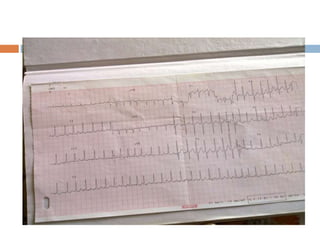
 ECG –
 Rate 170/min.
 Absent p wave.
 RR irregularly irregular.
 Rapid ventricular rate.
 Imp ; AF with Rapid ventricular rate.
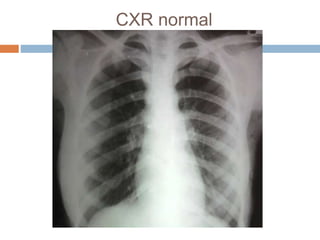
CXR normal
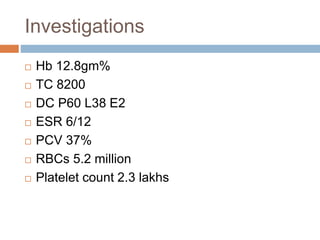
Investigations
 Hb 12.8gm%
 TC 8200
 DC P60 L38 E2
 ESR 6/12
 PCV 37%
 RBCs 5.2 million
 Platelet count 2.3 lakhs
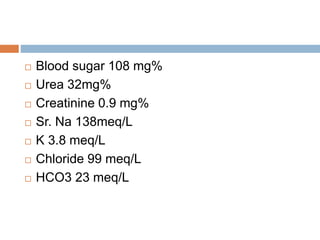
 Blood sugar 108 mg%
 Urea 32mg%
 Creatinine 0.9 mg%
 Sr. Na 138meq/L
 K 3.8 meq/L
 Chloride 99 meq/L
 HCO3 23 meq/L
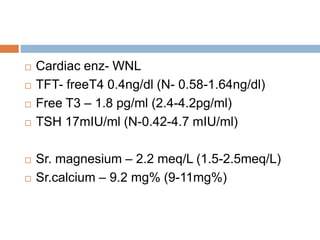
 Cardiac enz- WNL
 TFT- freeT4 0.4ng/dl (N- 0.58-1.64ng/dl)
 Free T3 – 1.8 pg/ml (2.4-4.2pg/ml)
 TSH 17mIU/ml (N-0.42-4.7 mIU/ml)
 Sr. magnesium – 2.2 meq/L (1.5-2.5meq/L)
 Sr.calcium – 9.2 mg% (9-11mg%)
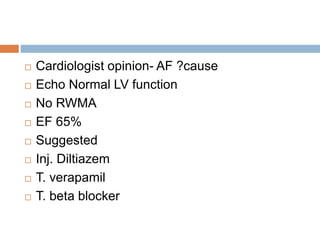
 Cardiologist opinion- AF ?cause
 Echo Normal LV function
 No RWMA
 EF 65%
 Suggested
 Inj. Diltiazem
 T. verapamil
 T. beta blocker
Diagnosis
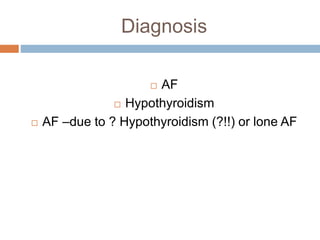
 AF
 Hypothyroidism
 AF –due to ? Hypothyroidism (?!!) or lone AF
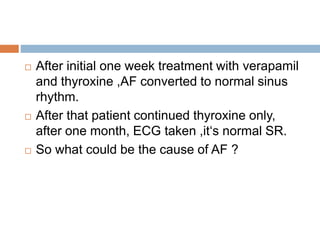
 After initial one week treatment with verapamil
and thyroxine ,AF converted to normal sinus
rhythm.
 After that patient continued thyroxine only,
after one month, ECG taken ,it‘s normal SR.
 So what could be the cause of AF ?
Case reports & journal evidence for
AF due to hypothyroidism
 the editorial by Forfar1 that both clinical and subclinical
hyperthyroidism are associated with the subsequent
development of atrial fibrillation. The association of
hypothyroidism with atrial fibrillation is less recognised.2 3
For example, the Canadian Registry of Atrial Fibrillation
Investigators4reported that 1.5% of 726 patients with atrial
fibrillation had hypothyroidism over a period of 1.7 years.
However, Tajiri et al reported that up to 8% of the 75 elderly
patients with atrial fibrillation (mean age 75.6 years) studied
were found to be hypothyroid
-Heart 1997;78:623-624 doi:10.1136/hrt.78.6.623a
 There are also non-cardiac conditions that can
lead to atrial fibrillation. Hyperthyroidism (high
thyroid levels) is commonly accompanied by
atrial fibrillation. On occasion, hypothyroidism
(low thyroid levels) can also be accompanied
by atrial fibrillation.
-The Causes of Atrial Fibrillation
By Richard N. Fogoros, M.D., About.com Guide
Updated November 12, 2007
 Subclinical Hypothyroidism Might Increase the
Risk of Transient Atrial Fibrillation
-Ann Thorac Surg 2009;87:1846-1852.
doi:10.1016/j.athoracsur.2009.03.032
© 2009 The Society of Thoracic Surgeons
C A S E R E P O R T JIACM 2009; 10(3):
140-2
* Fellow, Section of Cardiology, ** Associate Professor,
Department of Medicine,
Medical College of Georgia, 1120, 15th Street, Augusta, GA 30912,
USA.
Atrial Fibrillation in Hypothyroidism
Dinesh Kumar Patel*, Jaspal S Gujral**
Abstract
A 27-year-old woman presented with palpitation, chest pain, and
shortness of breath in the emergency room. Electrocardiogram
revealed atrial fibrillation. Subsequent work-up was normal
including oxygen saturation, chest X-ray, electrolytes, and
echocardiogram, but showed clear evidence of primary
hypothyroidism (sensitive thyroid stimulating hormone (TSH)
of 14 mcIU/
ml and free T4 < 0.5 ng/dl). She was treated with appropriate
thyroxin replacement without recurrence of atrial fibrillation.
Key words: Atrial fibrillation, hypothyroidism, hyperthyroidism.
Conclusion
This case is a reminder that hypothyroidism, as
well as
hyperthyroidism, can be associated with the
development
of atrial fibrillation, and careful vigilance is
necessary
ATRIAL FIBRILLATION
 Most common sustained arrhythmia
 Characterized by disorganized rapid & irregular atrial activation
 Ventricular response to rapid atrial activation is also irregular
 Mechanism for AF initiation & maintenance also though debated
appears to represent a complex interaction between drivers
responsible for the initiation & complex anatomic Atrial substrate
that promotes the maintenance of multiple wavelets of micro re
entry
 The drivers appear to originate predominantly from atrialized
musculature that enters the pulmonary veins & either represent
focal abnormal automaticity or triggered firing that is somewhat
modulated by autonomic influence
 Non pulmonary vein drivers has also been documented
 The role of these drivers play in maintaining the tachycardias may
also been significant & may explain the success of the pulmonary
vein isolation procedure in eliminating more chronic & persistent
form of AF
 AF is more common in adult population &
children with structural heart disease
 The incidence of AF increases with age such
that 5 % of the adult population over 70 yrs will
experience the arrhythmia
 Because of more asymptomatic patients the
overall incidence may be more than double of
previously reported rates
Causes
Cardiac causes Other causes
•Structural heart diseases like MS,
MR etc
•Lung diseases such as pneumonia,
lung ca, pulmonary embolism,
sarcoidosis
•Congenital heart diseases •CO poisoning
•Coronary heart diseases •Low level of potassium, magnesium
and calcium
•Hypertension heart diseases •Pheochromocytoma
•Cardiomyopathies •Hyper / hypothyroidism
•hypothermia
•Acute alcohol intoxication
•Electrocution
•Severe anaemia
•Acute vagotonic episode
•Acute or early recovery phase of
major vascular abdominal & thoracic
surgery (where autonomic fluxes
and/or direct mechanical irritation
potentiate the arrhythmia
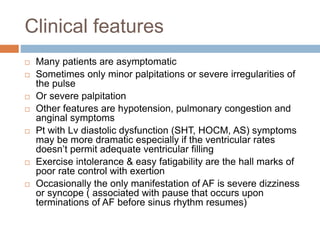
Clinical features
 Many patients are asymptomatic
 Sometimes only minor palpitations or severe irregularities of
the pulse
 Or severe palpitation
 Other features are hypotension, pulmonary congestion and
anginal symptoms
 Pt with Lv diastolic dysfunction (SHT, HOCM, AS) symptoms
may be more dramatic especially if the ventricular rates
doesn’t permit adequate ventricular filling
 Exercise intolerance & easy fatigability are the hall marks of
poor rate control with exertion
 Occasionally the only manifestation of AF is severe dizziness
or syncope ( associated with pause that occurs upon
terminations of AF before sinus rhythm resumes)
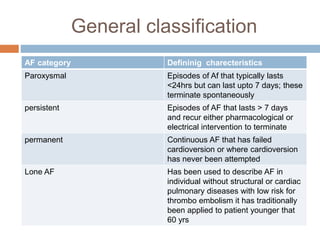
General classification
AF category Defininig charecteristics
Paroxysmal Episodes of Af that typically lasts
<24hrs but can last upto 7 days; these
terminate spontaneously
persistent Episodes of AF that lasts > 7 days
and recur either pharmacological or
electrical intervention to terminate
permanent Continuous AF that has failed
cardioversion or where cardioversion
has never been attempted
Lone AF Has been used to describe AF in
individual without structural or cardiac
pulmonary diseases with low risk for
thrombo embolism it has traditionally
been applied to patient younger that
60 yrs
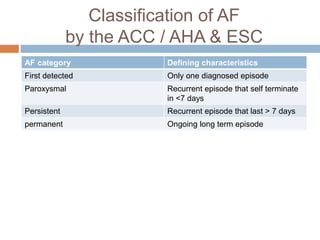
Classification of AF
by the ACC / AHA & ESC
AF category Defining characteristics
First detected Only one diagnosed episode
Paroxysmal Recurrent episode that self terminate
in <7 days
Persistent Recurrent episode that last > 7 days
permanent Ongoing long term episode
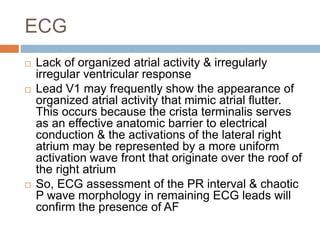
ECG
 Lack of organized atrial activity & irregularly
irregular ventricular response
 Lead V1 may frequently show the appearance of
organized atrial activity that mimic atrial flutter.
This occurs because the crista terminalis serves
as an effective anatomic barrier to electrical
conduction & the activations of the lateral right
atrium may be represented by a more uniform
activation wave front that originate over the roof of
the right atrium
 So, ECG assessment of the PR interval & chaotic
P wave morphology in remaining ECG leads will
confirm the presence of AF
Rx
 Depends upon clinical situation, chronicity and
risk factors of stroke , hemodynamic impact of AF
& ventricular rate
 Acute rate control: the initial goal of therapy –
 1) to establish control of the ventricular rate 2) to
address the anticoagulant status & begin IV
heparin Rx, if the duration of AF is >12 hrs & risk
factors for stroke with AF are present
 Drugs are Beta blocker & CCBs
 Digoxin may add to the rate controlling benefit of
the other agents
 Risk factors of stroke in AF
 h/o stroke or TIA, MS, SHT, DM, CCF, >75 yrs, LV dysfunction, marked left atrial
enlargement (>5cm), Spontaneous echo contrast
 Chronic anticoagulation with warfarin targeting an INR b/w 2-3 is recommended in
patients with persistent or frequent and long lived paroxysmal AF & risk factors
 Heparin is maintained routinely until the INR 1.8 with the administration of warfarin
after TEE
 For patients who don’t warrant early cardioversion of AF, anti coagulation should be
maintained for at least 3 weeks with the INR confirmed to be >1.8 on at least 2
separate occasions prior to attempts at cardioversion.
 Direct current transthoracic cardioversion during short acting anasthesia is a reliable
way to terminate AF. Conversion rates using a 200 joule biphasic shock delivered
synchronously with the QRS complex typically are >90%.
 Oral and/or IV administrations of amiodarone or procainamide have only modest
success
 iV ibutilide somewhat more effective
 A single episode of AF may not warrant any intervention or only a short course of
beta blocker therapy.
 The presence of any significant structural heart disease typically narrows RX to the
use of sotalol, amiodarone or dofetilide.
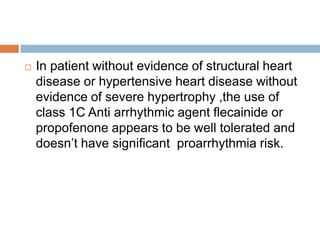
 In patient without evidence of structural heart
disease or hypertensive heart disease without
evidence of severe hypertrophy ,the use of
class 1C Anti arrhythmic agent flecainide or
propofenone appears to be well tolerated and
doesn’t have significant proarrhythmia risk.
Chronic rate control
 With more persistent form of AF, rate control, with beta
blocker, CCB and/or digoxine can frequently be
achieved.
 Heart rate >80/min at rest or 100/min with very
modest physical activity are indications that rate
control is inadequate in persistent AF.
 For that -a hiss bundle /AV junction ablation can be
performed.
 The ablation must be coupled with the implantations
of an activity sensor pacemaker with maintaining a
physiological range of heart rates.
 Occasionally biventricular pacing may be used to
minimize the degree of dyssynchronization that can
occur with RV apical pacing alone.
Catheter and surgical ablative
therapy to prevent recurrent AF
 Most ablation strategies incorporate techniques that isolate an atrial
muscle sleeves entering the pulmonary veins.
 Patient with recurrent symptomatic AF, because of by this procedure
, elimination of AF is 50-80%.
 Risk related to left atrial ablation procedure albeit low[over all 2-4
%], include pulmonary vein stenosis, atrio esophageal fistula,
systemic embolic event & perforation/tamponade.
 Surgical ablation usually performed at the time of other cardiac
valve or coronary artery surgery & less commonly as a stand alone
procedure.
 The cox surgical maze procedure is designed to interrupt all macro
re entrant circuits that might potentially develop in the atria thereby
precluding the ability of the atria to fibrillate.
 The multiple incisions of the traditional cox maze procedure have
been replaced with linear lines of ablation, and pulmonary vein
isolation using a variety of energy sources
 Thank you

Atrial Fibrillation in Hypothyroidism

  • 1.
    AN UNUSUAL PRESENTATION OF COMMONDISORDER Prof . Dr . G. Sundaramurthy’s unit, Dr. A.Prakash, PG,
  • 2.
     A 28yr old female patient, Mrs.Neela, from vyasarpaadi, with  c/o episodic palpitations- 3 months  h/o associated chest pain- substernal,  Nonradiating, throbbing  h/o weight gain +  h/o constipation +  h/o menstrual disturbances +
  • 3.
    No h/o  Sweating, Dyspnoea  Giddiness  Syncope  Fever  Cough with expectoration  Abd pain, LOA  Bladder disturbances  Heat intolerance  Insomnia
  • 4.
    Past & personalhistory  No h/o previous similar episode  Not a known DM, TB, HTN, BA, cardiac diseases, seizures  Taking mixed diet  Not an alcoholic & smoker
  • 5.
    Menstrual history  Attainedmenarche at 14 yrs  Normal & regular – 3/30 moderate flow till 6 months back  Now, h/o menorrhagia -6 months  Increased flow --- 5 to 7 days  Not associated with abd pain & clots  Pt delivered 2 males, FTND  Last child birth -3 yrs back  No h/o any abortion
  • 6.
    Family history &Rx history  Not relevant
  • 7.
    Examination  Conscious, comfortable.oriented, afebrile  Well built & nourished  No pallor, no cyanosis, no clubbing, no significant lymphadenopathy  Hirsuitism +, no thyroid swelling  No pedal edema
  • 8.
    vitals  HR- 140/min,irregularly irregular  PR- 126/min, irregularly irregular  Pulse deficit -14 BP- 120/70 mmHg  RR- 15/min  JVP –not raised  Temp- normal  Overweight (BMI 26)
  • 9.
    Systemic examination  CVS-S1 S2 heard; tachycardia- irregularly irregular  RS- NVBS +, no added sounds  P/A soft not tender no organomegaly no free fluid  CNS- NFND
  • 10.
  • 11.
    Investigation  ECG – Rate 170/min.  Absent p wave.  RR irregularly irregular.  Rapid ventricular rate.  Imp ; AF with Rapid ventricular rate.
  • 13.
  • 14.
    Investigations  Hb 12.8gm% TC 8200  DC P60 L38 E2  ESR 6/12  PCV 37%  RBCs 5.2 million  Platelet count 2.3 lakhs
  • 15.
     Blood sugar108 mg%  Urea 32mg%  Creatinine 0.9 mg%  Sr. Na 138meq/L  K 3.8 meq/L  Chloride 99 meq/L  HCO3 23 meq/L
  • 16.
     Cardiac enz-WNL  TFT- freeT4 0.4ng/dl (N- 0.58-1.64ng/dl)  Free T3 – 1.8 pg/ml (2.4-4.2pg/ml)  TSH 17mIU/ml (N-0.42-4.7 mIU/ml)  Sr. magnesium – 2.2 meq/L (1.5-2.5meq/L)  Sr.calcium – 9.2 mg% (9-11mg%)
  • 17.
     Cardiologist opinion-AF ?cause  Echo Normal LV function  No RWMA  EF 65%  Suggested  Inj. Diltiazem  T. verapamil  T. beta blocker
  • 18.
    Diagnosis  AF  Hypothyroidism AF –due to ? Hypothyroidism (?!!) or lone AF
  • 19.
     After initialone week treatment with verapamil and thyroxine ,AF converted to normal sinus rhythm.  After that patient continued thyroxine only, after one month, ECG taken ,it‘s normal SR.  So what could be the cause of AF ?
  • 20.
    Case reports &journal evidence for AF due to hypothyroidism  the editorial by Forfar1 that both clinical and subclinical hyperthyroidism are associated with the subsequent development of atrial fibrillation. The association of hypothyroidism with atrial fibrillation is less recognised.2 3 For example, the Canadian Registry of Atrial Fibrillation Investigators4reported that 1.5% of 726 patients with atrial fibrillation had hypothyroidism over a period of 1.7 years. However, Tajiri et al reported that up to 8% of the 75 elderly patients with atrial fibrillation (mean age 75.6 years) studied were found to be hypothyroid -Heart 1997;78:623-624 doi:10.1136/hrt.78.6.623a
  • 21.
     There arealso non-cardiac conditions that can lead to atrial fibrillation. Hyperthyroidism (high thyroid levels) is commonly accompanied by atrial fibrillation. On occasion, hypothyroidism (low thyroid levels) can also be accompanied by atrial fibrillation. -The Causes of Atrial Fibrillation By Richard N. Fogoros, M.D., About.com Guide Updated November 12, 2007
  • 22.
     Subclinical HypothyroidismMight Increase the Risk of Transient Atrial Fibrillation -Ann Thorac Surg 2009;87:1846-1852. doi:10.1016/j.athoracsur.2009.03.032 © 2009 The Society of Thoracic Surgeons
  • 23.
    C A SE R E P O R T JIACM 2009; 10(3): 140-2 * Fellow, Section of Cardiology, ** Associate Professor, Department of Medicine, Medical College of Georgia, 1120, 15th Street, Augusta, GA 30912, USA. Atrial Fibrillation in Hypothyroidism Dinesh Kumar Patel*, Jaspal S Gujral** Abstract A 27-year-old woman presented with palpitation, chest pain, and shortness of breath in the emergency room. Electrocardiogram revealed atrial fibrillation. Subsequent work-up was normal including oxygen saturation, chest X-ray, electrolytes, and echocardiogram, but showed clear evidence of primary hypothyroidism (sensitive thyroid stimulating hormone (TSH) of 14 mcIU/ ml and free T4 < 0.5 ng/dl). She was treated with appropriate thyroxin replacement without recurrence of atrial fibrillation. Key words: Atrial fibrillation, hypothyroidism, hyperthyroidism.
  • 24.
    Conclusion This case isa reminder that hypothyroidism, as well as hyperthyroidism, can be associated with the development of atrial fibrillation, and careful vigilance is necessary
  • 25.
    ATRIAL FIBRILLATION  Mostcommon sustained arrhythmia  Characterized by disorganized rapid & irregular atrial activation  Ventricular response to rapid atrial activation is also irregular  Mechanism for AF initiation & maintenance also though debated appears to represent a complex interaction between drivers responsible for the initiation & complex anatomic Atrial substrate that promotes the maintenance of multiple wavelets of micro re entry  The drivers appear to originate predominantly from atrialized musculature that enters the pulmonary veins & either represent focal abnormal automaticity or triggered firing that is somewhat modulated by autonomic influence  Non pulmonary vein drivers has also been documented  The role of these drivers play in maintaining the tachycardias may also been significant & may explain the success of the pulmonary vein isolation procedure in eliminating more chronic & persistent form of AF
  • 27.
     AF ismore common in adult population & children with structural heart disease  The incidence of AF increases with age such that 5 % of the adult population over 70 yrs will experience the arrhythmia  Because of more asymptomatic patients the overall incidence may be more than double of previously reported rates
  • 28.
    Causes Cardiac causes Othercauses •Structural heart diseases like MS, MR etc •Lung diseases such as pneumonia, lung ca, pulmonary embolism, sarcoidosis •Congenital heart diseases •CO poisoning •Coronary heart diseases •Low level of potassium, magnesium and calcium •Hypertension heart diseases •Pheochromocytoma •Cardiomyopathies •Hyper / hypothyroidism •hypothermia •Acute alcohol intoxication •Electrocution •Severe anaemia •Acute vagotonic episode •Acute or early recovery phase of major vascular abdominal & thoracic surgery (where autonomic fluxes and/or direct mechanical irritation potentiate the arrhythmia
  • 29.
    Clinical features  Manypatients are asymptomatic  Sometimes only minor palpitations or severe irregularities of the pulse  Or severe palpitation  Other features are hypotension, pulmonary congestion and anginal symptoms  Pt with Lv diastolic dysfunction (SHT, HOCM, AS) symptoms may be more dramatic especially if the ventricular rates doesn’t permit adequate ventricular filling  Exercise intolerance & easy fatigability are the hall marks of poor rate control with exertion  Occasionally the only manifestation of AF is severe dizziness or syncope ( associated with pause that occurs upon terminations of AF before sinus rhythm resumes)
  • 30.
    General classification AF categoryDefininig charecteristics Paroxysmal Episodes of Af that typically lasts <24hrs but can last upto 7 days; these terminate spontaneously persistent Episodes of AF that lasts > 7 days and recur either pharmacological or electrical intervention to terminate permanent Continuous AF that has failed cardioversion or where cardioversion has never been attempted Lone AF Has been used to describe AF in individual without structural or cardiac pulmonary diseases with low risk for thrombo embolism it has traditionally been applied to patient younger that 60 yrs
  • 31.
    Classification of AF bythe ACC / AHA & ESC AF category Defining characteristics First detected Only one diagnosed episode Paroxysmal Recurrent episode that self terminate in <7 days Persistent Recurrent episode that last > 7 days permanent Ongoing long term episode
  • 32.
    ECG  Lack oforganized atrial activity & irregularly irregular ventricular response  Lead V1 may frequently show the appearance of organized atrial activity that mimic atrial flutter. This occurs because the crista terminalis serves as an effective anatomic barrier to electrical conduction & the activations of the lateral right atrium may be represented by a more uniform activation wave front that originate over the roof of the right atrium  So, ECG assessment of the PR interval & chaotic P wave morphology in remaining ECG leads will confirm the presence of AF
  • 33.
    Rx  Depends uponclinical situation, chronicity and risk factors of stroke , hemodynamic impact of AF & ventricular rate  Acute rate control: the initial goal of therapy –  1) to establish control of the ventricular rate 2) to address the anticoagulant status & begin IV heparin Rx, if the duration of AF is >12 hrs & risk factors for stroke with AF are present  Drugs are Beta blocker & CCBs  Digoxin may add to the rate controlling benefit of the other agents
  • 34.
     Risk factorsof stroke in AF  h/o stroke or TIA, MS, SHT, DM, CCF, >75 yrs, LV dysfunction, marked left atrial enlargement (>5cm), Spontaneous echo contrast  Chronic anticoagulation with warfarin targeting an INR b/w 2-3 is recommended in patients with persistent or frequent and long lived paroxysmal AF & risk factors  Heparin is maintained routinely until the INR 1.8 with the administration of warfarin after TEE  For patients who don’t warrant early cardioversion of AF, anti coagulation should be maintained for at least 3 weeks with the INR confirmed to be >1.8 on at least 2 separate occasions prior to attempts at cardioversion.  Direct current transthoracic cardioversion during short acting anasthesia is a reliable way to terminate AF. Conversion rates using a 200 joule biphasic shock delivered synchronously with the QRS complex typically are >90%.  Oral and/or IV administrations of amiodarone or procainamide have only modest success  iV ibutilide somewhat more effective  A single episode of AF may not warrant any intervention or only a short course of beta blocker therapy.  The presence of any significant structural heart disease typically narrows RX to the use of sotalol, amiodarone or dofetilide.
  • 35.
     In patientwithout evidence of structural heart disease or hypertensive heart disease without evidence of severe hypertrophy ,the use of class 1C Anti arrhythmic agent flecainide or propofenone appears to be well tolerated and doesn’t have significant proarrhythmia risk.
  • 36.
    Chronic rate control With more persistent form of AF, rate control, with beta blocker, CCB and/or digoxine can frequently be achieved.  Heart rate >80/min at rest or 100/min with very modest physical activity are indications that rate control is inadequate in persistent AF.  For that -a hiss bundle /AV junction ablation can be performed.  The ablation must be coupled with the implantations of an activity sensor pacemaker with maintaining a physiological range of heart rates.  Occasionally biventricular pacing may be used to minimize the degree of dyssynchronization that can occur with RV apical pacing alone.
  • 37.
    Catheter and surgicalablative therapy to prevent recurrent AF  Most ablation strategies incorporate techniques that isolate an atrial muscle sleeves entering the pulmonary veins.  Patient with recurrent symptomatic AF, because of by this procedure , elimination of AF is 50-80%.  Risk related to left atrial ablation procedure albeit low[over all 2-4 %], include pulmonary vein stenosis, atrio esophageal fistula, systemic embolic event & perforation/tamponade.  Surgical ablation usually performed at the time of other cardiac valve or coronary artery surgery & less commonly as a stand alone procedure.  The cox surgical maze procedure is designed to interrupt all macro re entrant circuits that might potentially develop in the atria thereby precluding the ability of the atria to fibrillate.  The multiple incisions of the traditional cox maze procedure have been replaced with linear lines of ablation, and pulmonary vein isolation using a variety of energy sources
  • 38.