ATOMIC STRUCTURE PDF: HOW TO
DESCRIBE ITS
Spread the love
ATOMIC STRUCTURE PDF
INTRODUCTION:
(BASIC ATOMIC STRUCTURE) All matters are in nature is made up of only a few elements. The elements
exist as atoms and/or molecules. Molecules of an atom are made up of atoms of the same type. Compounds
contain two or more elements. Thus, the molecules of compounds contain atoms of different elements.
MODEL OF AN ATOM: ( BASIC ATOMIC STRUCTURE)
(BASIC ATOMIC STRUCTURE) Atoms are too small to see even with a powerful microscope and
too light to be weighed even on the most sensitive balance. The history of the discovery of the structure of
an atom is fascinating but a complicated subject. Only 100 years ago, scientists believed that atoms
were solid, indestructible particles. Since then many great scientists had contributed brilliantly to give us the
today’s model of an atom. Over the centuries, many philosophers and scientists tried to develop a model of
the atom.
SOME IMPORTANT ATOMIC MODELS ARE
DESCRIBED HERE (BASIC ATOMIC STRUCTURE)
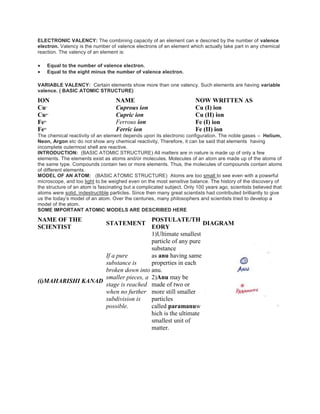
NAME OF THE
SCIENTIST
STATEMENT
POSTULATE/TH
EORY
DIAGRAM
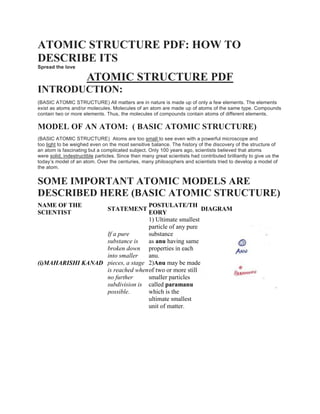
(i)MAHARISHI KANAD
If a pure
substance is
broken down
into smaller
pieces, a stage
is reached when
no further
subdivision is
possible.
1) Ultimate smallest
particle of any pure
substance
as anu having same
properties in each
anu.
2)Anu may be made
of two or more still
smaller particles
called paramanu
which is the
ultimate smallest
unit of matter.
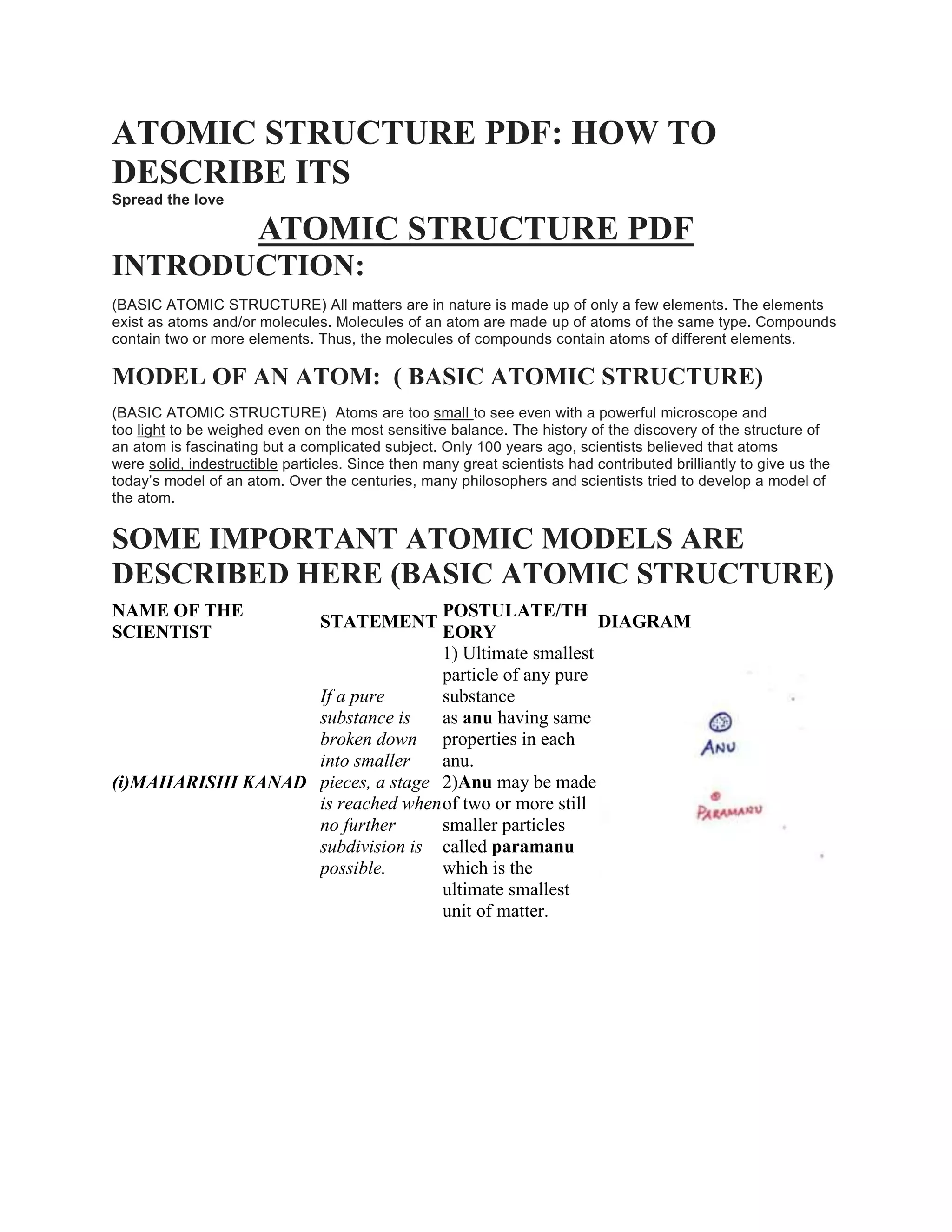
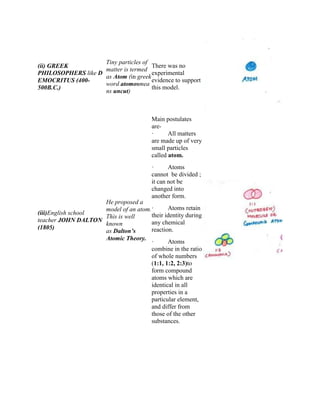
(ii) GREEK
PHILOSOPHERS like DE
MOCRITUS (400-
500B.C.)
Tiny particles
of matter is
termed
as Atom (in gre
ek word atomos
means uncut)
There was no
experimental
evidence to support
this model.
(iii)English school
teacher JOHN DALTON
(1805)
He proposed a
model of an
atom. This is
well known
as Dalton’s
Atomic Theory.
Main postulates are-
· All matters
are made up of very
small particles
called atom.
· Atoms
cannot be divided ;
it cannot be changed
into another form.
· Atoms retain
their identity during
any chemical
reaction.
· Atoms
combine in the ratio
of whole numbers
(1:1, 1:2, 2:3)to
form compound
atoms which are
identical in all
properties in a
particular element,
and differ from
those of the other
substances.
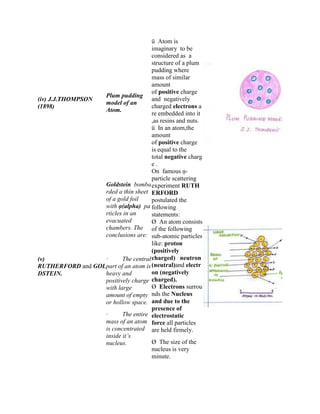
(iv) J.J.THOMPSON
(1898)
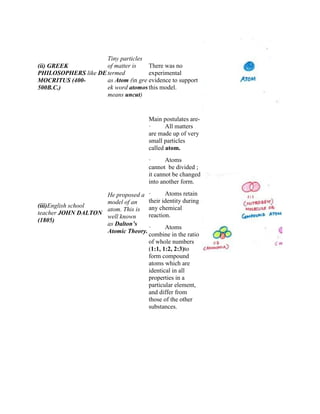
Plum pudding
model of an
Atom.
ü Atom is
imaginary to be
considered as a
structure of a plum
pudding where mass
of similar amount
of positive charge
and negatively
charged electrons ar
e embedded into it
,as resins and nuts.
ü In an atom, the
amount
of positive charge is
equal to the
total negative charg
e .
(v)
RUTHERFORD and GOL
DSTEIN.
Goldstein bom
barded a thin
sheet of a gold
foil
with ᾳ(alpha) p
articles in an
evacuated
chambers. The
conclusions
are:
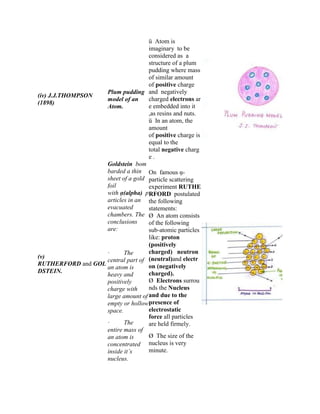
· The
central part of
an atom is
heavy and
positively
charge with
large amount of
empty or hollow
space.
· The
entire mass of
an atom is
concentrated
inside it’s
nucleus.
On famous ᾳ-
particle scattering
experiment RUTHE
RFORD postulated
the following
statements:
Ø An atom consists
of the following
sub-atomic particles
like: proton
(positively
charged) neutron
(neutral)and electr
on (negatively
charged).
Ø Electrons surrou
nds the Nucleus
and due to the
presence of
electrostatic
force all particles
are held firmely.
Ø The size of the
nucleus is very
minute.
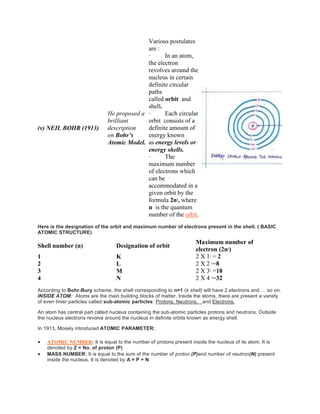
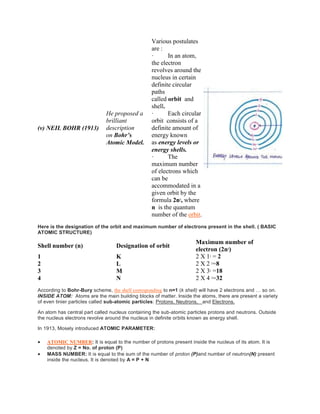
(v) NEIL BOHR (1913)
He proposed a
brilliant
description
on Bohr’s
Atomic Model.
Various postulates
are :
· In an atom,
the electron
revolves around the
nucleus in certain
definite circular
paths
called orbit and
shell.
· Each circular
orbit consists of a
definite amount of
energy known
as energy levels or
energy shells.
· The
maximum number
of electrons which
can be
accommodated in a
given orbit by the
formula 2n2
, where
n is the quantum
number of the orbit.
Here is the designation of the orbit and maximum number of electrons present in the shell. ( BASIC
ATOMIC STRUCTURE)
Shell number (n) Designation of orbit
Maximum number of
electron (2n2
)
1 K 2 X 12 = 2
2 L 2 X 2 2=8
3 M 2 X 32 =18
4 N 2 X 4 2=32
According to Bohr-Bury scheme, the shell corresponding to n=1 (k shell) will have 2 electrons and … so on.
INSIDE ATOM: Atoms are the main building blocks of matter. Inside the atoms, there are present a variety
of even tinier particles called sub-atomic particles: Protons, Neutrons, and Electrons.
An atom has central part called nucleus containing the sub-atomic particles protons and neutrons. Outside
the nucleus electrons revolve around the nucleus in definite orbits known as energy shell.
In 1913, Mosely introduced ATOMIC PARAMETER:
 ATOMIC NUMBER: It is equal to the number of protons present inside the nucleus of its atom. It is
denoted by Z = No. of proton (P)
 MASS NUMBER: It is equal to the sum of the number of proton (P)and number of neutron(N) present
inside the nucleus. It is denoted by A = P + N
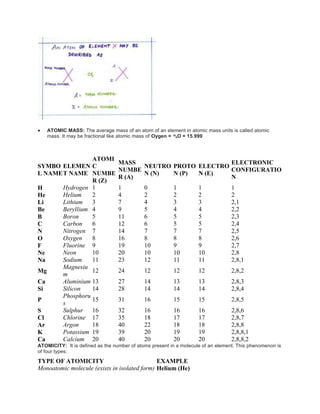
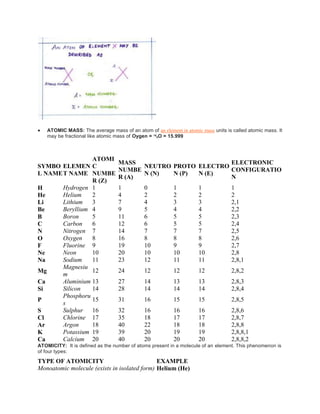
 ATOMIC MASS: The average mass of an atom of an element in atomic mass units is called atomic
mass. It may be fractional like atomic mass of Oygen = 16
8O = 15.999
SYMBO
L NAME
ELEMEN
T NAME
ATOMI
C
NUMBE
R (Z)
MASS
NUMBE
R (A)
NEUTRO
N (N)
PROTO
N (P)
ELECTRO
N (E)
ELECTRONIC
CONFIGURATIO
N
H Hydrogen 1 1 0 1 1 1
He Helium 2 4 2 2 2 2
Li Lithium 3 7 4 3 3 2,1
Be Beryllium 4 9 5 4 4 2,2
B Boron 5 11 6 5 5 2,3
C Carbon 6 12 6 5 5 2,4
N Nitrogen 7 14 7 7 7 2,5
O Oxygen 8 16 8 8 8 2,6
F Fluorine 9 19 10 9 9 2,7
Ne Neon 10 20 10 10 10 2,8
Na Sodium 11 23 12 11 11 2,8,1
Mg
Magnesiu
m
12 24 12 12 12 2,8,2
Ca Aluminium 13 27 14 13 13 2,8,3
Si Silicon 14 28 14 14 14 2,8,4
P
Phosphoru
s
15 31 16 15 15 2,8,5
S Sulphur 16 32 16 16 16 2,8,6
Cl Chlorine 17 35 18 17 17 2,8,7
Ar Argon 18 40 22 18 18 2,8,8
K Potassium 19 39 20 19 19 2,8,8,1
Ca Calcium 20 40 20 20 20 2,8,8,2
ATOMICITY: It is defined as the number of atoms present in a molecule of an element. This phenomenon is
of four types:
TYPE OF ATOMICITY EXAMPLE
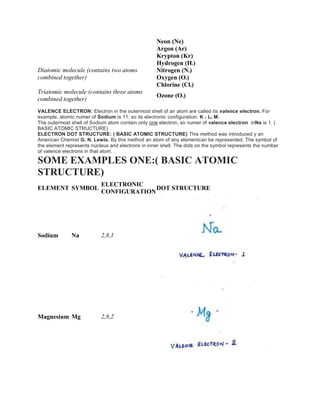
Monoatomic molecule (exists in isolated form) Helium (He)
Neon (Ne)
Argon (Ar)
Krypton (Kr)
Diatomic molecule (contains two atoms
combined together)
Hydrogen (H2)
Nitrogen (N2)
Oxygen (O2)
Chlorine (Cl2)
Triatomic molecule (contains three atoms
combined together)
Ozone (O3)
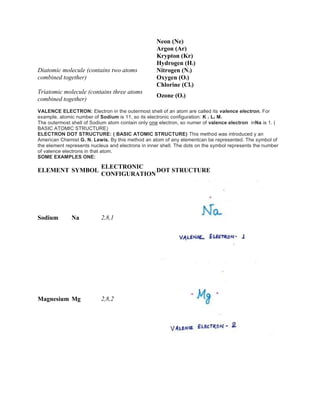
VALENCE ELECTRON: Electron in the outermost shell of an atom are called its valence electron. For
example, atomic number of Sodium is 11, so its electronic configuration: K 2 L8 M1
The outermost shell of Sodium atom contain only one electron, so numer of valence electron inNa is 1. (
BASIC ATOMIC STRUCTURE)
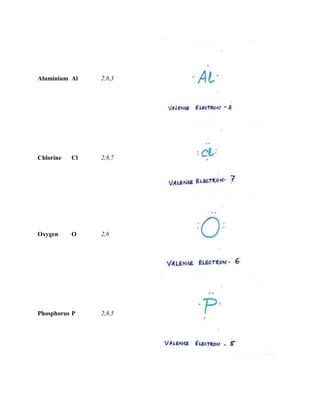
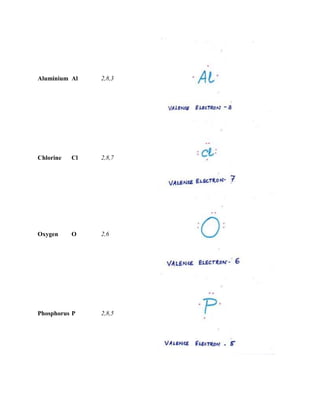
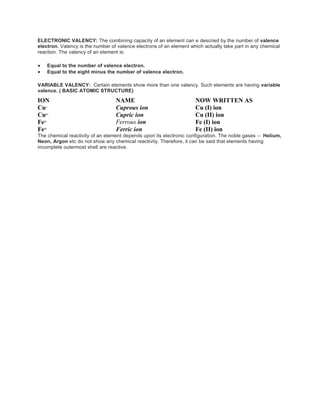
ELECTRON DOT STRUCTURE: ( BASIC ATOMIC STRUCTURE) This method was introduced y an
American Chemist G. N. Lewis. By this method an atom of any elementcan be represented. The symbol of
the element represents nucleus and electrons in inner shell. The dots on the symbol represents the number
of valence electrons in that atom.
SOME EXAMPLES ONE:
ELEMENT SYMBOL
ELECTRONIC
CONFIGURATION
DOT STRUCTURE
Sodium Na 2,8,1
Magnesium Mg 2,8,2
Aluminium Al 2,8,3
Chlorine Cl 2,8,7
Oxygen O 2,6
Phosphorus P 2,8,5
ELECTRONIC VALENCY: The combining capacity of an element can e descried by the number of valence
electron. Valency is the number of valence electrons of an element which actually take part in any chemical
reaction. The valency of an element is:
 Equal to the number of valence electron.
 Equal to the eight minus the number of valence electron.
VARIABLE VALENCY: Certain elements show more than one valency. Such elements are having variable
valence. ( BASIC ATOMIC STRUCTURE)
ION NAME NOW WRITTEN AS
Cu+
Cuprous ion Cu (I) ion
Cu2+
Cupric ion Cu (II) ion
Fe2+
Ferrous ion Fe (I) ion
Fe3+
Ferric ion Fe (II) ion
The chemical reactivity of an element depends upon its electronic configuration. The noble gases – Helium,
Neon, Argon etc do not show any chemical reactivity. Therefore, it can be said that elements having
incomplete outermost shell are reactive.
INTRODUCTION: (BASIC ATOMIC STRUCTURE) All matters are in nature is made up of only a few
elements. The elements exist as atoms and/or molecules. Molecules of an atom are made up of the atoms of
the same type. Compounds contain two or more elements. Thus, the molecules of compounds contain atoms
of different elements.
MODEL OF AN ATOM: (BASIC ATOMIC STRUCTURE) Atoms are too small to see even with a powerful
microscope, and too light to be weighed even on the most sensitive balance. The history of the discovery of
the structure of an atom is fascinating but a complicated subject. Only 100 years ago, scientists believed that
atoms were solid, indestructible particles. Since then many great scientists had contributed brilliantly to give
us the today’s model of an atom. Over the centuries, many philosophers and scientists tried to develop a
model of the atom.
SOME IMPORTANT ATOMIC MODELS ARE DESCRIBED HERE
NAME OF THE
SCIENTIST
STATEMENT
POSTULATE/TH
EORY
DIAGRAM
(i)MAHARISHI KANAD
If a pure
substance is
broken down into
smaller pieces, a
stage is reached
when no further
subdivision is
possible.
1)Ultimate smallest
particle of any pure
substance
as anu having same
properties in each
anu.
2)Anu may be
made of two or
more still smaller
particles
called paramanuw
hich is the ultimate
smallest unit of
matter.
(ii) GREEK
PHILOSOPHERS like D
EMOCRITUS (400-
500B.C.)
Tiny particles of
matter is termed
as Atom (in greek
word atomosmea
ns uncut)
There was no
experimental
evidence to support
this model.
(iii)English school
teacher JOHN DALTON
(1805)
He proposed a
model of an atom.
This is well
known
as Dalton’s
Atomic Theory.
Main postulates
are-
· All matters
are made up of very
small particles
called atom.
· Atoms
cannot be divided ;
it can not be
changed into
another form.
· Atoms retain
their identity during
any chemical
reaction.
· Atoms
combine in the ratio
of whole numbers
(1:1, 1:2, 2:3)to
form compound
atoms which are
identical in all
properties in a
particular element,
and differ from
those of the other
substances.
(iv) J.J.THOMPSON
(1898)
Plum pudding
model of an
Atom.
ü Atom is
imaginary to be
considered as a
structure of a plum
pudding where
mass of similar
amount
of positive charge
and negatively
charged electrons a
re embedded into it
,as resins and nuts.
ü In an atom,the
amount
of positive charge
is equal to the
total negative charg
e .
(v)
RUTHERFORD and GOL
DSTEIN.
Goldstein bomba
rded a thin sheet
of a gold foil
with ᾳ(alpha) pa
rticles in an
evacuated
chambers. The
conclusions are:
· The central
part of an atom is
heavy and
positively charge
with large
amount of empty
or hollow space.
· The entire
mass of an atom
is concentrated
inside it’s
nucleus.
On famous ᾳ-
particle scattering
experiment RUTH
ERFORD
postulated the
following
statements:
Ø An atom consists
of the following
sub-atomic particles
like: proton
(positively
charged) neutron
(neutral)and electr
on (negatively
charged).
Ø Electrons surrou
nds the Nucleus
and due to the
presence of
electrostatic
force all particles
are held firmely.
Ø The size of the
nucleus is very
minute.
(v) NEIL BOHR (1913)
He proposed a
brilliant
description
on Bohr’s
Atomic Model.
Various postulates
are :
· In an atom,
the electron
revolves around the
nucleus in certain
definite circular
paths
called orbit and
shell.
· Each circular
orbit consists of a
definite amount of
energy known
as energy levels or
energy shells.
· The
maximum number
of electrons which
can be
accommodated in a
given orbit by the
formula 2n2
, where
n is the quantum
number of the orbit.
Here is the designation of the orbit and maximum number of electrons present in the shell. ( BASIC
ATOMIC STRUCTURE)
Shell number (n) Designation of orbit
Maximum number of
electron (2n2
)
1 K 2 X 12 = 2
2 L 2 X 2 2=8
3 M 2 X 32 =18
4 N 2 X 4 2=32
According to Bohr-Bury scheme, the shell corresponding to n=1 (k shell) will have 2 electrons and … so on.
INSIDE ATOM: Atoms are the main building blocks of matter. Inside the atoms, there are present a variety
of even tinier particles called sub-atomic particles: Protons, Neutrons, and Electrons.
An atom has central part called nucleus containing the sub-atomic particles protons and neutrons. Outside
the nucleus electrons revolve around the nucleus in definite orbits known as energy shell.
In 1913, Mosely introduced ATOMIC PARAMETER:
 ATOMIC NUMBER: It is equal to the number of protons present inside the nucleus of its atom. It is
denoted by Z = No. of proton (P)
 MASS NUMBER: It is equal to the sum of the number of proton (P)and number of neutron(N) present
inside the nucleus. It is denoted by A = P + N
 ATOMIC MASS: The average mass of an atom of an element in atomic mass units is called atomic mass. It
may be fractional like atomic mass of Oygen = 16
8O = 15.999
SYMBO
L NAME
ELEMEN
T NAME
ATOMI
C
NUMBE
R (Z)
MASS
NUMBE
R (A)
NEUTRO
N (N)
PROTO
N (P)
ELECTRO
N (E)
ELECTRONIC
CONFIGURATIO
N
H Hydrogen 1 1 0 1 1 1
He Helium 2 4 2 2 2 2
Li Lithium 3 7 4 3 3 2,1
Be Beryllium 4 9 5 4 4 2,2
B Boron 5 11 6 5 5 2,3
C Carbon 6 12 6 5 5 2,4
N Nitrogen 7 14 7 7 7 2,5
O Oxygen 8 16 8 8 8 2,6
F Fluorine 9 19 10 9 9 2,7
Ne Neon 10 20 10 10 10 2,8
Na Sodium 11 23 12 11 11 2,8,1
Mg
Magnesiu
m
12 24 12 12 12 2,8,2
Ca Aluminium 13 27 14 13 13 2,8,3
Si Silicon 14 28 14 14 14 2,8,4
P
Phosphoru
s
15 31 16 15 15 2,8,5
S Sulphur 16 32 16 16 16 2,8,6
Cl Chlorine 17 35 18 17 17 2,8,7
Ar Argon 18 40 22 18 18 2,8,8
K Potassium 19 39 20 19 19 2,8,8,1
Ca Calcium 20 40 20 20 20 2,8,8,2
ATOMICITY: It is defined as the number of atoms present in a molecule of an element. This phenomenon is
of four types:
TYPE OF ATOMICITY EXAMPLE
Monoatomic molecule (exists in isolated form) Helium (He)
Neon (Ne)
Argon (Ar)
Krypton (Kr)
Diatomic molecule (contains two atoms
combined together)
Hydrogen (H2)
Nitrogen (N2)
Oxygen (O2)
Chlorine (Cl2)
Triatomic molecule (contains three atoms
combined together)
Ozone (O3)
VALENCE ELECTRON: Electron in the outermost shell of an atom are called its valence electron. For
example, atomic numer of Sodium is 11, so its electronic configuration: K 2 L8 M1
The outermost shell of Sodium atom contain only one electron, so numer of valence electron inNa is 1. (
BASIC ATOMIC STRUCTURE)
ELECTRON DOT STRUCTURE: ( BASIC ATOMIC STRUCTURE) This method was introduced y an
American Chemist G. N. Lewis. By this method an atom of any elementcan be represented. The symbol of
the element represents nucleus and electrons in inner shell. The dots on the symbol represents the number
of valence electrons in that atom.
SOME EXAMPLES ONE:( BASIC ATOMIC
STRUCTURE)
ELEMENT SYMBOL
ELECTRONIC
CONFIGURATION
DOT STRUCTURE
Sodium Na 2,8,1
Magnesium Mg 2,8,2
Aluminium Al 2,8,3
Chlorine Cl 2,8,7
Oxygen O 2,6
Phosphorus P 2,8,5
ELECTRONIC VALENCY: The combining capacity of an element can e descried by the number of valence
electron. Valency is the number of valence electrons of an element which actually take part in any chemical
reaction. The valency of an element is:
 Equal to the number of valence electron.
 Equal to the eight minus the number of valence electron.
VARIABLE VALENCY: Certain elements show more than one valency. Such elements are having variable
valence. ( BASIC ATOMIC STRUCTURE)
ION NAME NOW WRITTEN AS
Cu+
Cuprous ion Cu (I) ion
Cu2+
Cupric ion Cu (II) ion
Fe2+
Ferrous ion Fe (I) ion
Fe3+
Ferric ion Fe (II) ion
The chemical reactivity of an element depends upon its electronic configuration. The noble gases – Helium,
Neon, Argon etc do not show any chemical reactivity. Therefore, it can be said that elements having
incomplete outermost shell are reactive.

ATOMIC STRUCTURE PDF.docx

  • 1.
    ATOMIC STRUCTURE PDF:HOW TO DESCRIBE ITS Spread the love ATOMIC STRUCTURE PDF INTRODUCTION: (BASIC ATOMIC STRUCTURE) All matters are in nature is made up of only a few elements. The elements exist as atoms and/or molecules. Molecules of an atom are made up of atoms of the same type. Compounds contain two or more elements. Thus, the molecules of compounds contain atoms of different elements. MODEL OF AN ATOM: ( BASIC ATOMIC STRUCTURE) (BASIC ATOMIC STRUCTURE) Atoms are too small to see even with a powerful microscope and too light to be weighed even on the most sensitive balance. The history of the discovery of the structure of an atom is fascinating but a complicated subject. Only 100 years ago, scientists believed that atoms were solid, indestructible particles. Since then many great scientists had contributed brilliantly to give us the today’s model of an atom. Over the centuries, many philosophers and scientists tried to develop a model of the atom. SOME IMPORTANT ATOMIC MODELS ARE DESCRIBED HERE (BASIC ATOMIC STRUCTURE) NAME OF THE SCIENTIST STATEMENT POSTULATE/TH EORY DIAGRAM (i)MAHARISHI KANAD If a pure substance is broken down into smaller pieces, a stage is reached when no further subdivision is possible. 1) Ultimate smallest particle of any pure substance as anu having same properties in each anu. 2)Anu may be made of two or more still smaller particles called paramanu which is the ultimate smallest unit of matter.
  • 2.
    (ii) GREEK PHILOSOPHERS likeDE MOCRITUS (400- 500B.C.) Tiny particles of matter is termed as Atom (in gre ek word atomos means uncut) There was no experimental evidence to support this model. (iii)English school teacher JOHN DALTON (1805) He proposed a model of an atom. This is well known as Dalton’s Atomic Theory. Main postulates are- · All matters are made up of very small particles called atom. · Atoms cannot be divided ; it cannot be changed into another form. · Atoms retain their identity during any chemical reaction. · Atoms combine in the ratio of whole numbers (1:1, 1:2, 2:3)to form compound atoms which are identical in all properties in a particular element, and differ from those of the other substances.
  • 3.
    (iv) J.J.THOMPSON (1898) Plum pudding modelof an Atom. ü Atom is imaginary to be considered as a structure of a plum pudding where mass of similar amount of positive charge and negatively charged electrons ar e embedded into it ,as resins and nuts. ü In an atom, the amount of positive charge is equal to the total negative charg e . (v) RUTHERFORD and GOL DSTEIN. Goldstein bom barded a thin sheet of a gold foil with ᾳ(alpha) p articles in an evacuated chambers. The conclusions are: · The central part of an atom is heavy and positively charge with large amount of empty or hollow space. · The entire mass of an atom is concentrated inside it’s nucleus. On famous ᾳ- particle scattering experiment RUTHE RFORD postulated the following statements: Ø An atom consists of the following sub-atomic particles like: proton (positively charged) neutron (neutral)and electr on (negatively charged). Ø Electrons surrou nds the Nucleus and due to the presence of electrostatic force all particles are held firmely. Ø The size of the nucleus is very minute.
  • 4.
    (v) NEIL BOHR(1913) He proposed a brilliant description on Bohr’s Atomic Model. Various postulates are : · In an atom, the electron revolves around the nucleus in certain definite circular paths called orbit and shell. · Each circular orbit consists of a definite amount of energy known as energy levels or energy shells. · The maximum number of electrons which can be accommodated in a given orbit by the formula 2n2 , where n is the quantum number of the orbit. Here is the designation of the orbit and maximum number of electrons present in the shell. ( BASIC ATOMIC STRUCTURE) Shell number (n) Designation of orbit Maximum number of electron (2n2 ) 1 K 2 X 12 = 2 2 L 2 X 2 2=8 3 M 2 X 32 =18 4 N 2 X 4 2=32 According to Bohr-Bury scheme, the shell corresponding to n=1 (k shell) will have 2 electrons and … so on. INSIDE ATOM: Atoms are the main building blocks of matter. Inside the atoms, there are present a variety of even tinier particles called sub-atomic particles: Protons, Neutrons, and Electrons. An atom has central part called nucleus containing the sub-atomic particles protons and neutrons. Outside the nucleus electrons revolve around the nucleus in definite orbits known as energy shell. In 1913, Mosely introduced ATOMIC PARAMETER:  ATOMIC NUMBER: It is equal to the number of protons present inside the nucleus of its atom. It is denoted by Z = No. of proton (P)  MASS NUMBER: It is equal to the sum of the number of proton (P)and number of neutron(N) present inside the nucleus. It is denoted by A = P + N
  • 5.
     ATOMIC MASS:The average mass of an atom of an element in atomic mass units is called atomic mass. It may be fractional like atomic mass of Oygen = 16 8O = 15.999 SYMBO L NAME ELEMEN T NAME ATOMI C NUMBE R (Z) MASS NUMBE R (A) NEUTRO N (N) PROTO N (P) ELECTRO N (E) ELECTRONIC CONFIGURATIO N H Hydrogen 1 1 0 1 1 1 He Helium 2 4 2 2 2 2 Li Lithium 3 7 4 3 3 2,1 Be Beryllium 4 9 5 4 4 2,2 B Boron 5 11 6 5 5 2,3 C Carbon 6 12 6 5 5 2,4 N Nitrogen 7 14 7 7 7 2,5 O Oxygen 8 16 8 8 8 2,6 F Fluorine 9 19 10 9 9 2,7 Ne Neon 10 20 10 10 10 2,8 Na Sodium 11 23 12 11 11 2,8,1 Mg Magnesiu m 12 24 12 12 12 2,8,2 Ca Aluminium 13 27 14 13 13 2,8,3 Si Silicon 14 28 14 14 14 2,8,4 P Phosphoru s 15 31 16 15 15 2,8,5 S Sulphur 16 32 16 16 16 2,8,6 Cl Chlorine 17 35 18 17 17 2,8,7 Ar Argon 18 40 22 18 18 2,8,8 K Potassium 19 39 20 19 19 2,8,8,1 Ca Calcium 20 40 20 20 20 2,8,8,2 ATOMICITY: It is defined as the number of atoms present in a molecule of an element. This phenomenon is of four types: TYPE OF ATOMICITY EXAMPLE Monoatomic molecule (exists in isolated form) Helium (He)
  • 6.
    Neon (Ne) Argon (Ar) Krypton(Kr) Diatomic molecule (contains two atoms combined together) Hydrogen (H2) Nitrogen (N2) Oxygen (O2) Chlorine (Cl2) Triatomic molecule (contains three atoms combined together) Ozone (O3) VALENCE ELECTRON: Electron in the outermost shell of an atom are called its valence electron. For example, atomic number of Sodium is 11, so its electronic configuration: K 2 L8 M1 The outermost shell of Sodium atom contain only one electron, so numer of valence electron inNa is 1. ( BASIC ATOMIC STRUCTURE) ELECTRON DOT STRUCTURE: ( BASIC ATOMIC STRUCTURE) This method was introduced y an American Chemist G. N. Lewis. By this method an atom of any elementcan be represented. The symbol of the element represents nucleus and electrons in inner shell. The dots on the symbol represents the number of valence electrons in that atom. SOME EXAMPLES ONE: ELEMENT SYMBOL ELECTRONIC CONFIGURATION DOT STRUCTURE Sodium Na 2,8,1 Magnesium Mg 2,8,2
  • 7.
    Aluminium Al 2,8,3 ChlorineCl 2,8,7 Oxygen O 2,6 Phosphorus P 2,8,5
  • 8.
    ELECTRONIC VALENCY: Thecombining capacity of an element can e descried by the number of valence electron. Valency is the number of valence electrons of an element which actually take part in any chemical reaction. The valency of an element is:  Equal to the number of valence electron.  Equal to the eight minus the number of valence electron. VARIABLE VALENCY: Certain elements show more than one valency. Such elements are having variable valence. ( BASIC ATOMIC STRUCTURE) ION NAME NOW WRITTEN AS Cu+ Cuprous ion Cu (I) ion Cu2+ Cupric ion Cu (II) ion Fe2+ Ferrous ion Fe (I) ion Fe3+ Ferric ion Fe (II) ion The chemical reactivity of an element depends upon its electronic configuration. The noble gases – Helium, Neon, Argon etc do not show any chemical reactivity. Therefore, it can be said that elements having incomplete outermost shell are reactive. INTRODUCTION: (BASIC ATOMIC STRUCTURE) All matters are in nature is made up of only a few elements. The elements exist as atoms and/or molecules. Molecules of an atom are made up of the atoms of the same type. Compounds contain two or more elements. Thus, the molecules of compounds contain atoms of different elements. MODEL OF AN ATOM: (BASIC ATOMIC STRUCTURE) Atoms are too small to see even with a powerful microscope, and too light to be weighed even on the most sensitive balance. The history of the discovery of the structure of an atom is fascinating but a complicated subject. Only 100 years ago, scientists believed that atoms were solid, indestructible particles. Since then many great scientists had contributed brilliantly to give us the today’s model of an atom. Over the centuries, many philosophers and scientists tried to develop a model of the atom. SOME IMPORTANT ATOMIC MODELS ARE DESCRIBED HERE NAME OF THE SCIENTIST STATEMENT POSTULATE/TH EORY DIAGRAM (i)MAHARISHI KANAD If a pure substance is broken down into smaller pieces, a stage is reached when no further subdivision is possible. 1)Ultimate smallest particle of any pure substance as anu having same properties in each anu. 2)Anu may be made of two or more still smaller particles called paramanuw hich is the ultimate smallest unit of matter.
  • 9.
    (ii) GREEK PHILOSOPHERS likeD EMOCRITUS (400- 500B.C.) Tiny particles of matter is termed as Atom (in greek word atomosmea ns uncut) There was no experimental evidence to support this model. (iii)English school teacher JOHN DALTON (1805) He proposed a model of an atom. This is well known as Dalton’s Atomic Theory. Main postulates are- · All matters are made up of very small particles called atom. · Atoms cannot be divided ; it can not be changed into another form. · Atoms retain their identity during any chemical reaction. · Atoms combine in the ratio of whole numbers (1:1, 1:2, 2:3)to form compound atoms which are identical in all properties in a particular element, and differ from those of the other substances.
  • 10.
    (iv) J.J.THOMPSON (1898) Plum pudding modelof an Atom. ü Atom is imaginary to be considered as a structure of a plum pudding where mass of similar amount of positive charge and negatively charged electrons a re embedded into it ,as resins and nuts. ü In an atom,the amount of positive charge is equal to the total negative charg e . (v) RUTHERFORD and GOL DSTEIN. Goldstein bomba rded a thin sheet of a gold foil with ᾳ(alpha) pa rticles in an evacuated chambers. The conclusions are: · The central part of an atom is heavy and positively charge with large amount of empty or hollow space. · The entire mass of an atom is concentrated inside it’s nucleus. On famous ᾳ- particle scattering experiment RUTH ERFORD postulated the following statements: Ø An atom consists of the following sub-atomic particles like: proton (positively charged) neutron (neutral)and electr on (negatively charged). Ø Electrons surrou nds the Nucleus and due to the presence of electrostatic force all particles are held firmely. Ø The size of the nucleus is very minute.
  • 11.
    (v) NEIL BOHR(1913) He proposed a brilliant description on Bohr’s Atomic Model. Various postulates are : · In an atom, the electron revolves around the nucleus in certain definite circular paths called orbit and shell. · Each circular orbit consists of a definite amount of energy known as energy levels or energy shells. · The maximum number of electrons which can be accommodated in a given orbit by the formula 2n2 , where n is the quantum number of the orbit. Here is the designation of the orbit and maximum number of electrons present in the shell. ( BASIC ATOMIC STRUCTURE) Shell number (n) Designation of orbit Maximum number of electron (2n2 ) 1 K 2 X 12 = 2 2 L 2 X 2 2=8 3 M 2 X 32 =18 4 N 2 X 4 2=32 According to Bohr-Bury scheme, the shell corresponding to n=1 (k shell) will have 2 electrons and … so on. INSIDE ATOM: Atoms are the main building blocks of matter. Inside the atoms, there are present a variety of even tinier particles called sub-atomic particles: Protons, Neutrons, and Electrons. An atom has central part called nucleus containing the sub-atomic particles protons and neutrons. Outside the nucleus electrons revolve around the nucleus in definite orbits known as energy shell. In 1913, Mosely introduced ATOMIC PARAMETER:  ATOMIC NUMBER: It is equal to the number of protons present inside the nucleus of its atom. It is denoted by Z = No. of proton (P)  MASS NUMBER: It is equal to the sum of the number of proton (P)and number of neutron(N) present inside the nucleus. It is denoted by A = P + N
  • 12.
     ATOMIC MASS:The average mass of an atom of an element in atomic mass units is called atomic mass. It may be fractional like atomic mass of Oygen = 16 8O = 15.999 SYMBO L NAME ELEMEN T NAME ATOMI C NUMBE R (Z) MASS NUMBE R (A) NEUTRO N (N) PROTO N (P) ELECTRO N (E) ELECTRONIC CONFIGURATIO N H Hydrogen 1 1 0 1 1 1 He Helium 2 4 2 2 2 2 Li Lithium 3 7 4 3 3 2,1 Be Beryllium 4 9 5 4 4 2,2 B Boron 5 11 6 5 5 2,3 C Carbon 6 12 6 5 5 2,4 N Nitrogen 7 14 7 7 7 2,5 O Oxygen 8 16 8 8 8 2,6 F Fluorine 9 19 10 9 9 2,7 Ne Neon 10 20 10 10 10 2,8 Na Sodium 11 23 12 11 11 2,8,1 Mg Magnesiu m 12 24 12 12 12 2,8,2 Ca Aluminium 13 27 14 13 13 2,8,3 Si Silicon 14 28 14 14 14 2,8,4 P Phosphoru s 15 31 16 15 15 2,8,5 S Sulphur 16 32 16 16 16 2,8,6 Cl Chlorine 17 35 18 17 17 2,8,7 Ar Argon 18 40 22 18 18 2,8,8 K Potassium 19 39 20 19 19 2,8,8,1 Ca Calcium 20 40 20 20 20 2,8,8,2 ATOMICITY: It is defined as the number of atoms present in a molecule of an element. This phenomenon is of four types: TYPE OF ATOMICITY EXAMPLE Monoatomic molecule (exists in isolated form) Helium (He)
  • 13.
    Neon (Ne) Argon (Ar) Krypton(Kr) Diatomic molecule (contains two atoms combined together) Hydrogen (H2) Nitrogen (N2) Oxygen (O2) Chlorine (Cl2) Triatomic molecule (contains three atoms combined together) Ozone (O3) VALENCE ELECTRON: Electron in the outermost shell of an atom are called its valence electron. For example, atomic numer of Sodium is 11, so its electronic configuration: K 2 L8 M1 The outermost shell of Sodium atom contain only one electron, so numer of valence electron inNa is 1. ( BASIC ATOMIC STRUCTURE) ELECTRON DOT STRUCTURE: ( BASIC ATOMIC STRUCTURE) This method was introduced y an American Chemist G. N. Lewis. By this method an atom of any elementcan be represented. The symbol of the element represents nucleus and electrons in inner shell. The dots on the symbol represents the number of valence electrons in that atom. SOME EXAMPLES ONE:( BASIC ATOMIC STRUCTURE) ELEMENT SYMBOL ELECTRONIC CONFIGURATION DOT STRUCTURE Sodium Na 2,8,1 Magnesium Mg 2,8,2
  • 14.
    Aluminium Al 2,8,3 ChlorineCl 2,8,7 Oxygen O 2,6 Phosphorus P 2,8,5
  • 15.
    ELECTRONIC VALENCY: Thecombining capacity of an element can e descried by the number of valence electron. Valency is the number of valence electrons of an element which actually take part in any chemical reaction. The valency of an element is:  Equal to the number of valence electron.  Equal to the eight minus the number of valence electron. VARIABLE VALENCY: Certain elements show more than one valency. Such elements are having variable valence. ( BASIC ATOMIC STRUCTURE) ION NAME NOW WRITTEN AS Cu+ Cuprous ion Cu (I) ion Cu2+ Cupric ion Cu (II) ion Fe2+ Ferrous ion Fe (I) ion Fe3+ Ferric ion Fe (II) ion The chemical reactivity of an element depends upon its electronic configuration. The noble gases – Helium, Neon, Argon etc do not show any chemical reactivity. Therefore, it can be said that elements having incomplete outermost shell are reactive.