ATOMIC STRUCTURE S.MORRIS 2006 This Powerpoint is hosted on  www.worldofteaching.com Please visit for 100’s more free powerpoints
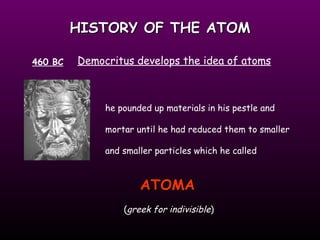
HISTORY OF THE ATOM 460 BC Democritus develops the idea of atoms he pounded up materials in his pestle and mortar until he had reduced them to smaller and smaller particles which he called ATOMA   ( greek for indivisible )
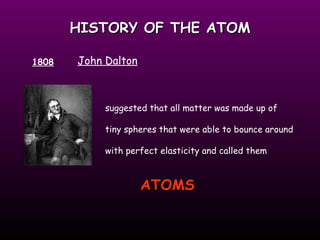
HISTORY OF THE ATOM 1808 John Dalton suggested that all matter was made up of tiny spheres that were able to bounce around with perfect elasticity and called them ATOMS
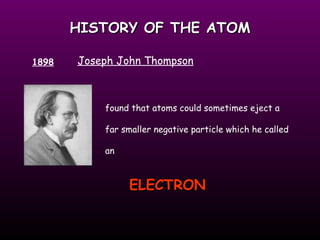
HISTORY OF THE ATOM 1898 Joseph John Thompson found that atoms could sometimes eject a far smaller negative particle which he called an ELECTRON
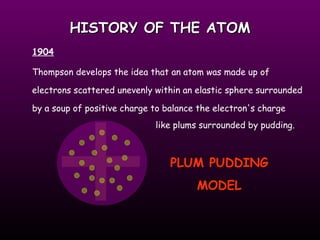
HISTORY OF THE ATOM Thompson develops the idea that an atom was made up of electrons scattered unevenly within an elastic sphere surrounded by a soup of positive charge to balance the electron's charge 1904 like plums surrounded by pudding. PLUM PUDDING MODEL
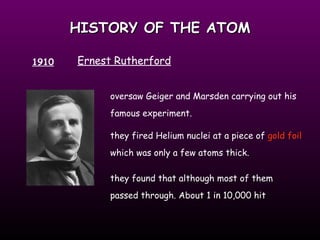
HISTORY OF THE ATOM 1910 Ernest Rutherford oversaw Geiger and Marsden carrying out his famous experiment.  they fired Helium nuclei at a piece of  gold foil  which was only a few atoms thick. they found that although most of them passed through. About 1 in 10,000 hit
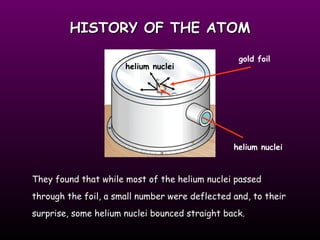
HISTORY OF THE ATOM gold foil helium nuclei They found that while most of the helium nuclei passed through the foil, a small number were deflected and, to their surprise, some helium nuclei bounced straight back. helium nuclei
HISTORY OF THE ATOM Rutherford’s new evidence allowed him to propose a more detailed model with a  central nucleus .  He suggested that the  positive charge  was all in a central nucleus.  With this holding the electrons in place by electrical attraction However, this was not the end of the story.
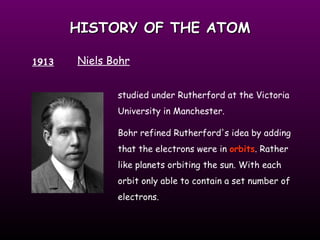
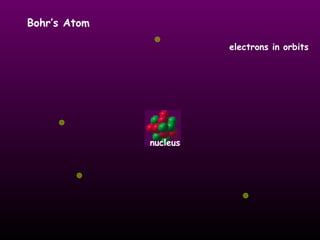
HISTORY OF THE ATOM 1913 Niels Bohr studied under Rutherford at the Victoria University in Manchester.  Bohr refined Rutherford's idea by adding that the electrons were in  orbits . Rather like planets orbiting the sun. With each orbit only able to contain a set number of electrons.
Bohr’s Atom electrons in orbits nucleus
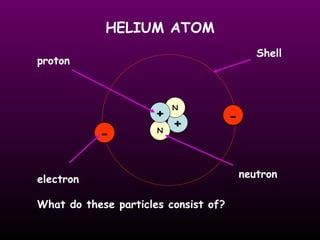
HELIUM ATOM + N N + - - proton electron neutron Shell What do these particles consist of?
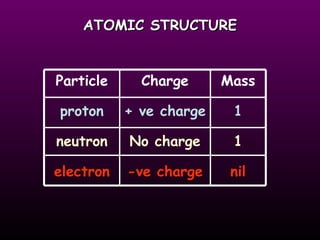
ATOMIC STRUCTURE Particle proton neutron electron Charge + ve charge -ve charge No charge 1 1 nil Mass
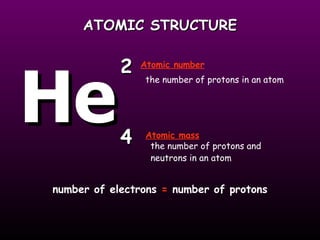
ATOMIC STRUCTURE the number of protons in an atom the number of protons and  neutrons in an atom He 2 4 Atomic mass Atomic number number of electrons  =  number of protons
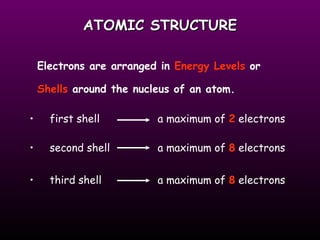
ATOMIC STRUCTURE Electrons are arranged in  Energy Levels  or  Shells  around the nucleus of an atom. first shell a maximum of  2  electrons second shell a maximum of  8  electrons third shell a maximum of  8  electrons
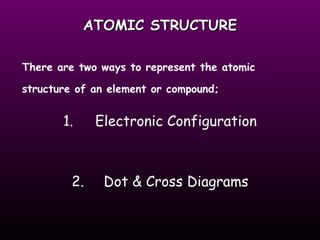
ATOMIC STRUCTURE There are two ways to represent the atomic structure of an element or compound; 1. Electronic Configuration 2. Dot & Cross Diagrams
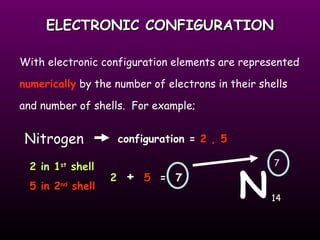
ELECTRONIC CONFIGURATION With electronic configuration elements are represented  numerically  by the number of electrons in their shells and number of shells.  For example; N Nitrogen 7 14 2 in 1 st  shell   5 in 2 nd  shell configuration =  2 , 5 2   +   5   =  7
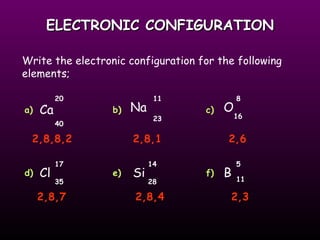
ELECTRONIC CONFIGURATION Write the electronic configuration for the following elements; Ca O Cl Si Na 20 40 11 23 8 17 16 35 14 28 B 11 5 a) b) c) d) e) f) 2,8,8,2 2,8,1 2,8,7 2,8,4 2,3 2,6
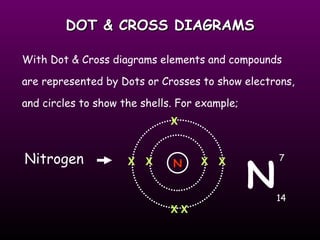
DOT & CROSS DIAGRAMS With Dot & Cross diagrams elements and compounds are represented by Dots or Crosses to show electrons, and circles to show the shells. For example; Nitrogen N X X X X X X X N 7 14
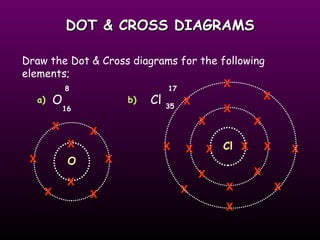
DOT & CROSS DIAGRAMS Draw the Dot & Cross diagrams for the following elements; O Cl 8 17 16 35 a) b) O X X X X X X X X Cl X X X X X X X X X X X X X X X X X X
SUMMARY The  Atomic Number  of an atom  =  number of  protons in the nucleus. The  Atomic Mass  of an atom  =  number of  Protons + Neutrons in the nucleus. The number of Protons  =  Number of Electrons. Electrons orbit the nucleus in  shells . Each shell can only carry a  set  number of electrons.

Atomic Structure

  • 1.
    ATOMIC STRUCTURE S.MORRIS2006 This Powerpoint is hosted on www.worldofteaching.com Please visit for 100’s more free powerpoints
  • 2.
    HISTORY OF THEATOM 460 BC Democritus develops the idea of atoms he pounded up materials in his pestle and mortar until he had reduced them to smaller and smaller particles which he called ATOMA ( greek for indivisible )
  • 3.
    HISTORY OF THEATOM 1808 John Dalton suggested that all matter was made up of tiny spheres that were able to bounce around with perfect elasticity and called them ATOMS
  • 4.
    HISTORY OF THEATOM 1898 Joseph John Thompson found that atoms could sometimes eject a far smaller negative particle which he called an ELECTRON
  • 5.
    HISTORY OF THEATOM Thompson develops the idea that an atom was made up of electrons scattered unevenly within an elastic sphere surrounded by a soup of positive charge to balance the electron's charge 1904 like plums surrounded by pudding. PLUM PUDDING MODEL
  • 6.
    HISTORY OF THEATOM 1910 Ernest Rutherford oversaw Geiger and Marsden carrying out his famous experiment. they fired Helium nuclei at a piece of gold foil which was only a few atoms thick. they found that although most of them passed through. About 1 in 10,000 hit
  • 7.
    HISTORY OF THEATOM gold foil helium nuclei They found that while most of the helium nuclei passed through the foil, a small number were deflected and, to their surprise, some helium nuclei bounced straight back. helium nuclei
  • 8.
    HISTORY OF THEATOM Rutherford’s new evidence allowed him to propose a more detailed model with a central nucleus . He suggested that the positive charge was all in a central nucleus. With this holding the electrons in place by electrical attraction However, this was not the end of the story.
  • 9.
    HISTORY OF THEATOM 1913 Niels Bohr studied under Rutherford at the Victoria University in Manchester. Bohr refined Rutherford's idea by adding that the electrons were in orbits . Rather like planets orbiting the sun. With each orbit only able to contain a set number of electrons.
  • 10.
    Bohr’s Atom electronsin orbits nucleus
  • 11.
    HELIUM ATOM +N N + - - proton electron neutron Shell What do these particles consist of?
  • 12.
    ATOMIC STRUCTURE Particleproton neutron electron Charge + ve charge -ve charge No charge 1 1 nil Mass
  • 13.
    ATOMIC STRUCTURE thenumber of protons in an atom the number of protons and neutrons in an atom He 2 4 Atomic mass Atomic number number of electrons = number of protons
  • 14.
    ATOMIC STRUCTURE Electronsare arranged in Energy Levels or Shells around the nucleus of an atom. first shell a maximum of 2 electrons second shell a maximum of 8 electrons third shell a maximum of 8 electrons
  • 15.
    ATOMIC STRUCTURE Thereare two ways to represent the atomic structure of an element or compound; 1. Electronic Configuration 2. Dot & Cross Diagrams
  • 16.
    ELECTRONIC CONFIGURATION Withelectronic configuration elements are represented numerically by the number of electrons in their shells and number of shells. For example; N Nitrogen 7 14 2 in 1 st shell 5 in 2 nd shell configuration = 2 , 5 2 + 5 = 7
  • 17.
    ELECTRONIC CONFIGURATION Writethe electronic configuration for the following elements; Ca O Cl Si Na 20 40 11 23 8 17 16 35 14 28 B 11 5 a) b) c) d) e) f) 2,8,8,2 2,8,1 2,8,7 2,8,4 2,3 2,6
  • 18.
    DOT & CROSSDIAGRAMS With Dot & Cross diagrams elements and compounds are represented by Dots or Crosses to show electrons, and circles to show the shells. For example; Nitrogen N X X X X X X X N 7 14
  • 19.
    DOT & CROSSDIAGRAMS Draw the Dot & Cross diagrams for the following elements; O Cl 8 17 16 35 a) b) O X X X X X X X X Cl X X X X X X X X X X X X X X X X X X
  • 20.
    SUMMARY The Atomic Number of an atom = number of protons in the nucleus. The Atomic Mass of an atom = number of Protons + Neutrons in the nucleus. The number of Protons = Number of Electrons. Electrons orbit the nucleus in shells . Each shell can only carry a set number of electrons.