01/04/2025
01/04/2025
Atomic
Structure
W Richards
Slides taken from
Education Using PowerPoint
A PowerPoint to cover most of the facts GCSE students need
to know about atomic structure and how (and why) our
understanding of it has changed
01/04/2025
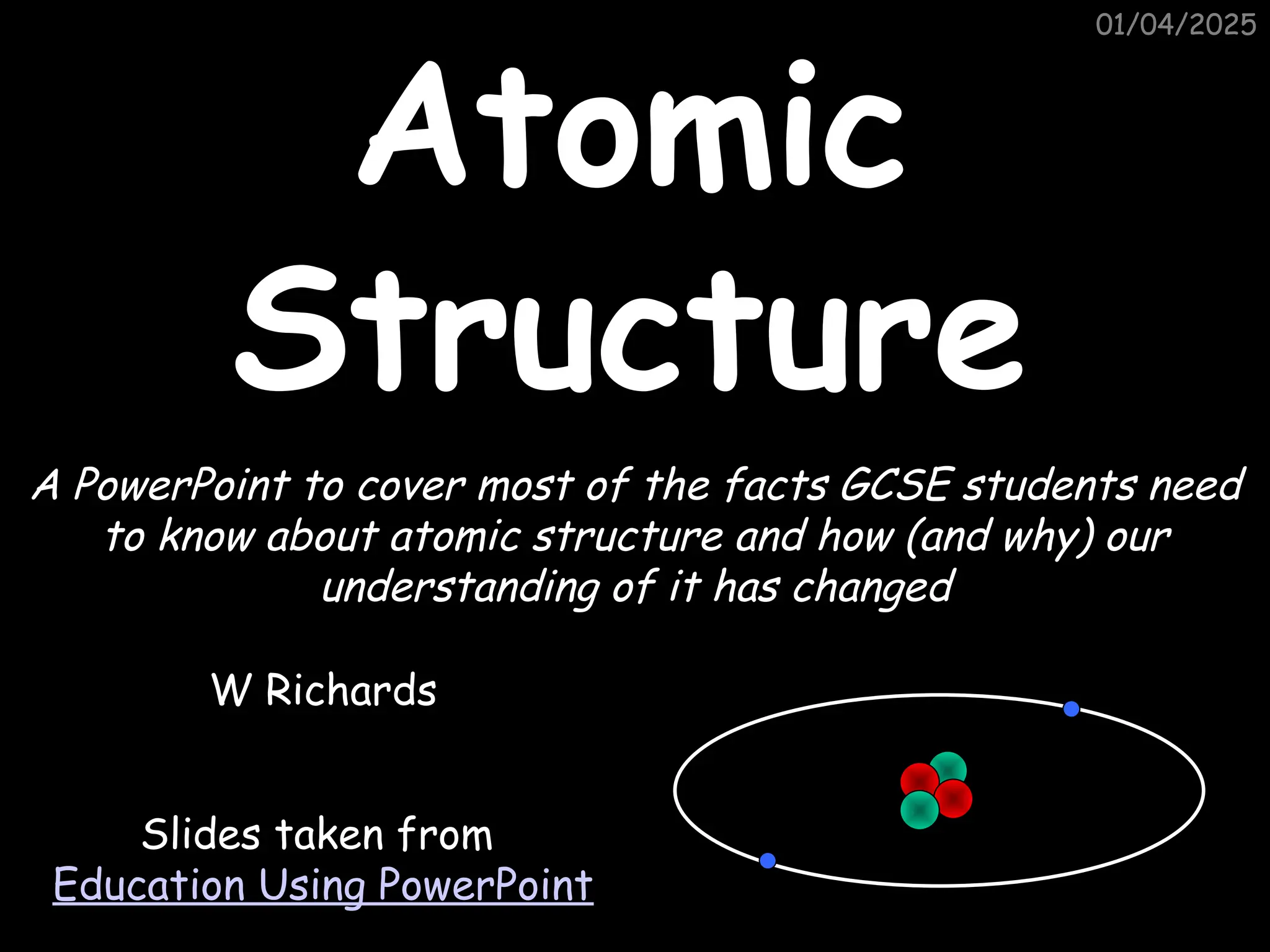
The basic structure of the atom
ELECTRON
PROTON
NEUTRON
Everything in the universe is basically made up of
atoms. An atom is the smallest part of an element
that can exist. This is what they “look” like:
Dalton
01/04/2025
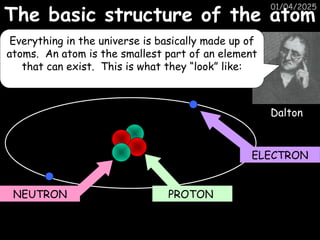
The Development of Atomic
Structure Theory
How have the following people developed our understanding of atomic
structure?
John Dalton
JJ Thomson
Ernest
Rutherford
Neils Bohr
James
Chadwick
01/04/2025
The Development of Atomic
Structure Theory
John
Dalton
JJ
Thomson
Ernest
Rutherford
Neils
Bohr
James
Chadwick
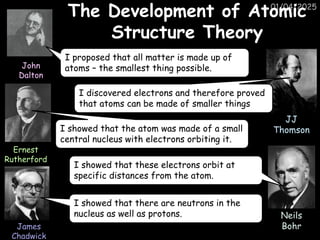
I proposed that all matter is made up of
atoms – the smallest thing possible.
I discovered electrons and therefore proved
that atoms can be made of smaller things
I showed that the atom was made of a small
central nucleus with electrons orbiting it.
I showed that these electrons orbit at
specific distances from the atom.
I showed that there are neutrons in the
nucleus as well as protons.
01/04/2025
01/04/2025
The structure of the atom
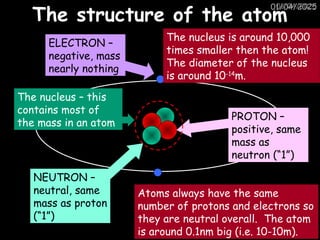
ELECTRON –
negative, mass
nearly nothing
PROTON –
positive, same
mass as
neutron (“1”)
NEUTRON –
neutral, same
mass as proton
(“1”)
Atoms always have the same
number of protons and electrons so
they are neutral overall. The atom
is around 0.1nm big (i.e. 10-10m).
The nucleus is around 10,000
times smaller then the atom!
The diameter of the nucleus
is around 10-14
m.
The nucleus – this
contains most of
the mass in an atom
01/04/2025
01/04/2025
How do we know?
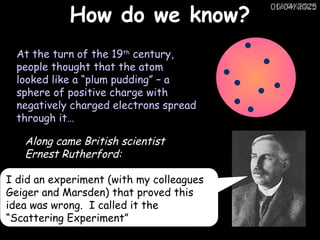
At the turn of the 19th
century,
people thought that the atom
looked like a “plum pudding” – a
sphere of positive charge with
negatively charged electrons spread
through it…
I did an experiment (with my colleagues
Geiger and Marsden) that proved this
idea was wrong. I called it the
“Scattering Experiment”
Along came British scientist
Ernest Rutherford:
01/04/2025
01/04/2025
The Rutherford Scattering Experiment
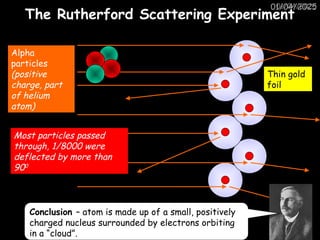
Alpha
particles
(positive
charge, part
of helium
atom)
Thin gold
foil
Most particles passed
through, 1/8000 were
deflected by more than
900
Conclusion – atom is made up of a small, positively
charged nucleus surrounded by electrons orbiting
in a “cloud”.
01/04/2025
01/04/2025
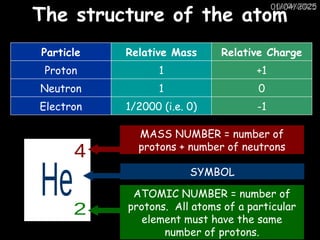
The structure of the atom
Particle Relative Mass Relative Charge
Proton 1 +1
Neutron 1 0
Electron 1/2000 (i.e. 0) -1
MASS NUMBER = number of
protons + number of neutrons
SYMBOL
ATOMIC NUMBER = number of
protons. All atoms of a particular
element must have the same
number of protons.
01/04/2025
01/04/2025
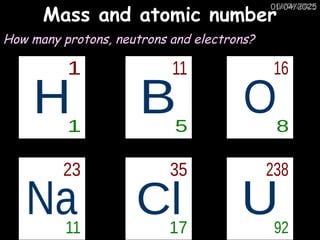
Mass and atomic number
How many protons, neutrons and electrons?
01/04/2025
01/04/2025
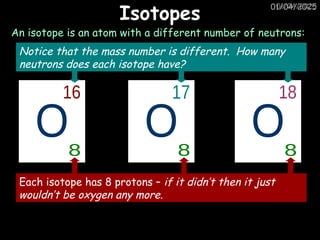
Isotopes
An isotope is an atom with a different number of neutrons:
Each isotope has 8 protons – if it didn’t then it just
wouldn’t be oxygen any more.
Notice that the mass number is different. How many
neutrons does each isotope have?
01/04/2025
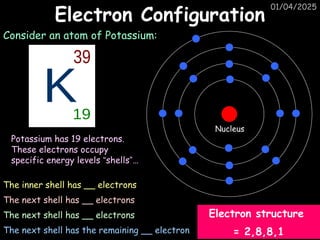
Electron Configuration
Consider an atom of Potassium:
Potassium has 19 electrons.
These electrons occupy
specific energy levels “shells”…
Nucleus
The inner shell has __ electrons
The next shell has __ electrons
The next shell has the remaining __ electron
Electron structure
= 2,8,8,1
01/04/2025
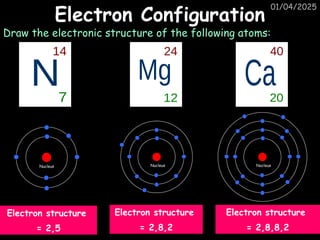
Electron Configuration
Draw the electronic structure of the following atoms:
Electron structure
= 2,8,8,2
Nucleus
Electron structure
= 2,8,2
Nucleus
Electron structure
= 2,5
Nucleus
This slideshow has been made freely available on the TES
Resources website.
More Science PowerPoints like this can be found at the
website www.educationusingpowerpoint.co.uk. This site
contains slideshows that are specifically matched to the:
• 2016 (9-1) AQA, EdExcel, OCR 21st
Century and OCR
Gateway courses
• EdExcel 2017 iGCSE (9-1) course
• EdExcel 2015 A Level Physics syllabus
• IB Physics (standard and higher level)
• KS3 material for the 2014 curriculum
Some slideshows are free, others require a small
subscription fee to be taken out (currently only £50 for a
year). Further details can be found at
Education Using PowerPoint.

Atomic-structure igcse chemistry chapter 2pptx

  • 1.
    01/04/2025 01/04/2025 Atomic Structure W Richards Slides takenfrom Education Using PowerPoint A PowerPoint to cover most of the facts GCSE students need to know about atomic structure and how (and why) our understanding of it has changed
  • 2.
    01/04/2025 The basic structureof the atom ELECTRON PROTON NEUTRON Everything in the universe is basically made up of atoms. An atom is the smallest part of an element that can exist. This is what they “look” like: Dalton
  • 3.
    01/04/2025 The Development ofAtomic Structure Theory How have the following people developed our understanding of atomic structure? John Dalton JJ Thomson Ernest Rutherford Neils Bohr James Chadwick
  • 4.
    01/04/2025 The Development ofAtomic Structure Theory John Dalton JJ Thomson Ernest Rutherford Neils Bohr James Chadwick I proposed that all matter is made up of atoms – the smallest thing possible. I discovered electrons and therefore proved that atoms can be made of smaller things I showed that the atom was made of a small central nucleus with electrons orbiting it. I showed that these electrons orbit at specific distances from the atom. I showed that there are neutrons in the nucleus as well as protons.
  • 5.
    01/04/2025 01/04/2025 The structure ofthe atom ELECTRON – negative, mass nearly nothing PROTON – positive, same mass as neutron (“1”) NEUTRON – neutral, same mass as proton (“1”) Atoms always have the same number of protons and electrons so they are neutral overall. The atom is around 0.1nm big (i.e. 10-10m). The nucleus is around 10,000 times smaller then the atom! The diameter of the nucleus is around 10-14 m. The nucleus – this contains most of the mass in an atom
  • 6.
    01/04/2025 01/04/2025 How do weknow? At the turn of the 19th century, people thought that the atom looked like a “plum pudding” – a sphere of positive charge with negatively charged electrons spread through it… I did an experiment (with my colleagues Geiger and Marsden) that proved this idea was wrong. I called it the “Scattering Experiment” Along came British scientist Ernest Rutherford:
  • 7.
    01/04/2025 01/04/2025 The Rutherford ScatteringExperiment Alpha particles (positive charge, part of helium atom) Thin gold foil Most particles passed through, 1/8000 were deflected by more than 900 Conclusion – atom is made up of a small, positively charged nucleus surrounded by electrons orbiting in a “cloud”.
  • 8.
    01/04/2025 01/04/2025 The structure ofthe atom Particle Relative Mass Relative Charge Proton 1 +1 Neutron 1 0 Electron 1/2000 (i.e. 0) -1 MASS NUMBER = number of protons + number of neutrons SYMBOL ATOMIC NUMBER = number of protons. All atoms of a particular element must have the same number of protons.
  • 9.
    01/04/2025 01/04/2025 Mass and atomicnumber How many protons, neutrons and electrons?
  • 10.
    01/04/2025 01/04/2025 Isotopes An isotope isan atom with a different number of neutrons: Each isotope has 8 protons – if it didn’t then it just wouldn’t be oxygen any more. Notice that the mass number is different. How many neutrons does each isotope have?
  • 11.
    01/04/2025 Electron Configuration Consider anatom of Potassium: Potassium has 19 electrons. These electrons occupy specific energy levels “shells”… Nucleus The inner shell has __ electrons The next shell has __ electrons The next shell has __ electrons The next shell has the remaining __ electron Electron structure = 2,8,8,1
  • 12.
    01/04/2025 Electron Configuration Draw theelectronic structure of the following atoms: Electron structure = 2,8,8,2 Nucleus Electron structure = 2,8,2 Nucleus Electron structure = 2,5 Nucleus
  • 13.
    This slideshow hasbeen made freely available on the TES Resources website. More Science PowerPoints like this can be found at the website www.educationusingpowerpoint.co.uk. This site contains slideshows that are specifically matched to the: • 2016 (9-1) AQA, EdExcel, OCR 21st Century and OCR Gateway courses • EdExcel 2017 iGCSE (9-1) course • EdExcel 2015 A Level Physics syllabus • IB Physics (standard and higher level) • KS3 material for the 2014 curriculum Some slideshows are free, others require a small subscription fee to be taken out (currently only £50 for a year). Further details can be found at Education Using PowerPoint.