
LOCAL
ANESTHESIA
CHAPTER 4
( ( T H E A R M A M E N TA R I U M ) )
D R . H AY D A R M U N I R S A L I H A L N A M E R
B D S , P H D ( B O A R D C E R T I F I E D )
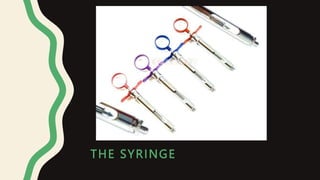
THE SYRINGE
TYPES OF SYRINGES
1 Non-disposable syringes:
a Breech-loading, metallic, cartridge-type, aspirating
b Breech-loading, plastic, cartridge-type, aspirating
c Breech-loading, metallic, cartridge-type, self-aspirating
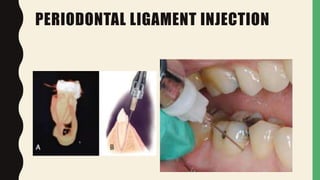
d Pressure syringe for periodontal ligament injection
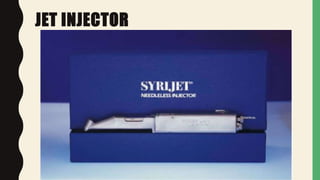
e Jet injector (“needle-less” syringe)
2 Disposable syringes
3 “Safety” syringes
4 Computer-controlled local anesthetic delivery systems
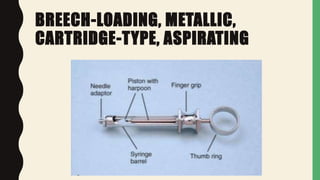
BREECH-LOADING, METALLIC,
CARTRIDGE-TYPE, ASPIRATING
• The term breech-loading implies that the cartridge is
inserted into the syringe from the side of the barrel of the
syringe.
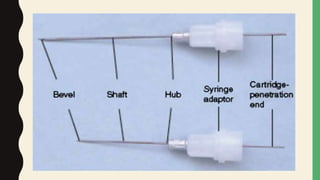
• The needle is attached to the barrel of the syringe at the
needle adaptor. The needle then passes into the barrel,
where it penetrates the diaphragm of the local anesthetic
cartridge.
• The aspirating syringe has a device such as a sharp, hook-
shaped end (often called the harpoon) attached to the
BREECH-LOADING, METALLIC,
CARTRIDGE-TYPE, ASPIRATING
INTRAVASCULAR ADMINISTRATION OF
LOCAL ANESTHETICS
• Potential hazards of intravascular administration of
local anesthetics are great and are discussed more
fully in. The incidence of positive aspiration may be as
high as 10% to 15%
• Unfortunately, it is abundantly clear that in actual
clinical practice, too little attention is paid to this
procedure
• To increase the ease of aspiration, self-aspirating
BREECH-LOADING, METALLIC,
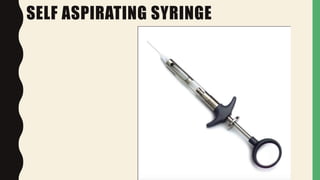
CARTRIDGE-TYPE, SELF-ASPIRATING:
• These syringes use the elasticity of the rubber diaphragm in
the anesthetic cartridge to obtain the necessary negative
pressure for aspiration.
• Pressure acting directly on the cartridge through the thumb
disc or indirectly through the plunger shaft distorts (stretches)
the rubber diaphragm, producing positive pressure within the
anesthetic cartridge.
• When that pressure is released, sufficient negative pressure
develops within the cartridge to permit aspiration. The thumb
ring produces twice as much negative pressure as the plunger
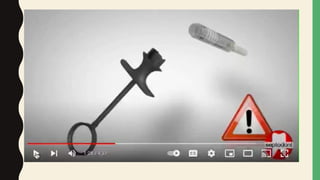
SELF ASPIRATING SYRINGE
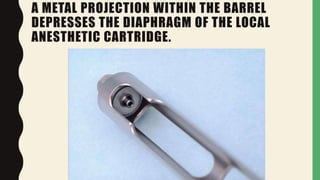
A METAL PROJECTION WITHIN THE BARREL
DEPRESSES THE DIAPHRAGM OF THE LOCAL
ANESTHETIC CARTRIDGE.
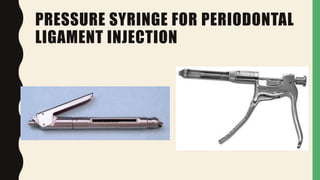
PRESSURE SYRINGE FOR PERIODONTAL
LIGAMENT INJECTION
PERIODONTAL LIGAMENT INJECTION
JET INJECTOR
• Jet injection is based on the principle that liquids forced through
very small openings, called jets, at very high pressure can
penetrate intact skin or mucous membrane
• The primary purpose of the jet injector is to obtain topical
anesthesia before insertion of a needle. In addition, it may be
used to obtain mucosal anesthesia of the palate.
• Regional nerve blocks or supraperiosteal injections are still
necessary for complete anesthesia. The jet injector is not an
adequate substitute for the more traditional needle and syringe
in obtaining pulpal or regional block anesthesia
JET INJECTOR
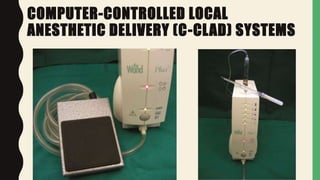
COMPUTER-CONTROLLED LOCAL
ANESTHETIC DELIVERY (C-CLAD) SYSTEMS
• This system enabled a dentist or hygienist to accurately
manipulate needle placement with fingertip accuracy
and deliver the local anesthetic with a foot-activated
control
• Available flow rates of local anesthetic delivery are
computer controlled and thus remain consistent from
one injection to the next
• It is likely that greater ergonomic control coupled with
fixed flow rates is responsible for the improved
COMPUTER-CONTROLLED LOCAL
ANESTHETIC DELIVERY (C-CLAD) SYSTEMS
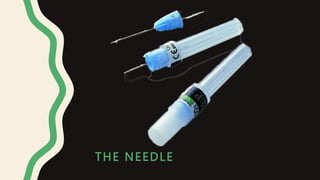
THE NEEDLE
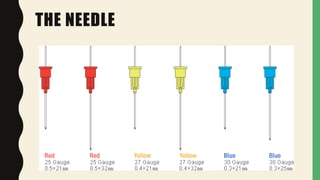
GAUGE
• Gauge refers to the diameter of the lumen of the
needle: the smaller the number, the greater the
diameter of the lumen. A 30-gauge needle has a
smaller internal diameter than a 25-gauge needle
• The most commonly used (e.g., most often purchased)
needles in dentistry are the 30-gauge short and the
27-gauge long
LENGTH
• Dental needles are available in three lengths: long,
short and ultrashort. Ultrashort needles are available
only as 30-gauge needles.
• The length of a short needle is between 20 and 25
mm (measured hub to tip) with a standard of about 20
mm, and is 30 to 35 mm for the long dental needle,
with a standard of about 32 mm
• A long needle is preferred for all injection techniques
for which penetration of significant thicknesses of soft
tissue
THE NEEDLE
THE CARTIL AGE
COMPONENT
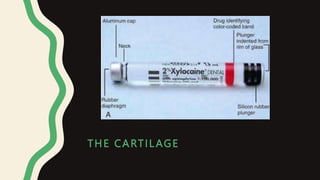
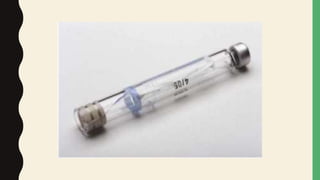
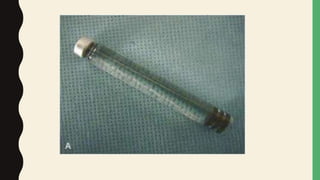
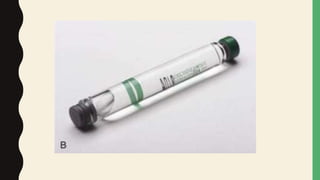
The prefilled 1.8-mL dental cartridge consists of four
parts :
1 Cylindrical glass tube
2 Stopper (plunger, bung)
3 Aluminum cap
4 Diaphragm
CLINICAL PROBLEMS
ASSOCIATED WITH
THE EQUIPMENT
USED IN LOCAL
ANESTHESIA
A- CLINICAL PROBLEMS RELATED TO
THE DENTAL SYRINGES
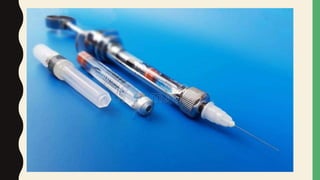
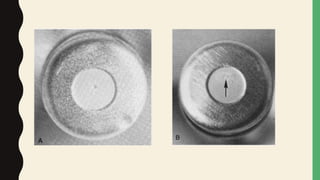
1- Leakage of the solution during injection:
The leakage of the anesthetic solution into the patient's
mouth during injection will occur
1. if the cartridge and the needle are improperly mounted
into the syringe.
2. When the needle is properly placed on the syringe after
the cartridge is inserted
A- CLINICAL PROBLEMS RELATED TO
THE DENTAL SYRINGES
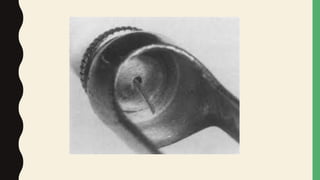
2- Broken cartridge
The breaking of the cartridge may result from a bent
needle at its proximal end, which may not perforate the
diaphragm of the cartridge, positive pressure on the
thumb ring increases intra-cartridge pressure leading
to breakage. A broken cartridge may also result from a
bent hook of an aspirating syringe
B- CLINICAL PROBLEMS RELATED TO THE
DENTAL NEEDLE
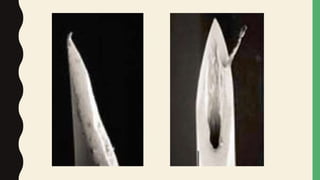
1 - Pain on withdrawal:
Pain on withdrawal of the needle from the tissue can be
produced by fishhook barbs on the tip, these barbs may be
produced during the manufacturing process but it is more
likely that they occur when the needle tip forcefully contact
a bone, therefore, needle should not be forced against
resistance.
B- CLINICAL PROBLEMS RELATED TO THE
DENTAL NEEDLE
2 - Pain on insertion:
This may be avoided by using sharp, new disposable
needles and the application of topical anesthetic at the
penetrating site.
B- CLINICAL PROBLEMS RELATED TO THE
DENTAL NEEDLE
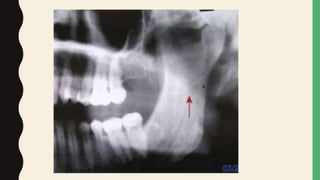
3 - Breakage of the needle:
In general, bending of the needle during insertion
weaken the needle and making them more likely to
break on subsequent contact with the hard tissue such
as bone.
B- CLINICAL PROBLEMS RELATED TO THE
DENTAL NEEDLE
4 - Injury to the patient or the administrator:
Major cause of injury is carelessness by the operator,
although sudden unexpected movement by the patient
is also a frequent cause, therefore the needle should be
capped until its use and should be recapped
immediately after withdrawal from the patient's mouth.
C- CLINICAL PROBLEMS RELATED TO
DENTAL CARTRIDGE
1 – Bubbles in the cartridge
A small bubble approximately 2 mm in diameter will
frequently be found in the dental cartridge. It is composed
of nitrogen gas which was bubbled into the local
anesthetic solution during its manufacture to prevent
oxygen from being trapped in the cartridge and potentially
destroying the vasopressor.
C- CLINICAL PROBLEMS RELATED TO
DENTAL CARTRIDGE
2 – Extruded stopper
The stopper can be extruded when a cartridge is frozen
and the liquid inside expands; in this case, the solution
can no longer be considered sterile and should not be
used for injection.
Also, an extruded stopper may be due to prolonged
storage in a chemical disinfecting solution and
diffusion of the solution through the rubber diaphragm
C- CLINICAL PROBLEMS RELATED TO
DENTAL CARTRIDGE
3 – Burning on injection
• A burning sensation on injection of anesthetic
solution may be the result of one of the following:
1 Normal response to the pH of the drug
2 Cartridge containing sterilizing solution
3 Overheated cartridge
• Because of this pH difference, plain local
anesthetics have a somewhat more rapid onset of
clinical action and are more comfortable (less
“burning” on injection)
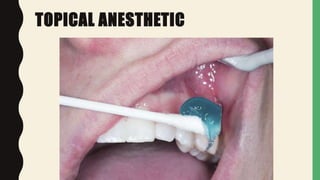
TOPICAL ANESTHETIC
Their use before initial needle penetration of the
mucous membrane is strongly recommended. With
proper application, initial penetration of mucous
membrane anywhere in the oral cavity can usually be
made without the patient's awareness. For
effectiveness, it is recommended that a minimal
quantity of topical anesthetic be applied to the end of
the applicator stick and placed directly at the site of
penetration for approximately 1 minute
TOPICAL ANESTHETIC
lec 16.pptx

lec 16.pptx

  • 1.
    LOCAL ANESTHESIA CHAPTER 4 ( (T H E A R M A M E N TA R I U M ) ) D R . H AY D A R M U N I R S A L I H A L N A M E R B D S , P H D ( B O A R D C E R T I F I E D )
  • 2.
  • 3.
    TYPES OF SYRINGES 1Non-disposable syringes: a Breech-loading, metallic, cartridge-type, aspirating b Breech-loading, plastic, cartridge-type, aspirating c Breech-loading, metallic, cartridge-type, self-aspirating d Pressure syringe for periodontal ligament injection e Jet injector (“needle-less” syringe) 2 Disposable syringes 3 “Safety” syringes 4 Computer-controlled local anesthetic delivery systems
  • 4.
    BREECH-LOADING, METALLIC, CARTRIDGE-TYPE, ASPIRATING •The term breech-loading implies that the cartridge is inserted into the syringe from the side of the barrel of the syringe. • The needle is attached to the barrel of the syringe at the needle adaptor. The needle then passes into the barrel, where it penetrates the diaphragm of the local anesthetic cartridge. • The aspirating syringe has a device such as a sharp, hook- shaped end (often called the harpoon) attached to the
  • 5.
  • 7.
    INTRAVASCULAR ADMINISTRATION OF LOCALANESTHETICS • Potential hazards of intravascular administration of local anesthetics are great and are discussed more fully in. The incidence of positive aspiration may be as high as 10% to 15% • Unfortunately, it is abundantly clear that in actual clinical practice, too little attention is paid to this procedure • To increase the ease of aspiration, self-aspirating
  • 8.
    BREECH-LOADING, METALLIC, CARTRIDGE-TYPE, SELF-ASPIRATING: •These syringes use the elasticity of the rubber diaphragm in the anesthetic cartridge to obtain the necessary negative pressure for aspiration. • Pressure acting directly on the cartridge through the thumb disc or indirectly through the plunger shaft distorts (stretches) the rubber diaphragm, producing positive pressure within the anesthetic cartridge. • When that pressure is released, sufficient negative pressure develops within the cartridge to permit aspiration. The thumb ring produces twice as much negative pressure as the plunger
  • 9.
  • 10.
    A METAL PROJECTIONWITHIN THE BARREL DEPRESSES THE DIAPHRAGM OF THE LOCAL ANESTHETIC CARTRIDGE.
  • 12.
    PRESSURE SYRINGE FORPERIODONTAL LIGAMENT INJECTION
  • 13.
  • 14.
    JET INJECTOR • Jetinjection is based on the principle that liquids forced through very small openings, called jets, at very high pressure can penetrate intact skin or mucous membrane • The primary purpose of the jet injector is to obtain topical anesthesia before insertion of a needle. In addition, it may be used to obtain mucosal anesthesia of the palate. • Regional nerve blocks or supraperiosteal injections are still necessary for complete anesthesia. The jet injector is not an adequate substitute for the more traditional needle and syringe in obtaining pulpal or regional block anesthesia
  • 15.
  • 16.
    COMPUTER-CONTROLLED LOCAL ANESTHETIC DELIVERY(C-CLAD) SYSTEMS • This system enabled a dentist or hygienist to accurately manipulate needle placement with fingertip accuracy and deliver the local anesthetic with a foot-activated control • Available flow rates of local anesthetic delivery are computer controlled and thus remain consistent from one injection to the next • It is likely that greater ergonomic control coupled with fixed flow rates is responsible for the improved
  • 17.
  • 18.
  • 19.
    GAUGE • Gauge refersto the diameter of the lumen of the needle: the smaller the number, the greater the diameter of the lumen. A 30-gauge needle has a smaller internal diameter than a 25-gauge needle • The most commonly used (e.g., most often purchased) needles in dentistry are the 30-gauge short and the 27-gauge long
  • 20.
    LENGTH • Dental needlesare available in three lengths: long, short and ultrashort. Ultrashort needles are available only as 30-gauge needles. • The length of a short needle is between 20 and 25 mm (measured hub to tip) with a standard of about 20 mm, and is 30 to 35 mm for the long dental needle, with a standard of about 32 mm • A long needle is preferred for all injection techniques for which penetration of significant thicknesses of soft tissue
  • 21.
  • 23.
  • 24.
    COMPONENT The prefilled 1.8-mLdental cartridge consists of four parts : 1 Cylindrical glass tube 2 Stopper (plunger, bung) 3 Aluminum cap 4 Diaphragm
  • 25.
    CLINICAL PROBLEMS ASSOCIATED WITH THEEQUIPMENT USED IN LOCAL ANESTHESIA
  • 26.
    A- CLINICAL PROBLEMSRELATED TO THE DENTAL SYRINGES 1- Leakage of the solution during injection: The leakage of the anesthetic solution into the patient's mouth during injection will occur 1. if the cartridge and the needle are improperly mounted into the syringe. 2. When the needle is properly placed on the syringe after the cartridge is inserted
  • 29.
    A- CLINICAL PROBLEMSRELATED TO THE DENTAL SYRINGES 2- Broken cartridge The breaking of the cartridge may result from a bent needle at its proximal end, which may not perforate the diaphragm of the cartridge, positive pressure on the thumb ring increases intra-cartridge pressure leading to breakage. A broken cartridge may also result from a bent hook of an aspirating syringe
  • 32.
    B- CLINICAL PROBLEMSRELATED TO THE DENTAL NEEDLE 1 - Pain on withdrawal: Pain on withdrawal of the needle from the tissue can be produced by fishhook barbs on the tip, these barbs may be produced during the manufacturing process but it is more likely that they occur when the needle tip forcefully contact a bone, therefore, needle should not be forced against resistance.
  • 34.
    B- CLINICAL PROBLEMSRELATED TO THE DENTAL NEEDLE 2 - Pain on insertion: This may be avoided by using sharp, new disposable needles and the application of topical anesthetic at the penetrating site.
  • 35.
    B- CLINICAL PROBLEMSRELATED TO THE DENTAL NEEDLE 3 - Breakage of the needle: In general, bending of the needle during insertion weaken the needle and making them more likely to break on subsequent contact with the hard tissue such as bone.
  • 37.
    B- CLINICAL PROBLEMSRELATED TO THE DENTAL NEEDLE 4 - Injury to the patient or the administrator: Major cause of injury is carelessness by the operator, although sudden unexpected movement by the patient is also a frequent cause, therefore the needle should be capped until its use and should be recapped immediately after withdrawal from the patient's mouth.
  • 38.
    C- CLINICAL PROBLEMSRELATED TO DENTAL CARTRIDGE 1 – Bubbles in the cartridge A small bubble approximately 2 mm in diameter will frequently be found in the dental cartridge. It is composed of nitrogen gas which was bubbled into the local anesthetic solution during its manufacture to prevent oxygen from being trapped in the cartridge and potentially destroying the vasopressor.
  • 40.
    C- CLINICAL PROBLEMSRELATED TO DENTAL CARTRIDGE 2 – Extruded stopper The stopper can be extruded when a cartridge is frozen and the liquid inside expands; in this case, the solution can no longer be considered sterile and should not be used for injection. Also, an extruded stopper may be due to prolonged storage in a chemical disinfecting solution and diffusion of the solution through the rubber diaphragm
  • 42.
    C- CLINICAL PROBLEMSRELATED TO DENTAL CARTRIDGE 3 – Burning on injection • A burning sensation on injection of anesthetic solution may be the result of one of the following: 1 Normal response to the pH of the drug 2 Cartridge containing sterilizing solution 3 Overheated cartridge • Because of this pH difference, plain local anesthetics have a somewhat more rapid onset of clinical action and are more comfortable (less “burning” on injection)
  • 43.
    TOPICAL ANESTHETIC Their usebefore initial needle penetration of the mucous membrane is strongly recommended. With proper application, initial penetration of mucous membrane anywhere in the oral cavity can usually be made without the patient's awareness. For effectiveness, it is recommended that a minimal quantity of topical anesthetic be applied to the end of the applicator stick and placed directly at the site of penetration for approximately 1 minute
  • 44.