Subject
Applied surgery
Topic
ATLS AND GCS
By
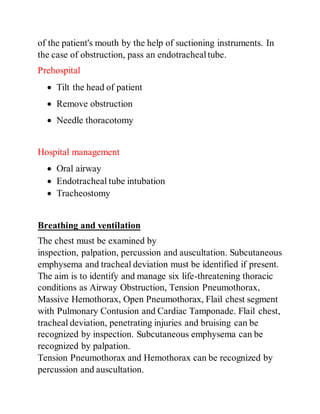
Advanced trauma life support
Advanced trauma life support is a training
program for medical providers in the
management of acute trauma cases
Primary survey
Madeeha Farooq
The first and key part of the assessment of patients presenting
with trauma is called the primary survey. During this time, life-
threatening injuries are identified and
simultaneously resuscitation is begun. A simple
mnemonic, ABCDE, is used as a mnemonic for the order in
which problems should be addressed.
Air way
The first stage of the primary survey is to assess the airway. If
the patient is able to talk, the airway is likely to be clear. If the
patient is unconscious, he/she may not be able to maintain
his/her own airway. The airway can be opened using a chin lift
or jaw thrust. Airway adjuncts may be required. If the airway is
blocked (e.g., by blood or vomit), the fluid must be cleaned out
of the patient's mouth by the help of suctioning instruments. In
the case of obstruction, pass an endotrachealtube.
Prehospital
 Tilt the head of patient
 Remove obstruction
 Needle thoracotomy
Hospital management
 Oral airway
 Endotracheal tube intubation
 Tracheostomy
Breathing and ventilation
The chest must be examined by
inspection, palpation, percussion and auscultation. Subcutaneous
emphysema and tracheal deviation must be identified if present.
The aim is to identify and manage six life-threatening thoracic
conditions as Airway Obstruction, Tension Pneumothorax,
Massive Hemothorax, Open Pneumothorax, Flail chest segment
with Pulmonary Contusion and Cardiac Tamponade. Flail chest,
tracheal deviation, penetrating injuries and bruising can be
recognized by inspection. Subcutaneous emphysema can be
recognized by palpation.
Tension Pneumothorax and Hemothorax can be recognized by
percussion and auscultation.
pulmonary occlusion
Prehospital
 Remove obstruction
 Mouth to mouth breathing
Hospital management
 Oxygen therapy
 May be invasive or non-invasive
Circulation with bleeding control
 Hemorrhage is the predominant cause of preventable post-
injury deaths.
 Hypovolemic shock is caused by significant blood loss.
 Two large-bore intravenous lines are established
and crystalloid solution may be given.
 If the person does not respond to this, type-specific blood,
or O-negative if this is not available, should be given.
External bleeding is controlled by direct pressure.
 Occult blood loss may be into the chest, abdomen, pelvis or
from the long bones
Prehospital
 Check the pulse of patient
 If pulse is absent provide CPR 30:2
Hospital management
 CPR
 Pass iv line
 Give fluids (blood is ideal fluid)
 For life saving R/L can be given send baseline
investigations
 CBC, LFT, RFT, serume electrolytes and other blood
investigations
 Epinephrine, dopamine, dobutamine can also be given for
increasing contractility of heart.
Deforming life threality
Primary survey
 Aim to manage life threatening diseases before stabilization
 GCS calculations
 Ultrasound, x ray, CT scan can be performed.
Secondary survey
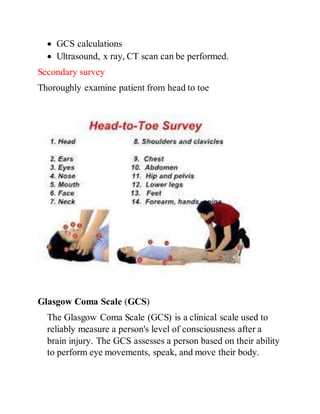
Thoroughly examine patient from head to toe
Glasgow Coma Scale (GCS)
The Glasgow Coma Scale (GCS) is a clinical scale used to
reliably measure a person's level of consciousness after a
brain injury. The GCS assesses a person based on their ability
to perform eye movements, speak, and move their body.
References
 The Royal College of Surgeons of England. Advanced
Trauma Life Support® (ATLS®)
 Bouillon B, Kanz KG, Lackner CK, Mutschler W, Sturm
J (October 2004). "[The importance of Advanced
Trauma Life Support (ATLS) in the emergency room]".
Der Unfallchirurg (in German). 107 (10): 844–50.
doi:10.1007/s00113-004-0847-2. PMID 15452655.
S2CID 36286887.
 Rotondo, Michael. "About ATLS". The American
College of Surgeons. The American College of
Surgeons. Retrieved 1 September 2020.

Gcs

  • 1.
    Subject Applied surgery Topic ATLS ANDGCS By Advanced trauma life support Advanced trauma life support is a training program for medical providers in the management of acute trauma cases Primary survey Madeeha Farooq
  • 2.
    The first andkey part of the assessment of patients presenting with trauma is called the primary survey. During this time, life- threatening injuries are identified and simultaneously resuscitation is begun. A simple mnemonic, ABCDE, is used as a mnemonic for the order in which problems should be addressed. Air way The first stage of the primary survey is to assess the airway. If the patient is able to talk, the airway is likely to be clear. If the patient is unconscious, he/she may not be able to maintain his/her own airway. The airway can be opened using a chin lift or jaw thrust. Airway adjuncts may be required. If the airway is blocked (e.g., by blood or vomit), the fluid must be cleaned out
  • 3.
    of the patient'smouth by the help of suctioning instruments. In the case of obstruction, pass an endotrachealtube. Prehospital  Tilt the head of patient  Remove obstruction  Needle thoracotomy Hospital management  Oral airway  Endotracheal tube intubation  Tracheostomy Breathing and ventilation The chest must be examined by inspection, palpation, percussion and auscultation. Subcutaneous emphysema and tracheal deviation must be identified if present. The aim is to identify and manage six life-threatening thoracic conditions as Airway Obstruction, Tension Pneumothorax, Massive Hemothorax, Open Pneumothorax, Flail chest segment with Pulmonary Contusion and Cardiac Tamponade. Flail chest, tracheal deviation, penetrating injuries and bruising can be recognized by inspection. Subcutaneous emphysema can be recognized by palpation. Tension Pneumothorax and Hemothorax can be recognized by percussion and auscultation.
  • 4.
    pulmonary occlusion Prehospital  Removeobstruction  Mouth to mouth breathing Hospital management  Oxygen therapy  May be invasive or non-invasive Circulation with bleeding control  Hemorrhage is the predominant cause of preventable post- injury deaths.  Hypovolemic shock is caused by significant blood loss.  Two large-bore intravenous lines are established and crystalloid solution may be given.  If the person does not respond to this, type-specific blood, or O-negative if this is not available, should be given. External bleeding is controlled by direct pressure.  Occult blood loss may be into the chest, abdomen, pelvis or from the long bones Prehospital
  • 5.
     Check thepulse of patient  If pulse is absent provide CPR 30:2 Hospital management  CPR  Pass iv line  Give fluids (blood is ideal fluid)  For life saving R/L can be given send baseline investigations  CBC, LFT, RFT, serume electrolytes and other blood investigations  Epinephrine, dopamine, dobutamine can also be given for increasing contractility of heart. Deforming life threality Primary survey  Aim to manage life threatening diseases before stabilization
  • 6.
     GCS calculations Ultrasound, x ray, CT scan can be performed. Secondary survey Thoroughly examine patient from head to toe Glasgow Coma Scale (GCS) The Glasgow Coma Scale (GCS) is a clinical scale used to reliably measure a person's level of consciousness after a brain injury. The GCS assesses a person based on their ability to perform eye movements, speak, and move their body.
  • 7.
    References  The RoyalCollege of Surgeons of England. Advanced Trauma Life Support® (ATLS®)  Bouillon B, Kanz KG, Lackner CK, Mutschler W, Sturm J (October 2004). "[The importance of Advanced Trauma Life Support (ATLS) in the emergency room]". Der Unfallchirurg (in German). 107 (10): 844–50. doi:10.1007/s00113-004-0847-2. PMID 15452655. S2CID 36286887.
  • 8.
     Rotondo, Michael."About ATLS". The American College of Surgeons. The American College of Surgeons. Retrieved 1 September 2020.