DIGITAL V/S BRANCH BANKING – A COMPARATIVE STUDY AND 
RECOMMENDATIONS FOR DIGITIZATION 
Xavier Institute of Management Bhubaneswar
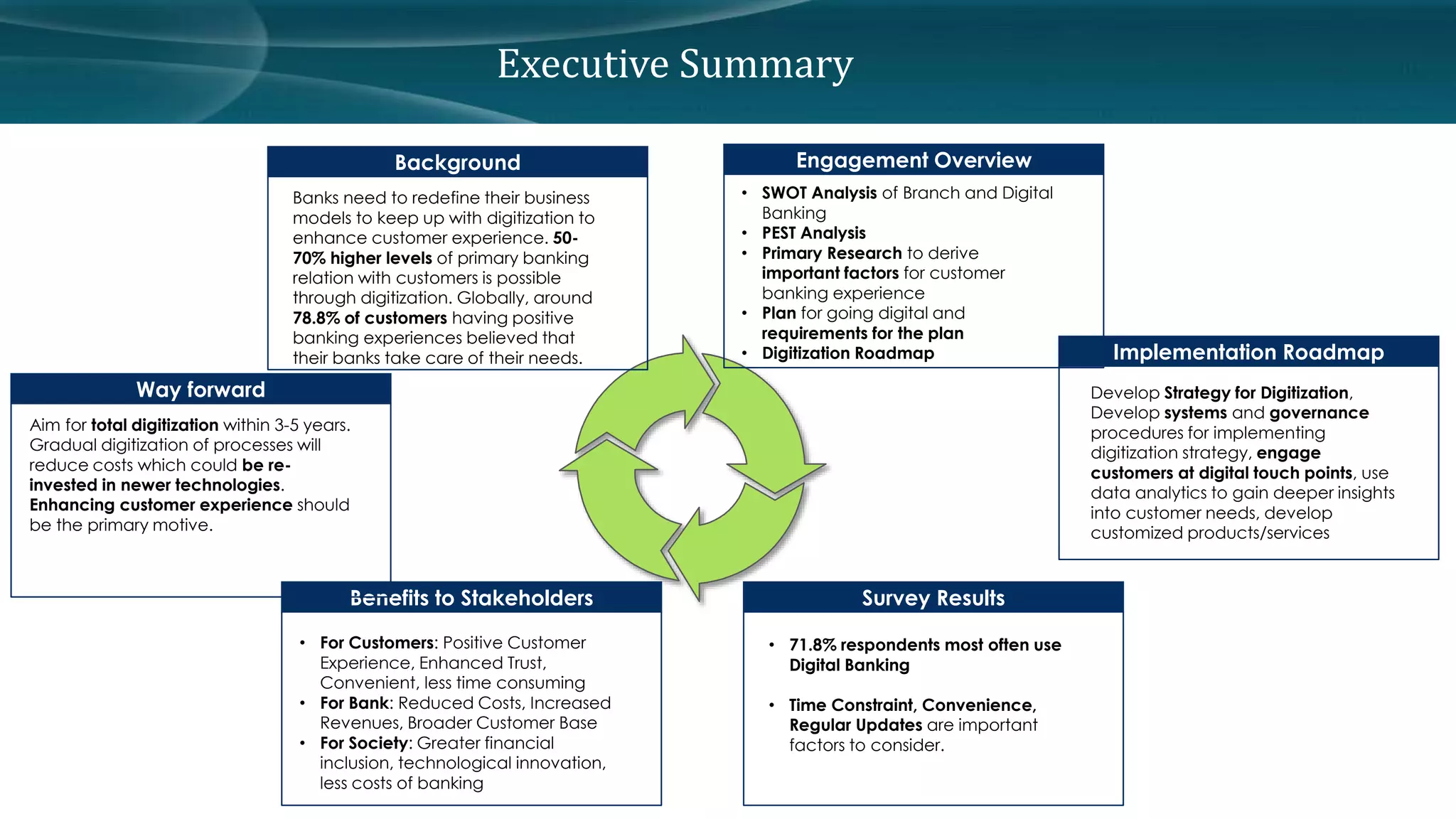
Executive Summary 
Background 
Benefits to Stakeholders 
Engagement Overview 
• SWOT Analysis of Branch and Digital 
• PEST Analysis 
• Primary Research to derive 
important factors for customer 
banking experience 
• Plan for going digital and 
requirements for the plan 
• Digitization Roadmap 
Survey Results 
Implementation Roadmap 
Way forward 
Banks need to redefine their business 
models to keep up with digitization to 
enhance customer experience. 50- 
70% higher levels of primary banking 
relation with customers is possible 
through digitization. Globally, around 
78.8% of customers having positive 
banking experiences believed that 
their banks take care of their needs. 
• For Customers: Positive Customer 
Experience, Enhanced Trust, 
Convenient, less time consuming 
• For Bank: Reduced Costs, Increased 
Revenues, Broader Customer Base 
• For Society: Greater financial 
inclusion, technological innovation, 
less costs of banking 
Develop Strategy for Digitization, 
Develop systems and governance 
procedures for implementing 
digitization strategy, engage 
customers at digital touch points, use 
data analytics to gain deeper insights 
into customer needs, develop 
customized products/services 
Aim for total digitization within 3-5 years. 
Gradual digitization of processes will 
reduce costs which could be re-invested 
in newer technologies. 
Enhancing customer experience should 
be the primary motive. 
Banking 
• 71.8% respondents most often use 
Digital Banking 
• Time Constraint, Convenience, 
Regular Updates are important 
factors to consider.
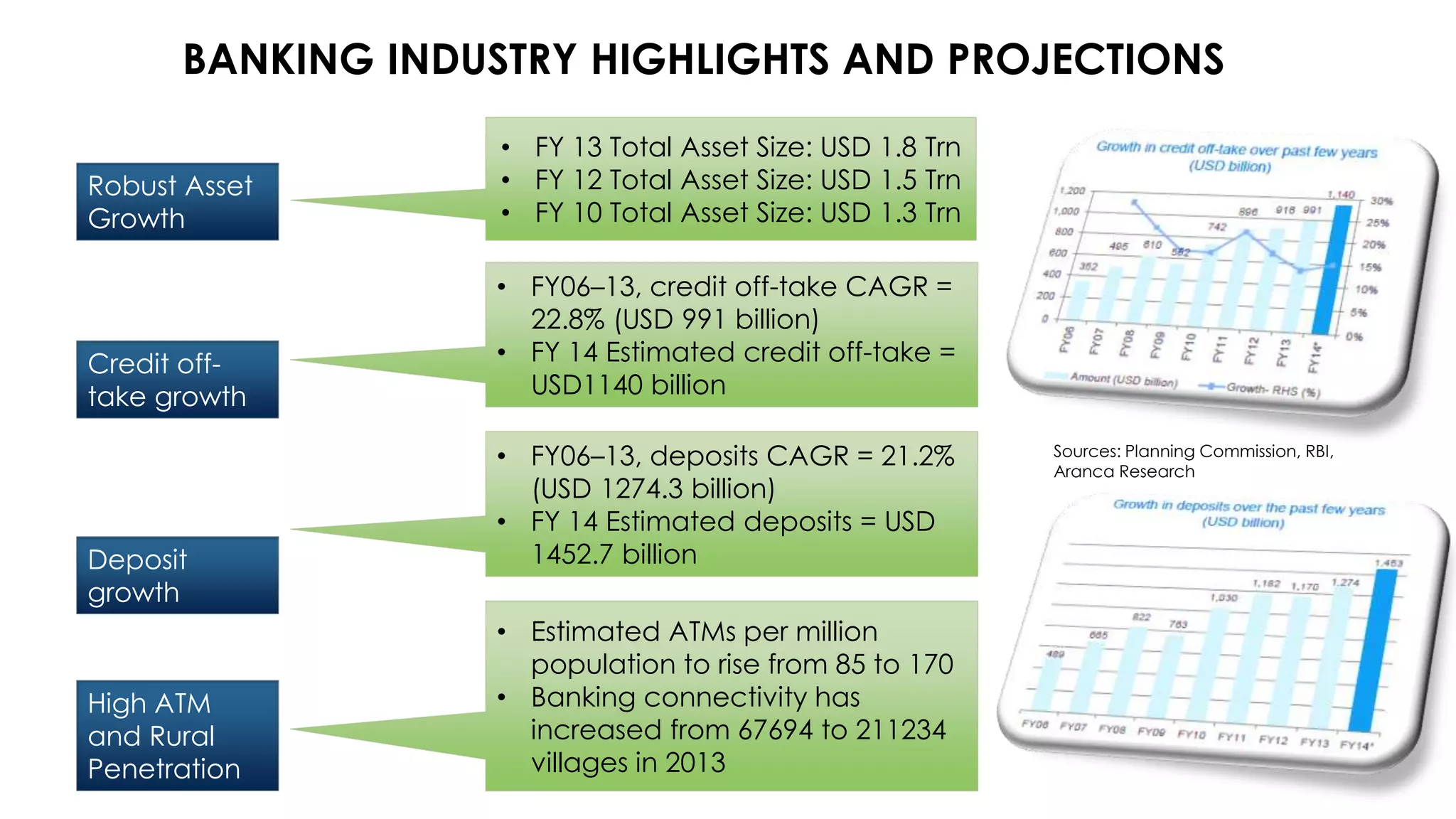
BANKING INDUSTRY HIGHLIGHTS AND PROJECTIONS 
Robust Asset 
Growth 
• FY 13 Total Asset Size: USD 1.8 Trn 
• FY 12 Total Asset Size: USD 1.5 Trn 
• FY 10 Total Asset Size: USD 1.3 Trn 
Credit off-take 
growth 
• FY06–13, credit off-take CAGR = 
22.8% (USD 991 billion) 
• FY 14 Estimated credit off-take = 
USD1140 billion 
Deposit 
growth 
• FY06–13, deposits CAGR = 21.2% 
(USD 1274.3 billion) 
• FY 14 Estimated deposits = USD 
1452.7 billion 
High ATM 
and Rural 
Penetration 
• Estimated ATMs per million 
population to rise from 85 to 170 
• Banking connectivity has 
increased from 67694 to 211234 
villages in 2013 
Sources: Planning Commission, RBI, 
Aranca Research
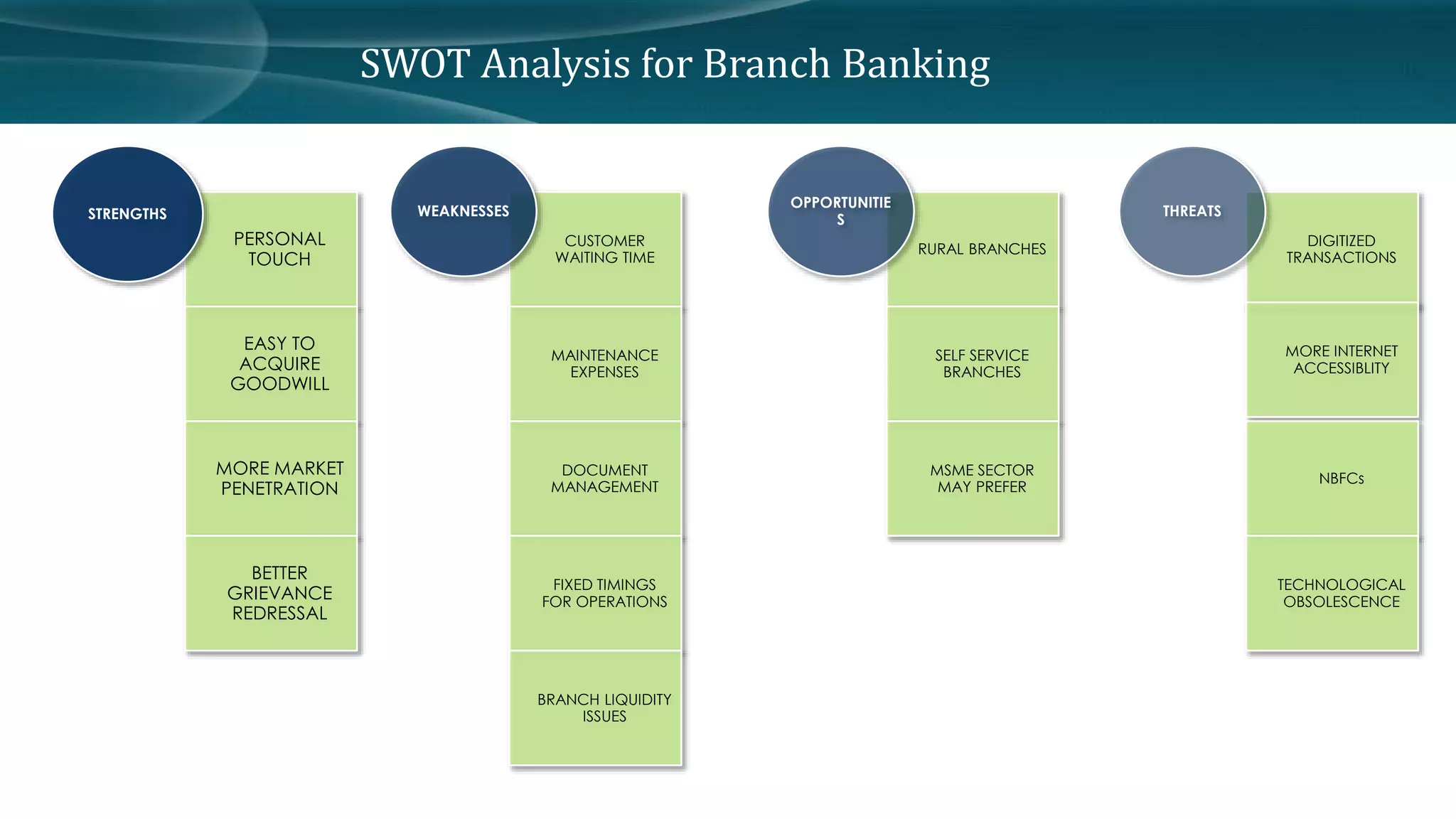
SWOT Analysis for Branch Banking 
PERSONAL 
TOUCH 
EASY TO 
ACQUIRE 
GOODWILL 
MORE MARKET 
PENETRATION 
BETTER 
GRIEVANCE 
REDRESSAL 
STRENGTHS 
CUSTOMER 
WAITING TIME 
MAINTENANCE 
EXPENSES 
DOCUMENT 
MANAGEMENT 
FIXED TIMINGS 
FOR OPERATIONS 
BRANCH LIQUIDITY 
ISSUES 
WEAKNESSES 
RURAL BRANCHES 
SELF SERVICE 
BRANCHES 
MSME SECTOR 
MAY PREFER 
OPPORTUNITIE 
S 
DIGITIZED 
TRANSACTIONS 
MORE INTERNET 
ACCESSIBLITY 
NBFCs 
TECHNOLOGICAL 
OBSOLESCENCE 
THREATS
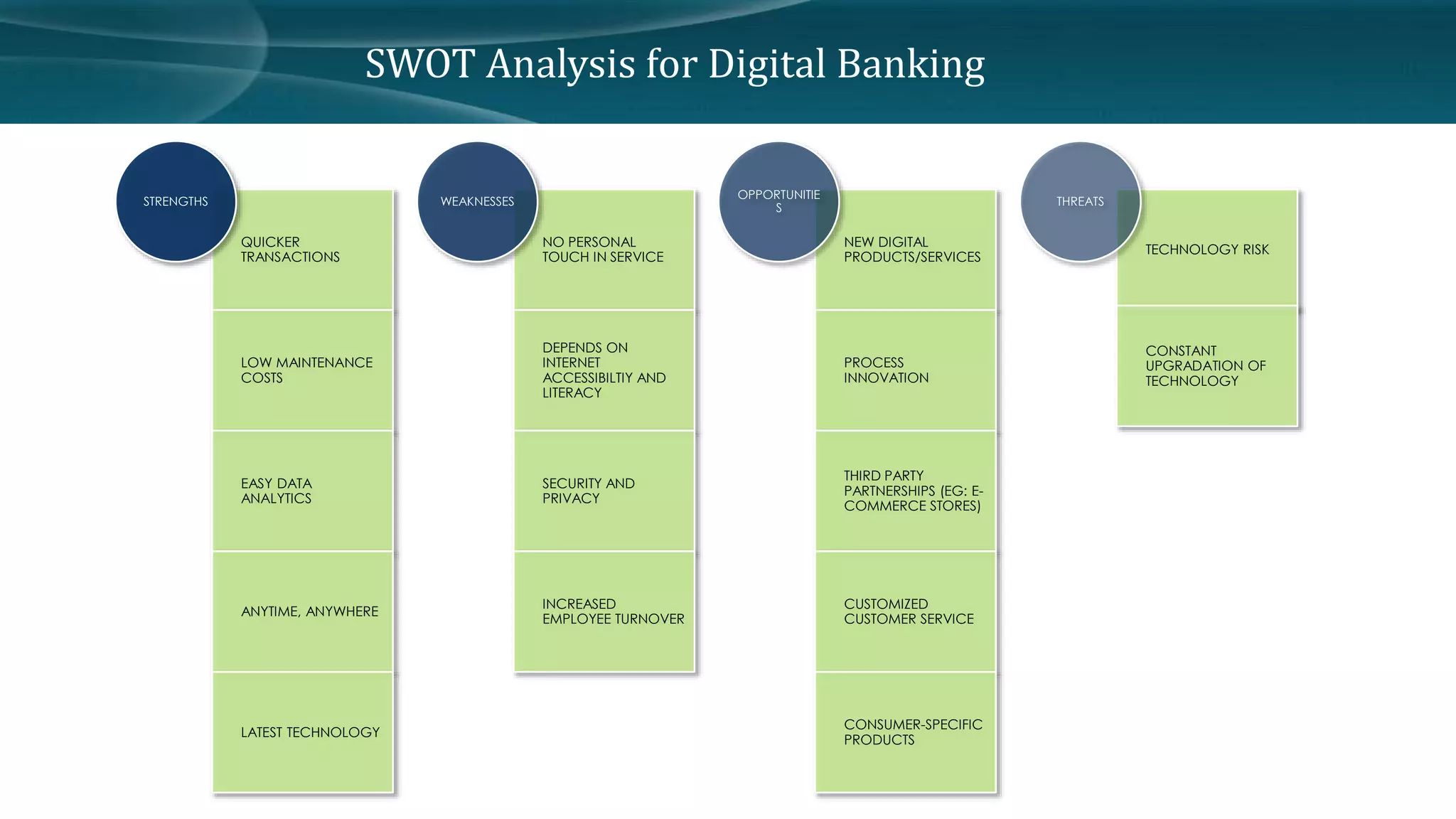
SWOT Analysis for Digital Banking 
QUICKER 
TRANSACTIONS 
LOW MAINTENANCE 
COSTS 
EASY DATA 
ANALYTICS 
ANYTIME, ANYWHERE 
LATEST TECHNOLOGY 
STRENGTHS 
NO PERSONAL 
TOUCH IN SERVICE 
DEPENDS ON 
INTERNET 
ACCESSIBILTIY AND 
LITERACY 
SECURITY AND 
PRIVACY 
INCREASED 
EMPLOYEE TURNOVER 
WEAKNESSES 
NEW DIGITAL 
PRODUCTS/SERVICES 
PROCESS 
INNOVATION 
THIRD PARTY 
PARTNERSHIPS (EG: E-COMMERCE 
STORES) 
CUSTOMIZED 
CUSTOMER SERVICE 
CONSUMER-SPECIFIC 
PRODUCTS 
OPPORTUNITIE 
S 
TECHNOLOGY RISK 
CONSTANT 
UPGRADATION OF 
TECHNOLOGY 
THREATS
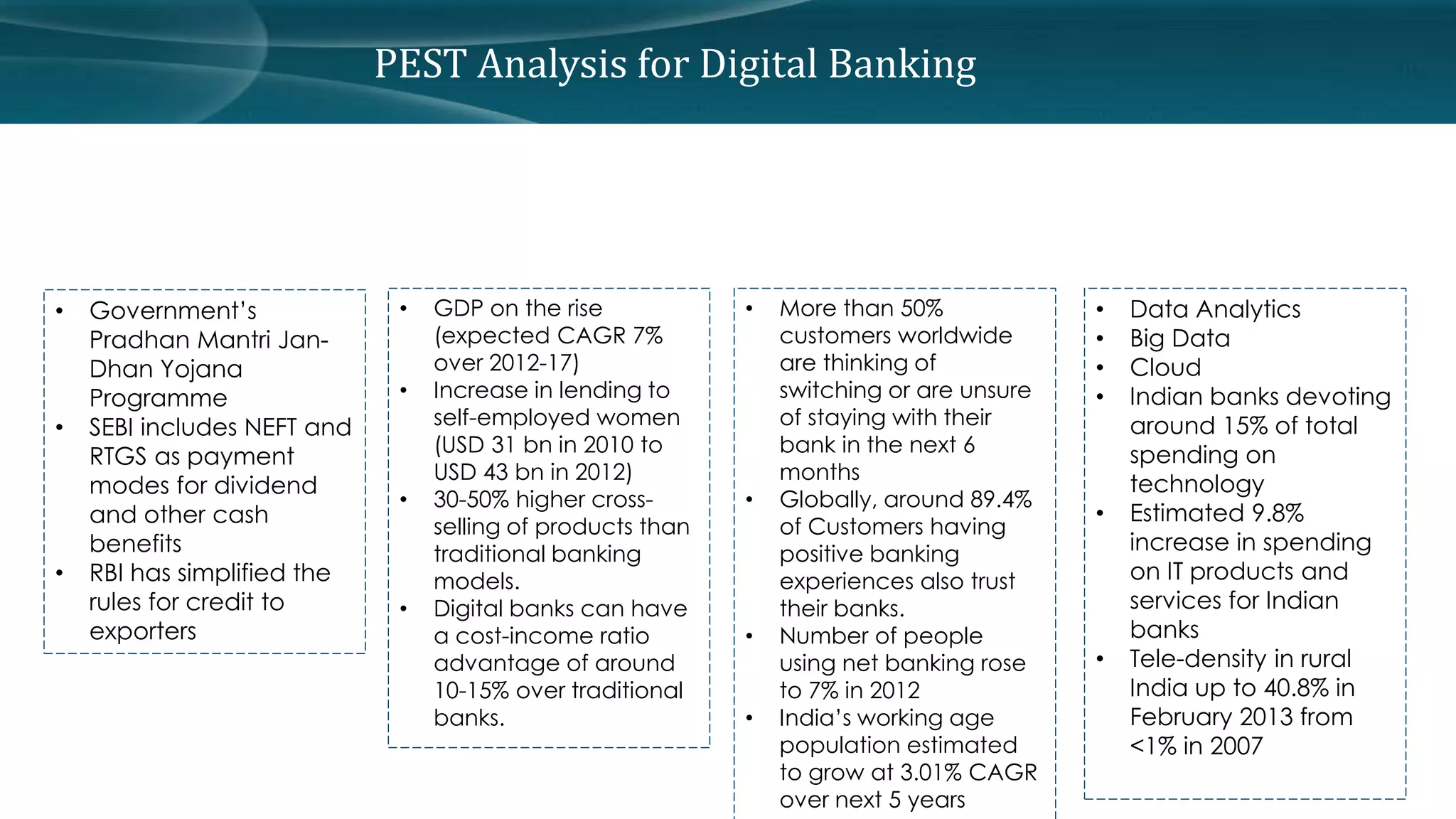
PEST Analysis for Digital Banking 
Political Economical Social Technological 
• Government’s 
Pradhan Mantri Jan- 
Dhan Yojana 
Programme 
• SEBI includes NEFT and 
RTGS as payment 
modes for dividend 
and other cash 
benefits 
• RBI has simplified the 
rules for credit to 
exporters 
• GDP on the rise 
(expected CAGR 7% 
over 2012-17) 
• Increase in lending to 
self-employed women 
(USD 31 bn in 2010 to 
USD 43 bn in 2012) 
• 30-50% higher cross-selling 
of products than 
traditional banking 
models. 
• Digital banks can have 
a cost-income ratio 
advantage of around 
10-15% over traditional 
banks. 
• More than 50% 
customers worldwide 
are thinking of 
switching or are unsure 
of staying with their 
bank in the next 6 
months 
• Globally, around 89.4% 
of Customers having 
positive banking 
experiences also trust 
their banks. 
• Number of people 
using net banking rose 
to 7% in 2012 
• India’s working age 
population estimated 
to grow at 3.01% CAGR 
over next 5 years 
• Data Analytics 
• Big Data 
• Cloud 
• Indian banks devoting 
around 15% of total 
spending on 
technology 
• Estimated 9.8% 
increase in spending 
on IT products and 
services for Indian 
banks 
• Tele-density in rural 
India up to 40.8% in 
February 2013 from 
<1% in 2007
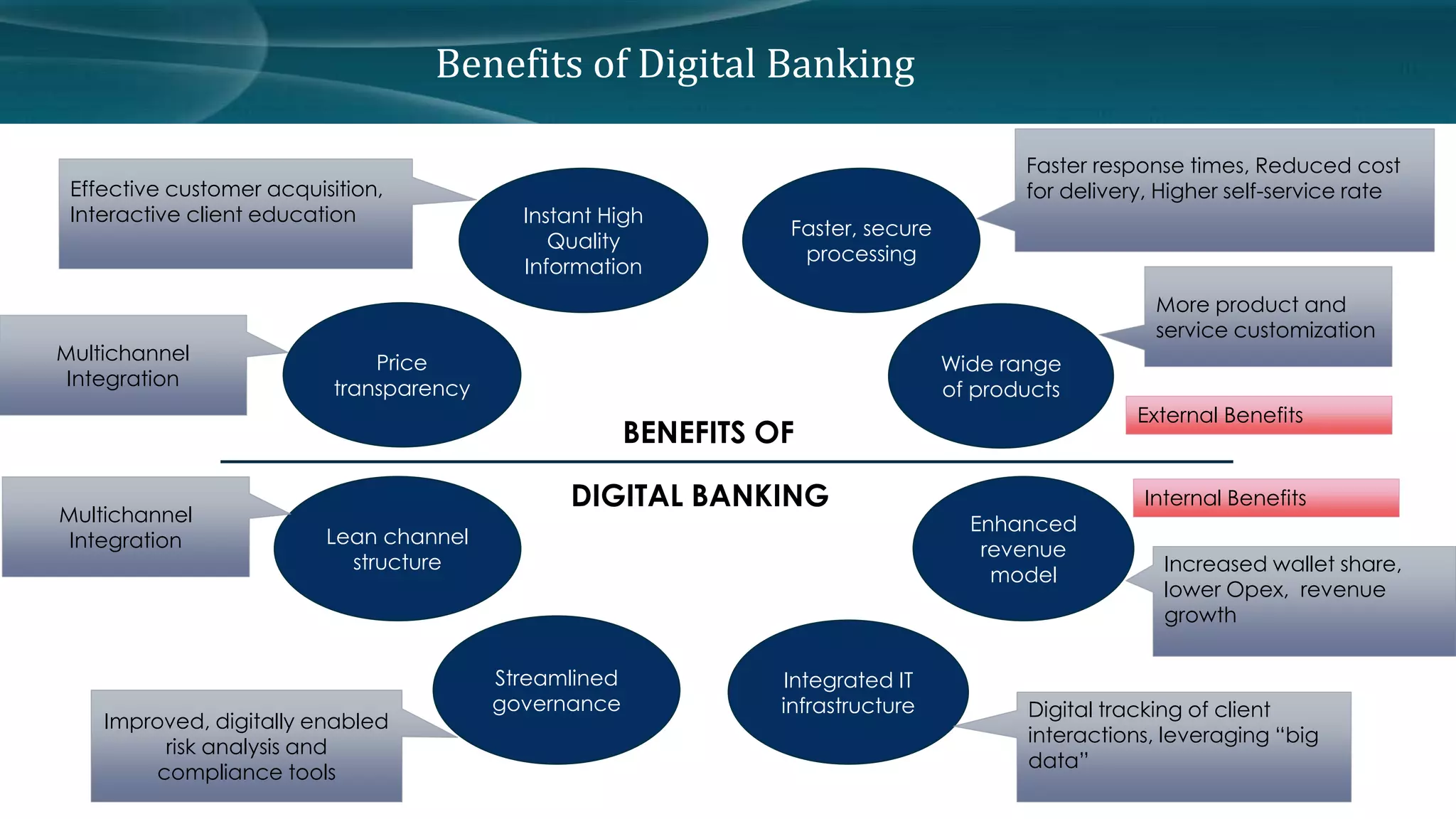
Benefits of Digital Banking 
Faster, secure 
processing 
Instant High 
Quality 
Information 
Faster response times, Reduced cost 
for delivery, Higher self-service rate 
Wide range 
of products 
Effective customer acquisition, 
Interactive client education 
Price 
transparency 
Lean channel 
structure 
Streamlined 
governance 
Integrated IT 
infrastructure 
Enhanced 
revenue 
model 
External Benefits 
Internal Benefits 
Multichannel 
Integration 
Improved, digitally enabled 
risk analysis and 
compliance tools 
Increased wallet share, 
lower Opex, revenue 
growth 
Digital tracking of client 
interactions, leveraging “big 
data” 
Multichannel 
Integration 
More product and 
service customization 
BENEFITS OF 
DIGITAL BANKING
Primary Research Results 
Research Details 
• Sample Size: 103 
• Survey Method: Internet Survey 
• Analysis: Discriminant Analysis with 9 variables (SPSS used) 
• Two Groups: Use Digital Banking Often (coded as 0) and 
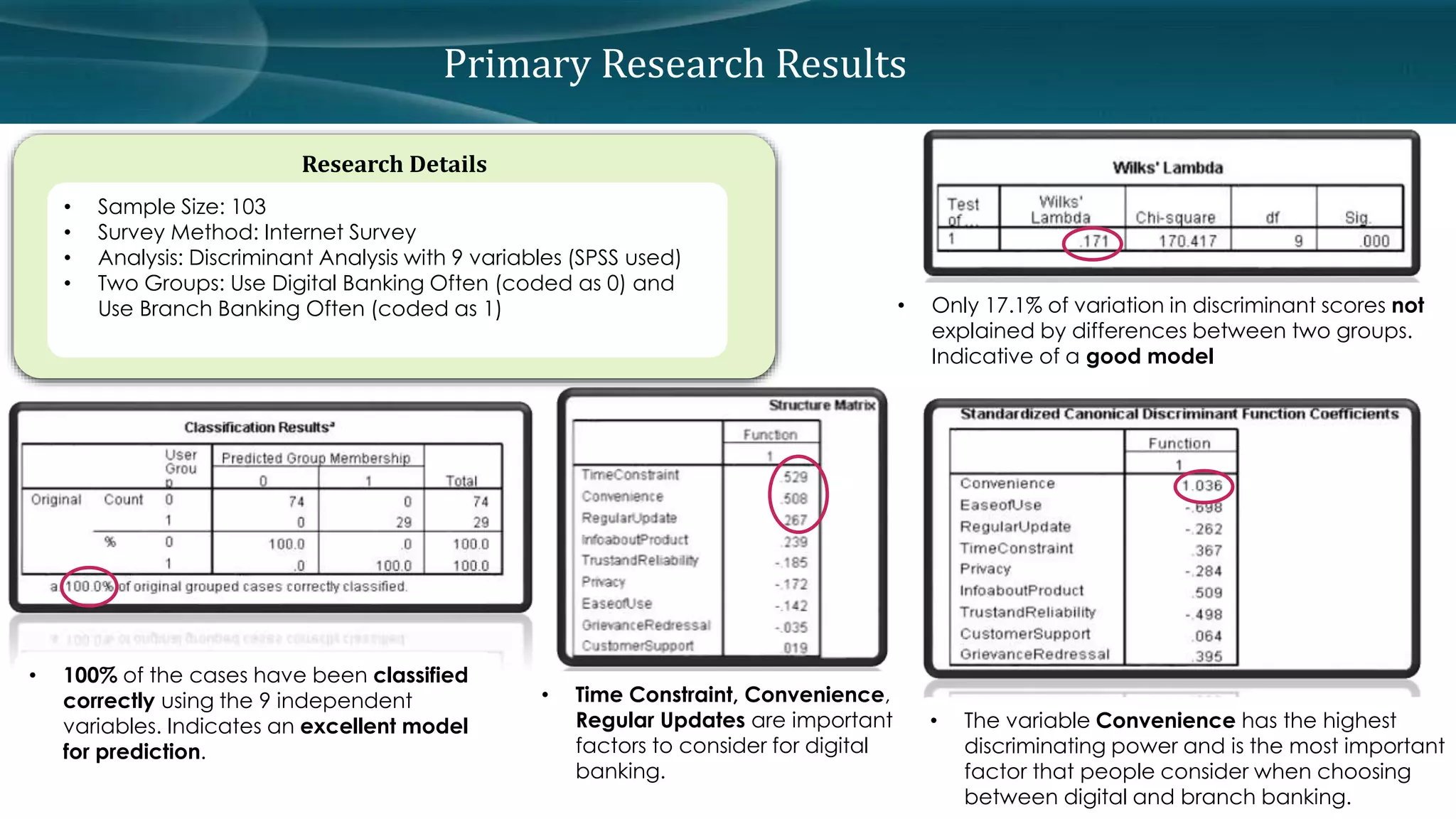
Use Branch Banking Often (coded as 1) • Only 17.1% of variation in discriminant scores not 
explained by differences between two groups. 
Indicative of a good model 
• The variable Convenience has the highest 
discriminating power and is the most important 
factor that people consider when choosing 
between digital and branch banking. 
• 100% of the cases have been classified 
correctly using the 9 independent 
variables. Indicates an excellent model 
for prediction. 
• Time Constraint, Convenience, 
Regular Updates are important 
factors to consider for digital 
banking.
Transformation of Business Model 
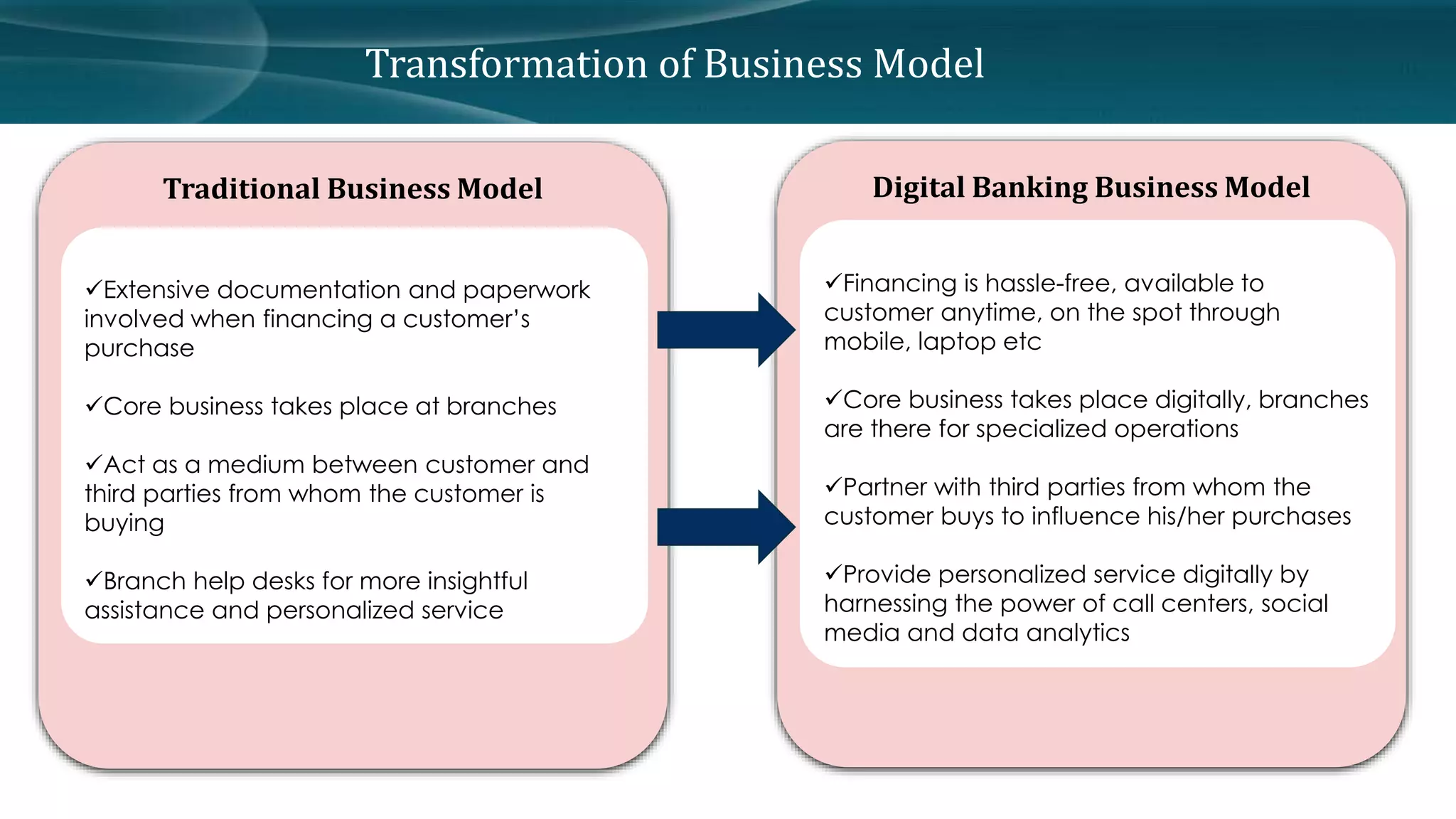
Traditional Business Model 
Extensive documentation and paperwork 
involved when financing a customer’s 
purchase 
Core business takes place at branches 
Act as a medium between customer and 
third parties from whom the customer is 
buying 
Branch help desks for more insightful 
assistance and personalized service 
Digital Banking Business Model 
Financing is hassle-free, available to 
customer anytime, on the spot through 
mobile, laptop etc 
Core business takes place digitally, branches 
are there for specialized operations 
Partner with third parties from whom the 
customer buys to influence his/her purchases 
Provide personalized service digitally by 
harnessing the power of call centers, social 
media and data analytics
ING Vysya’s Current Structure 
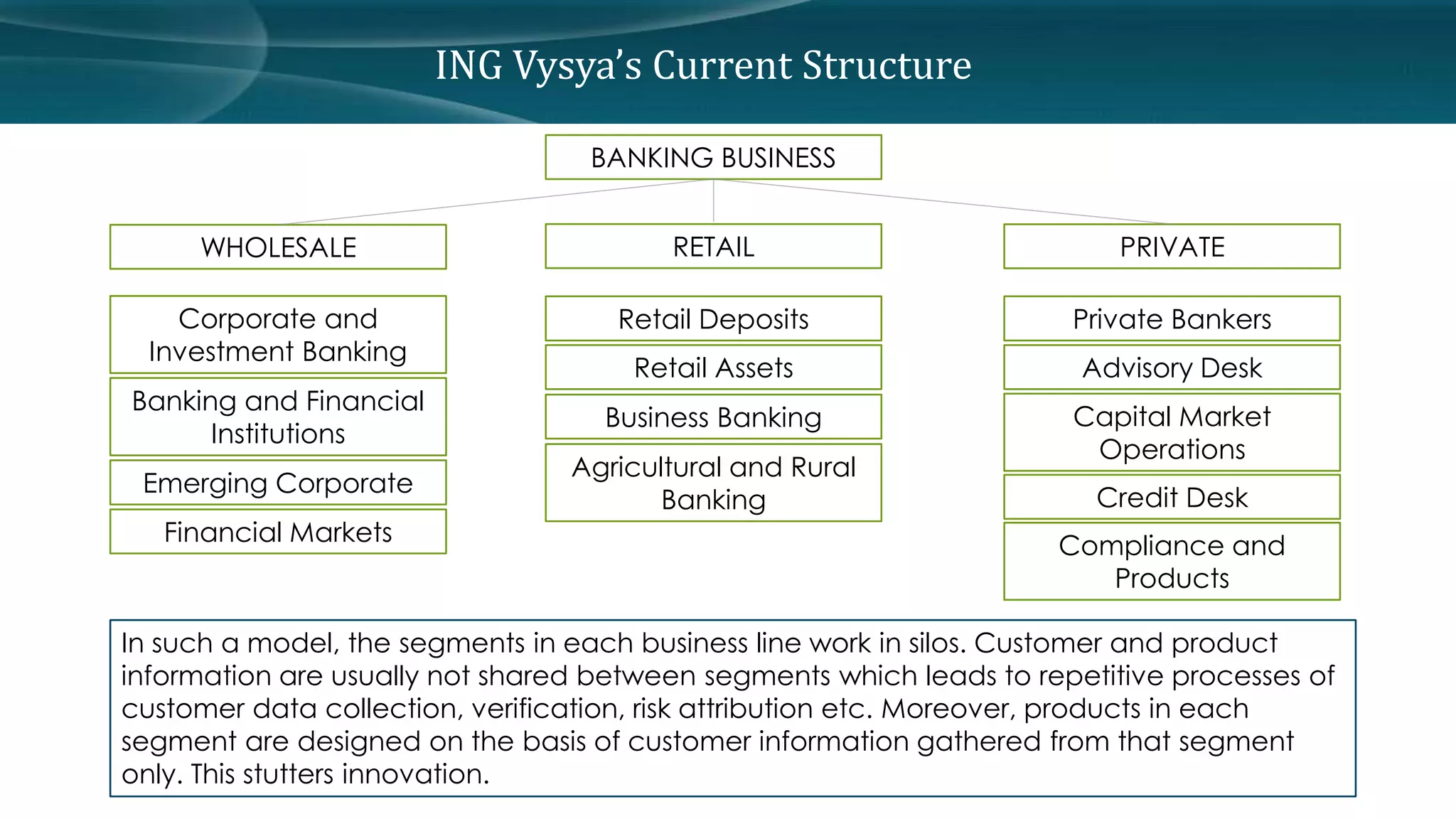
BANKING BUSINESS 
WHOLESALE RETAIL PRIVATE 
Corporate and 
Investment Banking 
Banking and Financial 
Institutions 
Emerging Corporate 
Financial Markets 
Retail Deposits 
Retail Assets 
Business Banking 
Agricultural and Rural 
Banking 
Private Bankers 
Advisory Desk 
Capital Market 
Operations 
Credit Desk 
Compliance and 
Products 
In such a model, the segments in each business line work in silos. Customer and product 
information are usually not shared between segments which leads to repetitive processes of 
customer data collection, verification, risk attribution etc. Moreover, products in each 
segment are designed on the basis of customer information gathered from that segment 
only. This stutters innovation.
Plan for Implementing Digital Banking 
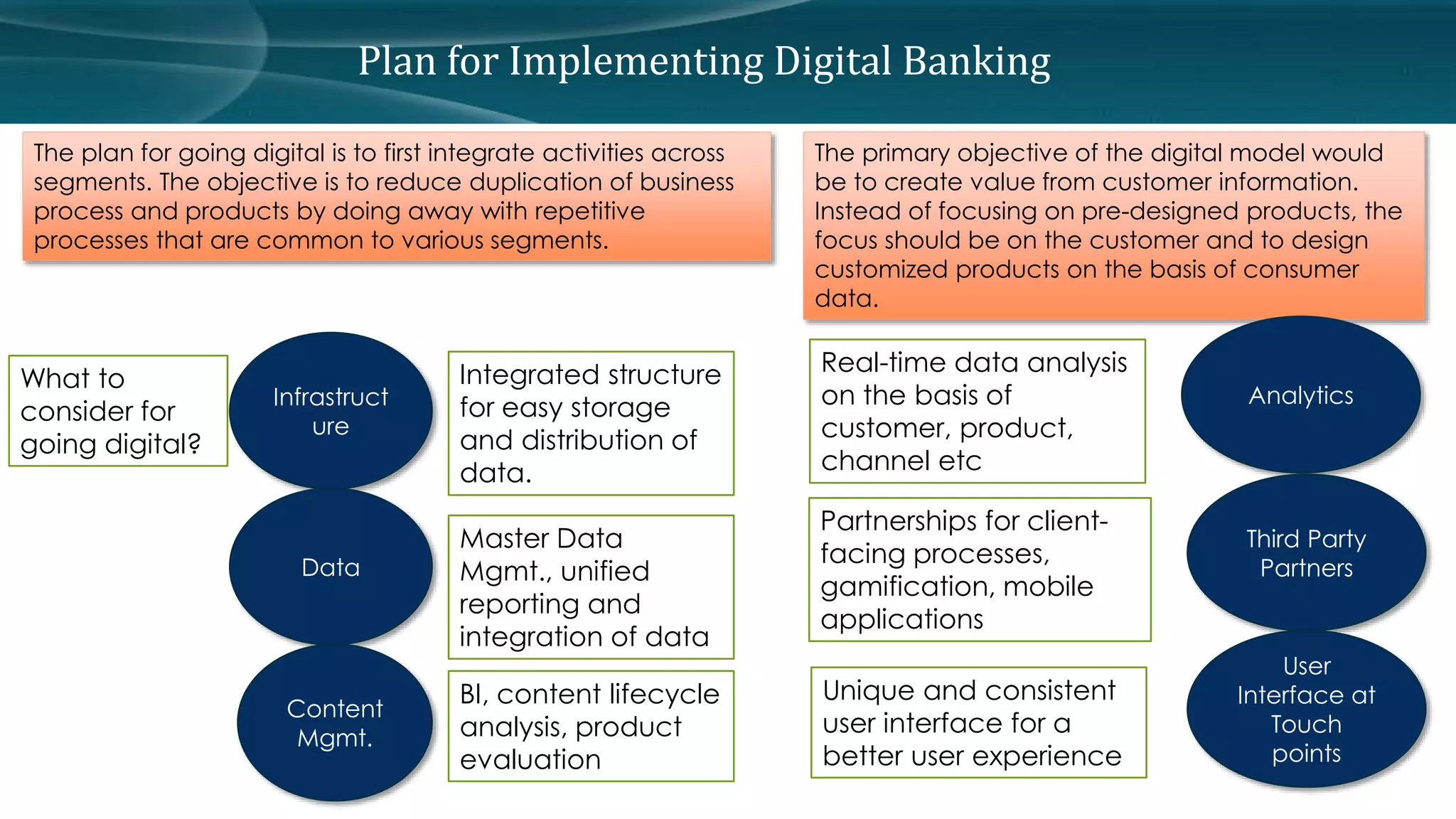
The plan for going digital is to first integrate activities across 
segments. The objective is to reduce duplication of business 
process and products by doing away with repetitive 
processes that are common to various segments. 
The primary objective of the digital model would 
be to create value from customer information. 
Instead of focusing on pre-designed products, the 
focus should be on the customer and to design 
customized products on the basis of consumer 
data. 
What to 
consider for 
going digital? 
Infrastruct 
ure 
Data 
Content 
Mgmt. 
Analytics 
Third Party 
Partners 
User 
Interface at 
Touch 
points 
Integrated structure 
for easy storage 
and distribution of 
data. 
Master Data 
Mgmt., unified 
reporting and 
integration of data 
BI, content lifecycle 
analysis, product 
evaluation 
Real-time data analysis 
on the basis of 
customer, product, 
channel etc 
Partnerships for client-facing 
processes, 
gamification, mobile 
applications 
Unique and consistent 
user interface for a 
better user experience
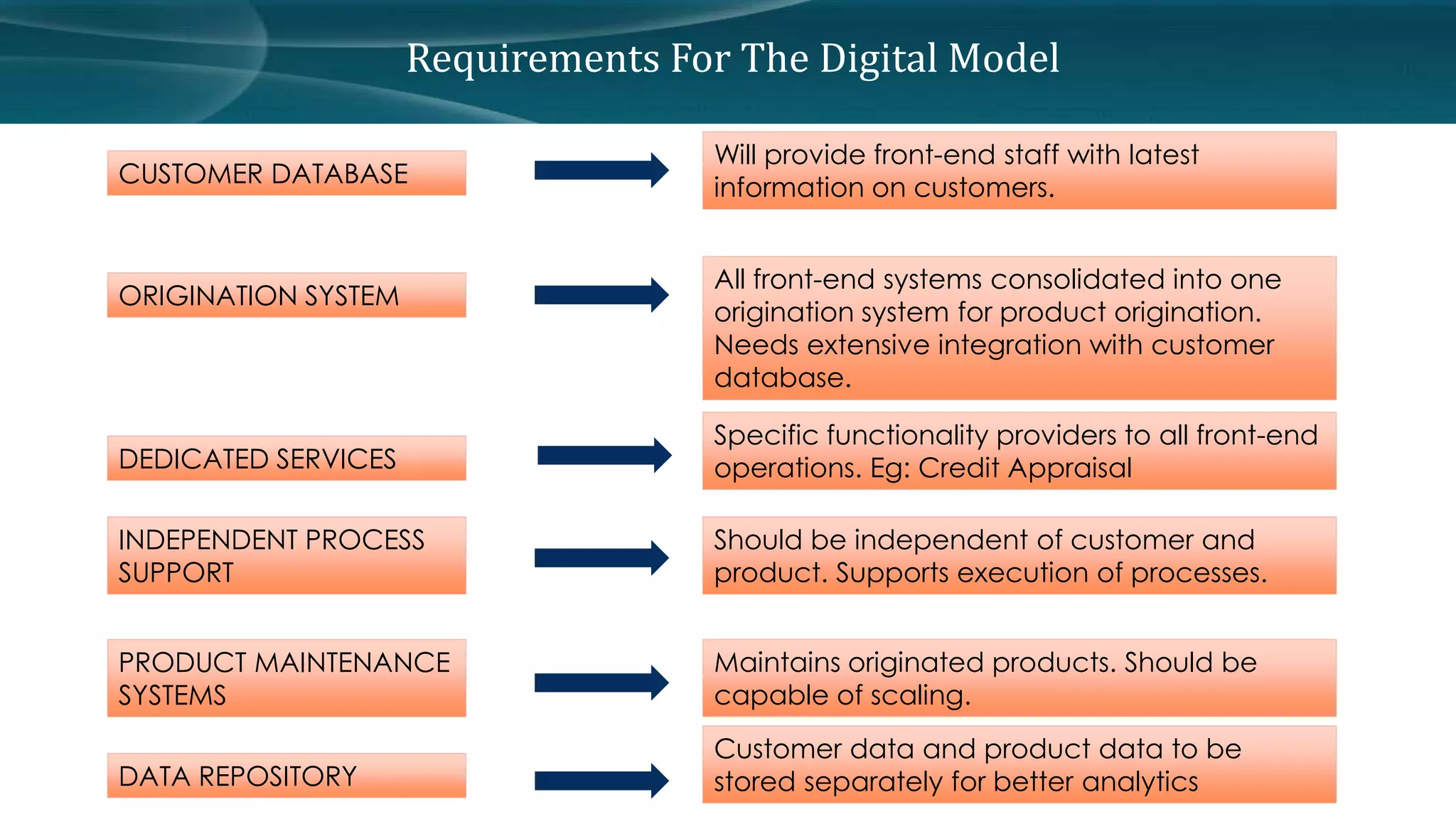
Requirements For The Digital Model 
CUSTOMER DATABASE 
ORIGINATION SYSTEM 
DEDICATED SERVICES 
INDEPENDENT PROCESS 
SUPPORT 
PRODUCT MAINTENANCE 
SYSTEMS 
DATA REPOSITORY 
Will provide front-end staff with latest 
information on customers. 
All front-end systems consolidated into one 
origination system for product origination. 
Needs extensive integration with customer 
database. 
Specific functionality providers to all front-end 
operations. Eg: Credit Appraisal 
Should be independent of customer and 
product. Supports execution of processes. 
Maintains originated products. Should be 
capable of scaling. 
Customer data and product data to be 
stored separately for better analytics
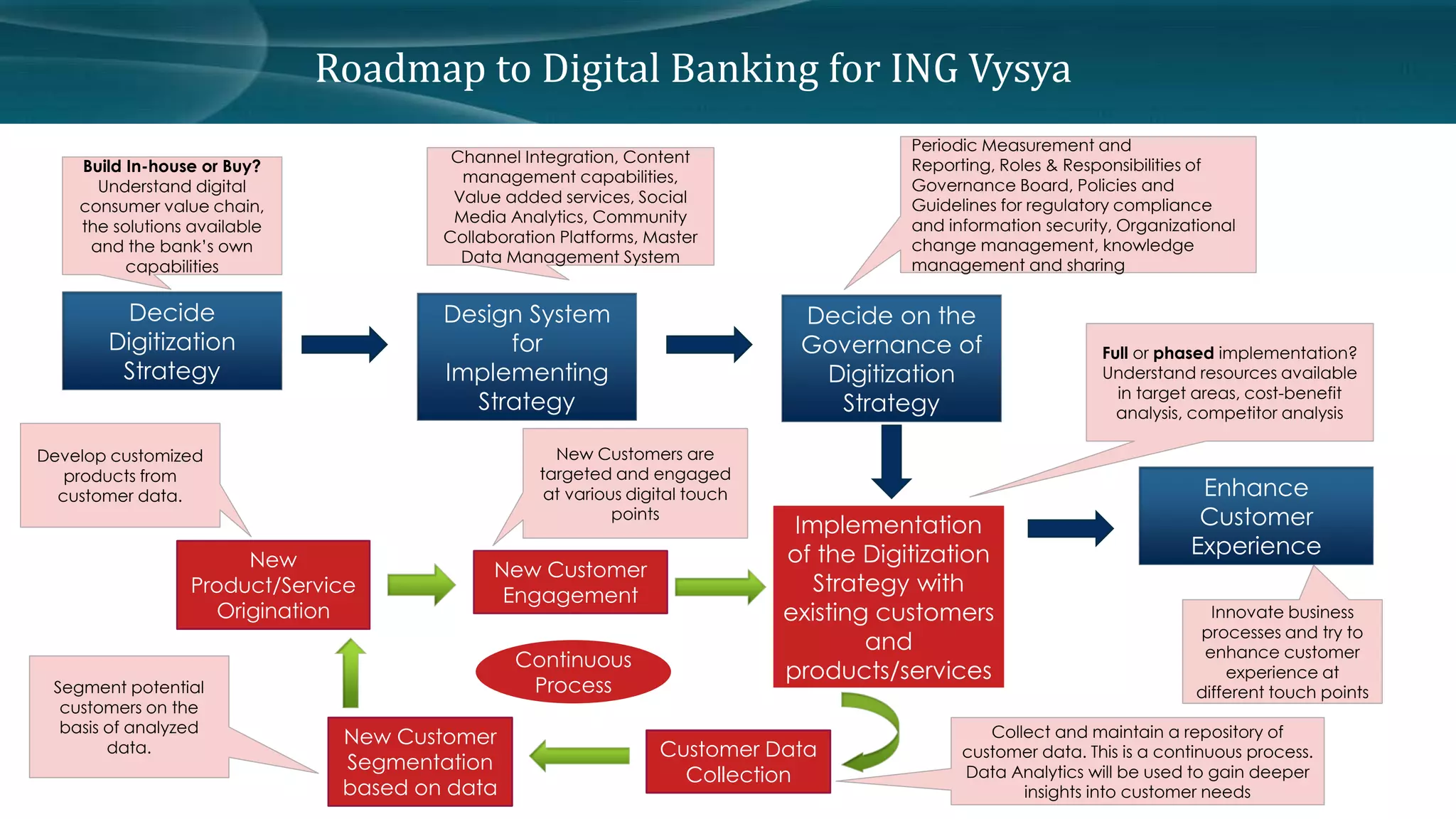
Build In-house or Buy? 
Understand digital 
consumer value chain, 
the solutions available 
and the bank’s own 
capabilities 
Decide 
Digitization 
Strategy 
Design System 
for 
Implementing 
Strategy 
Decide on the 
Governance of 
Digitization 
Strategy 
New Customer 
Engagement 
Implementation 
of the Digitization 
Strategy with 
existing customers 
and 
products/services 
Customer Data 
Collection 
New 
Product/Service 
Origination 
Channel Integration, Content 
management capabilities, 
Value added services, Social 
Media Analytics, Community 
Collaboration Platforms, Master 
Data Management System 
Periodic Measurement and 
Reporting, Roles & Responsibilities of 
Governance Board, Policies and 
Guidelines for regulatory compliance 
and information security, Organizational 
change management, knowledge 
management and sharing 
Full or phased implementation? 
Understand resources available 
in target areas, cost-benefit 
analysis, competitor analysis 
New Customers are 
targeted and engaged 
at various digital touch 
points 
Collect and maintain a repository of 
customer data. This is a continuous process. 
Data Analytics will be used to gain deeper 
insights into customer needs 
Develop customized 
products from 
customer data. Enhance 
Customer 
Experience 
Innovate business 
processes and try to 
enhance customer 
experience at 
different touch points 
Roadmap to Digital Banking for ING Vysya 
Continuous 
Process 
New Customer 
Segmentation 
based on data 
Segment potential 
customers on the 
basis of analyzed 
data.
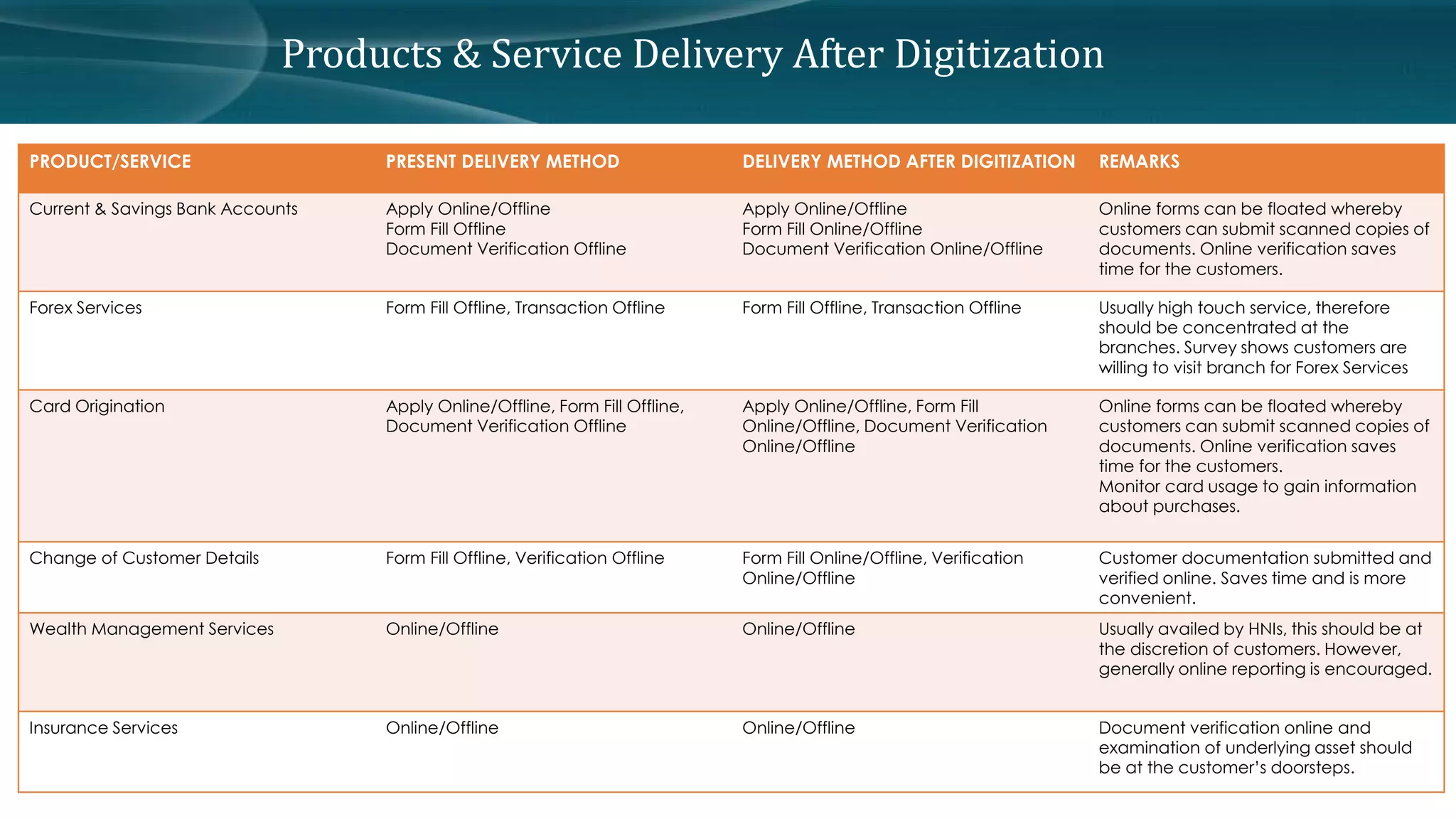
Products & Service Delivery After Digitization 
PRODUCT/SERVICE PRESENT DELIVERY METHOD DELIVERY METHOD AFTER DIGITIZATION REMARKS 
Current & Savings Bank Accounts Apply Online/Offline 
Form Fill Offline 
Document Verification Offline 
Apply Online/Offline 
Form Fill Online/Offline 
Document Verification Online/Offline 
Online forms can be floated whereby 
customers can submit scanned copies of 
documents. Online verification saves 
time for the customers. 
Forex Services Form Fill Offline, Transaction Offline Form Fill Offline, Transaction Offline Usually high touch service, therefore 
should be concentrated at the 
branches. Survey shows customers are 
willing to visit branch for Forex Services 
Card Origination Apply Online/Offline, Form Fill Offline, 
Document Verification Offline 
Apply Online/Offline, Form Fill 
Online/Offline, Document Verification 
Online/Offline 
Online forms can be floated whereby 
customers can submit scanned copies of 
documents. Online verification saves 
time for the customers. 
Monitor card usage to gain information 
about purchases. 
Change of Customer Details Form Fill Offline, Verification Offline Form Fill Online/Offline, Verification 
Online/Offline 
Customer documentation submitted and 
verified online. Saves time and is more 
convenient. 
Wealth Management Services Online/Offline Online/Offline Usually availed by HNIs, this should be at 
the discretion of customers. However, 
generally online reporting is encouraged. 
Insurance Services Online/Offline Online/Offline Document verification online and 
examination of underlying asset should 
be at the customer’s doorsteps.
Research Files and References 
SURVEY DATA AND FILES: 
References: 
• http://www.pwc.com/gx/en/banking-capital-markets/publications/digital-banking-survey.jhtml 
• http://www.slideshare.net/morellimarc/report-15092014 
• http://www.wordstream.com/blog/ws/2014/05/12/customer-churn 
• http://www.in.capgemini.com/thought-leadership/world-retail-banking-report-2013 
• http://www.executiveboard.com/exbd/about/index.page? 
• http://www.livemint.com/Opinion/TOfsav5Xaj2HZhtGNASgaN/Getting-financial-inclusion-back-on-track.html 
• http://www.atkearney.com/paper/-/asset_publisher/dVxv4Hz2h8bS/content/banking-in-a-digital-world/10192 
• Indian Bank's Association, Indian Banking Sector 2020, Business India Aranca Research 
• PWC, ‘Searching for new frontiers of growth’, Aranca Research 
• Capgemini Analysis, 2013; 2013 Retail Banking Voice of the Customer Survey, Capgemini 
• “DIGITAL BANKING”- Opportunity for Extraordinary Gains in Reach, Service, and Productivity in the Next 5 Years, 
Boston Consulting Group (BCG), FICCI, IBA

Atish Bakshi XIMB

  • 2.
    DIGITAL V/S BRANCHBANKING – A COMPARATIVE STUDY AND RECOMMENDATIONS FOR DIGITIZATION Xavier Institute of Management Bhubaneswar
  • 3.
    Executive Summary Background Benefits to Stakeholders Engagement Overview • SWOT Analysis of Branch and Digital • PEST Analysis • Primary Research to derive important factors for customer banking experience • Plan for going digital and requirements for the plan • Digitization Roadmap Survey Results Implementation Roadmap Way forward Banks need to redefine their business models to keep up with digitization to enhance customer experience. 50- 70% higher levels of primary banking relation with customers is possible through digitization. Globally, around 78.8% of customers having positive banking experiences believed that their banks take care of their needs. • For Customers: Positive Customer Experience, Enhanced Trust, Convenient, less time consuming • For Bank: Reduced Costs, Increased Revenues, Broader Customer Base • For Society: Greater financial inclusion, technological innovation, less costs of banking Develop Strategy for Digitization, Develop systems and governance procedures for implementing digitization strategy, engage customers at digital touch points, use data analytics to gain deeper insights into customer needs, develop customized products/services Aim for total digitization within 3-5 years. Gradual digitization of processes will reduce costs which could be re-invested in newer technologies. Enhancing customer experience should be the primary motive. Banking • 71.8% respondents most often use Digital Banking • Time Constraint, Convenience, Regular Updates are important factors to consider.
  • 4.
    BANKING INDUSTRY HIGHLIGHTSAND PROJECTIONS Robust Asset Growth • FY 13 Total Asset Size: USD 1.8 Trn • FY 12 Total Asset Size: USD 1.5 Trn • FY 10 Total Asset Size: USD 1.3 Trn Credit off-take growth • FY06–13, credit off-take CAGR = 22.8% (USD 991 billion) • FY 14 Estimated credit off-take = USD1140 billion Deposit growth • FY06–13, deposits CAGR = 21.2% (USD 1274.3 billion) • FY 14 Estimated deposits = USD 1452.7 billion High ATM and Rural Penetration • Estimated ATMs per million population to rise from 85 to 170 • Banking connectivity has increased from 67694 to 211234 villages in 2013 Sources: Planning Commission, RBI, Aranca Research
  • 5.
    SWOT Analysis forBranch Banking PERSONAL TOUCH EASY TO ACQUIRE GOODWILL MORE MARKET PENETRATION BETTER GRIEVANCE REDRESSAL STRENGTHS CUSTOMER WAITING TIME MAINTENANCE EXPENSES DOCUMENT MANAGEMENT FIXED TIMINGS FOR OPERATIONS BRANCH LIQUIDITY ISSUES WEAKNESSES RURAL BRANCHES SELF SERVICE BRANCHES MSME SECTOR MAY PREFER OPPORTUNITIE S DIGITIZED TRANSACTIONS MORE INTERNET ACCESSIBLITY NBFCs TECHNOLOGICAL OBSOLESCENCE THREATS
  • 6.
    SWOT Analysis forDigital Banking QUICKER TRANSACTIONS LOW MAINTENANCE COSTS EASY DATA ANALYTICS ANYTIME, ANYWHERE LATEST TECHNOLOGY STRENGTHS NO PERSONAL TOUCH IN SERVICE DEPENDS ON INTERNET ACCESSIBILTIY AND LITERACY SECURITY AND PRIVACY INCREASED EMPLOYEE TURNOVER WEAKNESSES NEW DIGITAL PRODUCTS/SERVICES PROCESS INNOVATION THIRD PARTY PARTNERSHIPS (EG: E-COMMERCE STORES) CUSTOMIZED CUSTOMER SERVICE CONSUMER-SPECIFIC PRODUCTS OPPORTUNITIE S TECHNOLOGY RISK CONSTANT UPGRADATION OF TECHNOLOGY THREATS
  • 7.
    PEST Analysis forDigital Banking Political Economical Social Technological • Government’s Pradhan Mantri Jan- Dhan Yojana Programme • SEBI includes NEFT and RTGS as payment modes for dividend and other cash benefits • RBI has simplified the rules for credit to exporters • GDP on the rise (expected CAGR 7% over 2012-17) • Increase in lending to self-employed women (USD 31 bn in 2010 to USD 43 bn in 2012) • 30-50% higher cross-selling of products than traditional banking models. • Digital banks can have a cost-income ratio advantage of around 10-15% over traditional banks. • More than 50% customers worldwide are thinking of switching or are unsure of staying with their bank in the next 6 months • Globally, around 89.4% of Customers having positive banking experiences also trust their banks. • Number of people using net banking rose to 7% in 2012 • India’s working age population estimated to grow at 3.01% CAGR over next 5 years • Data Analytics • Big Data • Cloud • Indian banks devoting around 15% of total spending on technology • Estimated 9.8% increase in spending on IT products and services for Indian banks • Tele-density in rural India up to 40.8% in February 2013 from <1% in 2007
  • 8.
    Benefits of DigitalBanking Faster, secure processing Instant High Quality Information Faster response times, Reduced cost for delivery, Higher self-service rate Wide range of products Effective customer acquisition, Interactive client education Price transparency Lean channel structure Streamlined governance Integrated IT infrastructure Enhanced revenue model External Benefits Internal Benefits Multichannel Integration Improved, digitally enabled risk analysis and compliance tools Increased wallet share, lower Opex, revenue growth Digital tracking of client interactions, leveraging “big data” Multichannel Integration More product and service customization BENEFITS OF DIGITAL BANKING
  • 9.
    Primary Research Results Research Details • Sample Size: 103 • Survey Method: Internet Survey • Analysis: Discriminant Analysis with 9 variables (SPSS used) • Two Groups: Use Digital Banking Often (coded as 0) and Use Branch Banking Often (coded as 1) • Only 17.1% of variation in discriminant scores not explained by differences between two groups. Indicative of a good model • The variable Convenience has the highest discriminating power and is the most important factor that people consider when choosing between digital and branch banking. • 100% of the cases have been classified correctly using the 9 independent variables. Indicates an excellent model for prediction. • Time Constraint, Convenience, Regular Updates are important factors to consider for digital banking.
  • 10.
    Transformation of BusinessModel Traditional Business Model Extensive documentation and paperwork involved when financing a customer’s purchase Core business takes place at branches Act as a medium between customer and third parties from whom the customer is buying Branch help desks for more insightful assistance and personalized service Digital Banking Business Model Financing is hassle-free, available to customer anytime, on the spot through mobile, laptop etc Core business takes place digitally, branches are there for specialized operations Partner with third parties from whom the customer buys to influence his/her purchases Provide personalized service digitally by harnessing the power of call centers, social media and data analytics
  • 11.
    ING Vysya’s CurrentStructure BANKING BUSINESS WHOLESALE RETAIL PRIVATE Corporate and Investment Banking Banking and Financial Institutions Emerging Corporate Financial Markets Retail Deposits Retail Assets Business Banking Agricultural and Rural Banking Private Bankers Advisory Desk Capital Market Operations Credit Desk Compliance and Products In such a model, the segments in each business line work in silos. Customer and product information are usually not shared between segments which leads to repetitive processes of customer data collection, verification, risk attribution etc. Moreover, products in each segment are designed on the basis of customer information gathered from that segment only. This stutters innovation.
  • 12.
    Plan for ImplementingDigital Banking The plan for going digital is to first integrate activities across segments. The objective is to reduce duplication of business process and products by doing away with repetitive processes that are common to various segments. The primary objective of the digital model would be to create value from customer information. Instead of focusing on pre-designed products, the focus should be on the customer and to design customized products on the basis of consumer data. What to consider for going digital? Infrastruct ure Data Content Mgmt. Analytics Third Party Partners User Interface at Touch points Integrated structure for easy storage and distribution of data. Master Data Mgmt., unified reporting and integration of data BI, content lifecycle analysis, product evaluation Real-time data analysis on the basis of customer, product, channel etc Partnerships for client-facing processes, gamification, mobile applications Unique and consistent user interface for a better user experience
  • 13.
    Requirements For TheDigital Model CUSTOMER DATABASE ORIGINATION SYSTEM DEDICATED SERVICES INDEPENDENT PROCESS SUPPORT PRODUCT MAINTENANCE SYSTEMS DATA REPOSITORY Will provide front-end staff with latest information on customers. All front-end systems consolidated into one origination system for product origination. Needs extensive integration with customer database. Specific functionality providers to all front-end operations. Eg: Credit Appraisal Should be independent of customer and product. Supports execution of processes. Maintains originated products. Should be capable of scaling. Customer data and product data to be stored separately for better analytics
  • 14.
    Build In-house orBuy? Understand digital consumer value chain, the solutions available and the bank’s own capabilities Decide Digitization Strategy Design System for Implementing Strategy Decide on the Governance of Digitization Strategy New Customer Engagement Implementation of the Digitization Strategy with existing customers and products/services Customer Data Collection New Product/Service Origination Channel Integration, Content management capabilities, Value added services, Social Media Analytics, Community Collaboration Platforms, Master Data Management System Periodic Measurement and Reporting, Roles & Responsibilities of Governance Board, Policies and Guidelines for regulatory compliance and information security, Organizational change management, knowledge management and sharing Full or phased implementation? Understand resources available in target areas, cost-benefit analysis, competitor analysis New Customers are targeted and engaged at various digital touch points Collect and maintain a repository of customer data. This is a continuous process. Data Analytics will be used to gain deeper insights into customer needs Develop customized products from customer data. Enhance Customer Experience Innovate business processes and try to enhance customer experience at different touch points Roadmap to Digital Banking for ING Vysya Continuous Process New Customer Segmentation based on data Segment potential customers on the basis of analyzed data.
  • 15.
    Products & ServiceDelivery After Digitization PRODUCT/SERVICE PRESENT DELIVERY METHOD DELIVERY METHOD AFTER DIGITIZATION REMARKS Current & Savings Bank Accounts Apply Online/Offline Form Fill Offline Document Verification Offline Apply Online/Offline Form Fill Online/Offline Document Verification Online/Offline Online forms can be floated whereby customers can submit scanned copies of documents. Online verification saves time for the customers. Forex Services Form Fill Offline, Transaction Offline Form Fill Offline, Transaction Offline Usually high touch service, therefore should be concentrated at the branches. Survey shows customers are willing to visit branch for Forex Services Card Origination Apply Online/Offline, Form Fill Offline, Document Verification Offline Apply Online/Offline, Form Fill Online/Offline, Document Verification Online/Offline Online forms can be floated whereby customers can submit scanned copies of documents. Online verification saves time for the customers. Monitor card usage to gain information about purchases. Change of Customer Details Form Fill Offline, Verification Offline Form Fill Online/Offline, Verification Online/Offline Customer documentation submitted and verified online. Saves time and is more convenient. Wealth Management Services Online/Offline Online/Offline Usually availed by HNIs, this should be at the discretion of customers. However, generally online reporting is encouraged. Insurance Services Online/Offline Online/Offline Document verification online and examination of underlying asset should be at the customer’s doorsteps.
  • 16.
    Research Files andReferences SURVEY DATA AND FILES: References: • http://www.pwc.com/gx/en/banking-capital-markets/publications/digital-banking-survey.jhtml • http://www.slideshare.net/morellimarc/report-15092014 • http://www.wordstream.com/blog/ws/2014/05/12/customer-churn • http://www.in.capgemini.com/thought-leadership/world-retail-banking-report-2013 • http://www.executiveboard.com/exbd/about/index.page? • http://www.livemint.com/Opinion/TOfsav5Xaj2HZhtGNASgaN/Getting-financial-inclusion-back-on-track.html • http://www.atkearney.com/paper/-/asset_publisher/dVxv4Hz2h8bS/content/banking-in-a-digital-world/10192 • Indian Bank's Association, Indian Banking Sector 2020, Business India Aranca Research • PWC, ‘Searching for new frontiers of growth’, Aranca Research • Capgemini Analysis, 2013; 2013 Retail Banking Voice of the Customer Survey, Capgemini • “DIGITAL BANKING”- Opportunity for Extraordinary Gains in Reach, Service, and Productivity in the Next 5 Years, Boston Consulting Group (BCG), FICCI, IBA