

EXECUTIVE SUMMARY 
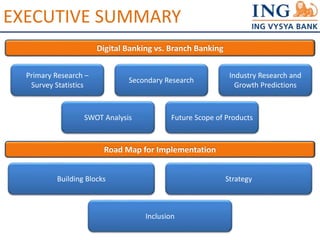
Digital Banking vs. Branch Banking 
Road Map for Implementation 
Primary Research – 
Survey Statistics 
Secondary Research 
Industry Research and 
Growth Predictions 
SWOT Analysis Future Scope of Products 
Building Blocks Strategy 
Inclusion
INTRODUCTION 
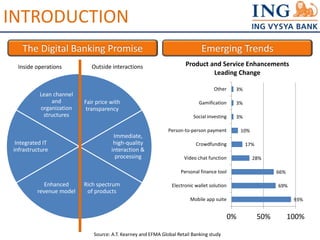
The Digital Banking Promise Emerging Trends 
Fair price with 
transparency 
Immediate, 
high-quality 
interaction & 
processing 
Rich spectrum 
of products 
Lean channel 
organization 
structures 
Integrated IT 
infrastructure 
and 
Enhanced 
revenue model 
Outside interactions 
Product and Service Enhancements 
Leading Change 
Other 
Gamification 
Social investing 
Person-to-person payment 
Crowdfunding 
Video chat function 
Personal finance tool 
Electronic wallet solution 
Source: A.T. Kearney and EFMA Global Retail Banking study 
93% 
66% 
69% 
17% 
28% 
3% 
3% 
3% 
10% 
0% 50% 100% 
Mobile app suite 
Inside operations
PRIMARY RESEARCH INSIGHTS 
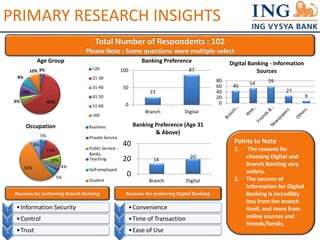
Age Group 
3% 
8% 
10% 
10% 
6% 63% 
Total Number of Respondents : 102 
Please Note : Some questions were multiple-select 
<20 
21-30 
31-40 
41-50 
51-60 
>60 
Occupation Business 
5% 
15% 
10% 
4% 
5% 
53% 
8% 
Private Service 
Public Service - 
Banks 
Teaching 
Self-employed 
Student 
Banking Preference 
23 
87 
100 
50 
0 
Branch Digital 
Banking Preference (Age 31 
& Above) 
14 
20 
40 
20 
0 
Branch Digital 
45 54 59 
27 
9 
80 
60 
40 
20 
0 
Digital Banking - Information 
Sources 
Reasons for preferring Branch Banking Reasons for preferring Digital Banking 
1 • Information Security 
2 •Control 
3 •Trust 
1 •Convenience 
2 • Time of Transaction 
3 •Ease of Use 
Points to Note 
1. The reasons for 
choosing Digital and 
Branch Banking vary 
widely. 
2. The sources of 
information for Digital 
Banking is incredibly 
less from the branch 
itself, and more from 
online sources and 
friends/family.
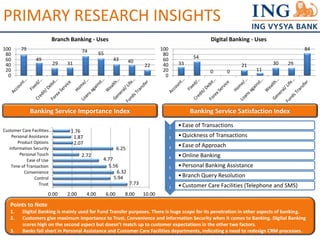
PRIMARY RESEARCH INSIGHTS 
79 
49 
29 31 
74 65 
43 40 
22 
100 
80 
60 
40 
20 
0 
Branch Banking - Uses 
33 
54 
0 0 
21 
11 
30 29 
84 
100 
80 
60 
40 
20 
0 
Digital Banking - Uses 
Banking Service Importance Index Banking Service Satisfaction Index 
7.73 
5.56 
6.32 
5.94 
4.77 
1.76 
1.87 
2.72 
6.25 
2.07 
Customer Care Facilities… 
Personal Assistance 
Product Options 
Information Security 
Personal Touch 
Ease of Use 
Time of Transaction 
Convenience 
Control 
Trust 
0.00 2.00 4.00 6.00 8.00 10.00 
1 • Ease of Transactions 
2 • Quickness of Transactions 
3 • Ease of Approach 
4 •Online Banking 
5 • Personal Banking Assistance 
6 • Branch Query Resolution 
7 • Customer Care Facilities (Telephone and SMS) 
Points to Note 
1. Digital Banking is mainly used for Fund Transfer purposes. There is huge scope for its penetration in other aspects of banking. 
2. Customers give maximum importance to Trust, Convenience and Information Security when it comes to Banking. Digital Banking 
scores high on the second aspect but doesn’t match up to customer expectations in the other two factors. 
3. Banks fall short in Personal Assistance and Customer Care Facilities departments, indicating a need to redesign CRM processes.
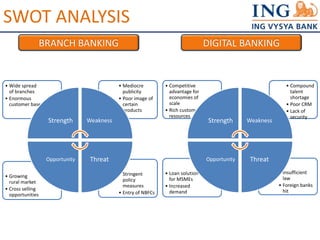
SWOT ANALYSIS 
BRANCH BANKING DIGITAL BANKING 
• Stringent 
policy 
measures 
• Entry of NBFCs 
• Growing 
rural market 
• Cross selling 
opportunities 
• Mediocre 
publicity 
• Poor image of 
certain 
products 
• Wide spread 
of branches 
• Enormous 
customer base 
Strength Weakness 
Opportunity Threat 
• Insufficient 
law 
• Foreign banks 
hit 
• Loan solution 
for MSMEs 
• Increased 
demand 
• Compound 
talent 
shortage 
• Poor CRM 
• Lack of 
security 
• Competitive 
advantage for 
economies of 
scale 
• Rich customer 
resources 
Strength Weakness 
Opportunity Threat
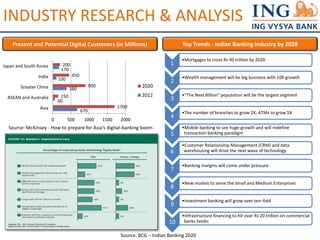
INDUSTRY RESEARCH & ANALYSIS 
Present and Potential Digital Customers (in Millions) 
670 
170 
60 
380 
100 
1700 
150 
900 
450 
200 
0 500 1000 1500 2000 
Japan and South Korea 
India 
Greater China 
ASEAN and Australia 
Asia 
2020 
2012 
Source: McKinsey - How to prepare for Asia’s digital-banking boom 
Top Trends - Indian Banking Industry by 2020 
1 
•Mortgages to cross Rs 40 trillion by 2020 
2 
•Wealth management will be big business with 10X growth 
3 
•“The Next Billion” population will be the largest segment 
4 
•The number of branches to grow 2X; ATMs to grow 5X 
5 
•Mobile banking to see huge growth and will redefine 
transaction banking paradigm 
6 
•Customer Relationship Management (CRM) and data 
warehousing will drive the next wave of technology 
7 
•Banking margins will come under pressure 
8 
•New models to serve the Small and Medium Enterprises 
9 
•Investment banking will grow over ten–fold 
10 
•Infrastructure financing to hit over Rs 20 trillion on commercial 
banks books 
Source: BCG – Indian Banking 2020
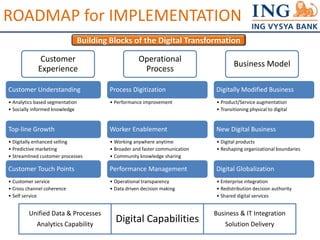
ROADMAP for IMPLEMENTATION 
Building Blocks of the Digital Transformation 
Customer Understanding 
• Analytics based segmentation 
• Socially informed knowledge 
Top-line Growth 
• Digitally enhanced selling 
• Predictive marketing 
• Streamlined customer processes 
Customer Touch Points 
• Customer service 
• Cross channel coherence 
• Self service 
Process Digitization 
• Performance improvement 
Worker Enablement 
• Working anywhere anytime 
• Broader and faster communication 
• Community knowledge sharing 
Performance Management 
• Operational transparency 
• Data driven decision making 
Customer 
Experience 
Operational 
Process 
Business Model 
Unified Data & Processes 
Digitally Modified Business 
• Product/Service augmentation 
• Transitioning physical to digital 
New Digital Business 
• Digital products 
• Reshaping organizational boundaries 
Digital Globalization 
• Enterprise integration 
• Redistribution decision authority 
• Shared digital services 
Analytics Capability Digital Capabilities Business & IT Integration 
Solution Delivery
ROADMAP for IMPLEMENTATION 
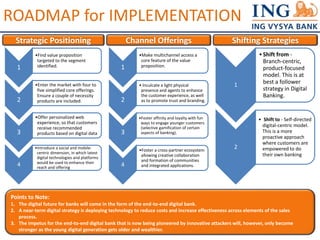
Strategic Positioning 
1 
•Find value proposition 
targeted to the segment 
identified. 
2 
•Enter the market with four to 
five simplified core offerings. 
Ensure a couple of necessity 
products are included. 
3 
•Offer personalized web 
experience, so that customers 
receive recommended 
products based on digital data 
4 
•Introduce a social and mobile-centric 
dimension, in which latest 
digital technologies and platforms 
would be used to enhance their 
reach and offering 
Channel Offerings 
1 
•Make multichannel access a 
core feature of the value 
proposition. 
2 
• Inculcate a light physical 
presence and agents to enhance 
the customer experience, as well 
as to promote trust and branding. 
3 
•Foster affinity and loyalty with fun 
ways to engage younger customers 
(selective gamification of certain 
aspects of banking). 
4 
•Foster a cross-partner ecosystem 
allowing creative collaboration 
and formation of communities 
and integrated applications. 
Shifting Strategies 
1 
• Shift from - 
Branch-centric, 
product-focused 
model. This is at 
best a follower 
strategy in Digital 
Banking. 
2 
• Shift to - Self-directed 
digital-centric model. 
This is a more 
proactive approach 
where customers are 
empowered to do 
their own banking 
Points to Note: 
1. The digital future for banks will come in the form of the end-to-end digital bank. 
2. A near-term digital strategy is deploying technology to reduce costs and increase effectiveness across elements of the sales 
process. 
3. The impetus for the end-to-end digital bank that is now being pioneered by innovative attackers will, however, only become 
stronger as the young digital generation gets older and wealthier.
ROADMAP for IMPLEMENTATION 
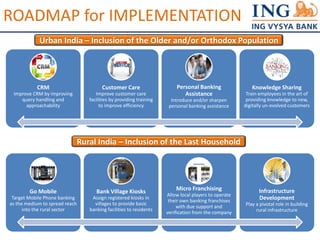
Urban India – Inclusion of the Older and/or Orthodox Population 
Rural India – Inclusion of the Last Household 
CRM 
Improve CRM by improving 
query handling and 
approachability 
Customer Care 
Improve customer care 
facilities by providing training 
to improve efficiency 
Personal Banking 
Assistance 
Introduce and/or sharpen 
personal banking assistance 
Knowledge Sharing 
Train employees in the art of 
providing knowledge to new, 
digitally un-evolved customers 
Go Mobile 
Target Mobile Phone banking 
as the medium to spread reach 
into the rural sector 
Bank Village Kiosks 
Assign registered kiosks in 
villages to provide basic 
banking facilities to residents 
Micro Franchising 
Allow local players to operate 
their own banking franchises 
with due support and 
verification from the company 
Infrastructure 
Development 
Play a pivotal role in building 
rural infrastructure
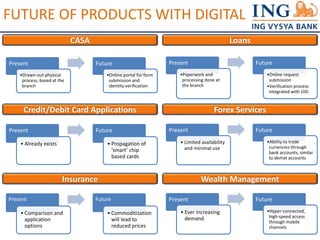
FUTURE OF PRODUCTS WITH DIGITAL 
CASA 
Present 
•Drawn-out physical 
process, based at the 
branch 
Future 
•Online portal for form 
submission and 
identity verification 
Loans 
Present 
•Paperwork and 
processing done at 
the branch 
Future 
Credit/Debit Card Applications Forex Services 
•Online request 
submission 
•Verification process 
integrated with UID. 
Insurance Wealth Management 
Present 
• Already exists 
Future 
• Propagation of 
‘smart’ chip 
based cards 
Present 
• Limited availability 
and minimal use 
Future 
•Ability to trade 
currencies through 
bank accounts, similar 
to demat accounts 
Present 
• Comparison and 
application 
options 
Future 
• Commoditization 
will lead to 
reduced prices 
Present 
• Ever increasing 
demand 
Future 
•Hyper-connected, 
high-speed access 
through mobile 
channels
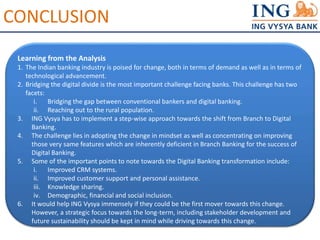
CONCLUSION 
Learning from the Analysis 
1. The Indian banking industry is poised for change, both in terms of demand as well as in terms of 
technological advancement. 
2. Bridging the digital divide is the most important challenge facing banks. This challenge has two 
facets: 
i. Bridging the gap between conventional bankers and digital banking. 
ii. Reaching out to the rural population. 
3. ING Vysya has to implement a step-wise approach towards the shift from Branch to Digital 
Banking. 
4. The challenge lies in adopting the change in mindset as well as concentrating on improving 
those very same features which are inherently deficient in Branch Banking for the success of 
Digital Banking. 
5. Some of the important points to note towards the Digital Banking transformation include: 
i. Improved CRM systems. 
ii. Improved customer support and personal assistance. 
iii. Knowledge sharing. 
iv. Demographic, financial and social inclusion. 
6. It would help ING Vysya immensely if they could be the first mover towards this change. 
However, a strategic focus towards the long-term, including stakeholder development and 
future sustainability should be kept in mind while driving towards this change.
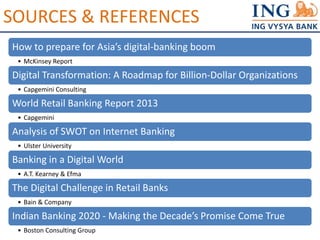
SOURCES & REFERENCES 
How to prepare for Asia’s digital-banking boom 
• McKinsey Report 
Digital Transformation: A Roadmap for Billion-Dollar Organizations 
• Capgemini Consulting 
World Retail Banking Report 2013 
• Capgemini 
Analysis of SWOT on Internet Banking 
• Ulster University 
Banking in a Digital World 
• A.T. Kearney & Efma 
The Digital Challenge in Retail Banks 
• Bain & Company 
Indian Banking 2020 - Making the Decade’s Promise Come True 
• Boston Consulting Group
THANK YOU FOR BANKING WITH US

Abhishek Sinha XIMB

  • 3.
    EXECUTIVE SUMMARY DigitalBanking vs. Branch Banking Road Map for Implementation Primary Research – Survey Statistics Secondary Research Industry Research and Growth Predictions SWOT Analysis Future Scope of Products Building Blocks Strategy Inclusion
  • 4.
    INTRODUCTION The DigitalBanking Promise Emerging Trends Fair price with transparency Immediate, high-quality interaction & processing Rich spectrum of products Lean channel organization structures Integrated IT infrastructure and Enhanced revenue model Outside interactions Product and Service Enhancements Leading Change Other Gamification Social investing Person-to-person payment Crowdfunding Video chat function Personal finance tool Electronic wallet solution Source: A.T. Kearney and EFMA Global Retail Banking study 93% 66% 69% 17% 28% 3% 3% 3% 10% 0% 50% 100% Mobile app suite Inside operations
  • 5.
    PRIMARY RESEARCH INSIGHTS Age Group 3% 8% 10% 10% 6% 63% Total Number of Respondents : 102 Please Note : Some questions were multiple-select <20 21-30 31-40 41-50 51-60 >60 Occupation Business 5% 15% 10% 4% 5% 53% 8% Private Service Public Service - Banks Teaching Self-employed Student Banking Preference 23 87 100 50 0 Branch Digital Banking Preference (Age 31 & Above) 14 20 40 20 0 Branch Digital 45 54 59 27 9 80 60 40 20 0 Digital Banking - Information Sources Reasons for preferring Branch Banking Reasons for preferring Digital Banking 1 • Information Security 2 •Control 3 •Trust 1 •Convenience 2 • Time of Transaction 3 •Ease of Use Points to Note 1. The reasons for choosing Digital and Branch Banking vary widely. 2. The sources of information for Digital Banking is incredibly less from the branch itself, and more from online sources and friends/family.
  • 6.
    PRIMARY RESEARCH INSIGHTS 79 49 29 31 74 65 43 40 22 100 80 60 40 20 0 Branch Banking - Uses 33 54 0 0 21 11 30 29 84 100 80 60 40 20 0 Digital Banking - Uses Banking Service Importance Index Banking Service Satisfaction Index 7.73 5.56 6.32 5.94 4.77 1.76 1.87 2.72 6.25 2.07 Customer Care Facilities… Personal Assistance Product Options Information Security Personal Touch Ease of Use Time of Transaction Convenience Control Trust 0.00 2.00 4.00 6.00 8.00 10.00 1 • Ease of Transactions 2 • Quickness of Transactions 3 • Ease of Approach 4 •Online Banking 5 • Personal Banking Assistance 6 • Branch Query Resolution 7 • Customer Care Facilities (Telephone and SMS) Points to Note 1. Digital Banking is mainly used for Fund Transfer purposes. There is huge scope for its penetration in other aspects of banking. 2. Customers give maximum importance to Trust, Convenience and Information Security when it comes to Banking. Digital Banking scores high on the second aspect but doesn’t match up to customer expectations in the other two factors. 3. Banks fall short in Personal Assistance and Customer Care Facilities departments, indicating a need to redesign CRM processes.
  • 7.
    SWOT ANALYSIS BRANCHBANKING DIGITAL BANKING • Stringent policy measures • Entry of NBFCs • Growing rural market • Cross selling opportunities • Mediocre publicity • Poor image of certain products • Wide spread of branches • Enormous customer base Strength Weakness Opportunity Threat • Insufficient law • Foreign banks hit • Loan solution for MSMEs • Increased demand • Compound talent shortage • Poor CRM • Lack of security • Competitive advantage for economies of scale • Rich customer resources Strength Weakness Opportunity Threat
  • 8.
    INDUSTRY RESEARCH &ANALYSIS Present and Potential Digital Customers (in Millions) 670 170 60 380 100 1700 150 900 450 200 0 500 1000 1500 2000 Japan and South Korea India Greater China ASEAN and Australia Asia 2020 2012 Source: McKinsey - How to prepare for Asia’s digital-banking boom Top Trends - Indian Banking Industry by 2020 1 •Mortgages to cross Rs 40 trillion by 2020 2 •Wealth management will be big business with 10X growth 3 •“The Next Billion” population will be the largest segment 4 •The number of branches to grow 2X; ATMs to grow 5X 5 •Mobile banking to see huge growth and will redefine transaction banking paradigm 6 •Customer Relationship Management (CRM) and data warehousing will drive the next wave of technology 7 •Banking margins will come under pressure 8 •New models to serve the Small and Medium Enterprises 9 •Investment banking will grow over ten–fold 10 •Infrastructure financing to hit over Rs 20 trillion on commercial banks books Source: BCG – Indian Banking 2020
  • 9.
    ROADMAP for IMPLEMENTATION Building Blocks of the Digital Transformation Customer Understanding • Analytics based segmentation • Socially informed knowledge Top-line Growth • Digitally enhanced selling • Predictive marketing • Streamlined customer processes Customer Touch Points • Customer service • Cross channel coherence • Self service Process Digitization • Performance improvement Worker Enablement • Working anywhere anytime • Broader and faster communication • Community knowledge sharing Performance Management • Operational transparency • Data driven decision making Customer Experience Operational Process Business Model Unified Data & Processes Digitally Modified Business • Product/Service augmentation • Transitioning physical to digital New Digital Business • Digital products • Reshaping organizational boundaries Digital Globalization • Enterprise integration • Redistribution decision authority • Shared digital services Analytics Capability Digital Capabilities Business & IT Integration Solution Delivery
  • 10.
    ROADMAP for IMPLEMENTATION Strategic Positioning 1 •Find value proposition targeted to the segment identified. 2 •Enter the market with four to five simplified core offerings. Ensure a couple of necessity products are included. 3 •Offer personalized web experience, so that customers receive recommended products based on digital data 4 •Introduce a social and mobile-centric dimension, in which latest digital technologies and platforms would be used to enhance their reach and offering Channel Offerings 1 •Make multichannel access a core feature of the value proposition. 2 • Inculcate a light physical presence and agents to enhance the customer experience, as well as to promote trust and branding. 3 •Foster affinity and loyalty with fun ways to engage younger customers (selective gamification of certain aspects of banking). 4 •Foster a cross-partner ecosystem allowing creative collaboration and formation of communities and integrated applications. Shifting Strategies 1 • Shift from - Branch-centric, product-focused model. This is at best a follower strategy in Digital Banking. 2 • Shift to - Self-directed digital-centric model. This is a more proactive approach where customers are empowered to do their own banking Points to Note: 1. The digital future for banks will come in the form of the end-to-end digital bank. 2. A near-term digital strategy is deploying technology to reduce costs and increase effectiveness across elements of the sales process. 3. The impetus for the end-to-end digital bank that is now being pioneered by innovative attackers will, however, only become stronger as the young digital generation gets older and wealthier.
  • 11.
    ROADMAP for IMPLEMENTATION Urban India – Inclusion of the Older and/or Orthodox Population Rural India – Inclusion of the Last Household CRM Improve CRM by improving query handling and approachability Customer Care Improve customer care facilities by providing training to improve efficiency Personal Banking Assistance Introduce and/or sharpen personal banking assistance Knowledge Sharing Train employees in the art of providing knowledge to new, digitally un-evolved customers Go Mobile Target Mobile Phone banking as the medium to spread reach into the rural sector Bank Village Kiosks Assign registered kiosks in villages to provide basic banking facilities to residents Micro Franchising Allow local players to operate their own banking franchises with due support and verification from the company Infrastructure Development Play a pivotal role in building rural infrastructure
  • 12.
    FUTURE OF PRODUCTSWITH DIGITAL CASA Present •Drawn-out physical process, based at the branch Future •Online portal for form submission and identity verification Loans Present •Paperwork and processing done at the branch Future Credit/Debit Card Applications Forex Services •Online request submission •Verification process integrated with UID. Insurance Wealth Management Present • Already exists Future • Propagation of ‘smart’ chip based cards Present • Limited availability and minimal use Future •Ability to trade currencies through bank accounts, similar to demat accounts Present • Comparison and application options Future • Commoditization will lead to reduced prices Present • Ever increasing demand Future •Hyper-connected, high-speed access through mobile channels
  • 13.
    CONCLUSION Learning fromthe Analysis 1. The Indian banking industry is poised for change, both in terms of demand as well as in terms of technological advancement. 2. Bridging the digital divide is the most important challenge facing banks. This challenge has two facets: i. Bridging the gap between conventional bankers and digital banking. ii. Reaching out to the rural population. 3. ING Vysya has to implement a step-wise approach towards the shift from Branch to Digital Banking. 4. The challenge lies in adopting the change in mindset as well as concentrating on improving those very same features which are inherently deficient in Branch Banking for the success of Digital Banking. 5. Some of the important points to note towards the Digital Banking transformation include: i. Improved CRM systems. ii. Improved customer support and personal assistance. iii. Knowledge sharing. iv. Demographic, financial and social inclusion. 6. It would help ING Vysya immensely if they could be the first mover towards this change. However, a strategic focus towards the long-term, including stakeholder development and future sustainability should be kept in mind while driving towards this change.
  • 14.
    SOURCES & REFERENCES How to prepare for Asia’s digital-banking boom • McKinsey Report Digital Transformation: A Roadmap for Billion-Dollar Organizations • Capgemini Consulting World Retail Banking Report 2013 • Capgemini Analysis of SWOT on Internet Banking • Ulster University Banking in a Digital World • A.T. Kearney & Efma The Digital Challenge in Retail Banks • Bain & Company Indian Banking 2020 - Making the Decade’s Promise Come True • Boston Consulting Group
  • 15.
    THANK YOU FORBANKING WITH US