
BANKING IN INDIA 
 Definition : Accepts deposits and lends the same to earn same to earn some 
profit 
 Now Banking is used for multipurpose : Saving, day-to-day transactions, 
Foreign exchange, maintaining financial portfolio and many more. 
 Reserve Bank of India : India’s central Bank, established on April 1, 1935. 
 RBI Maintains record of government expenditure and revenues, a controlling 
body for all others banks in the country. 
 In 1839, India’s first bank “Union Bank” was established but failed in 1848 
 In 1865, “Allahabad Bank” was established and considered as oldest surviving 
bank. 
 Now India has 1,10,000 branches and every year 7000 t0 8000 branches were 
open in last nine years 
 The size of banking assets in India totaled US$ 1.8 trillion in FY 13 and is 
expected to touch US$ 28.5 trillion in FY 25. 
 Banking services: Instantaneous money, ATMs, Digital Banking, Mobile Banking, 
BFSI sector 
 Banking now plays a role in day-to-day personal and business activities
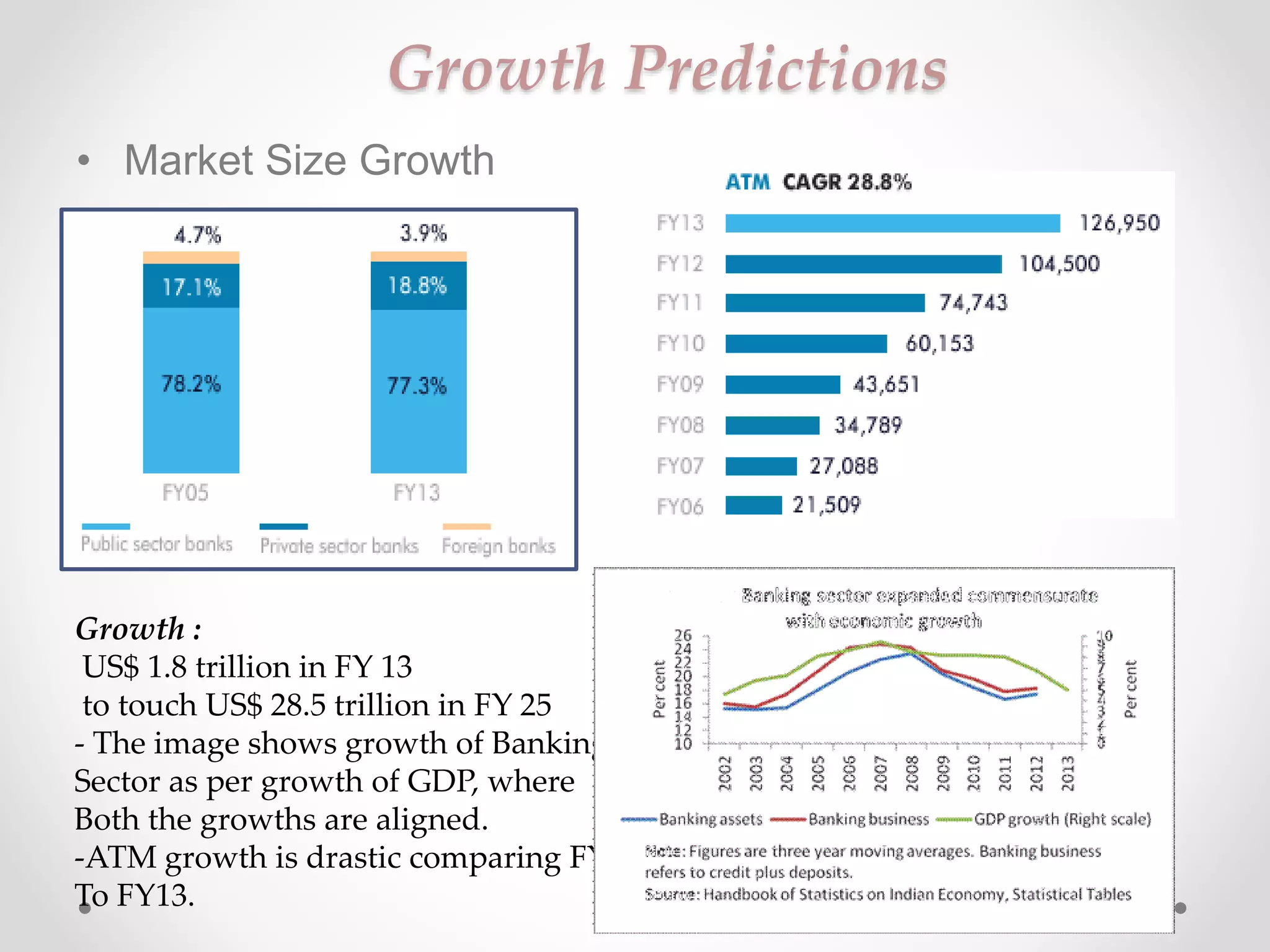
Growth Predictions 
• Market Size Growth 
Growth : 
US$ 1.8 trillion in FY 13 
to touch US$ 28.5 trillion in FY 25 
- The image shows growth of Banking 
Sector as per growth of GDP, where 
Both the growths are aligned. 
-ATM growth is drastic comparing FY06 
To FY13.
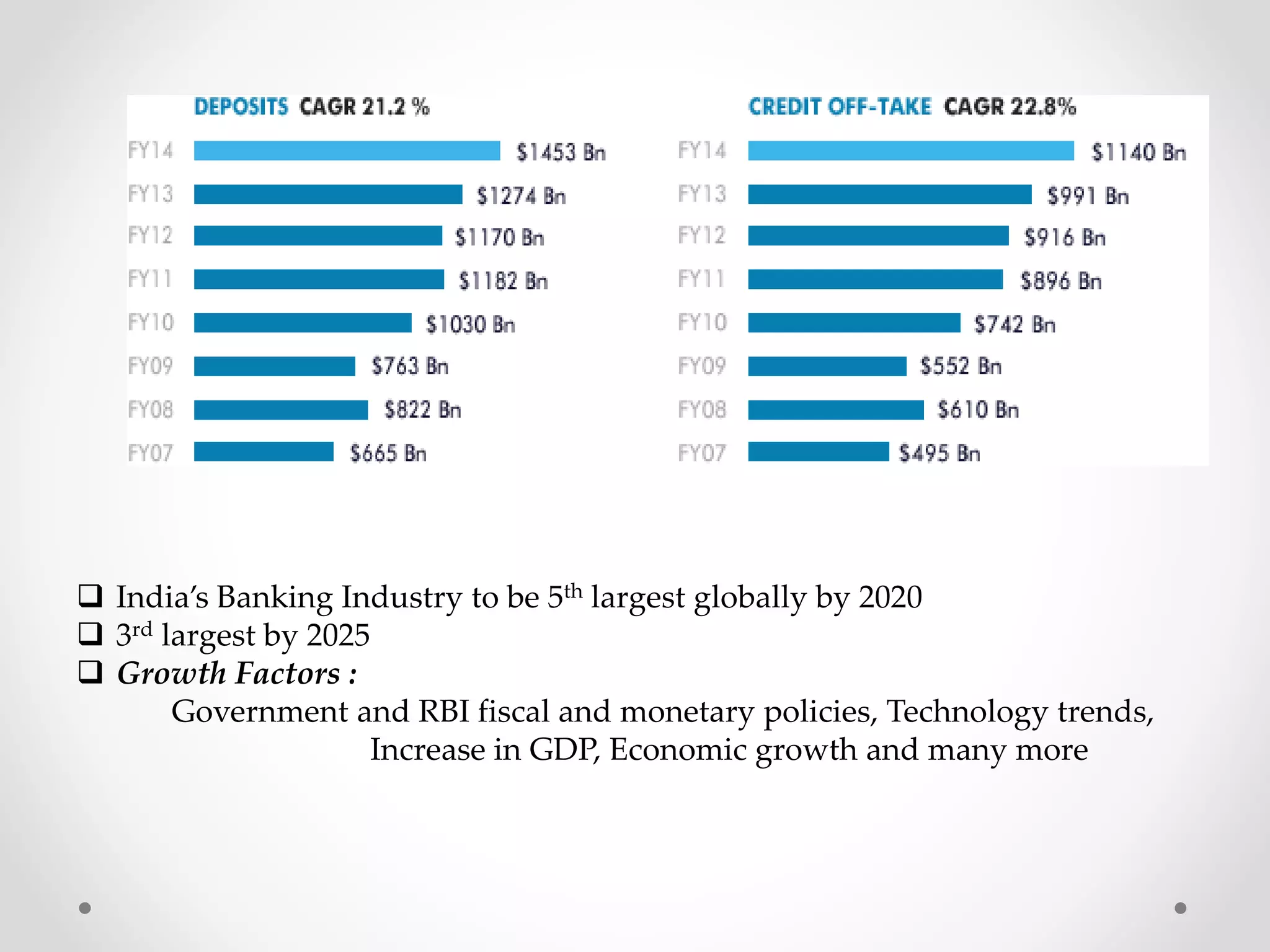
 India’s Banking Industry to be 5th largest globally by 2020 
 3rd largest by 2025 
 Growth Factors : 
Government and RBI fiscal and monetary policies, Technology trends, 
Increase in GDP, Economic growth and many more
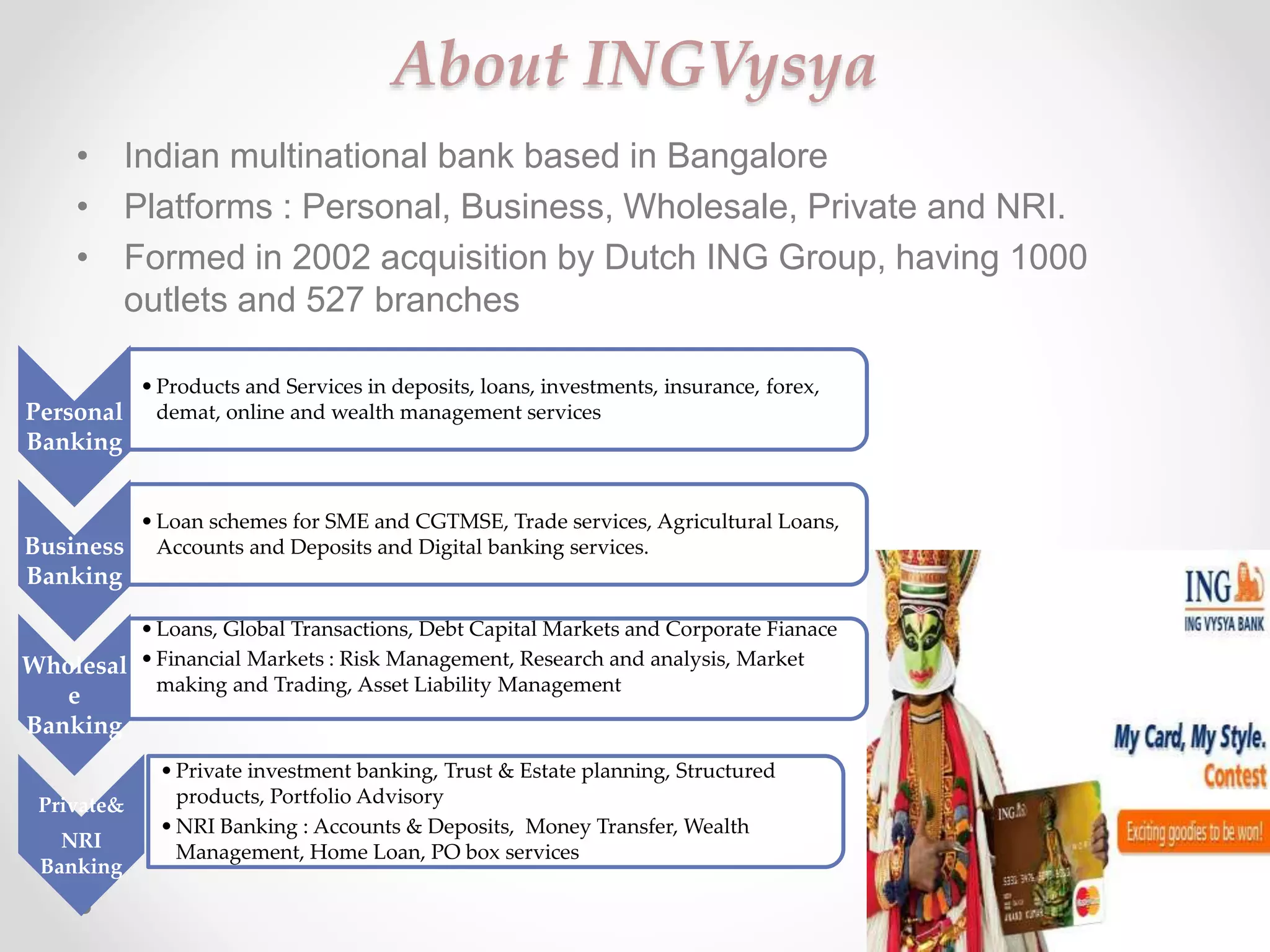
About INGVysya 
• Indian multinational bank based in Bangalore 
• Platforms : Personal, Business, Wholesale, Private and NRI. 
• Formed in 2002 acquisition by Dutch ING Group, having 1000 
outlets and 527 branches 
Personal 
Banking 
•Products and Services in deposits, loans, investments, insurance, forex, 
demat, online and wealth management services 
Business 
Banking 
•Loan schemes for SME and CGTMSE, Trade services, Agricultural Loans, 
Accounts and Deposits and Digital banking services. 
Wholesal 
e 
Banking 
•Loans, Global Transactions, Debt Capital Markets and Corporate Fianace 
• Financial Markets : Risk Management, Research and analysis, Market 
making and Trading, Asset Liability Management 
Private& 
NRI 
Banking 
•Private investment banking, Trust & Estate planning, Structured 
products, Portfolio Advisory 
• NRI Banking : Accounts & Deposits, Money Transfer, Wealth 
Management, Home Loan, PO box services
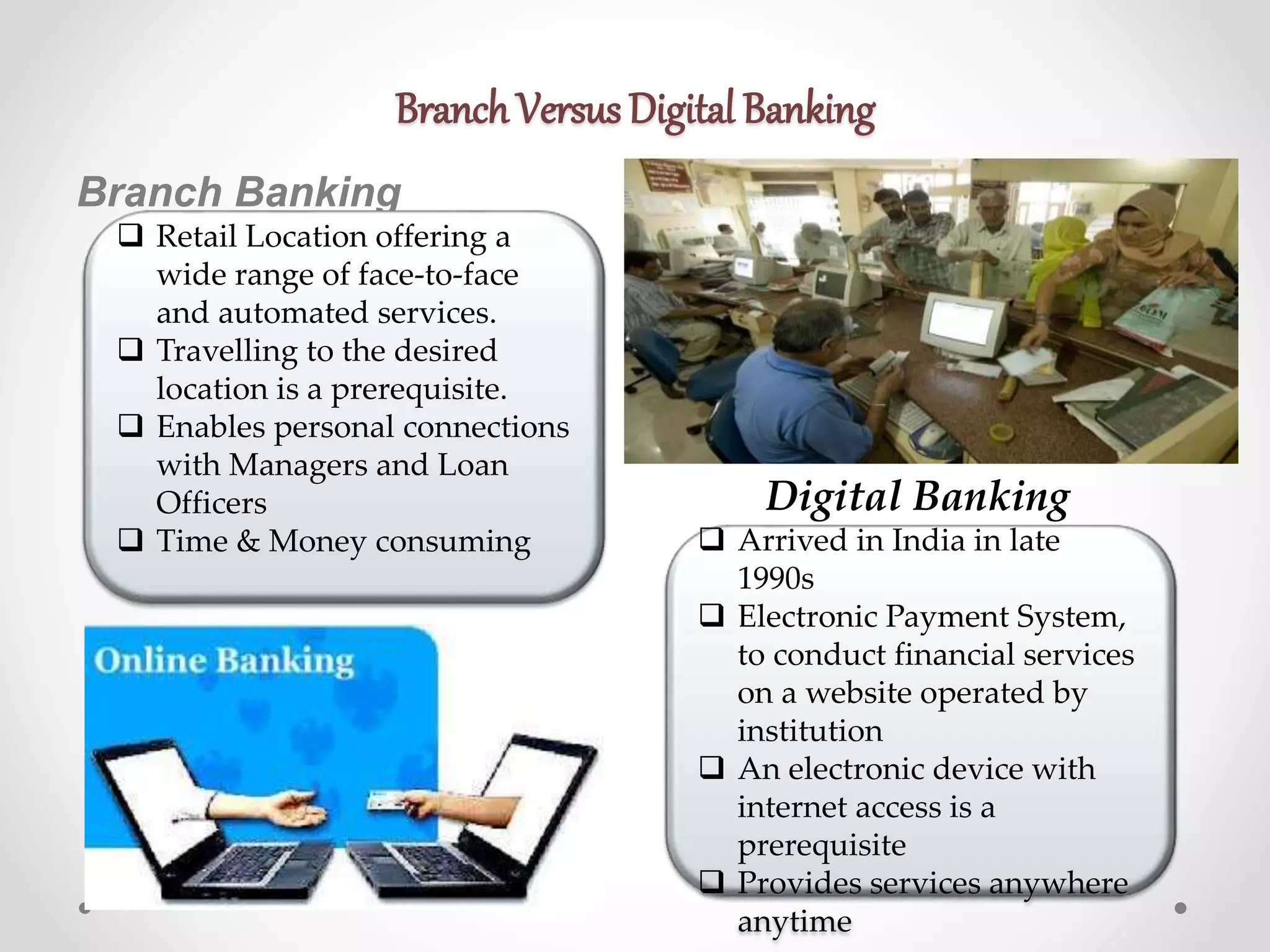
Branch Versus Digital Banking 
Branch Banking 
 Retail Location offering a 
wide range of face-to-face 
and automated services. 
 Travelling to the desired 
location is a prerequisite. 
 Enables personal connections 
with Managers and Loan 
Officers 
Digital Banking 
 Time & Money consuming  Arrived in India in late 
1990s 
 Electronic Payment System, 
to conduct financial services 
on a website operated by 
institution 
 An electronic device with 
internet access is a 
prerequisite 
 Provides services anywhere 
anytime
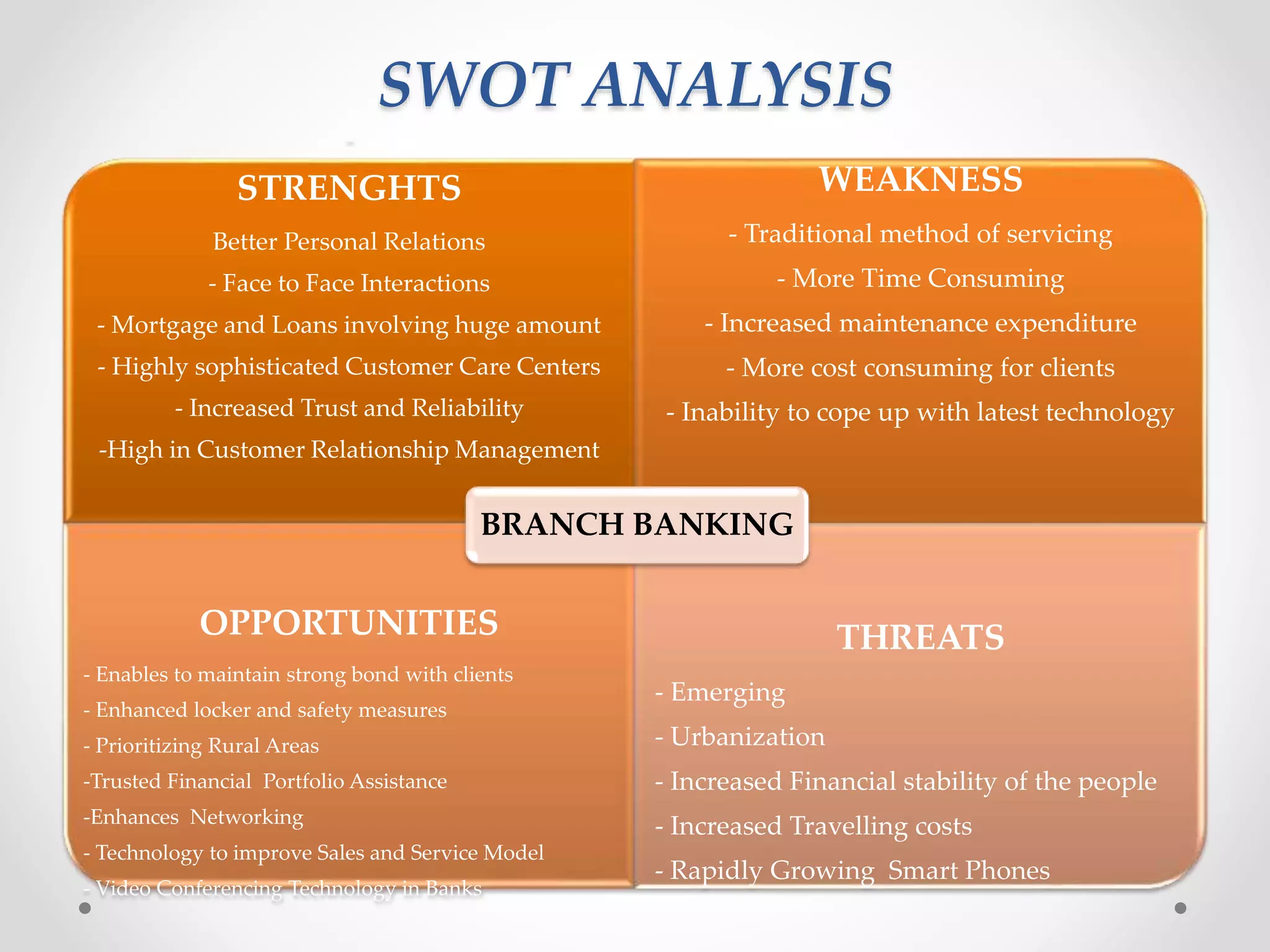
SWOT ANALYSIS 
- 
STRENGHTS 
Better Personal Relations 
- Face to Face Interactions 
- Mortgage and Loans involving huge amount 
- Highly sophisticated Customer Care Centers 
- Increased Trust and Reliability 
-High in Customer Relationship Management 
WEAKNESS 
- Traditional method of servicing 
- More Time Consuming 
- Increased maintenance expenditure 
- More cost consuming for clients 
- Inability to cope up with latest technology 
BRANCH BANKING 
OPPORTUNITIES 
- Enables to maintain strong bond with clients 
- Enhanced locker and safety measures 
- Prioritizing Rural Areas 
-Trusted Financial Portfolio Assistance 
-Enhances Networking 
- Technology to improve Sales and Service Model 
- Video Conferencing Technology in Banks 
THREATS 
- Emerging 
- Urbanization 
- Increased Financial stability of the people 
- Increased Travelling costs 
- Rapidly Growing Smart Phones
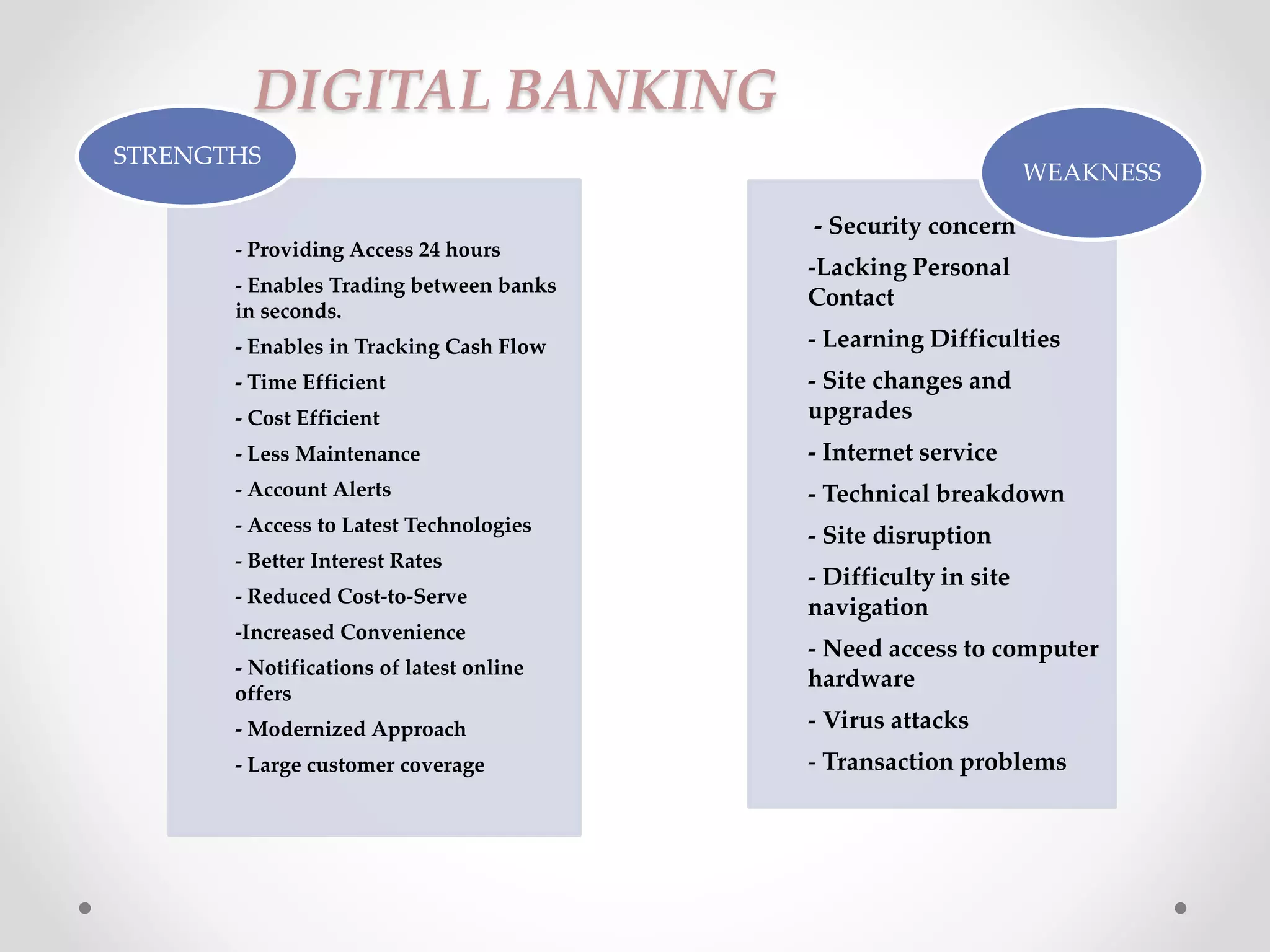
STRENGTHS 
- Providing Access 24 hours 
- Enables Trading between banks 
in seconds. 
- Enables in Tracking Cash Flow 
- Time Efficient 
- Cost Efficient 
- Less Maintenance 
- Account Alerts 
- Access to Latest Technologies 
- Better Interest Rates 
- Reduced Cost-to-Serve 
-Increased Convenience 
- Notifications of latest online 
offers 
- Modernized Approach 
- Large customer coverage 
WEAKNESS 
- Security concern 
-Lacking Personal 
Contact 
- Learning Difficulties 
- Site changes and 
upgrades 
- Internet service 
- Technical breakdown 
- Site disruption 
- Difficulty in site 
navigation 
- Need access to computer 
hardware 
- Virus attacks 
- Transaction problems 
DIGITAL BANKING
- 
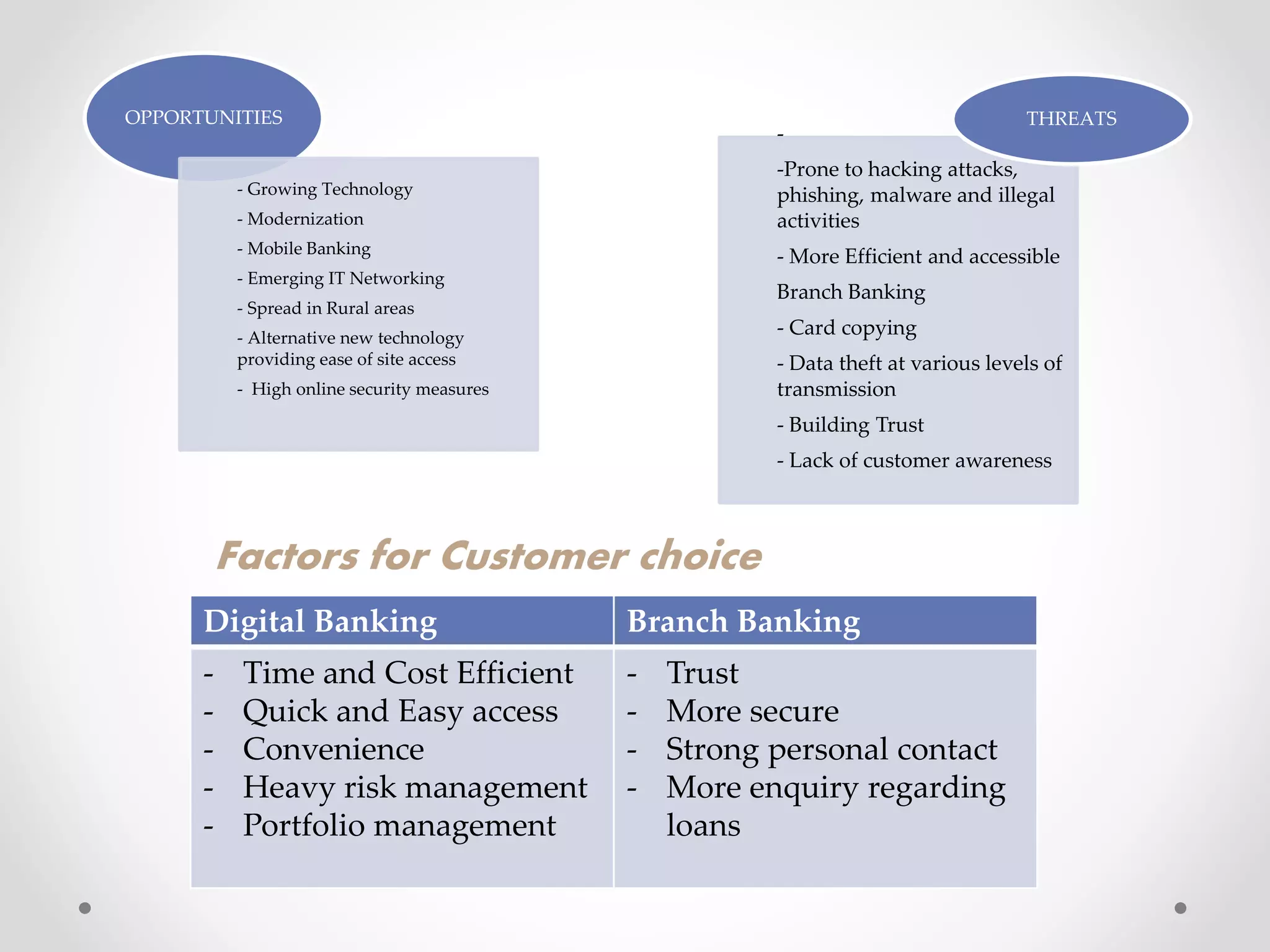
-Prone to hacking attacks, 
phishing, malware and illegal 
activities 
- More Efficient and accessible 
Branch Banking 
- Card copying 
- Data theft at various levels of 
transmission 
- Building Trust 
- Lack of customer awareness 
OPPORTUNITIES 
- Growing Technology 
- Modernization 
- Mobile Banking 
- Emerging IT Networking 
- Spread in Rural areas 
- Alternative new technology 
providing ease of site access 
- High online security measures 
THREATS 
Factors for Customer choice 
Digital Banking Branch Banking 
- Time and Cost Efficient 
- Quick and Easy access 
- Convenience 
- Heavy risk management 
- Portfolio management 
- Trust 
- More secure 
- Strong personal contact 
- More enquiry regarding 
loans
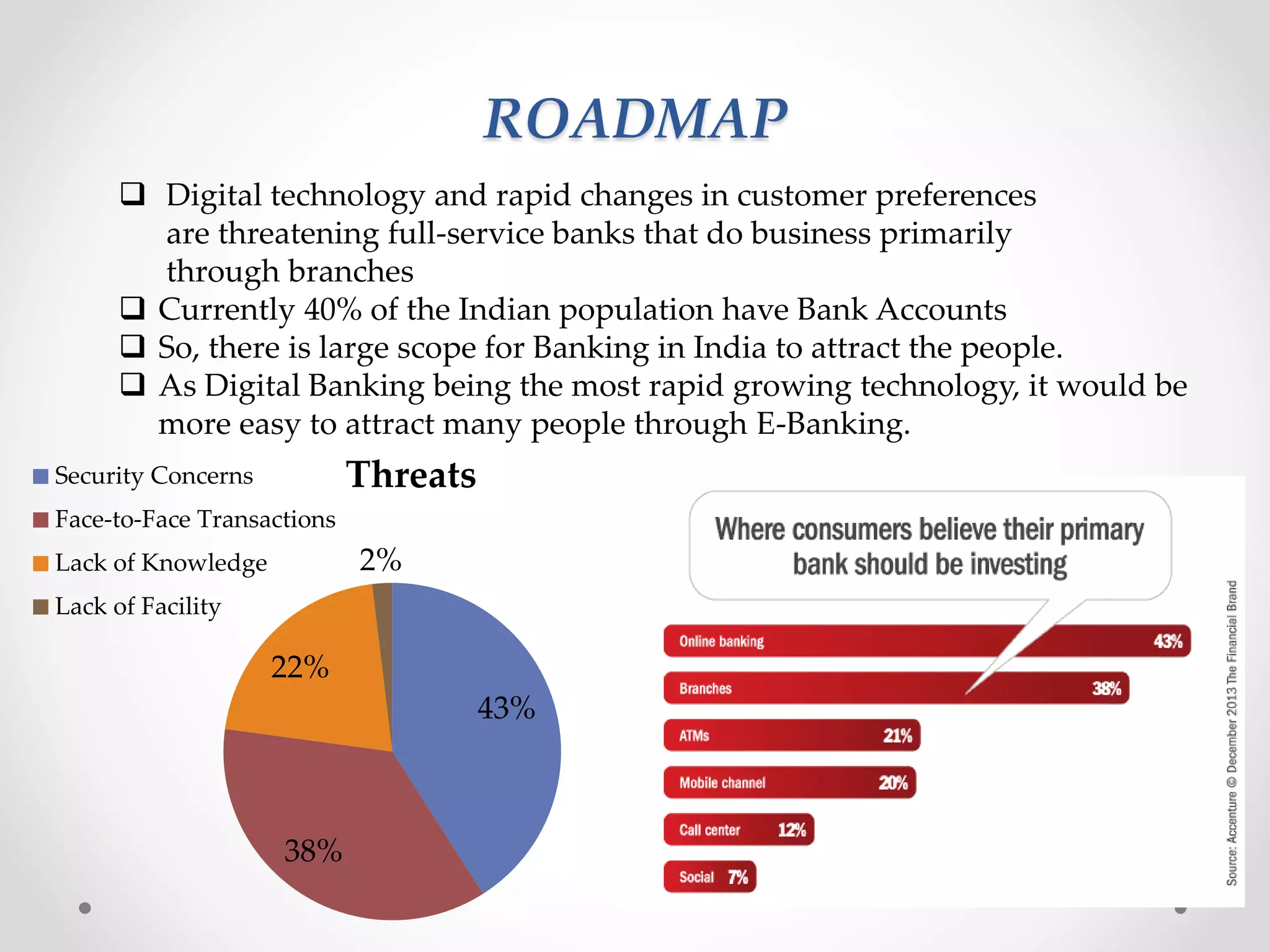
ROADMAP 
 Digital technology and rapid changes in customer preferences 
are threatening full-service banks that do business primarily 
through branches 
 Currently 40% of the Indian population have Bank Accounts 
 So, there is large scope for Banking in India to attract the people. 
 As Digital Banking being the most rapid growing technology, it would be 
more easy to attract many people through E-Banking. 
43% 
Security Concerns Threats 
Face-to-Face Transactions 
Lack of Knowledge 
Lack of Facility 
22% 
38% 
2%
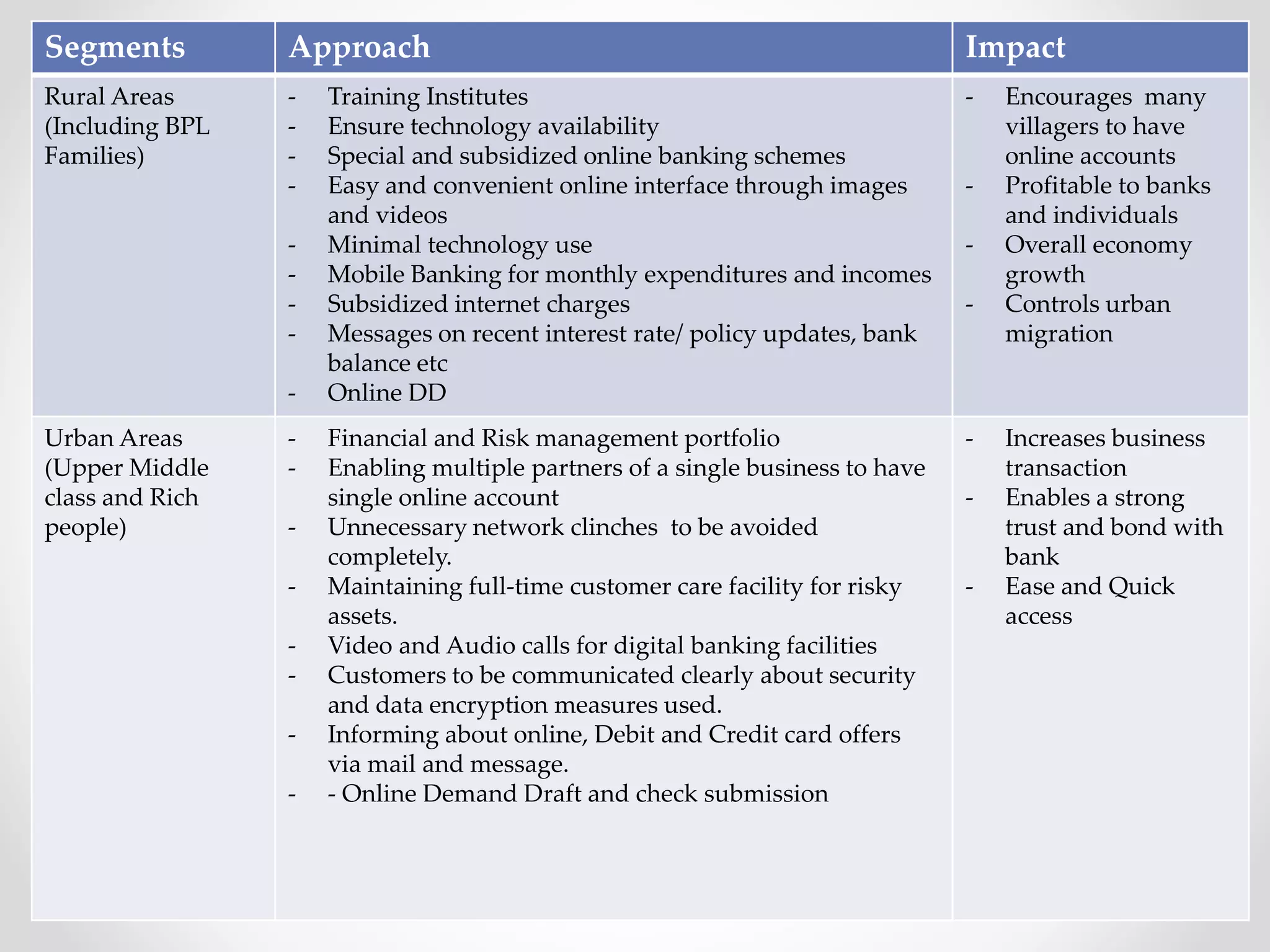
Segments Approach Impact 
Rural Areas 
(Including BPL 
Families) 
- Training Institutes 
- Ensure technology availability 
- Special and subsidized online banking schemes 
- Easy and convenient online interface through images 
and videos 
- Minimal technology use 
- Mobile Banking for monthly expenditures and incomes 
- Subsidized internet charges 
- Messages on recent interest rate/ policy updates, bank 
balance etc 
- Online DD 
- Encourages many 
villagers to have 
online accounts 
- Profitable to banks 
and individuals 
- Overall economy 
growth 
- Controls urban 
migration 
Urban Areas 
(Upper Middle 
class and Rich 
people) 
- Financial and Risk management portfolio 
- Enabling multiple partners of a single business to have 
single online account 
- Unnecessary network clinches to be avoided 
completely. 
- Maintaining full-time customer care facility for risky 
assets. 
- Video and Audio calls for digital banking facilities 
- Customers to be communicated clearly about security 
and data encryption measures used. 
- Informing about online, Debit and Credit card offers 
via mail and message. 
- - Online Demand Draft and check submission 
- Increases business 
transaction 
- Enables a strong 
trust and bond with 
bank 
- Ease and Quick 
access
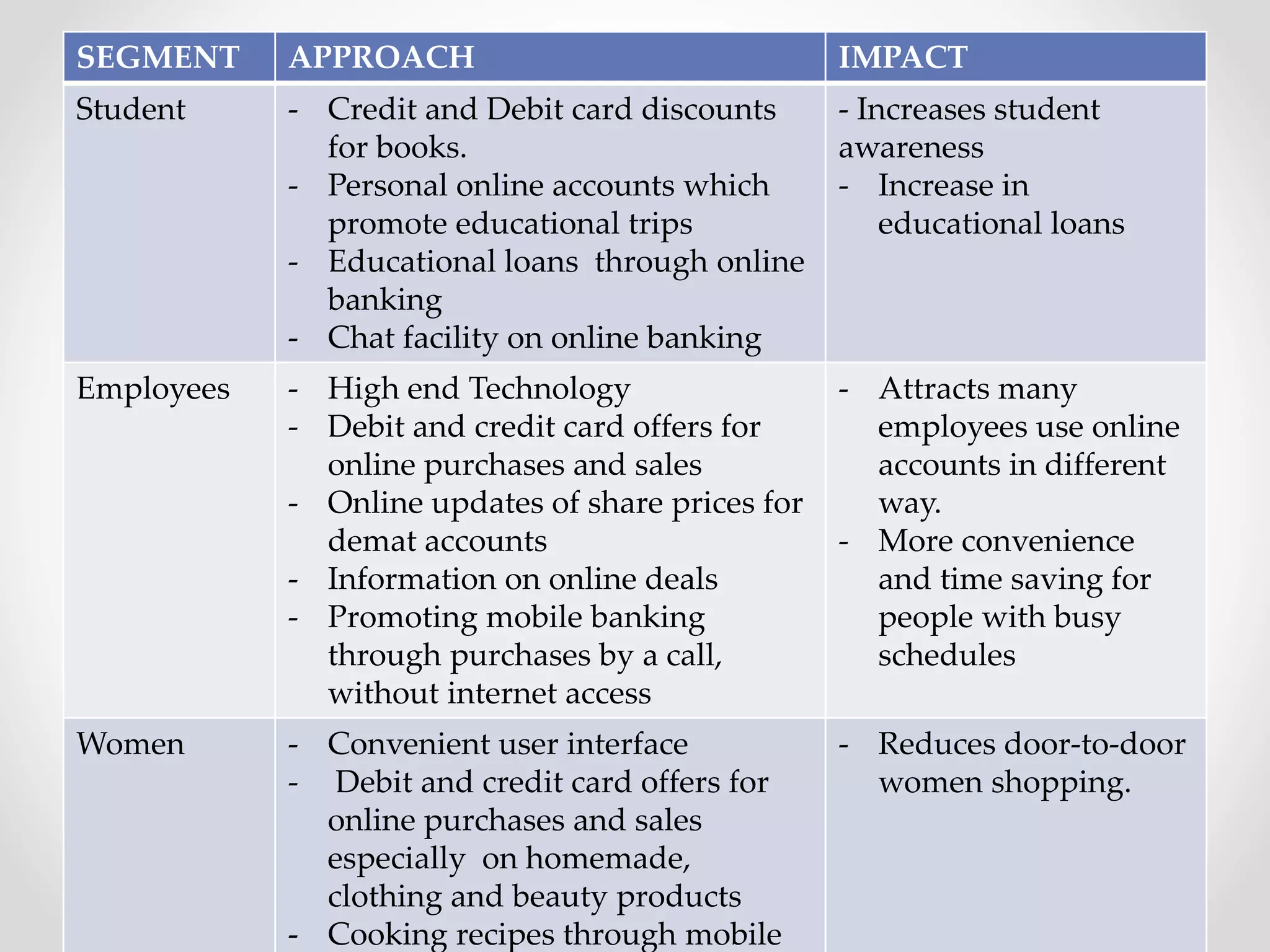
SEGMENT APPROACH IMPACT 
Student - Credit and Debit card discounts 
for books. 
- Personal online accounts which 
promote educational trips 
- Educational loans through online 
banking 
- Chat facility on online banking 
- Increases student 
awareness 
- Increase in 
educational loans 
Employees - High end Technology 
- Debit and credit card offers for 
online purchases and sales 
- Online updates of share prices for 
demat accounts 
- Information on online deals 
- Promoting mobile banking 
through purchases by a call, 
without internet access 
- Attracts many 
employees use online 
accounts in different 
way. 
- More convenience 
and time saving for 
people with busy 
schedules 
Women - Convenient user interface 
- Debit and credit card offers for 
online purchases and sales 
especially on homemade, 
clothing and beauty products 
- Cooking recipes through mobile 
- Reduces door-to-door 
women shopping.
Customer Insights 
• Primary Data : Survey on Digital banking conducted on 90 people, of which 90% 
of 15-25 age group, who are mostly students preferred Online Banking. 
• People between age group 26 – 40 who are mostly working population almost 60% 
preferred both online and branch banking 
• People above age of fifty who are not much aware of technology preferred traditional 
way of Branch Banking 
• Major Concerns for Digital Banking : 
• Security Concerns 
• Internet Access 
• Lack of Face to Face Interaction 
• Network Glitches 
• Difficulty in switching to multiple sites 
• Failure in transactions 
• Secondary Data : People are shifting from Branch to Digital Banking, growth of 
digital banking in urban areas increasing rapidly, same to ensured in rural. Rural 
population lack awareness and access to online banking.
• Executive Summary : 
A detailed analysis of Banking industry in India, the growth of 
banking sector in terms of deposits, rural and urban growth has 
been given. Further SWOT analysis of Branch and Digital 
banking is made. Customer Insights are collected from primary 
and secondary data sources. A long term roadmap for Digital 
banking segment wise along with impact is presented. 
Conclusion : 
India being one of the developing countries, where major 
economic growth is contributed by technology youth and working 
population are more convenient to digital banking. It offers many 
benefits at the same time has certain negative aspects which are 
to be nullified. 
Undoubtedly it is essential to have major investment in 
online banking, coming up with more customer benefits apps at 
the same time branch banking can be eradicated completely, it is 
essential too though plays minor role.
BIBLIOGRAPHY 
• http://smallbusiness.chron.com/online-banking-disadvantages-2248.html 
• http://info.shine.com/industry/banking-financial-services/8.html 
• http://gradestack.com/IBPS-Bank-PO-Clerk-by-Bank-Power/ 
Indian-Economy-Concepts-Understand/14347-2890-627-study-wtw 
• http://www.wbiworldconpro.com/uploads/ 
melbourne-conference-2013-november/banking/1384600741_607-Jamal.pdf 
• http://web.stanford.edu/~pdupas/Challenges_DupasEtAl2011.pdf 
• http://www.ibef.org/industry/banking-india.aspx 
• http://www.rbi.org.in/scripts/BS_SpeechesView.aspx?Id=810 
• http://www.ibef.org/industry/banking-india.aspx 
• http://www.accenture.com/us-en/Pages/ 
insight-retail-banking-survey-2013-us-retail-banking-digital-era.aspx 
• http://www.infosys.com/finacle/solutions/thought-papers 
/Documents/banking-in-emerging-economies.pdf
THANK YOU

Sruthi IFMR

  • 2.
    BANKING IN INDIA  Definition : Accepts deposits and lends the same to earn same to earn some profit  Now Banking is used for multipurpose : Saving, day-to-day transactions, Foreign exchange, maintaining financial portfolio and many more.  Reserve Bank of India : India’s central Bank, established on April 1, 1935.  RBI Maintains record of government expenditure and revenues, a controlling body for all others banks in the country.  In 1839, India’s first bank “Union Bank” was established but failed in 1848  In 1865, “Allahabad Bank” was established and considered as oldest surviving bank.  Now India has 1,10,000 branches and every year 7000 t0 8000 branches were open in last nine years  The size of banking assets in India totaled US$ 1.8 trillion in FY 13 and is expected to touch US$ 28.5 trillion in FY 25.  Banking services: Instantaneous money, ATMs, Digital Banking, Mobile Banking, BFSI sector  Banking now plays a role in day-to-day personal and business activities
  • 3.
    Growth Predictions •Market Size Growth Growth : US$ 1.8 trillion in FY 13 to touch US$ 28.5 trillion in FY 25 - The image shows growth of Banking Sector as per growth of GDP, where Both the growths are aligned. -ATM growth is drastic comparing FY06 To FY13.
  • 4.
     India’s BankingIndustry to be 5th largest globally by 2020  3rd largest by 2025  Growth Factors : Government and RBI fiscal and monetary policies, Technology trends, Increase in GDP, Economic growth and many more
  • 5.
    About INGVysya •Indian multinational bank based in Bangalore • Platforms : Personal, Business, Wholesale, Private and NRI. • Formed in 2002 acquisition by Dutch ING Group, having 1000 outlets and 527 branches Personal Banking •Products and Services in deposits, loans, investments, insurance, forex, demat, online and wealth management services Business Banking •Loan schemes for SME and CGTMSE, Trade services, Agricultural Loans, Accounts and Deposits and Digital banking services. Wholesal e Banking •Loans, Global Transactions, Debt Capital Markets and Corporate Fianace • Financial Markets : Risk Management, Research and analysis, Market making and Trading, Asset Liability Management Private& NRI Banking •Private investment banking, Trust & Estate planning, Structured products, Portfolio Advisory • NRI Banking : Accounts & Deposits, Money Transfer, Wealth Management, Home Loan, PO box services
  • 6.
    Branch Versus DigitalBanking Branch Banking  Retail Location offering a wide range of face-to-face and automated services.  Travelling to the desired location is a prerequisite.  Enables personal connections with Managers and Loan Officers Digital Banking  Time & Money consuming  Arrived in India in late 1990s  Electronic Payment System, to conduct financial services on a website operated by institution  An electronic device with internet access is a prerequisite  Provides services anywhere anytime
  • 7.
    SWOT ANALYSIS - STRENGHTS Better Personal Relations - Face to Face Interactions - Mortgage and Loans involving huge amount - Highly sophisticated Customer Care Centers - Increased Trust and Reliability -High in Customer Relationship Management WEAKNESS - Traditional method of servicing - More Time Consuming - Increased maintenance expenditure - More cost consuming for clients - Inability to cope up with latest technology BRANCH BANKING OPPORTUNITIES - Enables to maintain strong bond with clients - Enhanced locker and safety measures - Prioritizing Rural Areas -Trusted Financial Portfolio Assistance -Enhances Networking - Technology to improve Sales and Service Model - Video Conferencing Technology in Banks THREATS - Emerging - Urbanization - Increased Financial stability of the people - Increased Travelling costs - Rapidly Growing Smart Phones
  • 8.
    STRENGTHS - ProvidingAccess 24 hours - Enables Trading between banks in seconds. - Enables in Tracking Cash Flow - Time Efficient - Cost Efficient - Less Maintenance - Account Alerts - Access to Latest Technologies - Better Interest Rates - Reduced Cost-to-Serve -Increased Convenience - Notifications of latest online offers - Modernized Approach - Large customer coverage WEAKNESS - Security concern -Lacking Personal Contact - Learning Difficulties - Site changes and upgrades - Internet service - Technical breakdown - Site disruption - Difficulty in site navigation - Need access to computer hardware - Virus attacks - Transaction problems DIGITAL BANKING
  • 9.
    - -Prone tohacking attacks, phishing, malware and illegal activities - More Efficient and accessible Branch Banking - Card copying - Data theft at various levels of transmission - Building Trust - Lack of customer awareness OPPORTUNITIES - Growing Technology - Modernization - Mobile Banking - Emerging IT Networking - Spread in Rural areas - Alternative new technology providing ease of site access - High online security measures THREATS Factors for Customer choice Digital Banking Branch Banking - Time and Cost Efficient - Quick and Easy access - Convenience - Heavy risk management - Portfolio management - Trust - More secure - Strong personal contact - More enquiry regarding loans
  • 10.
    ROADMAP  Digitaltechnology and rapid changes in customer preferences are threatening full-service banks that do business primarily through branches  Currently 40% of the Indian population have Bank Accounts  So, there is large scope for Banking in India to attract the people.  As Digital Banking being the most rapid growing technology, it would be more easy to attract many people through E-Banking. 43% Security Concerns Threats Face-to-Face Transactions Lack of Knowledge Lack of Facility 22% 38% 2%
  • 11.
    Segments Approach Impact Rural Areas (Including BPL Families) - Training Institutes - Ensure technology availability - Special and subsidized online banking schemes - Easy and convenient online interface through images and videos - Minimal technology use - Mobile Banking for monthly expenditures and incomes - Subsidized internet charges - Messages on recent interest rate/ policy updates, bank balance etc - Online DD - Encourages many villagers to have online accounts - Profitable to banks and individuals - Overall economy growth - Controls urban migration Urban Areas (Upper Middle class and Rich people) - Financial and Risk management portfolio - Enabling multiple partners of a single business to have single online account - Unnecessary network clinches to be avoided completely. - Maintaining full-time customer care facility for risky assets. - Video and Audio calls for digital banking facilities - Customers to be communicated clearly about security and data encryption measures used. - Informing about online, Debit and Credit card offers via mail and message. - - Online Demand Draft and check submission - Increases business transaction - Enables a strong trust and bond with bank - Ease and Quick access
  • 12.
    SEGMENT APPROACH IMPACT Student - Credit and Debit card discounts for books. - Personal online accounts which promote educational trips - Educational loans through online banking - Chat facility on online banking - Increases student awareness - Increase in educational loans Employees - High end Technology - Debit and credit card offers for online purchases and sales - Online updates of share prices for demat accounts - Information on online deals - Promoting mobile banking through purchases by a call, without internet access - Attracts many employees use online accounts in different way. - More convenience and time saving for people with busy schedules Women - Convenient user interface - Debit and credit card offers for online purchases and sales especially on homemade, clothing and beauty products - Cooking recipes through mobile - Reduces door-to-door women shopping.
  • 13.
    Customer Insights •Primary Data : Survey on Digital banking conducted on 90 people, of which 90% of 15-25 age group, who are mostly students preferred Online Banking. • People between age group 26 – 40 who are mostly working population almost 60% preferred both online and branch banking • People above age of fifty who are not much aware of technology preferred traditional way of Branch Banking • Major Concerns for Digital Banking : • Security Concerns • Internet Access • Lack of Face to Face Interaction • Network Glitches • Difficulty in switching to multiple sites • Failure in transactions • Secondary Data : People are shifting from Branch to Digital Banking, growth of digital banking in urban areas increasing rapidly, same to ensured in rural. Rural population lack awareness and access to online banking.
  • 14.
    • Executive Summary: A detailed analysis of Banking industry in India, the growth of banking sector in terms of deposits, rural and urban growth has been given. Further SWOT analysis of Branch and Digital banking is made. Customer Insights are collected from primary and secondary data sources. A long term roadmap for Digital banking segment wise along with impact is presented. Conclusion : India being one of the developing countries, where major economic growth is contributed by technology youth and working population are more convenient to digital banking. It offers many benefits at the same time has certain negative aspects which are to be nullified. Undoubtedly it is essential to have major investment in online banking, coming up with more customer benefits apps at the same time branch banking can be eradicated completely, it is essential too though plays minor role.
  • 15.
    BIBLIOGRAPHY • http://smallbusiness.chron.com/online-banking-disadvantages-2248.html • http://info.shine.com/industry/banking-financial-services/8.html • http://gradestack.com/IBPS-Bank-PO-Clerk-by-Bank-Power/ Indian-Economy-Concepts-Understand/14347-2890-627-study-wtw • http://www.wbiworldconpro.com/uploads/ melbourne-conference-2013-november/banking/1384600741_607-Jamal.pdf • http://web.stanford.edu/~pdupas/Challenges_DupasEtAl2011.pdf • http://www.ibef.org/industry/banking-india.aspx • http://www.rbi.org.in/scripts/BS_SpeechesView.aspx?Id=810 • http://www.ibef.org/industry/banking-india.aspx • http://www.accenture.com/us-en/Pages/ insight-retail-banking-survey-2013-us-retail-banking-digital-era.aspx • http://www.infosys.com/finacle/solutions/thought-papers /Documents/banking-in-emerging-economies.pdf
  • 16.

Editor's Notes