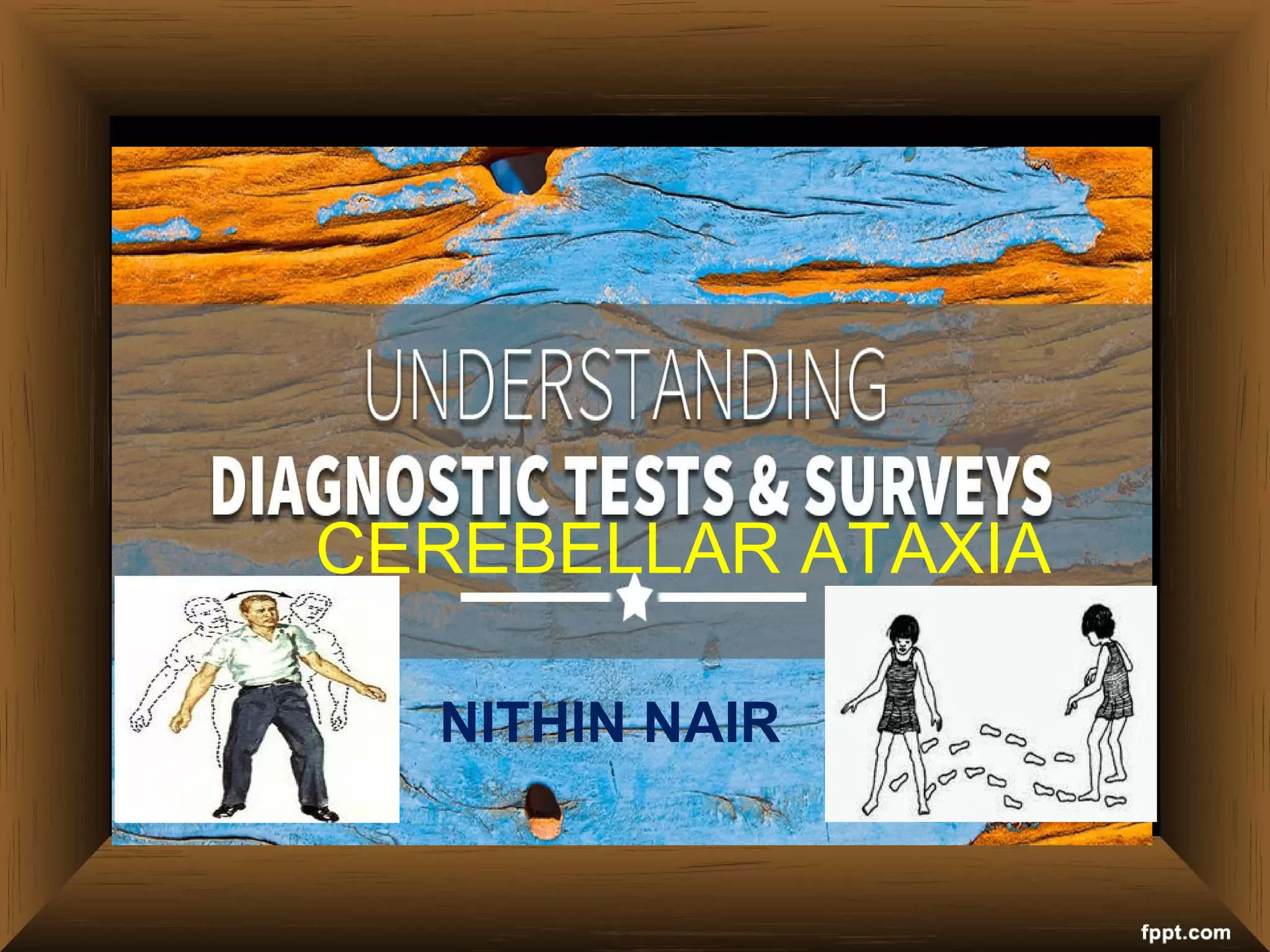
CEREBELLAR ATAXIA
NITHIN NAIR
DIAGNOSTIC INVESTIGATIONS
• Haematology: CBC, Creatinine, Liver
Enzymes, Electrophoresis, ESR, CRP, TFT,
Vitamin B12, Cholestrol – helps to evaluate overall
health and detect a range of disorders inculding
infection and heavy metal poisoning
DIAGNOSTIC INVESTIGATIONS
• Urine tests: Urine analysis may suggest –
systemic abnormalities related to some forms
of ataxia. Wilson’s disease – screen 24 hrs
urine collection for copper.
DIAGNOSTIC INVESTIGATIONS
• Imaging studies: A computerized
tomography (CT) scan or Magnetic Resonance
Imaging (MRI) of brain may help to determine
potential causes.
DIAGNOSTIC INVESTIGATIONS
• Genetic testing: It is done to determine whether
a patient, particularly a child has the gene mutation
that causes one of the hereditary ataxic conditions.
Chromosomal studies are performed on peripheral
blood lymphocytes and cultured skin fibroblasts
DIAGNOSTIC INVESTIGATIONS
• Brainstem Auditory Potential (BAEP or BAER):
Helpful to determine the presence of intact
central pathways and may also provide some
information about central (brainstem)
projection pathways associated with hearing.
DIAGNOSTIC INVESTIGATIONS
• Lumbar Puncture: CSF analysis is helpful
primarily to determine the presence of
inflammatory diseases.
ASSESSMENT
• HISTORY: History taking needs following consideration –
 Duration (Acute, subacute, chronic)
 Symmetry
 Rate of progression (static, episodic, progressive)
 Associated features (headache, vomiting, dystonia/chorea,
proprioceptive dysfunction, visual deficits, auditory
involement)
 Medical history (infection, medications/intoxications,
environmental exposures)
 Family history (suggest genetic disorder – autosomal recessive
transmission/ autosomal dominant inheritence)
ASSESSMENT
• ON OBSERVATION
• PAIN ASSESSMENT
• ON EXAMINATION
HIGHER CENTRES (COGNITION, MEMORY,
ORIENTATION, SPEECH, PROBLEM SOLVING)
CRANIAL NERVES (II, III, IV, VI, VIII)
SENSORY ASSESSMENT
MOTOR ASSESSMENT (TONE, REFLEXES,
ROM, MUSCLE POWER, VCA, TREMOR)
ASSESSMENT
 BALANCE (BBS, FUNCTIONAL REACH TEST, TIMED UP
& GO, FRIEDREICH ATAXIA RATING SCALE)
 GAIT (DGI, OBSERVATIONAL GAIT ANALYSIS-SPEED,
SYMMETRY, LEVEL OF INDEPENDENCE)
 CO-ORDINATION (EQUILIBRIUM, NON-EQUILIBRIUM)
 CARDIOVASCULAR (SUBMAXIMAL GRADED EXERCISE
TESTING)
 FATIGUE (MODIFIED FATIGUE IMPACT SCALE)
 FUNCTION AND DISABILITY (FIM, BARTHEL INDEX)
 SPECIFIC SCALES (INTERNATIONAL COOPERATIVE
ATAXIA RATING SCALE, SCALE FOR ASSESSMENT
AND RATING OF ATAXIA)
TYPICAL CLINICAL TEST
• HYPOTONIA:
SPECIFIC TEST POSITIVE
MUSCLE PALPATION Reduced firmness
PASSIVE SHAKING OF
LIMBS
Moves through greater arc of
motion
HOLD OBJECTS WHILE
CONVERSING
Drops when distracted
VOL.FLEXION-EXTENSION
OF KNEE OR ELBOW
(SUPPORTED/UNSUPPORTED)
Ataxic when unsupported,
controlled when supported
FLEX ONE FINGER ONLY All fingers flex
TYPICAL CLINICAL TEST
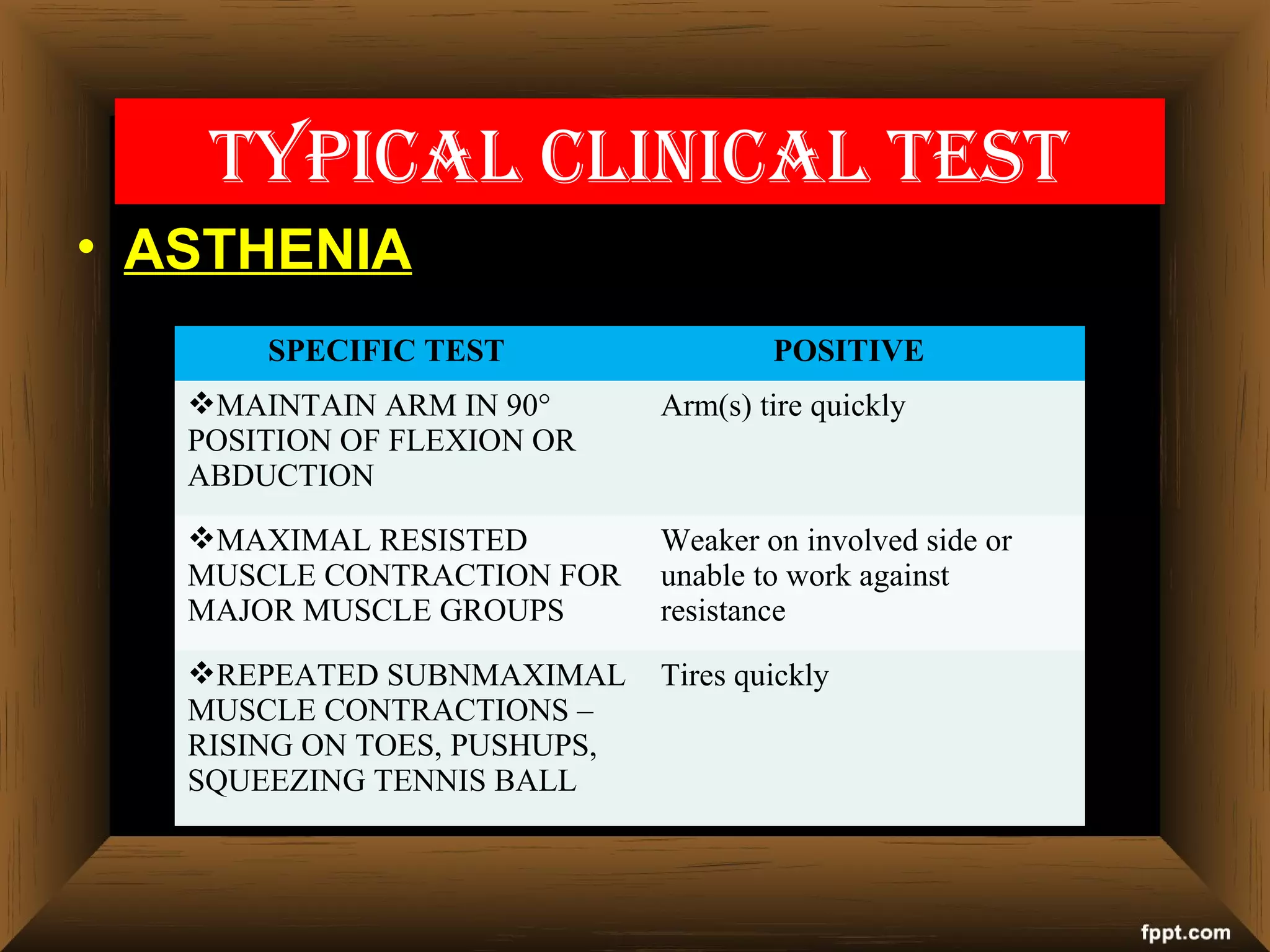
• ASTHENIA
SPECIFIC TEST POSITIVE
MAINTAIN ARM IN 90°
POSITION OF FLEXION OR
ABDUCTION
Arm(s) tire quickly
MAXIMAL RESISTED
MUSCLE CONTRACTION FOR
MAJOR MUSCLE GROUPS
Weaker on involved side or
unable to work against
resistance
REPEATED SUBNMAXIMAL
MUSCLE CONTRACTIONS –
RISING ON TOES, PUSHUPS,
SQUEEZING TENNIS BALL
Tires quickly
TYPICAL CLINICAL TEST
• BALANCE AND POSTURAL CONTROL
SPECIFIC TEST POSITIVE
OBSERVATION-
STANDING POSTURE
Feet apart, trunk flexed slightly,
needs to hold for stability,
postural tremor of legs
HOLD LIMB AGAINST
PULL OF GRAVITY
Postural tremor
NUDGE CLIENT
UNEXPECTEDLY WHEN
SITTING OR STANDING
Loses balance
STAND ON ONE FOOT OR
WALK BACKWARD
Loses balance
TYPICAL CLINICAL TEST
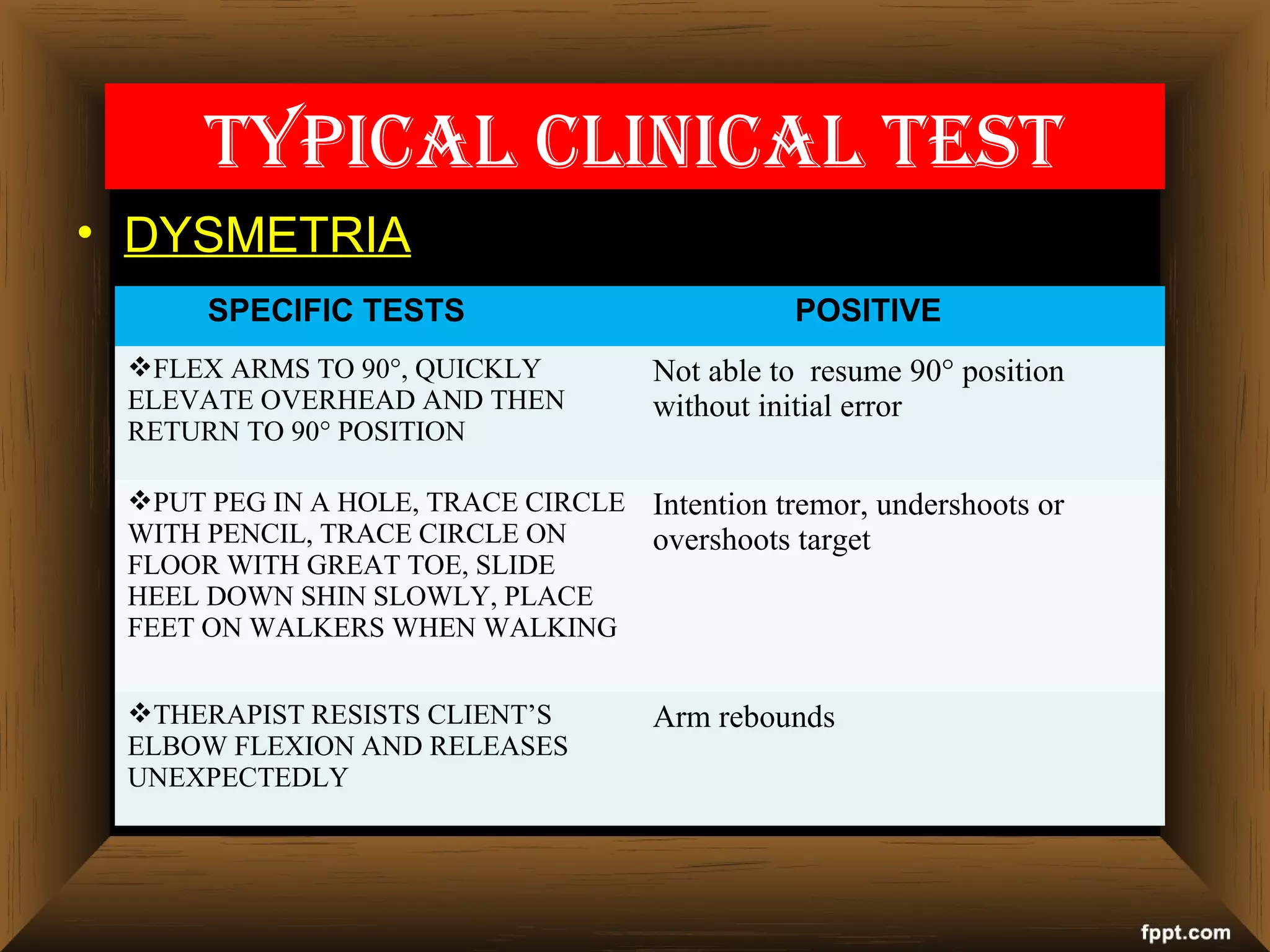
• DYSMETRIA
SPECIFIC TESTS POSITIVE
FLEX ARMS TO 90°, QUICKLY
ELEVATE OVERHEAD AND THEN
RETURN TO 90° POSITION
Not able to resume 90° position
without initial error
PUT PEG IN A HOLE, TRACE CIRCLE
WITH PENCIL, TRACE CIRCLE ON
FLOOR WITH GREAT TOE, SLIDE
HEEL DOWN SHIN SLOWLY, PLACE
FEET ON WALKERS WHEN WALKING
Intention tremor, undershoots or
overshoots target
THERAPIST RESISTS CLIENT’S
ELBOW FLEXION AND RELEASES
UNEXPECTEDLY
Arm rebounds
TYPICAL CLINICAL TEST
SPECIFIC TESTS POSITIVE
MARCH TO CADENCE Unable to follow rhythm
WALK ON HEELS OR TOES Loses balance and rhythm
WALK CLOCKWISE AND
COUNTERWISE
Stumbles in one direction
WALK ON UNEVEN GROUND Cannot compensate and stumbles
OBSERVATION- TYPICAL GAIT
PATTERN
Slow, stumbles easily, not rhythmical,
step length irregular
GAIT DISTUBANCE
TYPICAL CLINICAL TEST
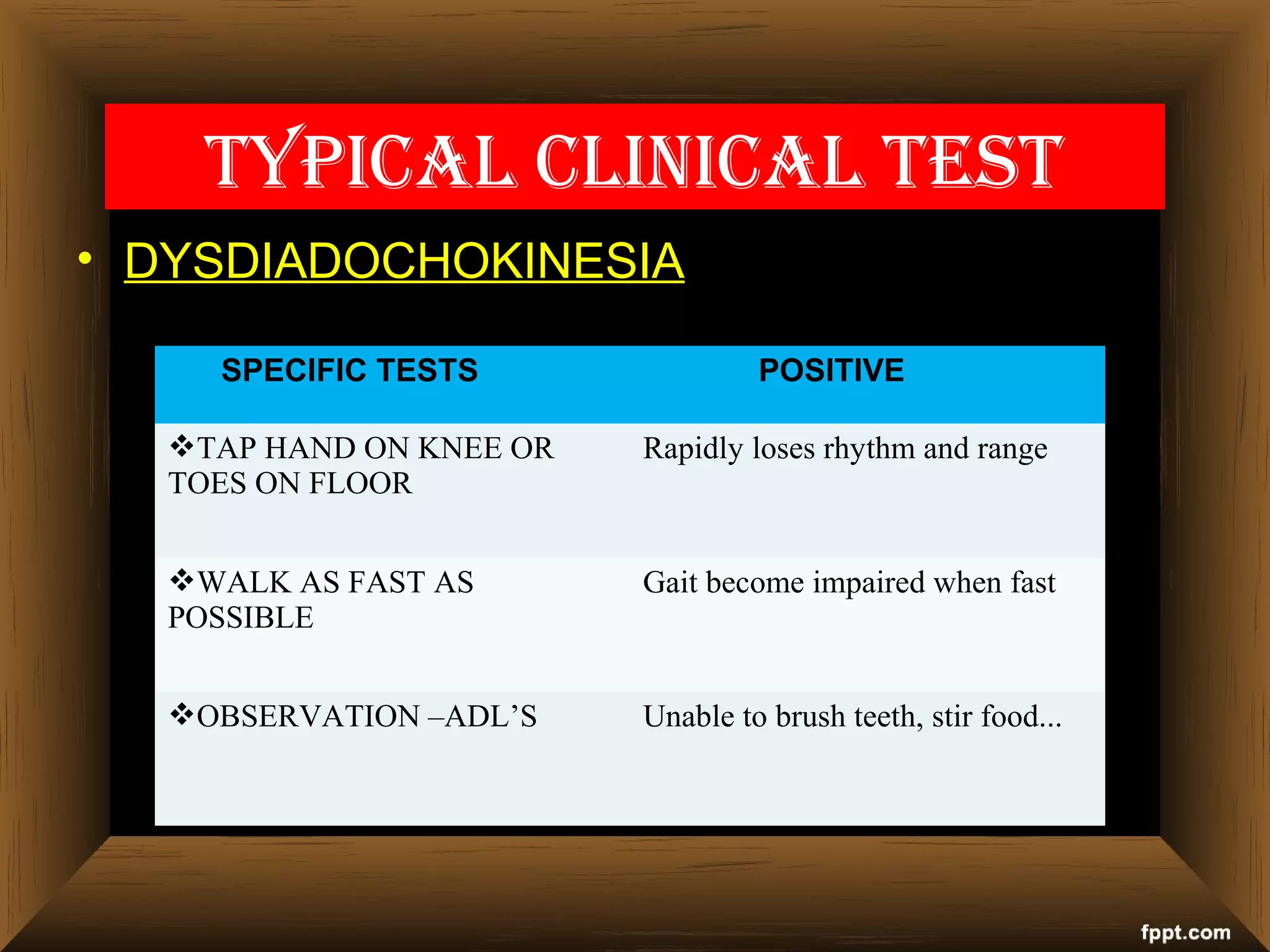
• DYSDIADOCHOKINESIA
SPECIFIC TESTS POSITIVE
TAP HAND ON KNEE OR
TOES ON FLOOR
Rapidly loses rhythm and range
WALK AS FAST AS
POSSIBLE
Gait become impaired when fast
OBSERVATION –ADL’S Unable to brush teeth, stir food...
TYPICAL CLINICAL TEST
• MOVEMENT DECOMPOSITION:
SPECIFIC TESTS POSITIVE
SUPINE- CLIENT TOUCHES
HEEL TO OPPOSITE KNEE
Movement broken into separate
phases – does not flow
OBSERVATION – TYPICAL
MOVEMENT
Activity appears as if in a slow
motion – mechanical like a
puppet
TYPICAL CLINICAL TEST
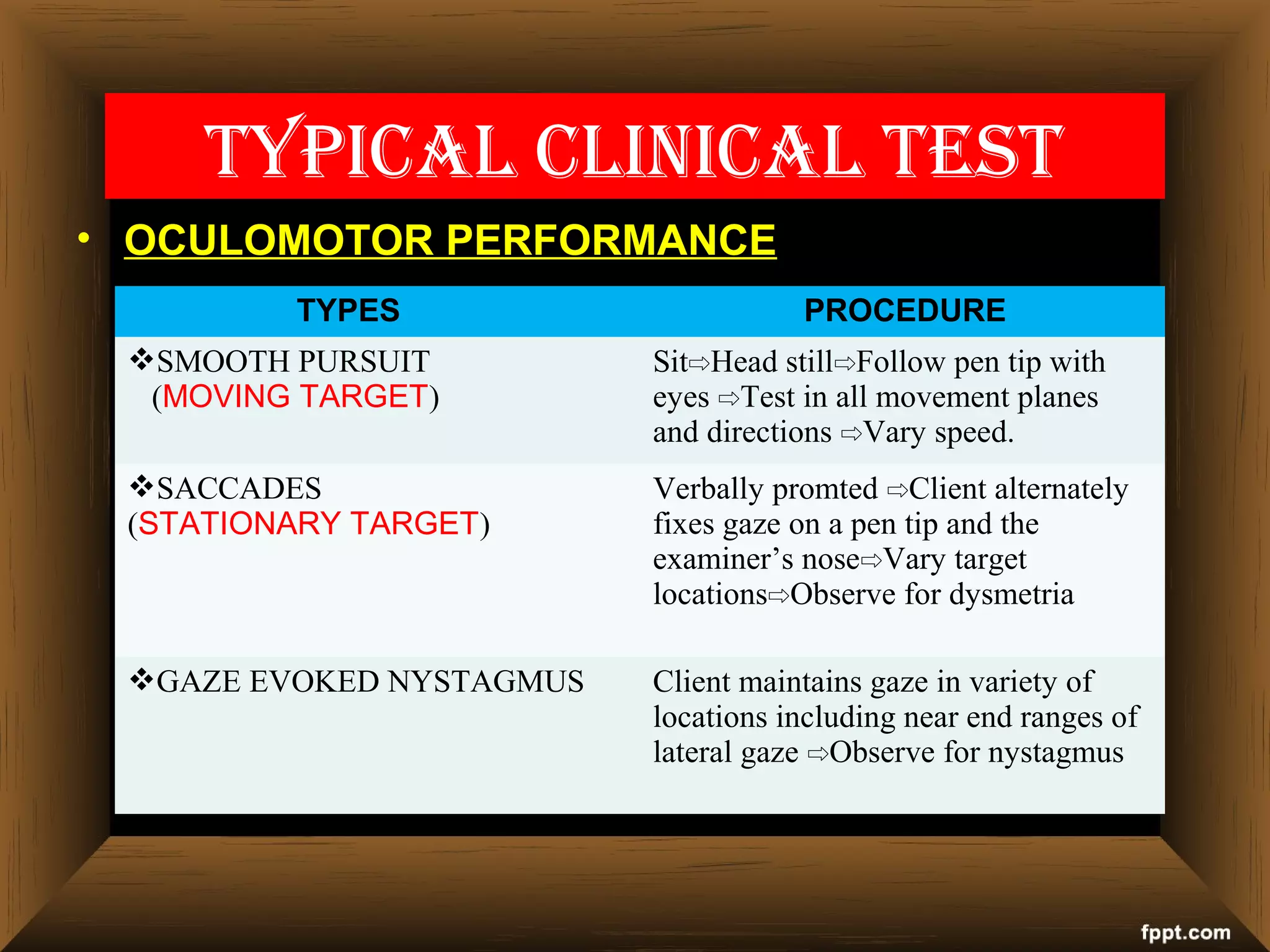
• OCULOMOTOR PERFORMANCE
TYPES PROCEDURE
SMOOTH PURSUIT
(MOVING TARGET)
Sit Head still Follow pen tip with⇨ ⇨
eyes Test in all movement planes⇨
and directions Vary speed.⇨
SACCADES
(STATIONARY TARGET)
Verbally promted Client alternately⇨
fixes gaze on a pen tip and the
examiner’s nose Vary target⇨
locations Observe for dysmetria⇨
GAZE EVOKED NYSTAGMUS Client maintains gaze in variety of
locations including near end ranges of
lateral gaze Observe for nystagmus⇨
REFERENCE....
Neurological Rehabilitation - Darcy
Umphred (5th
and 6th
edition)
Neurorehabilitation (Neurogen) – Dr.
VC Jacob
Text book of Neurology – Navneet
kumar

Ataxia diagnosis and assessment

  • 1.
  • 2.
    DIAGNOSTIC INVESTIGATIONS • Haematology:CBC, Creatinine, Liver Enzymes, Electrophoresis, ESR, CRP, TFT, Vitamin B12, Cholestrol – helps to evaluate overall health and detect a range of disorders inculding infection and heavy metal poisoning
  • 3.
    DIAGNOSTIC INVESTIGATIONS • Urinetests: Urine analysis may suggest – systemic abnormalities related to some forms of ataxia. Wilson’s disease – screen 24 hrs urine collection for copper.
  • 4.
    DIAGNOSTIC INVESTIGATIONS • Imagingstudies: A computerized tomography (CT) scan or Magnetic Resonance Imaging (MRI) of brain may help to determine potential causes.
  • 5.
    DIAGNOSTIC INVESTIGATIONS • Genetictesting: It is done to determine whether a patient, particularly a child has the gene mutation that causes one of the hereditary ataxic conditions. Chromosomal studies are performed on peripheral blood lymphocytes and cultured skin fibroblasts
  • 6.
    DIAGNOSTIC INVESTIGATIONS • BrainstemAuditory Potential (BAEP or BAER): Helpful to determine the presence of intact central pathways and may also provide some information about central (brainstem) projection pathways associated with hearing.
  • 7.
    DIAGNOSTIC INVESTIGATIONS • LumbarPuncture: CSF analysis is helpful primarily to determine the presence of inflammatory diseases.
  • 9.
    ASSESSMENT • HISTORY: Historytaking needs following consideration –  Duration (Acute, subacute, chronic)  Symmetry  Rate of progression (static, episodic, progressive)  Associated features (headache, vomiting, dystonia/chorea, proprioceptive dysfunction, visual deficits, auditory involement)  Medical history (infection, medications/intoxications, environmental exposures)  Family history (suggest genetic disorder – autosomal recessive transmission/ autosomal dominant inheritence)
  • 10.
    ASSESSMENT • ON OBSERVATION •PAIN ASSESSMENT • ON EXAMINATION HIGHER CENTRES (COGNITION, MEMORY, ORIENTATION, SPEECH, PROBLEM SOLVING) CRANIAL NERVES (II, III, IV, VI, VIII) SENSORY ASSESSMENT MOTOR ASSESSMENT (TONE, REFLEXES, ROM, MUSCLE POWER, VCA, TREMOR)
  • 11.
    ASSESSMENT  BALANCE (BBS,FUNCTIONAL REACH TEST, TIMED UP & GO, FRIEDREICH ATAXIA RATING SCALE)  GAIT (DGI, OBSERVATIONAL GAIT ANALYSIS-SPEED, SYMMETRY, LEVEL OF INDEPENDENCE)  CO-ORDINATION (EQUILIBRIUM, NON-EQUILIBRIUM)  CARDIOVASCULAR (SUBMAXIMAL GRADED EXERCISE TESTING)  FATIGUE (MODIFIED FATIGUE IMPACT SCALE)  FUNCTION AND DISABILITY (FIM, BARTHEL INDEX)  SPECIFIC SCALES (INTERNATIONAL COOPERATIVE ATAXIA RATING SCALE, SCALE FOR ASSESSMENT AND RATING OF ATAXIA)
  • 12.
    TYPICAL CLINICAL TEST •HYPOTONIA: SPECIFIC TEST POSITIVE MUSCLE PALPATION Reduced firmness PASSIVE SHAKING OF LIMBS Moves through greater arc of motion HOLD OBJECTS WHILE CONVERSING Drops when distracted VOL.FLEXION-EXTENSION OF KNEE OR ELBOW (SUPPORTED/UNSUPPORTED) Ataxic when unsupported, controlled when supported FLEX ONE FINGER ONLY All fingers flex
  • 13.
    TYPICAL CLINICAL TEST •ASTHENIA SPECIFIC TEST POSITIVE MAINTAIN ARM IN 90° POSITION OF FLEXION OR ABDUCTION Arm(s) tire quickly MAXIMAL RESISTED MUSCLE CONTRACTION FOR MAJOR MUSCLE GROUPS Weaker on involved side or unable to work against resistance REPEATED SUBNMAXIMAL MUSCLE CONTRACTIONS – RISING ON TOES, PUSHUPS, SQUEEZING TENNIS BALL Tires quickly
  • 14.
    TYPICAL CLINICAL TEST •BALANCE AND POSTURAL CONTROL SPECIFIC TEST POSITIVE OBSERVATION- STANDING POSTURE Feet apart, trunk flexed slightly, needs to hold for stability, postural tremor of legs HOLD LIMB AGAINST PULL OF GRAVITY Postural tremor NUDGE CLIENT UNEXPECTEDLY WHEN SITTING OR STANDING Loses balance STAND ON ONE FOOT OR WALK BACKWARD Loses balance
  • 15.
    TYPICAL CLINICAL TEST •DYSMETRIA SPECIFIC TESTS POSITIVE FLEX ARMS TO 90°, QUICKLY ELEVATE OVERHEAD AND THEN RETURN TO 90° POSITION Not able to resume 90° position without initial error PUT PEG IN A HOLE, TRACE CIRCLE WITH PENCIL, TRACE CIRCLE ON FLOOR WITH GREAT TOE, SLIDE HEEL DOWN SHIN SLOWLY, PLACE FEET ON WALKERS WHEN WALKING Intention tremor, undershoots or overshoots target THERAPIST RESISTS CLIENT’S ELBOW FLEXION AND RELEASES UNEXPECTEDLY Arm rebounds
  • 16.
    TYPICAL CLINICAL TEST SPECIFICTESTS POSITIVE MARCH TO CADENCE Unable to follow rhythm WALK ON HEELS OR TOES Loses balance and rhythm WALK CLOCKWISE AND COUNTERWISE Stumbles in one direction WALK ON UNEVEN GROUND Cannot compensate and stumbles OBSERVATION- TYPICAL GAIT PATTERN Slow, stumbles easily, not rhythmical, step length irregular GAIT DISTUBANCE
  • 17.
    TYPICAL CLINICAL TEST •DYSDIADOCHOKINESIA SPECIFIC TESTS POSITIVE TAP HAND ON KNEE OR TOES ON FLOOR Rapidly loses rhythm and range WALK AS FAST AS POSSIBLE Gait become impaired when fast OBSERVATION –ADL’S Unable to brush teeth, stir food...
  • 18.
    TYPICAL CLINICAL TEST •MOVEMENT DECOMPOSITION: SPECIFIC TESTS POSITIVE SUPINE- CLIENT TOUCHES HEEL TO OPPOSITE KNEE Movement broken into separate phases – does not flow OBSERVATION – TYPICAL MOVEMENT Activity appears as if in a slow motion – mechanical like a puppet
  • 19.
    TYPICAL CLINICAL TEST •OCULOMOTOR PERFORMANCE TYPES PROCEDURE SMOOTH PURSUIT (MOVING TARGET) Sit Head still Follow pen tip with⇨ ⇨ eyes Test in all movement planes⇨ and directions Vary speed.⇨ SACCADES (STATIONARY TARGET) Verbally promted Client alternately⇨ fixes gaze on a pen tip and the examiner’s nose Vary target⇨ locations Observe for dysmetria⇨ GAZE EVOKED NYSTAGMUS Client maintains gaze in variety of locations including near end ranges of lateral gaze Observe for nystagmus⇨
  • 20.
    REFERENCE.... Neurological Rehabilitation -Darcy Umphred (5th and 6th edition) Neurorehabilitation (Neurogen) – Dr. VC Jacob Text book of Neurology – Navneet kumar