Presentedby,
Priyadarshini. R
M.Pharm(sem-I)
DEPT OF PHARM.CHEMISTRY
CONTENTS
Introduction
Reaction
Mechanism
Application
Scope
Conclusion
Reference
INTRODUCTION
First observedby Henry Gilman in early 1950 -
Suggestedthe migration of the Si group.
Extensively developedin 1957 by Adrian G. Brook -
Proposed a nucleophilic attack of oxygen to α-silicon
atom.
INTRODUCTION
Adrian Gibbs Brook discovered the
rearrangement in 1974.
Brook did mechanistic studies as well.
He was first to synthesis a silicon-carbon
double bond
DEFINITION
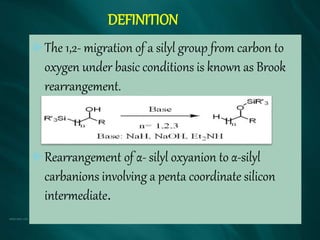
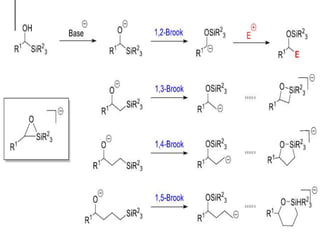
The 1,2- migration of a silyl group from carbon to
oxygen under basic conditions is known as Brook
rearrangement.
Rearrangement of α- silyl oxyanion to α-silyl
carbanions involving a penta coordinate silicon
intermediate.
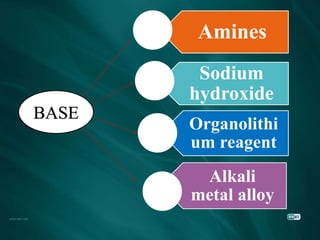
Amines
Sodium
hydroxide
Organolithi
um reagent
Alkali
metal alloy
BASE
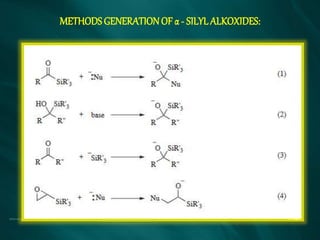
METHODSGENERATIONOF α - SILYLALKOXIDES:
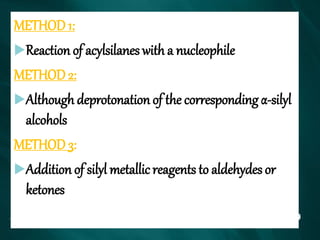
METHOD 1:
Reaction of acylsilanes with a nucleophile
METHOD 2:
Although deprotonation of the corresponding α-silyl
alcohols
METHOD 3:
Addition of silyl metallic reagents to aldehydes or
ketones
DRAWBACK:
 Organosilyl metal reagents are only readily generated
when there is atleast one anion stabilizing group such as
phenyl attached to the silicon.
METHOD 4:
Regioselective β-ring opening of α,β-epoxysilanes can also
same as a source of α-silyl alkoxides.
CHARACTERISTICS
Depends on the amount of base added.
 Pseudofirst order kinetics.
A silyl shift from oxygen to carbon, the reverse
process is called retro-Brook rearrangement.
Aza- or Thia- variants of the rearrangement have
also been observed
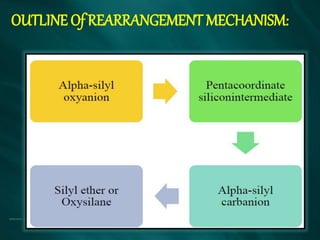
OUTLINE Of REARRANGEMENT MECHANISM:
MECHANISM-STEPS INVOLVED
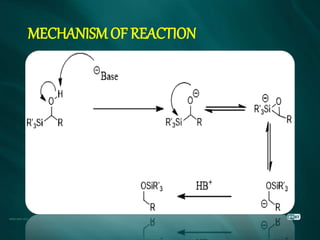
The mechanism as described by Brook includes the
formationof a cyclic pentavalent silicon species .
Immediately following the deprotonation.
Subsequentring opening and irreversible.
Fast protonation of the carbanion by the starting alcohol
or the conjugate base leads to the corresponding silyl
ether.
MECHANISM OF REACTION
SYNTHETIC APPLICATIONS
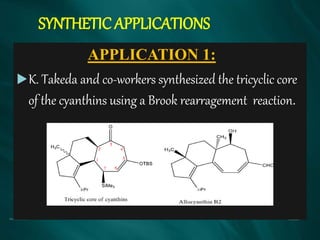
APPLICATION 1:
K. Takeda and co-workers synthesized the tricyclic core
of the cyanthins using a Brook rearragement reaction.
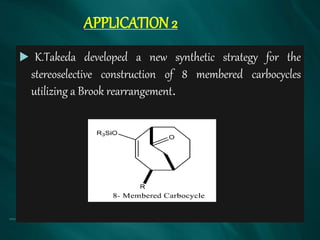
APPLICATION 2
 K.Takeda developed a new synthetic strategy for the
stereoselective construction of 8 membered carbocycles
utilizing a Brook rearrangement.
APPLICATION3
E.J. Corey synthesized (+)- Onocerin from farnesyl
acetate- derived acyl silane via four-component
coupling and tetracyclization steps.
APPLICATION 4
Brook rearrangement is used for another
important name reaction called vinylogues
Michael-cascade reaction.(vinylation and 1,2-
brook rearrangement reaction is used).
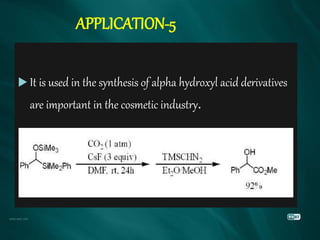
APPLICATION-5
 It is used in the synthesis of alpha hydroxyl acid derivatives
are important in the cosmetic industry.
APPLICATION6
1,4 Brook rearrangement –wittingreaction-
synthesis of silyl dienol ether.
APPLICATION 7
For the preparation of functionalised,stereo
defined 8-membered ring.
APPLICATION 8
Silyl ethers are used as protecting agents for
alcohols.
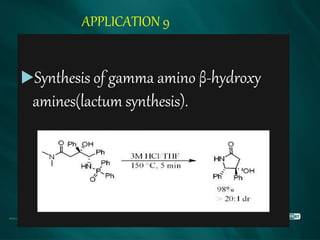
APPLICATION 9
Synthesis of gamma amino β-hydroxy
amines(lactum synthesis).
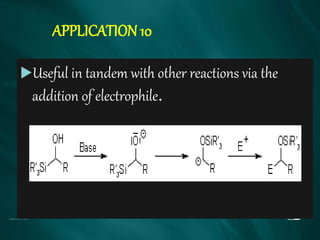
APPLICATION 10
Useful in tandem with other reactions via the
addition of electrophile.
SCOPE
Brook rearrangements are known in acylsilanes. Beyond
that, acylsilanes are well known for their hydrolysis in
basic solution to a silanol and an aldehyde – initiated by
attack-carbonyl group.
A related reaction, involving initial attack at the silicon
center, causes migration of one of the silicon groups to
the carbonyl carbon, which initiates a Brook-
Rearrangement. If the silicon group was chiral, the end
product is a chiral silyl ether, as the migration occurs
stereo specifically.
Conclusion
 The Brook rearrangement has been applied widely since its discovery in
1957.
 some of which have been used as tools in the synthesisof structurally
challenging organic compounds.
 Useful reaction in tandem with others to form bonds.
 Several one-pot synthesis in recent literature.
 Recent literature have used this chemistry to synthesize the following
1. γ-amino-β- hydroxy amide
2. α- hydroxy acid derivatives
3. Aryl vinyl ketones
4. Eight-membered rings
REFERENCE
1.Jie Jack Li:Name Reactions Third Edition;Springer
Science & Bussiness Media, 2006:Page no:83-84
2. Brook, A. G. (1958). "Isomerism of some α-
hydroxysilanes to silyl ethers". J. Am. Chem. Soc. 80:
1886–1889.
3.Laszlo Kurti,Barbara Czako:Strategic Applications of
Named Reactions in Organic Synthesis;Elsevier,29-
Apr-2005;page no:64-65
4.Christian M. Rojas:Molecular Rearrangements in
Organic Synthesis:Wiley,March-2015,Page no:207-
241
5.A. Hassner, I.Namboothiri;Organic Syntheses Based
on Named Reactions, Third Edition;Elsevier;Page
no:62
6. : Boyce, Gregory R. and Johnson, Jeffery S., J. Org.
Chem. 2016, 81, 1712-1717
BROOK  REARRANGEMENT

BROOK REARRANGEMENT

  • 1.
  • 2.
  • 3.
    INTRODUCTION First observedby HenryGilman in early 1950 - Suggestedthe migration of the Si group. Extensively developedin 1957 by Adrian G. Brook - Proposed a nucleophilic attack of oxygen to α-silicon atom.
  • 4.
    INTRODUCTION Adrian Gibbs Brookdiscovered the rearrangement in 1974. Brook did mechanistic studies as well. He was first to synthesis a silicon-carbon double bond
  • 5.
    DEFINITION The 1,2- migrationof a silyl group from carbon to oxygen under basic conditions is known as Brook rearrangement. Rearrangement of α- silyl oxyanion to α-silyl carbanions involving a penta coordinate silicon intermediate.
  • 7.
  • 8.
    METHODSGENERATIONOF α -SILYLALKOXIDES:
  • 9.
    METHOD 1: Reaction ofacylsilanes with a nucleophile METHOD 2: Although deprotonation of the corresponding α-silyl alcohols METHOD 3: Addition of silyl metallic reagents to aldehydes or ketones
  • 10.
    DRAWBACK:  Organosilyl metalreagents are only readily generated when there is atleast one anion stabilizing group such as phenyl attached to the silicon. METHOD 4: Regioselective β-ring opening of α,β-epoxysilanes can also same as a source of α-silyl alkoxides.
  • 11.
    CHARACTERISTICS Depends on theamount of base added.  Pseudofirst order kinetics. A silyl shift from oxygen to carbon, the reverse process is called retro-Brook rearrangement. Aza- or Thia- variants of the rearrangement have also been observed
  • 12.
  • 13.
    MECHANISM-STEPS INVOLVED The mechanismas described by Brook includes the formationof a cyclic pentavalent silicon species . Immediately following the deprotonation. Subsequentring opening and irreversible. Fast protonation of the carbanion by the starting alcohol or the conjugate base leads to the corresponding silyl ether.
  • 14.
  • 15.
    SYNTHETIC APPLICATIONS APPLICATION 1: K.Takeda and co-workers synthesized the tricyclic core of the cyanthins using a Brook rearragement reaction.
  • 16.
    APPLICATION 2  K.Takedadeveloped a new synthetic strategy for the stereoselective construction of 8 membered carbocycles utilizing a Brook rearrangement.
  • 17.
    APPLICATION3 E.J. Corey synthesized(+)- Onocerin from farnesyl acetate- derived acyl silane via four-component coupling and tetracyclization steps.
  • 18.
    APPLICATION 4 Brook rearrangementis used for another important name reaction called vinylogues Michael-cascade reaction.(vinylation and 1,2- brook rearrangement reaction is used).
  • 19.
    APPLICATION-5  It isused in the synthesis of alpha hydroxyl acid derivatives are important in the cosmetic industry.
  • 20.
    APPLICATION6 1,4 Brook rearrangement–wittingreaction- synthesis of silyl dienol ether.
  • 21.
    APPLICATION 7 For thepreparation of functionalised,stereo defined 8-membered ring. APPLICATION 8 Silyl ethers are used as protecting agents for alcohols.
  • 22.
    APPLICATION 9 Synthesis ofgamma amino β-hydroxy amines(lactum synthesis).
  • 23.
    APPLICATION 10 Useful intandem with other reactions via the addition of electrophile.
  • 24.
    SCOPE Brook rearrangements areknown in acylsilanes. Beyond that, acylsilanes are well known for their hydrolysis in basic solution to a silanol and an aldehyde – initiated by attack-carbonyl group. A related reaction, involving initial attack at the silicon center, causes migration of one of the silicon groups to the carbonyl carbon, which initiates a Brook- Rearrangement. If the silicon group was chiral, the end product is a chiral silyl ether, as the migration occurs stereo specifically.
  • 25.
    Conclusion  The Brookrearrangement has been applied widely since its discovery in 1957.  some of which have been used as tools in the synthesisof structurally challenging organic compounds.  Useful reaction in tandem with others to form bonds.  Several one-pot synthesis in recent literature.  Recent literature have used this chemistry to synthesize the following 1. γ-amino-β- hydroxy amide 2. α- hydroxy acid derivatives 3. Aryl vinyl ketones 4. Eight-membered rings
  • 26.
    REFERENCE 1.Jie Jack Li:NameReactions Third Edition;Springer Science & Bussiness Media, 2006:Page no:83-84 2. Brook, A. G. (1958). "Isomerism of some α- hydroxysilanes to silyl ethers". J. Am. Chem. Soc. 80: 1886–1889. 3.Laszlo Kurti,Barbara Czako:Strategic Applications of Named Reactions in Organic Synthesis;Elsevier,29- Apr-2005;page no:64-65 4.Christian M. Rojas:Molecular Rearrangements in Organic Synthesis:Wiley,March-2015,Page no:207- 241
  • 27.
    5.A. Hassner, I.Namboothiri;OrganicSyntheses Based on Named Reactions, Third Edition;Elsevier;Page no:62 6. : Boyce, Gregory R. and Johnson, Jeffery S., J. Org. Chem. 2016, 81, 1712-1717

Editor's Notes