MR.GOPAL ,..MSC (N),
MEDICAL SURGICAL NURSING
ASSISTANT PROFESSOR
GANGA COLLEGE OF NURSING
COIMBATORE
CONTENT OVERVIEW
• Introduction
• Anatomy & physiology
• Definition
• Incidence
• Etiological factors
• Types of asthma
• Stages of Asthma
• Pathophysiology
• Signs & symptoms
• Diagnostic evaluation
• Complication
• Management
INTRODUCTION
Bronchial asthma is a medical condition which
causes the airway path of the lungs to swell and
narrow. The disease is chronic and interferes with daily
working. The disease is curable and inhalers help
overcome asthma attacks.
Bronchial Asthma can affect any age or gender
and depends upon environmental and hereditary
factors at large. When ignored, disease proves fatal
claiming lives in many cases.
ANATOMY & PHYSIOLOGY
DEFINITION
Bronchial asthma is a chronic , inflammatory
disease of the airways, characterized by airflow
obstruction, bronchial hyperactivity, and a mucous
production.
INCIDENCE
Worldwide, it is estimated that approximately
334 million people currently suffer from asthma, and
250,000 deaths are attributed to the disease each
year. The prevalence of the disease is continuing to
grow, and the overall prevalence is estimated to
increase by 100 million by 2025.
ETIOLOGY
• Genetic factors
• Environmental factors
a) House dust mites
b) Exposure to tobacco smoke.
c) Predisposed to animals, pollens mould and dust.
• Dietary changes – junk food and fast food
contain Mono-Sodium Glutamate
ETIOLOGY
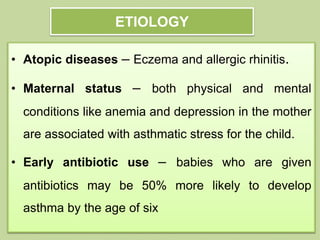
• Atopic diseases – Eczema and allergic rhinitis.
• Maternal status – both physical and mental
conditions like anemia and depression in the mother
are associated with asthmatic stress for the child.
• Early antibiotic use – babies who are given
antibiotics may be 50% more likely to develop
asthma by the age of six
COMMON TRIGGERING FACTORS
Extrinsic (Allergic)
Triggers:
• Dust mites
• Mould
• Certain foods
• Animal dander
• Pollen
Intrinsic (Non-Allergic)
Triggers:
• Exercise & Stress
• Infections (cold and flu)
• Cold or humid air
• Medications (aspirin)
• Hormones & Air pollution
• Occupational irritants
TYPES OF ASTHMA
STAGES OF ASTHMA
The four stages of asthma are:
• Mild intermittent asthma: Mild symptoms of
asthma occur no more than two days per week or
two times per month.
• Mild persistent asthma: Mild symptoms occur
more often than twice per week.
• Moderate persistent asthma: Increasingly severe
symptoms of asthma occur daily and at least one
night each week.
• Severe persistent asthma: At this stage,
symptoms occur several times per day almost every
day. You may also experience symptoms many
nights each week. This stage of asthma may not
respond well to treatment.
STAGES OF ASTHMA
PATHOPHYSIOLOGY
SIGNS & SYMPTOMS
Common symptoms of asthma
MILD SYMPTOMS
1. Coughing
2. Mild difficulty breathing during normal activities
2. Wheezing
4. Difficulty sleeping
5. Hiccups
6. Peak expiratory flow rate (PEFR) is 70 to 90% of
personal best
MODERATE SYMPTOMS
1. Severe cough
2. Moderate wheezing
3. Shortness of breath
4. Chest tightness
• Usually worsens with exercise
5. Inability to sleep
6. Nasal congestion
7. PEFR is 50 to 70% of personal best
8. Clubbing of finger
SEVERE SYMPTOMS
1. Severe wheezing
2. Severe difficulty breathing
3. Inability to speak in complete sentences
4. Inability to lie down
5. Signs of severe difficulty breathing
 Rib retractions: ribs are visible during each breath
 Nasal flaring: nostrils open wide during each breath
 Use of accessory muscles: neck muscles are prominent
during each breath
SEVERE SYMPTOMS
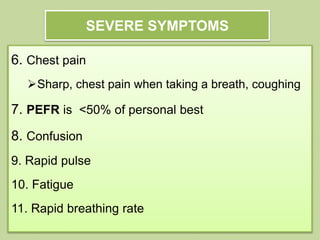
6. Chest pain
Sharp, chest pain when taking a breath, coughing
7. PEFR is <50% of personal best
8. Confusion
9. Rapid pulse
10. Fatigue
11. Rapid breathing rate
DIAGNOSTIC EVALUATION
• The Medical history
• Physical Examination
• Differential Diagnosis
• Laboratory Investigations
HISTORY COLLECTION
• A complete family history
• Environmental Factors
• occupational history is essential.
to establish the diagnosis
PHYSICAL EXAMINATION
• Hyper-expansion of the thorax
• Sounds of wheezing during normal breathing or a
prolonged phase of forced exhalation Increased
nasal secretions, mucosal swelling, sinusitis,
rhinitis, or nasal polyps
• Rales, Rhonchi,
• Tachypnea &Orthopnea
• Chest constriction
LABORATORY INVESTIGATIONS
• Arterial blood gas analysis
• Spo2 monitoring
• Elevated IgE level
• Complete blood count
• Blood levels of eosinophil
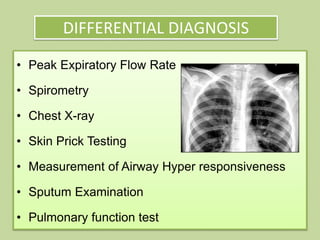
DIFFERENTIAL DIAGNOSIS
• Peak Expiratory Flow Rate
• Spirometry
• Chest X-ray
• Skin Prick Testing
• Measurement of Airway Hyper responsiveness
• Sputum Examination
• Pulmonary function test
PEFR is used to assess
the severity of wheezing in
those who have asthma.
PEFR measures how quickly
a person can exhale air from
the lungs
PEAK EXPIRATORY FLOW RATE
INCENTIVE SPIROMETRY
• It measures how much air you can exhale.
• FEV1(force expiratory volume) > 80% = normal
• Confirms the presence of airway obstruction and
measure the degree of lung function impairment.
• Monitor your response to asthma medications
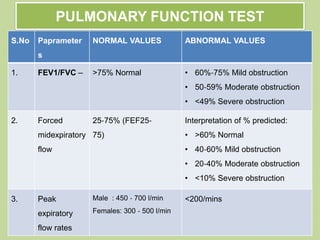
PULMONARY FUNCTION TEST
S.No Paprameter
s
NORMAL VALUES ABNORMAL VALUES
1. FEV1/FVC – >75% Normal • 60%‐75% Mild obstruction
• 50‐59% Moderate obstruction
• <49% Severe obstruction
2. Forced
midexpiratory
flow
25‐75% (FEF25‐
75)
Interpretation of % predicted:
• >60% Normal
• 40‐60% Mild obstruction
• 20‐40% Moderate obstruction
• <10% Severe obstruction
3. Peak
expiratory
flow rates
Male : 450 ‐ 700 l/min
Females: 300 ‐ 500 l/min
<200/mins
PARAMETERS OBSTRUCTIVE RESTRICTIVE
Vital capacity Normal or decreased decreased
Total lung capacity Normal or increased decreased
Residual volume Increased decreased
FEV1/FVC decreased Normal or increased
Maximum mid
expiratory flow
decreased Normal
Maximum breathing
capacity
decreased Normal or decreased
PULMONARY FUNCTION TEST
CHEST X-RAY
ALLERGY-SKIN TEST
• A drop of liquid containing the allergen in placed on
your skin
• A small lance with a pinpoint is poked through the
liquid into the top layer of skin (prick test).
• If you are allergic to the allergen, after about 2
minutes the skin begins to form a reaction (red,
slightly swollen, and itchy.
• The size of the hive is measured and recorded. The
larger the hive, the more likely it is that you are
allergic to the allergen tested.
COMPLICATIONS OF ASTHMA
STATUS ASTHMATICS RESPIRATORY FAILURE
PNEUMONIA ATELECTASIS
MANAGEMENT
• Medical management
• Pharmacological management
• Surgical management
• Nursing management
MEDICAL MANAGEMENT
• Fowlers/ semi fowlers position
• Oxygen administration
• Incentive spirometry exercise
• Deep breathing exercises
• Pursed-lip breathing
• Steam inhalation
PHARMACOLOGICAL MANAGEMENT
• Bronchodilators – rapid relief, by relaxation of
airway smooth muscle
– β2 Agonists & Methylxanthines
– Anticholinergic Agents
• Controllers – inhibit the inflammatory process
– Glucocorticoids
– Leukotrienes pathway inhibitors
– Cromones & Anti-IgE therapy
β2 Agonists in asthma
• Potent bronchodilators.(TOC)
• Usually given by inhalation route.
• MOA:
– Relaxation of airway smooth muscle
– Non-bronchodilator effects
• Inhibition of mast cell mediator release
• Reduction in plasma exudation
• Increased mucociliary transport
• Inhibition of sensory nerve activation
• Inflammatory cells express β2 receptors but these
are rapidly down regulated.
• No effect on airway inflammation and AHR
β2 Agonists in asthma
• Short-Acting β2 Agonists :3-6 hours
– Albuterol /salbutamol
– Levalbuterol, the (R)-enantiomer of albuterol
– Metaproterenol & Terbutaline
– Pirbuterol & Bambuterol
• Long-Acting β2Agonists : >12 hours
– Salmeterol
– Formoterol
ADRs – β2 agonists
• Muscle tremors(direct effect on skeletal muscle
β2 receptors)
• Tachycardia(direct effect on atrial β2 receptors)
• Hypokalemia(direct β2 effect on skeletal muscle
uptake of K+)
• Hypoxemia
• Restlessness
Anticholinergic agents
• Ipratropium bromide, Tiotropium.
– Prevent cholinergic nerve induced
bronchoconstriction.
– Block M3 receptor on bronchial smooth muscles.
– Less effective than β2 agonists
• Ipratropium- slow, bitter taste, precipitate glaucoma,
paradoxical broncho –constriction (hypotonic
nebulizer sol. & antibacterial additive)
• Tiotropium – longer acting, approved for treatment
of COPD. Dryness of mouth
Methylxanthines
• Medium potency bronchodilator
• Theophylline, Theobromine, Caffeine
Mechanism of action
a) Inhibition of several members of the
phosphodiesterase (PDE) enzyme family
b) Inhibition of cell-surface receptors for adenosine
c) IL-10 release-anti inflammatory action
d) Prevents translocation of NF-kB into nucleus
e) Activation of histone deacetylation. (HDAC2)
Adverse effect of theophylline
• Anorexia, nausea, vomiting, abdominal discomfort,
headache, and anxiety – start at >20 mg/L.(PDE4
inhibition)
• Seizures or arrhythmias at conc.>40 mg/L(A1
receptor antagonism)
• Diuresis(A1 receptor antagonism)
Corticosteroids – asthma
• Effective drugs for treatment of asthma.
• Development of inhaled corticosteroids is a major
advance in asthma therapy.
• Used prophylactically as a controller therapy.
• Benefit starts in 1week but continues upto several
months.
• If asthma not controlled at low dose of ICS then
addition of long acting β2 agonist is more effective
than doubling steroid dose.
Inhaled corticosteroids( ICS)
Use of β2Agonists >2 times a week indicates need of
a ICS
• Beclomethasone & Budesonide
• Fluticasone
• Triamcinolone
• Flunisolide
• Ciclesonide
Side effect of inhaled corticosteroids
• Oropharyngeal candidiasis, dysphonia –
frequent at high doses. Reduced by using spacer
device.
• Decreased bone mineral density.
• Hypothalamic-pituitary-adrenal axis
suppression- >2000µg/d of beclomethasone.
• Skin thinning, purpura- dose related effect.
• Growth retardation in children
Leukotrienes pathway inhibitors
• Two approaches to interrupt the leukotriene
pathway have been pursued
– Inhibition of 5-lipoxygenase, thereby preventing
leukotriene synthesis. Zileuton.
– Inhibition of the binding of LTD4 to its receptor on target
tissues, thereby preventing its action. Zafirlukast,
montelukast.
– Oral route.
ADR
• Liver toxicity
• Churg –Strauss synd.(vasculitis with eosinophilia)
Cromones
• Cromolyn sodium & nedocromil sodium
• On chronic use (four times daily) reduce the overall
level of bronchial reactivity.
• These drugs have no effect on airway smooth
muscle tone and are ineffective in reversing
asthmatic bronchospasm; they are only of value
when taken prophylactically.
• Inhalation route
Anti-IgE therapy
• Omalizumab - recombinant humanized monoclonal
antibody targeted against IgE.
• MOA - IgE bound to omalizumab cannot bind to IgE
receptors on mast cells and basophils, thereby
preventing the allergic reaction at a very early step
in the process.
NEBULIZATION
• Nebulised salbutamol(5mg) in oxygen given
immediately
• Ipratopium bromide(0.5mg) + salbutamol(5mg)
nebulised in oxygen,who don’t respond within 15-30 min
• Terbutaline -s.c.(0.25-0.5mg) or i.v (0.1μg/kg/min)
excessive coughing or too weak to inspire adequately.
• Hydrocortisone hemisuccinate 100mg i.v.stat,
followed by 100-200mg 4-8 hrly infusion.
• ET intubation & mechanical ventilation if above Tt fails
SURGICAL MANAGEMENT
Bronchial thermoplasty
• Invasive procedure for severe asthma
• Is not painful (no nerves inside airways)
• Risks : mainly lung collapse, bleeding and
additional breathing problems, mostly related to the
bronchoscope.
• Precaution: Pt. must be at least 18 y/o to have the
procedure.
• Pt. still need to use their asthma-maintenance
medications after the procedure
• Benefits: Pt. may use rescue inhalers less often
and are able to engage strenuous physical activity
than before
NURSING MANAGEMENT
• Ineffective airway clearance related to obstruction
of the airway, increased mucus secretion as
evidenced by secretion, decreased spo2 level,
tachypnea
• Ineffective breathing pattern related to
obstruction of airway, excessive mucus secretion
as evidenced by tachypnea and hypoxia.
• Acute pain on chest related to increased effort of
breath as evidenced by pain scale
• Impaired gas exchange related to decreased
oxygen level, bronchospasm as evidenced by
decreased spo2 level
• Impaired tissue perfusion related to v/q
mismatch, hypoxia as evidenced by delayed
capillary refills
• Activity intolerance related to impaired
respiratory function as evidenced by daily
activities
• Disturbed sleeping pattern related to breathing
difficulty as evidenced by redness of eyes.
REFERENCE
• Lewis & dirksen (2015); textbook of medical –
surgical nursing, 2nd South asian edition, vol:1;
elsevier publication.
• Brunner & suddarth’s (2014); textbook of
medical – surgical nursing, 13th edition, wolters
kluwer publications.
• Jennifer E. Helms, Claudia P. Barone, (2008)
physiology And Treatment Of Skin Disease, critical
Care Nurse, 4th edition; Vol 28; Philadelphia
publications.
Website :
• https://www.bing.com/images/search?q=asthma+infla
mmation+animated&form=qbir
• https://thumbs.dreamstime.com/x/asthma-chronic-
inflammatory-disease-anatomy-detailed-view-
41622161.jpg
BRONCHIAL ASTHMA.pptx

BRONCHIAL ASTHMA.pptx

  • 1.
    MR.GOPAL ,..MSC (N), MEDICALSURGICAL NURSING ASSISTANT PROFESSOR GANGA COLLEGE OF NURSING COIMBATORE
  • 3.
    CONTENT OVERVIEW • Introduction •Anatomy & physiology • Definition • Incidence • Etiological factors • Types of asthma • Stages of Asthma • Pathophysiology • Signs & symptoms • Diagnostic evaluation • Complication • Management
  • 4.
    INTRODUCTION Bronchial asthma isa medical condition which causes the airway path of the lungs to swell and narrow. The disease is chronic and interferes with daily working. The disease is curable and inhalers help overcome asthma attacks. Bronchial Asthma can affect any age or gender and depends upon environmental and hereditary factors at large. When ignored, disease proves fatal claiming lives in many cases.
  • 5.
  • 6.
    DEFINITION Bronchial asthma isa chronic , inflammatory disease of the airways, characterized by airflow obstruction, bronchial hyperactivity, and a mucous production.
  • 7.
    INCIDENCE Worldwide, it isestimated that approximately 334 million people currently suffer from asthma, and 250,000 deaths are attributed to the disease each year. The prevalence of the disease is continuing to grow, and the overall prevalence is estimated to increase by 100 million by 2025.
  • 9.
    ETIOLOGY • Genetic factors •Environmental factors a) House dust mites b) Exposure to tobacco smoke. c) Predisposed to animals, pollens mould and dust. • Dietary changes – junk food and fast food contain Mono-Sodium Glutamate
  • 10.
    ETIOLOGY • Atopic diseases– Eczema and allergic rhinitis. • Maternal status – both physical and mental conditions like anemia and depression in the mother are associated with asthmatic stress for the child. • Early antibiotic use – babies who are given antibiotics may be 50% more likely to develop asthma by the age of six
  • 11.
    COMMON TRIGGERING FACTORS Extrinsic(Allergic) Triggers: • Dust mites • Mould • Certain foods • Animal dander • Pollen Intrinsic (Non-Allergic) Triggers: • Exercise & Stress • Infections (cold and flu) • Cold or humid air • Medications (aspirin) • Hormones & Air pollution • Occupational irritants
  • 12.
  • 13.
    STAGES OF ASTHMA Thefour stages of asthma are: • Mild intermittent asthma: Mild symptoms of asthma occur no more than two days per week or two times per month. • Mild persistent asthma: Mild symptoms occur more often than twice per week.
  • 14.
    • Moderate persistentasthma: Increasingly severe symptoms of asthma occur daily and at least one night each week. • Severe persistent asthma: At this stage, symptoms occur several times per day almost every day. You may also experience symptoms many nights each week. This stage of asthma may not respond well to treatment. STAGES OF ASTHMA
  • 15.
  • 16.
    SIGNS & SYMPTOMS Commonsymptoms of asthma
  • 17.
    MILD SYMPTOMS 1. Coughing 2.Mild difficulty breathing during normal activities 2. Wheezing 4. Difficulty sleeping 5. Hiccups 6. Peak expiratory flow rate (PEFR) is 70 to 90% of personal best
  • 18.
    MODERATE SYMPTOMS 1. Severecough 2. Moderate wheezing 3. Shortness of breath 4. Chest tightness • Usually worsens with exercise 5. Inability to sleep 6. Nasal congestion 7. PEFR is 50 to 70% of personal best 8. Clubbing of finger
  • 19.
    SEVERE SYMPTOMS 1. Severewheezing 2. Severe difficulty breathing 3. Inability to speak in complete sentences 4. Inability to lie down 5. Signs of severe difficulty breathing  Rib retractions: ribs are visible during each breath  Nasal flaring: nostrils open wide during each breath  Use of accessory muscles: neck muscles are prominent during each breath
  • 20.
    SEVERE SYMPTOMS 6. Chestpain Sharp, chest pain when taking a breath, coughing 7. PEFR is <50% of personal best 8. Confusion 9. Rapid pulse 10. Fatigue 11. Rapid breathing rate
  • 21.
    DIAGNOSTIC EVALUATION • TheMedical history • Physical Examination • Differential Diagnosis • Laboratory Investigations
  • 22.
    HISTORY COLLECTION • Acomplete family history • Environmental Factors • occupational history is essential. to establish the diagnosis
  • 23.
    PHYSICAL EXAMINATION • Hyper-expansionof the thorax • Sounds of wheezing during normal breathing or a prolonged phase of forced exhalation Increased nasal secretions, mucosal swelling, sinusitis, rhinitis, or nasal polyps • Rales, Rhonchi, • Tachypnea &Orthopnea • Chest constriction
  • 24.
    LABORATORY INVESTIGATIONS • Arterialblood gas analysis • Spo2 monitoring • Elevated IgE level • Complete blood count • Blood levels of eosinophil
  • 25.
    DIFFERENTIAL DIAGNOSIS • PeakExpiratory Flow Rate • Spirometry • Chest X-ray • Skin Prick Testing • Measurement of Airway Hyper responsiveness • Sputum Examination • Pulmonary function test
  • 26.
    PEFR is usedto assess the severity of wheezing in those who have asthma. PEFR measures how quickly a person can exhale air from the lungs PEAK EXPIRATORY FLOW RATE
  • 27.
    INCENTIVE SPIROMETRY • Itmeasures how much air you can exhale. • FEV1(force expiratory volume) > 80% = normal • Confirms the presence of airway obstruction and measure the degree of lung function impairment. • Monitor your response to asthma medications
  • 28.
    PULMONARY FUNCTION TEST S.NoPaprameter s NORMAL VALUES ABNORMAL VALUES 1. FEV1/FVC – >75% Normal • 60%‐75% Mild obstruction • 50‐59% Moderate obstruction • <49% Severe obstruction 2. Forced midexpiratory flow 25‐75% (FEF25‐ 75) Interpretation of % predicted: • >60% Normal • 40‐60% Mild obstruction • 20‐40% Moderate obstruction • <10% Severe obstruction 3. Peak expiratory flow rates Male : 450 ‐ 700 l/min Females: 300 ‐ 500 l/min <200/mins
  • 29.
    PARAMETERS OBSTRUCTIVE RESTRICTIVE Vitalcapacity Normal or decreased decreased Total lung capacity Normal or increased decreased Residual volume Increased decreased FEV1/FVC decreased Normal or increased Maximum mid expiratory flow decreased Normal Maximum breathing capacity decreased Normal or decreased PULMONARY FUNCTION TEST
  • 30.
  • 31.
    ALLERGY-SKIN TEST • Adrop of liquid containing the allergen in placed on your skin • A small lance with a pinpoint is poked through the liquid into the top layer of skin (prick test). • If you are allergic to the allergen, after about 2 minutes the skin begins to form a reaction (red, slightly swollen, and itchy. • The size of the hive is measured and recorded. The larger the hive, the more likely it is that you are allergic to the allergen tested.
  • 32.
    COMPLICATIONS OF ASTHMA STATUSASTHMATICS RESPIRATORY FAILURE PNEUMONIA ATELECTASIS
  • 33.
    MANAGEMENT • Medical management •Pharmacological management • Surgical management • Nursing management
  • 34.
    MEDICAL MANAGEMENT • Fowlers/semi fowlers position • Oxygen administration • Incentive spirometry exercise • Deep breathing exercises • Pursed-lip breathing • Steam inhalation
  • 35.
    PHARMACOLOGICAL MANAGEMENT • Bronchodilators– rapid relief, by relaxation of airway smooth muscle – β2 Agonists & Methylxanthines – Anticholinergic Agents • Controllers – inhibit the inflammatory process – Glucocorticoids – Leukotrienes pathway inhibitors – Cromones & Anti-IgE therapy
  • 36.
    β2 Agonists inasthma • Potent bronchodilators.(TOC) • Usually given by inhalation route. • MOA: – Relaxation of airway smooth muscle – Non-bronchodilator effects • Inhibition of mast cell mediator release • Reduction in plasma exudation • Increased mucociliary transport • Inhibition of sensory nerve activation • Inflammatory cells express β2 receptors but these are rapidly down regulated. • No effect on airway inflammation and AHR
  • 37.
    β2 Agonists inasthma • Short-Acting β2 Agonists :3-6 hours – Albuterol /salbutamol – Levalbuterol, the (R)-enantiomer of albuterol – Metaproterenol & Terbutaline – Pirbuterol & Bambuterol • Long-Acting β2Agonists : >12 hours – Salmeterol – Formoterol
  • 38.
    ADRs – β2agonists • Muscle tremors(direct effect on skeletal muscle β2 receptors) • Tachycardia(direct effect on atrial β2 receptors) • Hypokalemia(direct β2 effect on skeletal muscle uptake of K+) • Hypoxemia • Restlessness
  • 39.
    Anticholinergic agents • Ipratropiumbromide, Tiotropium. – Prevent cholinergic nerve induced bronchoconstriction. – Block M3 receptor on bronchial smooth muscles. – Less effective than β2 agonists • Ipratropium- slow, bitter taste, precipitate glaucoma, paradoxical broncho –constriction (hypotonic nebulizer sol. & antibacterial additive) • Tiotropium – longer acting, approved for treatment of COPD. Dryness of mouth
  • 40.
    Methylxanthines • Medium potencybronchodilator • Theophylline, Theobromine, Caffeine Mechanism of action a) Inhibition of several members of the phosphodiesterase (PDE) enzyme family b) Inhibition of cell-surface receptors for adenosine c) IL-10 release-anti inflammatory action d) Prevents translocation of NF-kB into nucleus e) Activation of histone deacetylation. (HDAC2)
  • 41.
    Adverse effect oftheophylline • Anorexia, nausea, vomiting, abdominal discomfort, headache, and anxiety – start at >20 mg/L.(PDE4 inhibition) • Seizures or arrhythmias at conc.>40 mg/L(A1 receptor antagonism) • Diuresis(A1 receptor antagonism)
  • 42.
    Corticosteroids – asthma •Effective drugs for treatment of asthma. • Development of inhaled corticosteroids is a major advance in asthma therapy. • Used prophylactically as a controller therapy. • Benefit starts in 1week but continues upto several months. • If asthma not controlled at low dose of ICS then addition of long acting β2 agonist is more effective than doubling steroid dose.
  • 43.
    Inhaled corticosteroids( ICS) Useof β2Agonists >2 times a week indicates need of a ICS • Beclomethasone & Budesonide • Fluticasone • Triamcinolone • Flunisolide • Ciclesonide
  • 44.
    Side effect ofinhaled corticosteroids • Oropharyngeal candidiasis, dysphonia – frequent at high doses. Reduced by using spacer device. • Decreased bone mineral density. • Hypothalamic-pituitary-adrenal axis suppression- >2000µg/d of beclomethasone. • Skin thinning, purpura- dose related effect. • Growth retardation in children
  • 45.
    Leukotrienes pathway inhibitors •Two approaches to interrupt the leukotriene pathway have been pursued – Inhibition of 5-lipoxygenase, thereby preventing leukotriene synthesis. Zileuton. – Inhibition of the binding of LTD4 to its receptor on target tissues, thereby preventing its action. Zafirlukast, montelukast. – Oral route. ADR • Liver toxicity • Churg –Strauss synd.(vasculitis with eosinophilia)
  • 46.
    Cromones • Cromolyn sodium& nedocromil sodium • On chronic use (four times daily) reduce the overall level of bronchial reactivity. • These drugs have no effect on airway smooth muscle tone and are ineffective in reversing asthmatic bronchospasm; they are only of value when taken prophylactically. • Inhalation route
  • 47.
    Anti-IgE therapy • Omalizumab- recombinant humanized monoclonal antibody targeted against IgE. • MOA - IgE bound to omalizumab cannot bind to IgE receptors on mast cells and basophils, thereby preventing the allergic reaction at a very early step in the process.
  • 48.
    NEBULIZATION • Nebulised salbutamol(5mg)in oxygen given immediately • Ipratopium bromide(0.5mg) + salbutamol(5mg) nebulised in oxygen,who don’t respond within 15-30 min • Terbutaline -s.c.(0.25-0.5mg) or i.v (0.1μg/kg/min) excessive coughing or too weak to inspire adequately. • Hydrocortisone hemisuccinate 100mg i.v.stat, followed by 100-200mg 4-8 hrly infusion. • ET intubation & mechanical ventilation if above Tt fails
  • 49.
    SURGICAL MANAGEMENT Bronchial thermoplasty •Invasive procedure for severe asthma • Is not painful (no nerves inside airways) • Risks : mainly lung collapse, bleeding and additional breathing problems, mostly related to the bronchoscope. • Precaution: Pt. must be at least 18 y/o to have the procedure. • Pt. still need to use their asthma-maintenance medications after the procedure • Benefits: Pt. may use rescue inhalers less often and are able to engage strenuous physical activity than before
  • 50.
    NURSING MANAGEMENT • Ineffectiveairway clearance related to obstruction of the airway, increased mucus secretion as evidenced by secretion, decreased spo2 level, tachypnea • Ineffective breathing pattern related to obstruction of airway, excessive mucus secretion as evidenced by tachypnea and hypoxia.
  • 51.
    • Acute painon chest related to increased effort of breath as evidenced by pain scale • Impaired gas exchange related to decreased oxygen level, bronchospasm as evidenced by decreased spo2 level • Impaired tissue perfusion related to v/q mismatch, hypoxia as evidenced by delayed capillary refills
  • 52.
    • Activity intolerancerelated to impaired respiratory function as evidenced by daily activities • Disturbed sleeping pattern related to breathing difficulty as evidenced by redness of eyes.
  • 53.
    REFERENCE • Lewis &dirksen (2015); textbook of medical – surgical nursing, 2nd South asian edition, vol:1; elsevier publication. • Brunner & suddarth’s (2014); textbook of medical – surgical nursing, 13th edition, wolters kluwer publications.
  • 54.
    • Jennifer E.Helms, Claudia P. Barone, (2008) physiology And Treatment Of Skin Disease, critical Care Nurse, 4th edition; Vol 28; Philadelphia publications. Website : • https://www.bing.com/images/search?q=asthma+infla mmation+animated&form=qbir • https://thumbs.dreamstime.com/x/asthma-chronic- inflammatory-disease-anatomy-detailed-view- 41622161.jpg