BRONCHIAL ASTHMA
DR D M KILLINGO
DEFINITION
 Clinical syndrome defined physiologically by episodic
reversible airway narrowing and hyper responsiveness
of the airways to a variety of stimuli.
 Defined pathologically by presence of certain
recognizable microscopic features i.e. Infiltration of the
airways with eosinophils, hypertrophy and hyperplasia of
the airway smooth muscle, mucous secretory apparatus
and overall thickening of the airway wall.
 Chronic relapsing inflammatory disorder characterised
by hyperreactive airways leading to episodic reversible
bronchial obstruction owing to increased
responsiveness of the tracheobronchial tree to various
stimuli
EPIDEMIOLOGY
 Affects ~ 300million people globally.
 Men = Women in adulthood. In childhood 2:1
 Prevalence 8-30% in developed countries and 0-
5% in developing countries
 Kenyan: urban 10%, rural 3%
 Commoner in those <20years. Peak age 3 years
ETIOLOGY/ RISK FACTORS
 Interplay between genetic and environmental
factors
 Endogenous factors
 Genetic predisposition
 25 genes assoc with asthma
 Atopy
 Allergic rhinitis present in 80% of asthmatic patients
 Airway hyperresponsiveness
ETIOLOGY CONTINUED
 Environmental factors
 Indoor allergens i.e. house dust mite, domestic pets.
 Outdoor allergens e.g. air pollution by sulphur dioxide,
ozone, diesel particulates trigger symptoms
 Occupational sensitizers
 Hygiene hypothesis – exposure to infections and
endotoxin, helminthic infections
 Occupational exposure, chemicals e.g. toluene
diisocyanate, trimellitic anhydride
PATHOLOGY
 Associated with specific chronic inflammation of the
mucosa of the lower airways. Lung parenchyma
spared
 Degree of inflammation poorly related to disease
severity. Infiltration by T lymphocytes, activated
eosinophils and mast cells.
 Thickening of the basement membrane due to sub
epithelial collagen deposition
 Airway narrowed, reddened, wall thickened and
edematous
 Occlusion of airway by mucous plug
PATHOPHYSIOLOGY
 Limitation of airflow due to;
 Bronchoconstriction
 Airway edema
 Vascular congestion
 Luminal occlusion with exudate
 FEV1, FEV/FVC, PEF all reduced and an increase in airway
resistance
 Early closure of peripheral airway results in (air trapping) lung
hyperinflation, and increased residual volume
 Early phase reaction(within minutes) due to immediate
hypersensitivity reaction. Mediated by histamine,
prostaglandin D2 and leukotrienes C4,D4,E4
 Late phase reaction(4-6 hours) coincides with influx of
inflammmatoey cells mediated by T lymphocytes( eosinophils
and basophils)
INFLAMMATORY CELLS
 Inflammation assoc with airway hyper
responsiveness
 Mast cells
 Initiate bronchoconstrictor response to allergens or
stimuli e.g. hyperventilation, exercise, fog
 Activated by allergens through IgE dependent
mechanism
 Release brochoconstrictor mediators eg histamine,
cysteinyl-leukotrienes, cytokines, chemokines, growth
factors and neurotrophins
 Eosinophils
 Linked to dev of airway hyperresponsiveness
 Presence related to disease severity
 Release oxygen radicals and basic proteins
 Release growth factors involved in airway remodelling
 Recruitment involves
 adhesion to vascular endothelial cells via adhesion molecules
 migration to submucosa via chemokines
 Activation and prolonged survival
 Neutrophils
 Role unknown
 Resistant to anti-inflammatory effect of corticosteroids
 T lymphocytes
 Co-ordinate inflam response in asthma
 Release cytokines for recruitment and survival of
eosinophils
 Maintain mast cell population
 TH2 response predominant;
 Release IL-5 thus eosinophilic inflammation
 Release IL-13, IL-4 thus increased IgE production
 Structural cells i.e. epithelial cells, fibroblasts, and
smooth muscle cells release cytokines and lipid
mediators.
 Major source of mediators driving chronic inflammation
ASTHMA TRIGGERS
 Allergens
 Include pollen, fungal spores, allergens from
domestic pests, roaches, ragweed
 Viral infections
 URTIs esp rhinovirus, RSV, corona virus.
 Pharmacological agents
 Β adrenergic blockers
 ACE inhibitors
 aspirin
 Air pollution
 Increased ambient levels of sulphur dioxide, ozone
and nitrogen oxides
 Occupation factors
 Workplace sensitizing agents. Reversal if removed
within 6 months. Later irreversible airway changes
 Hormonal factors
 Premenstrual worsening assoc with fall in
progesterone
 Thyrotoxicosis and hypothyroidism worsen asthma
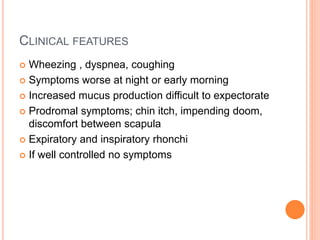
CLINICAL FEATURES
 Wheezing , dyspnea, coughing
 Symptoms worse at night or early morning
 Increased mucus production difficult to expectorate
 Prodromal symptoms; chin itch, impending doom,
discomfort between scapula
 Expiratory and inspiratory rhonchi
 If well controlled no symptoms
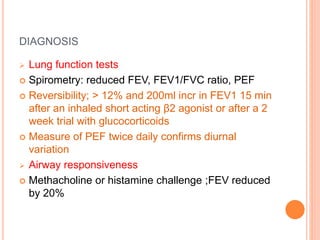
DIAGNOSIS
 Lung function tests
 Spirometry: reduced FEV, FEV1/FVC ratio, PEF
 Reversibility; > 12% and 200ml incr in FEV1 15 min
after an inhaled short acting β2 agonist or after a 2
week trial with glucocorticoids
 Measure of PEF twice daily confirms diurnal
variation
 Airway responsiveness
 Methacholine or histamine challenge ;FEV reduced
by 20%
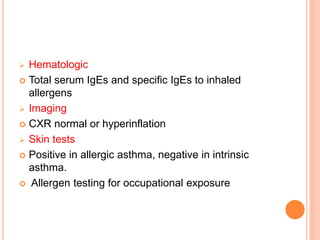
 Hematologic
 Total serum IgEs and specific IgEs to inhaled
allergens
 Imaging
 CXR normal or hyperinflation
 Skin tests
 Positive in allergic asthma, negative in intrinsic
asthma.
 Allergen testing for occupational exposure
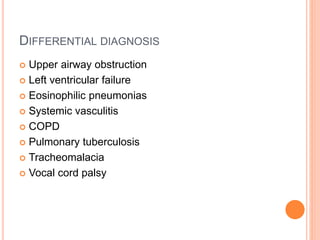
DIFFERENTIAL DIAGNOSIS
 Upper airway obstruction
 Left ventricular failure
 Eosinophilic pneumonias
 Systemic vasculitis
 COPD
 Pulmonary tuberculosis
 Tracheomalacia
 Vocal cord palsy
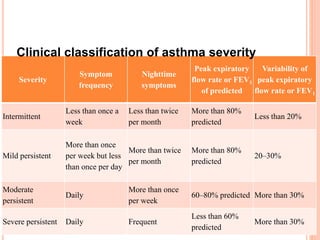
Severity
Symptom
frequency
Nighttime
symptoms
Peak expiratory
flow rate or FEV1
of predicted
Variability of
peak expiratory
flow rate or FEV1
Intermittent
Less than once a
week
Less than twice
per month
More than 80%
predicted
Less than 20%
Mild persistent
More than once
per week but less
than once per day
More than twice
per month
More than 80%
predicted
20–30%
Moderate
persistent
Daily
More than once
per week
60–80% predicted More than 30%
Severe persistent Daily Frequent
Less than 60%
predicted
More than 30%
Clinical classification of asthma severity
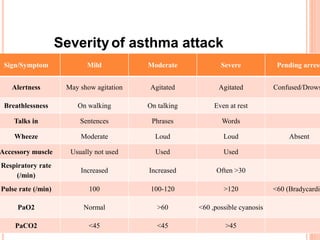
Sign/Symptom Mild Moderate Severe Pending arrest
Alertness May show agitation Agitated Agitated Confused/Drows
Breathlessness On walking On talking Even at rest
Talks in Sentences Phrases Words
Wheeze Moderate Loud Loud Absent
Accessory muscle Usually not used Used Used
Respiratory rate
(/min)
Increased Increased Often >30
Pulse rate (/min) 100 100-120 >120 <60 (Bradycardia
PaO2 Normal >60 <60 ,possible cyanosis
PaCO2 <45 <45 >45
Severity of asthma attack
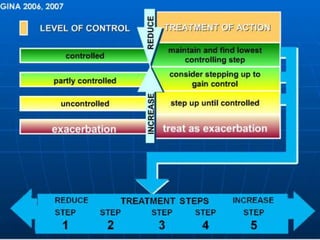
TREATMENT
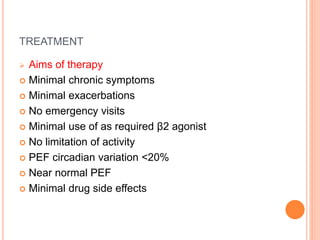
 Aims of therapy
 Minimal chronic symptoms
 Minimal exacerbations
 No emergency visits
 Minimal use of as required β2 agonist
 No limitation of activity
 PEF circadian variation <20%
 Near normal PEF
 Minimal drug side effects
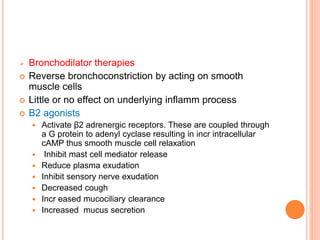
 Bronchodilator therapies
 Reverse bronchoconstriction by acting on smooth
muscle cells
 Little or no effect on underlying inflamm process
 Β2 agonists
 Activate β2 adrenergic receptors. These are coupled through
a G protein to adenyl cyclase resulting in incr intracellular
cAMP thus smooth muscle cell relaxation
 Inhibit mast cell mediator release
 Reduce plasma exudation
 Inhibit sensory nerve exudation
 Decreased cough
 Incr eased mucociliary clearance
 Increased mucus secretion
 Anticholinergics
 Prevent cholinergic nerve induced
bronchoconstriction and mucus secretion
 Slower onset of bronchodilation
 Less effective than β2 agonists
 Theophylline
 Inhibit phosphodiesterases in airway smooth
muscle cells thus increase cAMP
 Anti-inflammatory effects at lower doses via
activation of nuclear enzyme histone deacetylase-2
which switches off activated inflammatory genes
 Controller therapies
 Inhaled corticosteroids
 Most effective anti-inflammatory agents in asthma
 Switch off transcription genes that encode inflam
proteins
 Inhibit transcription factors NFkB and AP-1.
 Recruit histone deacetylase-2 to inflamm gene complex
thus reverses histone acetylation (assoc with incr gene
transcription)
 Reduce ; no. of inflammatory cells
; activation of inflammatory cells
; eosinophils in the airway and sputum
;activated T ymphocytes
;surface mast cells
 Systemic corticosteroids
IV for severe asthma
 Antileukotrienes
 Montelukast and zafirlukast
 Block cys-LT-1 receptors
 Add on therapy
 Cromones
 Cromolyn sodium and nedocromil sodium inhibit
mast cell and sensory nerve activation
 Block trigger induced asthma e.g. EIA
 Anti IgE
 Omalizumab
 Blocking Ab, which neutralizes circulating IgE
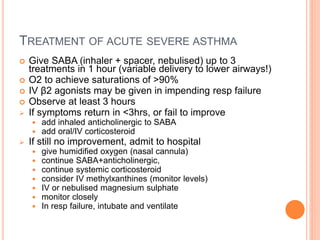
TREATMENT OF ACUTE SEVERE ASTHMA
 Give SABA (inhaler + spacer, nebulised) up to 3
treatments in 1 hour (variable delivery to lower airways!)
 O2 to achieve saturations of >90%
 IV β2 agonists may be given in impending resp failure
 Observe at least 3 hours
 If symptoms return in <3hrs, or fail to improve
 add inhaled anticholinergic to SABA
 add oral/IV corticosteroid
 If still no improvement, admit to hospital
 give humidified oxygen (nasal cannula)
 continue SABA+anticholinergic,
 continue systemic corticosteroid
 consider IV methylxanthines (monitor levels)
 IV or nebulised magnesium sulphate
 monitor closely
 In resp failure, intubate and ventilate

B'asthma -LECTURE.pptx

  • 1.
  • 2.
    DEFINITION  Clinical syndromedefined physiologically by episodic reversible airway narrowing and hyper responsiveness of the airways to a variety of stimuli.  Defined pathologically by presence of certain recognizable microscopic features i.e. Infiltration of the airways with eosinophils, hypertrophy and hyperplasia of the airway smooth muscle, mucous secretory apparatus and overall thickening of the airway wall.  Chronic relapsing inflammatory disorder characterised by hyperreactive airways leading to episodic reversible bronchial obstruction owing to increased responsiveness of the tracheobronchial tree to various stimuli
  • 3.
    EPIDEMIOLOGY  Affects ~300million people globally.  Men = Women in adulthood. In childhood 2:1  Prevalence 8-30% in developed countries and 0- 5% in developing countries  Kenyan: urban 10%, rural 3%  Commoner in those <20years. Peak age 3 years
  • 4.
    ETIOLOGY/ RISK FACTORS Interplay between genetic and environmental factors  Endogenous factors  Genetic predisposition  25 genes assoc with asthma  Atopy  Allergic rhinitis present in 80% of asthmatic patients  Airway hyperresponsiveness
  • 5.
    ETIOLOGY CONTINUED  Environmentalfactors  Indoor allergens i.e. house dust mite, domestic pets.  Outdoor allergens e.g. air pollution by sulphur dioxide, ozone, diesel particulates trigger symptoms  Occupational sensitizers  Hygiene hypothesis – exposure to infections and endotoxin, helminthic infections  Occupational exposure, chemicals e.g. toluene diisocyanate, trimellitic anhydride
  • 6.
    PATHOLOGY  Associated withspecific chronic inflammation of the mucosa of the lower airways. Lung parenchyma spared  Degree of inflammation poorly related to disease severity. Infiltration by T lymphocytes, activated eosinophils and mast cells.  Thickening of the basement membrane due to sub epithelial collagen deposition  Airway narrowed, reddened, wall thickened and edematous  Occlusion of airway by mucous plug
  • 7.
    PATHOPHYSIOLOGY  Limitation ofairflow due to;  Bronchoconstriction  Airway edema  Vascular congestion  Luminal occlusion with exudate  FEV1, FEV/FVC, PEF all reduced and an increase in airway resistance  Early closure of peripheral airway results in (air trapping) lung hyperinflation, and increased residual volume  Early phase reaction(within minutes) due to immediate hypersensitivity reaction. Mediated by histamine, prostaglandin D2 and leukotrienes C4,D4,E4  Late phase reaction(4-6 hours) coincides with influx of inflammmatoey cells mediated by T lymphocytes( eosinophils and basophils)
  • 8.
    INFLAMMATORY CELLS  Inflammationassoc with airway hyper responsiveness  Mast cells  Initiate bronchoconstrictor response to allergens or stimuli e.g. hyperventilation, exercise, fog  Activated by allergens through IgE dependent mechanism  Release brochoconstrictor mediators eg histamine, cysteinyl-leukotrienes, cytokines, chemokines, growth factors and neurotrophins
  • 9.
     Eosinophils  Linkedto dev of airway hyperresponsiveness  Presence related to disease severity  Release oxygen radicals and basic proteins  Release growth factors involved in airway remodelling  Recruitment involves  adhesion to vascular endothelial cells via adhesion molecules  migration to submucosa via chemokines  Activation and prolonged survival  Neutrophils  Role unknown  Resistant to anti-inflammatory effect of corticosteroids
  • 10.
     T lymphocytes Co-ordinate inflam response in asthma  Release cytokines for recruitment and survival of eosinophils  Maintain mast cell population  TH2 response predominant;  Release IL-5 thus eosinophilic inflammation  Release IL-13, IL-4 thus increased IgE production  Structural cells i.e. epithelial cells, fibroblasts, and smooth muscle cells release cytokines and lipid mediators.  Major source of mediators driving chronic inflammation
  • 11.
    ASTHMA TRIGGERS  Allergens Include pollen, fungal spores, allergens from domestic pests, roaches, ragweed  Viral infections  URTIs esp rhinovirus, RSV, corona virus.  Pharmacological agents  Β adrenergic blockers  ACE inhibitors  aspirin
  • 12.
     Air pollution Increased ambient levels of sulphur dioxide, ozone and nitrogen oxides  Occupation factors  Workplace sensitizing agents. Reversal if removed within 6 months. Later irreversible airway changes  Hormonal factors  Premenstrual worsening assoc with fall in progesterone  Thyrotoxicosis and hypothyroidism worsen asthma
  • 13.
    CLINICAL FEATURES  Wheezing, dyspnea, coughing  Symptoms worse at night or early morning  Increased mucus production difficult to expectorate  Prodromal symptoms; chin itch, impending doom, discomfort between scapula  Expiratory and inspiratory rhonchi  If well controlled no symptoms
  • 14.
    DIAGNOSIS  Lung functiontests  Spirometry: reduced FEV, FEV1/FVC ratio, PEF  Reversibility; > 12% and 200ml incr in FEV1 15 min after an inhaled short acting β2 agonist or after a 2 week trial with glucocorticoids  Measure of PEF twice daily confirms diurnal variation  Airway responsiveness  Methacholine or histamine challenge ;FEV reduced by 20%
  • 15.
     Hematologic  Totalserum IgEs and specific IgEs to inhaled allergens  Imaging  CXR normal or hyperinflation  Skin tests  Positive in allergic asthma, negative in intrinsic asthma.  Allergen testing for occupational exposure
  • 16.
    DIFFERENTIAL DIAGNOSIS  Upperairway obstruction  Left ventricular failure  Eosinophilic pneumonias  Systemic vasculitis  COPD  Pulmonary tuberculosis  Tracheomalacia  Vocal cord palsy
  • 17.
    Severity Symptom frequency Nighttime symptoms Peak expiratory flow rateor FEV1 of predicted Variability of peak expiratory flow rate or FEV1 Intermittent Less than once a week Less than twice per month More than 80% predicted Less than 20% Mild persistent More than once per week but less than once per day More than twice per month More than 80% predicted 20–30% Moderate persistent Daily More than once per week 60–80% predicted More than 30% Severe persistent Daily Frequent Less than 60% predicted More than 30% Clinical classification of asthma severity
  • 18.
    Sign/Symptom Mild ModerateSevere Pending arrest Alertness May show agitation Agitated Agitated Confused/Drows Breathlessness On walking On talking Even at rest Talks in Sentences Phrases Words Wheeze Moderate Loud Loud Absent Accessory muscle Usually not used Used Used Respiratory rate (/min) Increased Increased Often >30 Pulse rate (/min) 100 100-120 >120 <60 (Bradycardia PaO2 Normal >60 <60 ,possible cyanosis PaCO2 <45 <45 >45 Severity of asthma attack
  • 19.
    TREATMENT  Aims oftherapy  Minimal chronic symptoms  Minimal exacerbations  No emergency visits  Minimal use of as required β2 agonist  No limitation of activity  PEF circadian variation <20%  Near normal PEF  Minimal drug side effects
  • 20.
     Bronchodilator therapies Reverse bronchoconstriction by acting on smooth muscle cells  Little or no effect on underlying inflamm process  Β2 agonists  Activate β2 adrenergic receptors. These are coupled through a G protein to adenyl cyclase resulting in incr intracellular cAMP thus smooth muscle cell relaxation  Inhibit mast cell mediator release  Reduce plasma exudation  Inhibit sensory nerve exudation  Decreased cough  Incr eased mucociliary clearance  Increased mucus secretion
  • 21.
     Anticholinergics  Preventcholinergic nerve induced bronchoconstriction and mucus secretion  Slower onset of bronchodilation  Less effective than β2 agonists  Theophylline  Inhibit phosphodiesterases in airway smooth muscle cells thus increase cAMP  Anti-inflammatory effects at lower doses via activation of nuclear enzyme histone deacetylase-2 which switches off activated inflammatory genes
  • 22.
     Controller therapies Inhaled corticosteroids  Most effective anti-inflammatory agents in asthma  Switch off transcription genes that encode inflam proteins  Inhibit transcription factors NFkB and AP-1.  Recruit histone deacetylase-2 to inflamm gene complex thus reverses histone acetylation (assoc with incr gene transcription)  Reduce ; no. of inflammatory cells ; activation of inflammatory cells ; eosinophils in the airway and sputum ;activated T ymphocytes ;surface mast cells
  • 23.
     Systemic corticosteroids IVfor severe asthma  Antileukotrienes  Montelukast and zafirlukast  Block cys-LT-1 receptors  Add on therapy  Cromones  Cromolyn sodium and nedocromil sodium inhibit mast cell and sensory nerve activation  Block trigger induced asthma e.g. EIA
  • 24.
     Anti IgE Omalizumab  Blocking Ab, which neutralizes circulating IgE
  • 26.
    TREATMENT OF ACUTESEVERE ASTHMA  Give SABA (inhaler + spacer, nebulised) up to 3 treatments in 1 hour (variable delivery to lower airways!)  O2 to achieve saturations of >90%  IV β2 agonists may be given in impending resp failure  Observe at least 3 hours  If symptoms return in <3hrs, or fail to improve  add inhaled anticholinergic to SABA  add oral/IV corticosteroid  If still no improvement, admit to hospital  give humidified oxygen (nasal cannula)  continue SABA+anticholinergic,  continue systemic corticosteroid  consider IV methylxanthines (monitor levels)  IV or nebulised magnesium sulphate  monitor closely  In resp failure, intubate and ventilate