
Assessment-for-Learning Derek Moore http://www.webtests.co.za
Building a Shared Understanding How can we help learners to understand what they are meant to be learning?  Do we judge their ability to understand with summative assessments? Or do we measure their ability to improve their understanding with formative assessment?
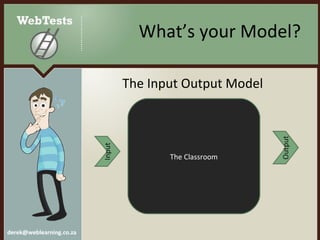
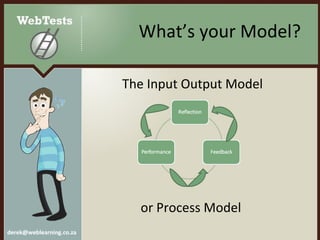
What’s your Model? The Input Output Model or Process Model  The Classroom
What’s your Model? The Input Output Model or Process Model
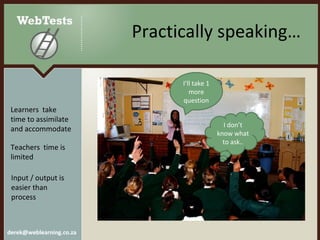
Practically speaking… I don’t know what to ask.. I’ll take 1 more question Learners  take time to assimilate and accommodate  Teachers  time is limited Input / output is easier than process
A Toolkit  Web Learning would like to develop, disseminate and support an assessment-for-learning toolkit for schools. A toolkit
Why’s a Toolkit necessary? Teachers need to know about their pupils' progress and difficulties with learning so that they can adapt their own work to meet pupils' needs -- needs that are often unpredictable and that vary from one pupil to another.”   Paul Black and Dylan Wiliam  A toolkit
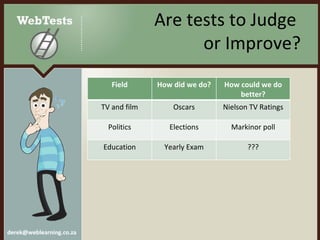
Are tests to Judge  or Improve? Field How did we do? How could we do better? TV and film Oscars Nielson TV Ratings Politics Elections Markinor poll Education Yearly Exam ???
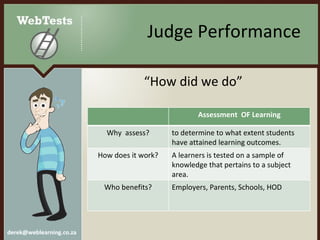
Judge Performance “ How did we do” Assessment  OF Learning Why  assess? to determine to what extent students have attained learning outcomes. How does it work? A learners is tested on a s ample of knowledge that pertains to a subject area. Who benefits? Employers, Parents, Schools, HOD
Improving Understanding “ How could we do better” Assessment FOR  Learning Why  assess? Assess understanding, set goals, review performance How does it work? A student performs a task, receives feedback  and then re-submits the task Who benefits? Learner and teacher
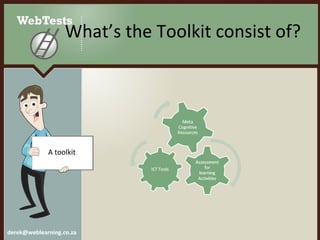
What’s the Toolkit consist of? A toolkit
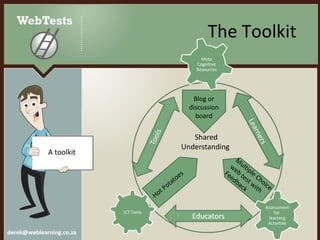
The Toolkit  Hot Potatoes Multiple Choice web test with Feedback Shared Understanding  Learners A toolkit Blog or discussion board ICT Tools Assessment for  learning Activities Meta Cognitive Resources
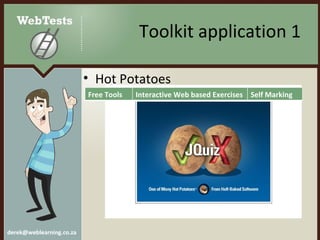
Toolkit application 1 Hot Potatoes Free Tools Interactive Web based Exercises Self Marking
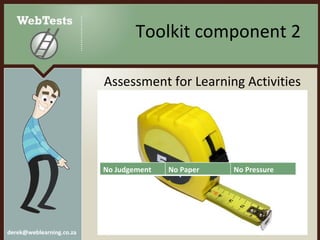
Toolkit component 2 Assessment for Learning Activities No Judgement No Paper No Pressure
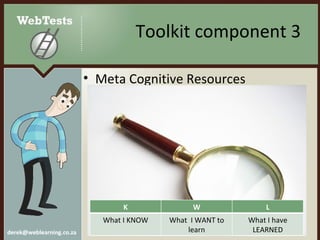
Toolkit component 3 Meta Cognitive Resources K W L What I KNOW What  I WANT to learn What I have LEARNED
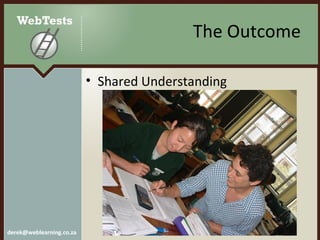
The Outcome Shared Understanding
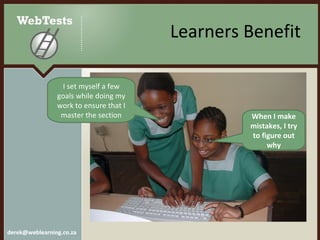
Learners Benefit When I make mistakes, I try to figure out why I set myself a few goals while doing my work to ensure that I master the section
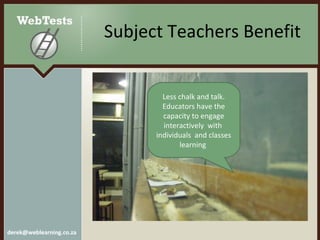
Subject Teachers Benefit Less chalk and talk. Educators have the capacity to engage interactively  with  individuals  and classes learning
Schooling Benefits We have a set of actionable data that we can use to improve our results
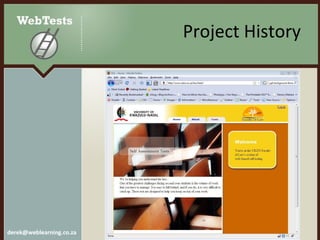
Project History
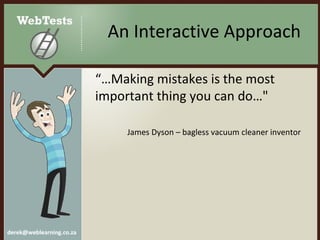
An Interactive Approach “… Making mistakes is the most important thing you can do…"  James Dyson – bagless vacuum cleaner inventor
Wrap Up A  toolkit that will assist educators and learners understand  what is happening inside their classroom. It will Empower teachers to use educational technology tools to innovate  Further ICT skills as students and educators go to the web.  Develop students and educators capacity to think a bit more about their learning and teaching with meta cognitive resources.
FAQ Assessment-for -Learning Thanks for you interest http://www.webtests.co.za Images: http://www.ghspmb.co.za, http://wefunction.com/2008/11/free-character-pack/ http://www.sxc.hu “ Assessment for learning guidance”  Qualifications and Curriculum Authority  Retrieved 16/12/2008/  http://www.qca.org.uk/qca_13440.aspx  Black, P. and Wiliam, D. (1998). Inside the black box: Raising standards through classroom assessment. Phi Delta Kappan, 80 (2): 139-148. (Available online: http://www.pdkintl.org/kappan/kbla9810.htm.)  "Formative Assessment".  Wikipedia.  Retrieved 12/12/2008 from http://en.wikipedia.org/wiki/Formative_assessment. Who is behind the project? Who’s  on the implementation team? Will the activities be free?  Who will author the materials? How sustainable is this project? Can I sign up?
Who’s behind the project? Derek Moore (who founded Web Learning) is driving this project.  Background Derek is teacher, part instructional designer, part information architect, part designer/developer, part web manager. He has worked professionally on the web and with web users since 1999.  Specialties: Instructional Design, Information Architecture, Web Design, Web Development, History Teaching , Education Lecturing  and ICT integration Qualifications M Ed Computer Assisted Education (cum laude) University of Pretoria Who is behind the project? Who’s  on the implementation team? Will the activities be free?  Who will author the materials? How sustainable is this project? Can I sign up?
Who’s on the  implementation team Derek Moore (Project Manager, Web Learning) Colin McKay (School Liason, SchoolTrade) Dr Sharon Grussendorf (SME, Independent Science Education consultant) Dr Edith Dempster (Evaluation, UKZN SED) Who is behind the project? Who’s  on the implementation team? Will the activities be free?  Who will author the materials? How sustainable is this project? Can I sign up?
Will the activities be free?  Yes for two reasons We are obliged all tests freely available. It’s a condition of using Hot Potatoes We subscribe to the Creative Commons Share Alike Licence. Under this licence you are free: to Share — to copy, distribute and transmit the work to Remix — to adapt the work Who is behind the project? Who’s  on the implementation team? Will the activities be free?  Who will author the materials? How sustainable is this project? Can I sign up?
Who will author  the materials? Selected educators will be selected to attend authoring workshops Materials development tutorials will also be online All educators will be encouraged to upload their tests to Web Tests Subject Matter experts and “Wisdom of the Crowds” ratings will ensure quality. Who is behind the project? Who’s  on the implementation team? Will the activities be free?  Who will author the materials? How sustainable is this project? Can I sign up?
How sustainable is  this project ? Web Learning will  develop and  host   the generic web tests website for free We will charge educational institutions for  Advanced Web Test Reporting Tools  Institution specific Web Test Support  Institution specific Web Test Hosting Institution specific Assessment for learning workshops Who is behind the project? Who’s  on the implementation team? Will the activities be free?  Who will author the materials? How sustainable is this project? Can I sign up?
Can I sign up The project is still in Alpha Stage. We are Looking for funding Developing the web site Writing manuals and resources looking for Subject Matter Experts Identifying schools and teachers Who is behind the project? Who’s  on the implementation team? Will the activities be free?  Who will author the materials? How sustainable is this project? Can I sign up?
The End Assessment-for -Learning

Assessment For Learning

  • 1.
    Assessment-for-Learning Derek Moorehttp://www.webtests.co.za
  • 2.
    Building a SharedUnderstanding How can we help learners to understand what they are meant to be learning? Do we judge their ability to understand with summative assessments? Or do we measure their ability to improve their understanding with formative assessment?
  • 3.
    What’s your Model?The Input Output Model or Process Model The Classroom
  • 4.
    What’s your Model?The Input Output Model or Process Model
  • 5.
    Practically speaking… Idon’t know what to ask.. I’ll take 1 more question Learners take time to assimilate and accommodate Teachers time is limited Input / output is easier than process
  • 6.
    A Toolkit Web Learning would like to develop, disseminate and support an assessment-for-learning toolkit for schools. A toolkit
  • 7.
    Why’s a Toolkitnecessary? Teachers need to know about their pupils' progress and difficulties with learning so that they can adapt their own work to meet pupils' needs -- needs that are often unpredictable and that vary from one pupil to another.” Paul Black and Dylan Wiliam A toolkit
  • 8.
    Are tests toJudge or Improve? Field How did we do? How could we do better? TV and film Oscars Nielson TV Ratings Politics Elections Markinor poll Education Yearly Exam ???
  • 9.
    Judge Performance “How did we do” Assessment OF Learning Why assess? to determine to what extent students have attained learning outcomes. How does it work? A learners is tested on a s ample of knowledge that pertains to a subject area. Who benefits? Employers, Parents, Schools, HOD
  • 10.
    Improving Understanding “How could we do better” Assessment FOR Learning Why assess? Assess understanding, set goals, review performance How does it work? A student performs a task, receives feedback and then re-submits the task Who benefits? Learner and teacher
  • 11.
    What’s the Toolkitconsist of? A toolkit
  • 12.
    The Toolkit Hot Potatoes Multiple Choice web test with Feedback Shared Understanding Learners A toolkit Blog or discussion board ICT Tools Assessment for learning Activities Meta Cognitive Resources
  • 13.
    Toolkit application 1Hot Potatoes Free Tools Interactive Web based Exercises Self Marking
  • 14.
    Toolkit component 2Assessment for Learning Activities No Judgement No Paper No Pressure
  • 15.
    Toolkit component 3Meta Cognitive Resources K W L What I KNOW What I WANT to learn What I have LEARNED
  • 16.
    The Outcome SharedUnderstanding
  • 17.
    Learners Benefit WhenI make mistakes, I try to figure out why I set myself a few goals while doing my work to ensure that I master the section
  • 18.
    Subject Teachers BenefitLess chalk and talk. Educators have the capacity to engage interactively with individuals and classes learning
  • 19.
    Schooling Benefits Wehave a set of actionable data that we can use to improve our results
  • 20.
  • 21.
    An Interactive Approach“… Making mistakes is the most important thing you can do…" James Dyson – bagless vacuum cleaner inventor
  • 22.
    Wrap Up A toolkit that will assist educators and learners understand what is happening inside their classroom. It will Empower teachers to use educational technology tools to innovate Further ICT skills as students and educators go to the web. Develop students and educators capacity to think a bit more about their learning and teaching with meta cognitive resources.
  • 23.
    FAQ Assessment-for -LearningThanks for you interest http://www.webtests.co.za Images: http://www.ghspmb.co.za, http://wefunction.com/2008/11/free-character-pack/ http://www.sxc.hu “ Assessment for learning guidance” Qualifications and Curriculum Authority Retrieved 16/12/2008/ http://www.qca.org.uk/qca_13440.aspx Black, P. and Wiliam, D. (1998). Inside the black box: Raising standards through classroom assessment. Phi Delta Kappan, 80 (2): 139-148. (Available online: http://www.pdkintl.org/kappan/kbla9810.htm.) "Formative Assessment".  Wikipedia.  Retrieved 12/12/2008 from http://en.wikipedia.org/wiki/Formative_assessment. Who is behind the project? Who’s on the implementation team? Will the activities be free? Who will author the materials? How sustainable is this project? Can I sign up?
  • 24.
    Who’s behind theproject? Derek Moore (who founded Web Learning) is driving this project. Background Derek is teacher, part instructional designer, part information architect, part designer/developer, part web manager. He has worked professionally on the web and with web users since 1999. Specialties: Instructional Design, Information Architecture, Web Design, Web Development, History Teaching , Education Lecturing and ICT integration Qualifications M Ed Computer Assisted Education (cum laude) University of Pretoria Who is behind the project? Who’s on the implementation team? Will the activities be free? Who will author the materials? How sustainable is this project? Can I sign up?
  • 25.
    Who’s on the implementation team Derek Moore (Project Manager, Web Learning) Colin McKay (School Liason, SchoolTrade) Dr Sharon Grussendorf (SME, Independent Science Education consultant) Dr Edith Dempster (Evaluation, UKZN SED) Who is behind the project? Who’s on the implementation team? Will the activities be free? Who will author the materials? How sustainable is this project? Can I sign up?
  • 26.
    Will the activitiesbe free? Yes for two reasons We are obliged all tests freely available. It’s a condition of using Hot Potatoes We subscribe to the Creative Commons Share Alike Licence. Under this licence you are free: to Share — to copy, distribute and transmit the work to Remix — to adapt the work Who is behind the project? Who’s on the implementation team? Will the activities be free? Who will author the materials? How sustainable is this project? Can I sign up?
  • 27.
    Who will author the materials? Selected educators will be selected to attend authoring workshops Materials development tutorials will also be online All educators will be encouraged to upload their tests to Web Tests Subject Matter experts and “Wisdom of the Crowds” ratings will ensure quality. Who is behind the project? Who’s on the implementation team? Will the activities be free? Who will author the materials? How sustainable is this project? Can I sign up?
  • 28.
    How sustainable is this project ? Web Learning will develop and host the generic web tests website for free We will charge educational institutions for Advanced Web Test Reporting Tools Institution specific Web Test Support Institution specific Web Test Hosting Institution specific Assessment for learning workshops Who is behind the project? Who’s on the implementation team? Will the activities be free? Who will author the materials? How sustainable is this project? Can I sign up?
  • 29.
    Can I signup The project is still in Alpha Stage. We are Looking for funding Developing the web site Writing manuals and resources looking for Subject Matter Experts Identifying schools and teachers Who is behind the project? Who’s on the implementation team? Will the activities be free? Who will author the materials? How sustainable is this project? Can I sign up?
  • 30.

Editor's Notes

  • #2 Introduction As a History teacher, I’d attempt to understand how much was being understood in my classroom by walking around and questioning each child individually. If they did understand, then fine. The lesson continued. When they didn’t, limited time and resources meant that comprehension problem were often unresolved. I’m embarrassed to admit that there were times when I became so frustrated by learners’ inability to understand my explanations / my ability to enlighten them that I broke my pencil while clarifying something on their page. This broken pencil - for me – has become a metaphor for my failure to understanding what was happening inside the students minds. My clarification methods and the received feedback did not generate a shared understanding of the comprehension problem. Why not? My tools (usually a pencil) was inadequate. My feedback was not appropriate and repeated explanations did not necessarily lead to improved performance Learner did not really see the need to understand. They simply wanted to get through the lesson. This Assessment-for-Learning toolkit that I have developed, is an attempt to engage with the broken pencil, and provide learners and educators with the space to create a shared understanding.