www.lumenlearning.com
Kaleidoscope Open Course Initiative
Central Community College
Workshop ~ 16-17 June 2013
Ronda Neugebauer
Lumen Learning Student Success Lead
Kaleidoscope Founding Member
Agenda
Why Open?
Practical Definitions and Considerations
Open Educational Resources
The Kaleidoscope Approach
Opportunities for Project Engagement
Education is Sharing
teachers with students
students with teachers
Shared by David Wiley under a Creative Commons Attribution 3.0 license.
Successful Educators
share most completely
with the most students
If There Is No Sharing
then there is no education
What can be given without
being given away?
Knowledge
can be given without being given away
Ideas are Non-rivalrous
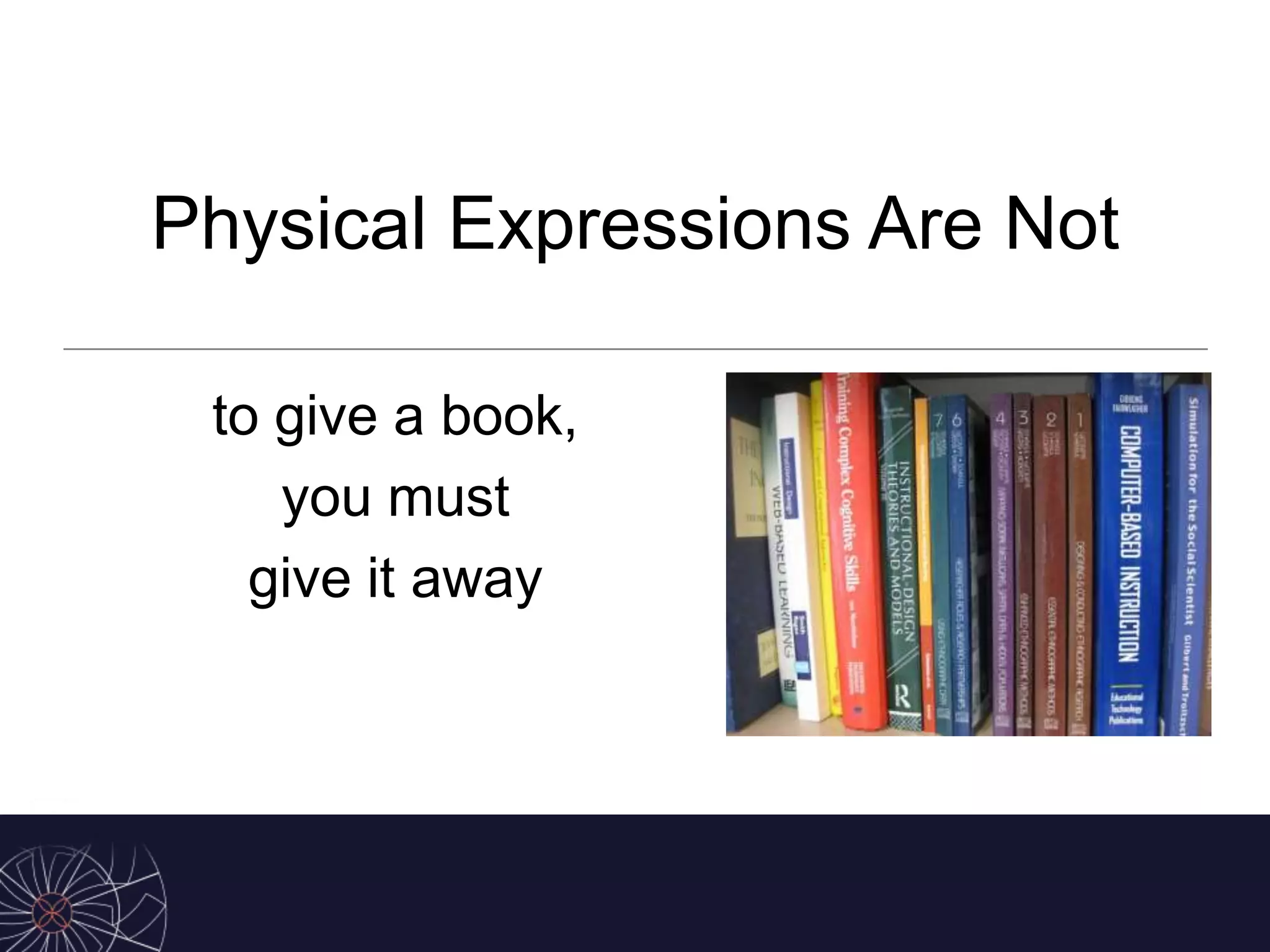
Physical Expressions Are Not
to give a book,
you must
give it away
When Expressions Are Digital
they also become non-rivalrous
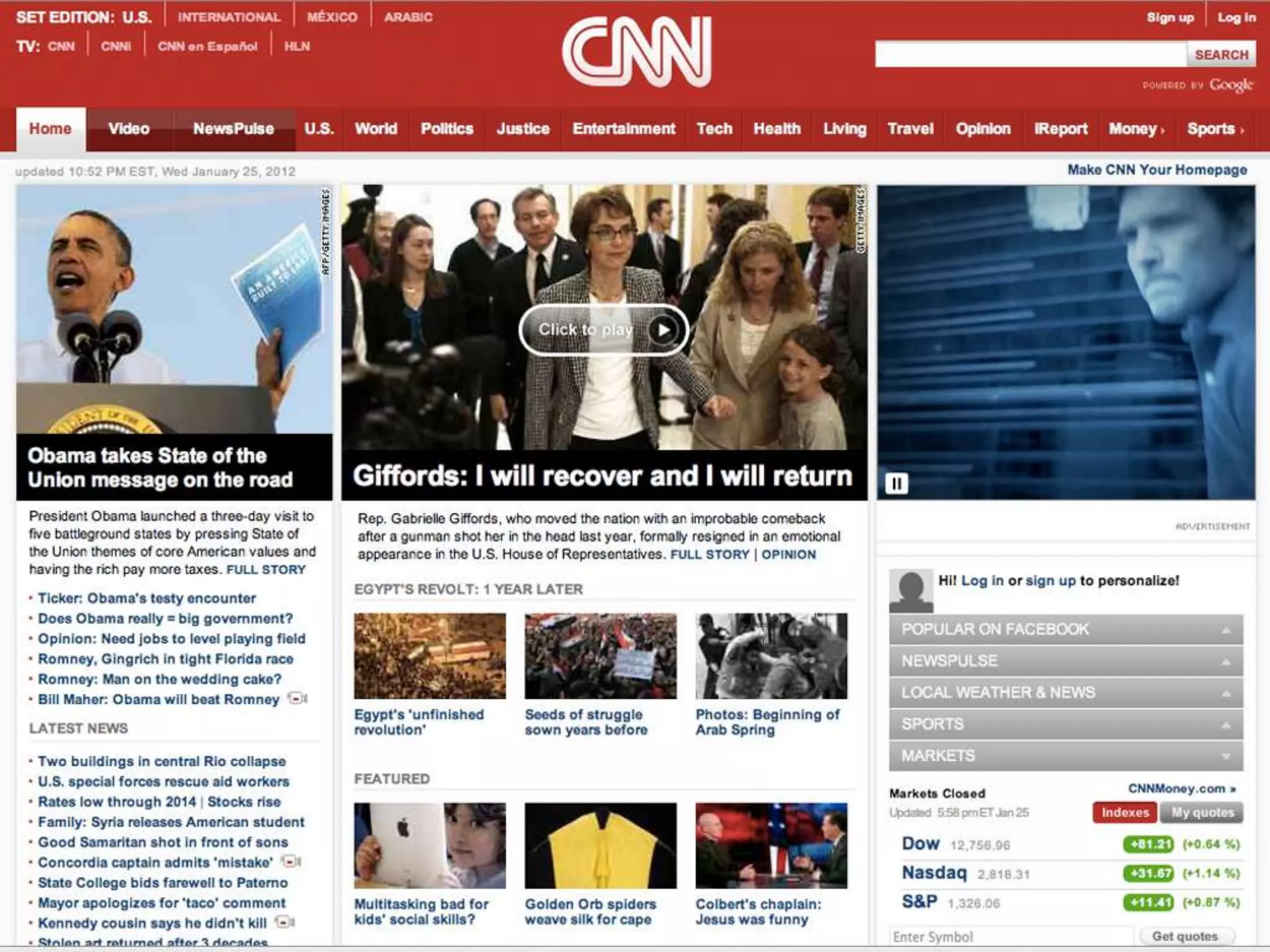
CC licensed photo http://www.flickr.com/photos/62693815@N03/6277209256/
Unprecedented Capacity
to share and educate as never before
Except We Can’t
© regulates copying, adapting, distributing
© Cancels the Possibilities
of digital media and the internet
Internet
Enables
what to do?
Copyright
Forbids
use copyright to enforce sharing
Makes It Easy to Share: 4Rs
• Use the content in its unaltered formReuse
• Adapt, adjust, modify, improve, or alter the
contentRevise
• Combine the original or revised content with
other OER to create something newRemix
• Share copies of the original content, revisions
or remixes with othersRedistribute
http://creativecommons.org
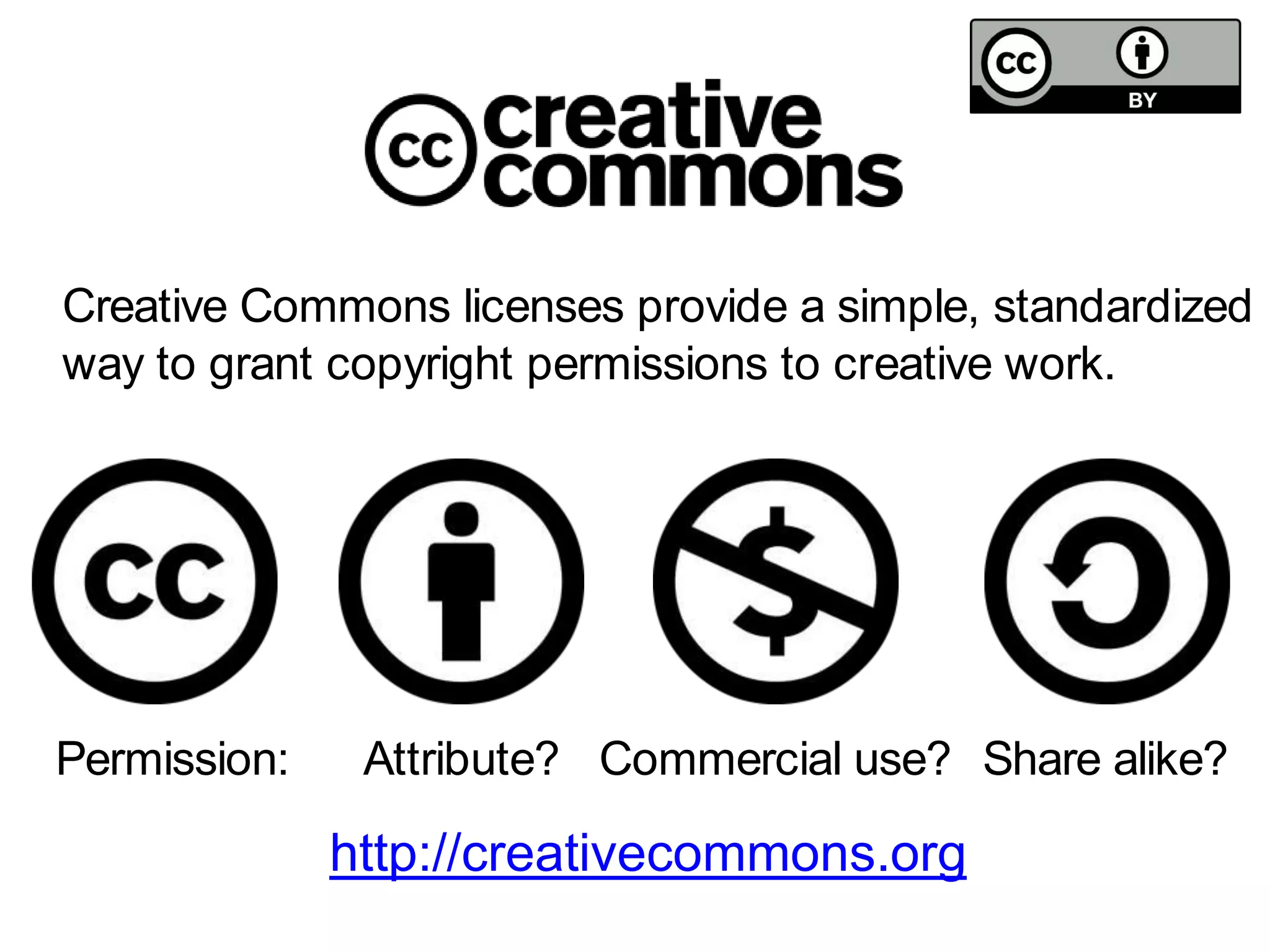
Creative Commons licenses provide a simple, standardized
way to grant copyright permissions to creative work.
Attribute? Commercial use? Share alike?Permission:
What are Open Educational
Resources (OER)?
(1)Any kind of teaching materials –
textbooks, syllabi, lesson
plans, videos, readings, exams
(2) Are free for anyone to access, and
(3) Include free permission to engage in the
4R activities: reuse, revise, remix, redistribute
What are Open Educational
Resources (OER)?
Internet
Enables
sharing and educating at
unprecedented scale
OER
Allows
Why Open (not cost)
Copy = no broken links
Copy = no surprise changes
Open = right to make changes
In Education
Free of cost
Improved access
Customization
Quality improvement
Collaboration
Open ≠ Digital
Open ≠ Free
OPEN
DIGITAL
FREE
Open Source Software
“Free” like “free scotch”
“Free” like “free speech”
Collaboration
“Release Early, Release Often”
“Given enough eyeballs, all bugs are
shallow”
The Promise of Open
For most authors the greatest
risk is
not piracy
but obscurity.
Why ?
- Tim O’Reilly
Because in the end
the love you take
is equal to
the love you make.
Why ?
- John Lennon
What do OER look like?
Mining OER
Click the Logo
OER Common Concerns
It’s too time-consuming to switch to OER.
If anyone can create OER, then the quality must
not be as good. Publisher materials are better.
I want a cohesive set of materials – from PPTs, to
practice sets, to textbooks – OER doesn’t offer this.
OER require online delivery. That’s not my teaching
style.
If I’m creating materials, then I should reap
the financial reward, not give it away for free.
If students can’t afford textbooks,
then they shouldn’t be in college.
OER Common Concerns
How can OER benefit students?
Kaleidoscope Project Goals
1. Eliminate textbook cost as a barrier
2. Drive assessment-driven enhancement of
course designs and materials
3. Connect to a global collaborative
community to share learning and
investment
Use Open Educational Resources to
Improve Student Success
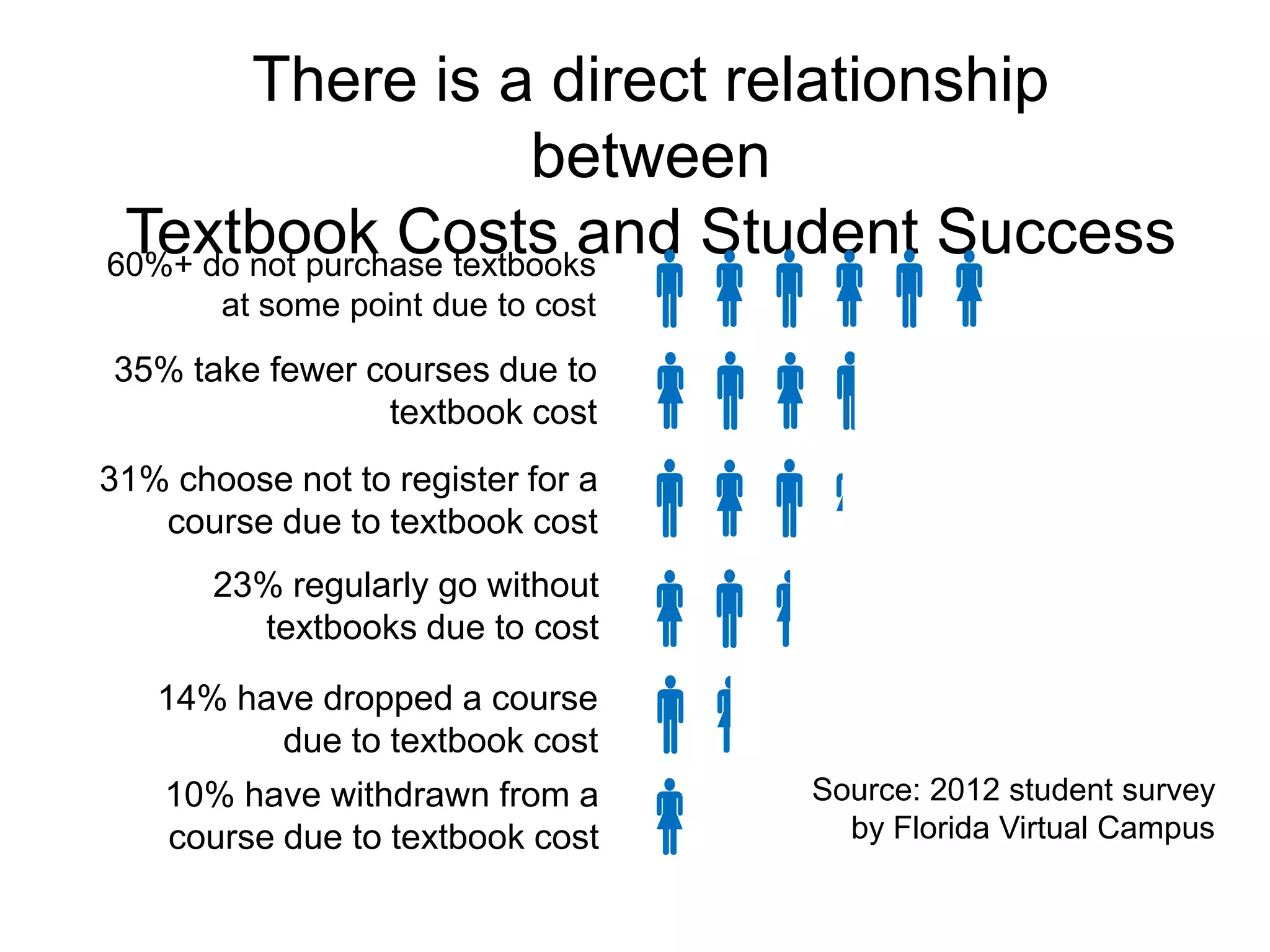
There is a direct relationship
between
Textbook Costs and Student Success






60%+ do not purchase textbooks
at some point due to cost
35% take fewer courses due to
textbook cost
31% choose not to register for a
course due to textbook cost
23% regularly go without
textbooks due to cost
14% have dropped a course
due to textbook cost
10% have withdrawn from a
course due to textbook cost
Source: 2012 student survey
by Florida Virtual Campus
The Vision

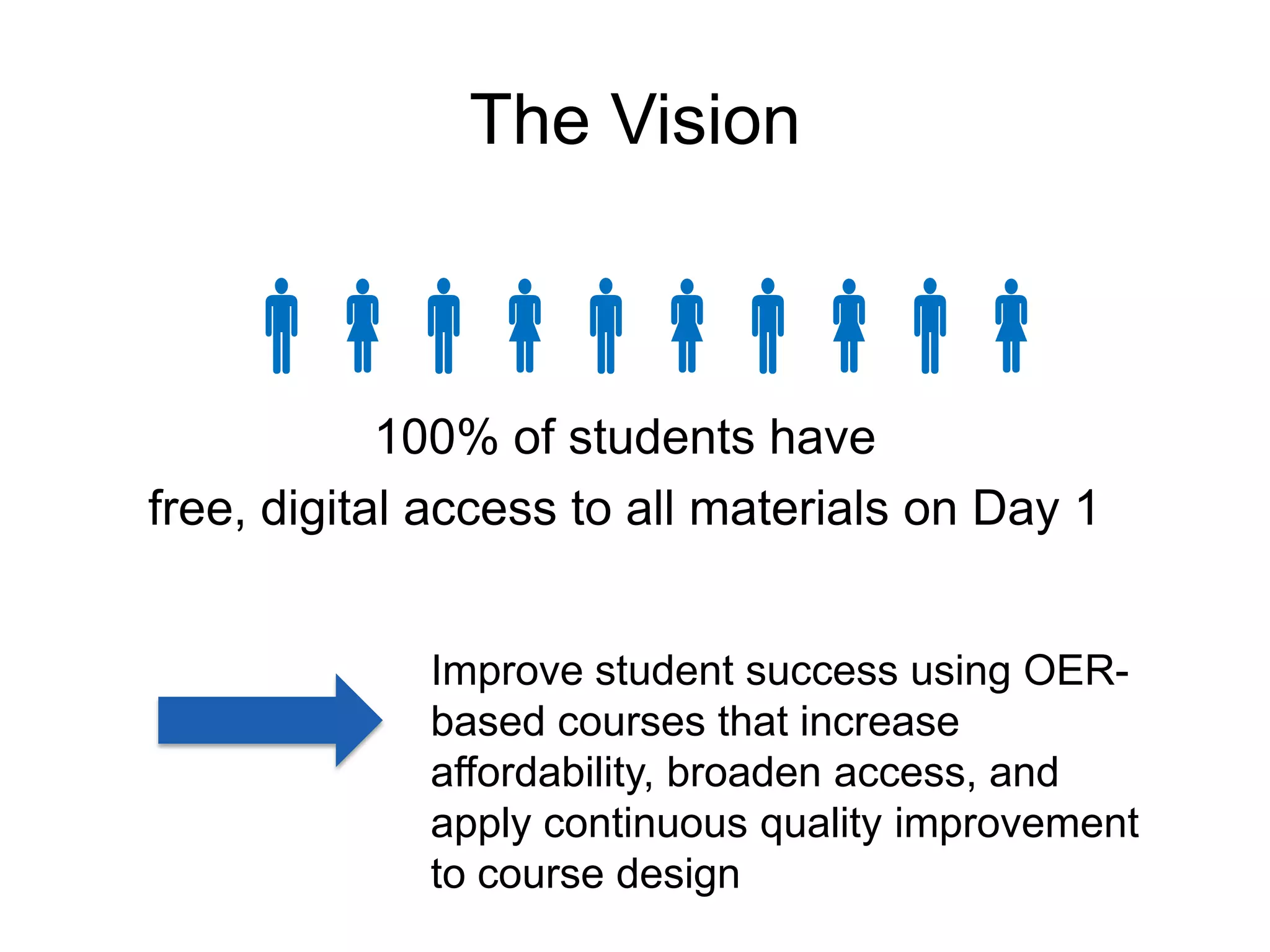
100% of students have
free, digital access to all materials on Day 1
Improve student success using OER-
based courses that increase
affordability, broaden access, and
apply continuous quality improvement
to course design
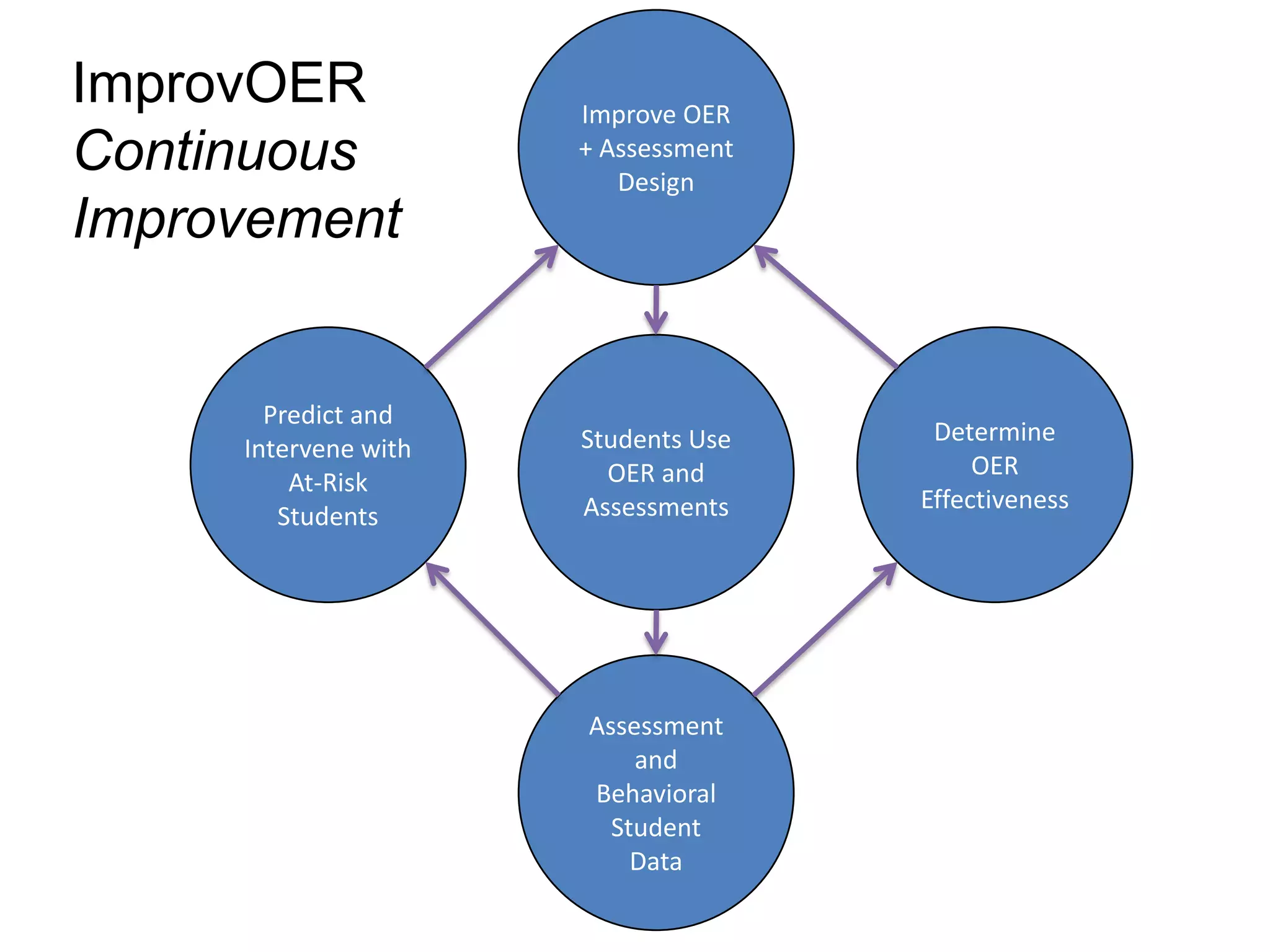
Students Use
OER and
Assessments
Improve OER
+ Assessment
Design
Assessment
and
Behavioral
Student
Data
Determine
OER
Effectiveness
Predict and
Intervene with
At-Risk
Students
ImprovOER
Continuous
Improvement
Open Course Framework
For each student learning outcome:
Complete set of open materials
Summative/Formative assessments
Supplemental and support resources
Fully mapped course
Close the assessment loop
Apply knowledge for continuous improvement of course
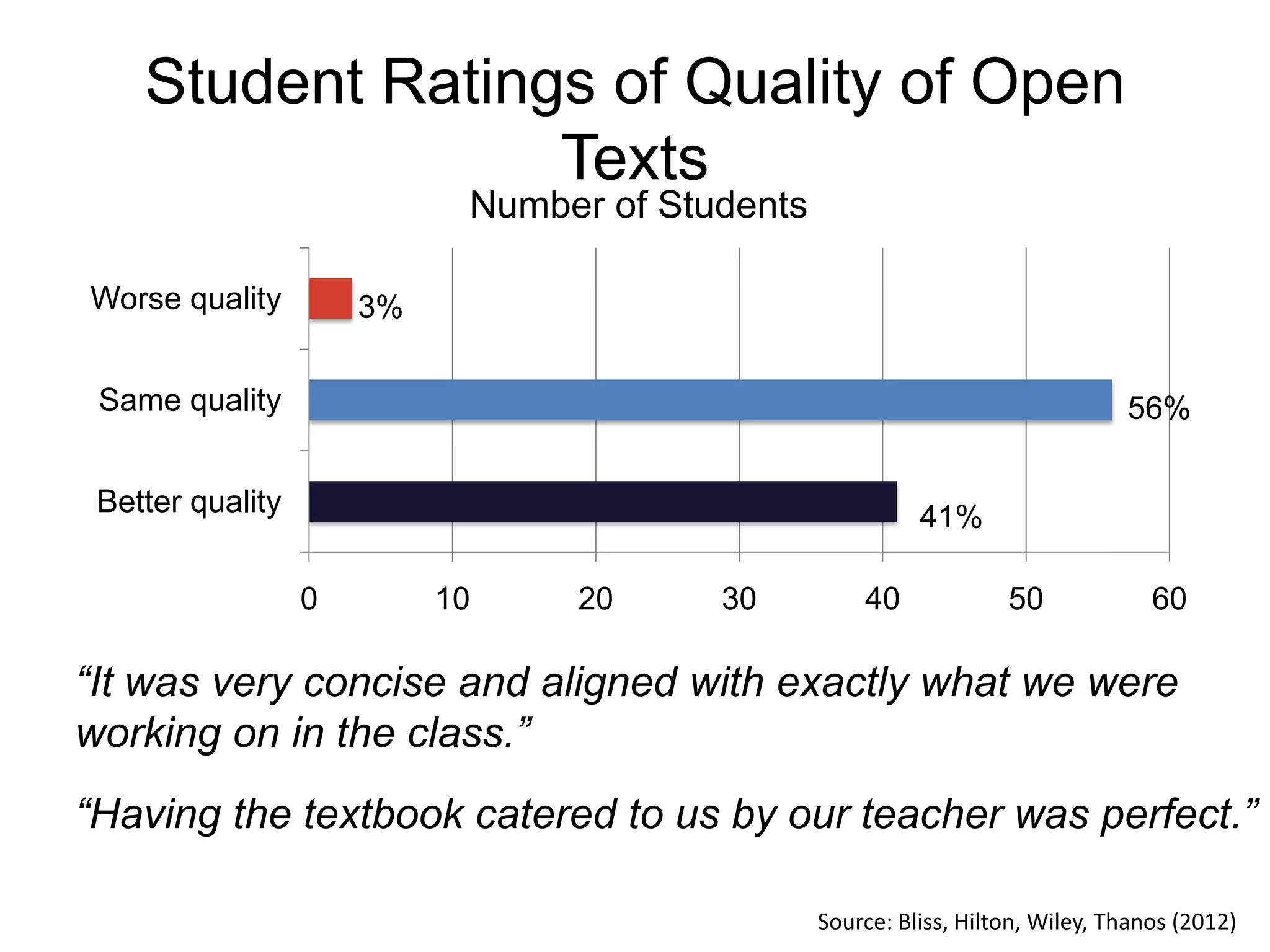
Student Ratings of Quality of Open
Texts
0 10 20 30 40 50 60
Better quality
Same quality
Worse quality
Number of Students
“It was very concise and aligned with exactly what we were
working on in the class.”
“Having the textbook catered to us by our teacher was perfect.”
3%
56%
41%
Source: Bliss, Hilton, Wiley, Thanos (2012)
Student Preference for Kaleidoscope
Courses
0 10 20 30 40 50 60 70 80
Prefer Kscope
Prefer traditional
No preference
Number of Students
“I enjoy having online texts provided for me because I'm poor. I
spend the money I have left after rent on school, so having
free online texts provided for me benefits me very much.”
“GREAT WAY TO DO ONLINE CLASSES!!!!”
13%
13%
73%
Source: Bliss, Hilton, Wiley, Thanos (2012)
Student Success C or Better
0
10
20
30
40
50
60
70
80
90
Historical Success Kaleidoscope
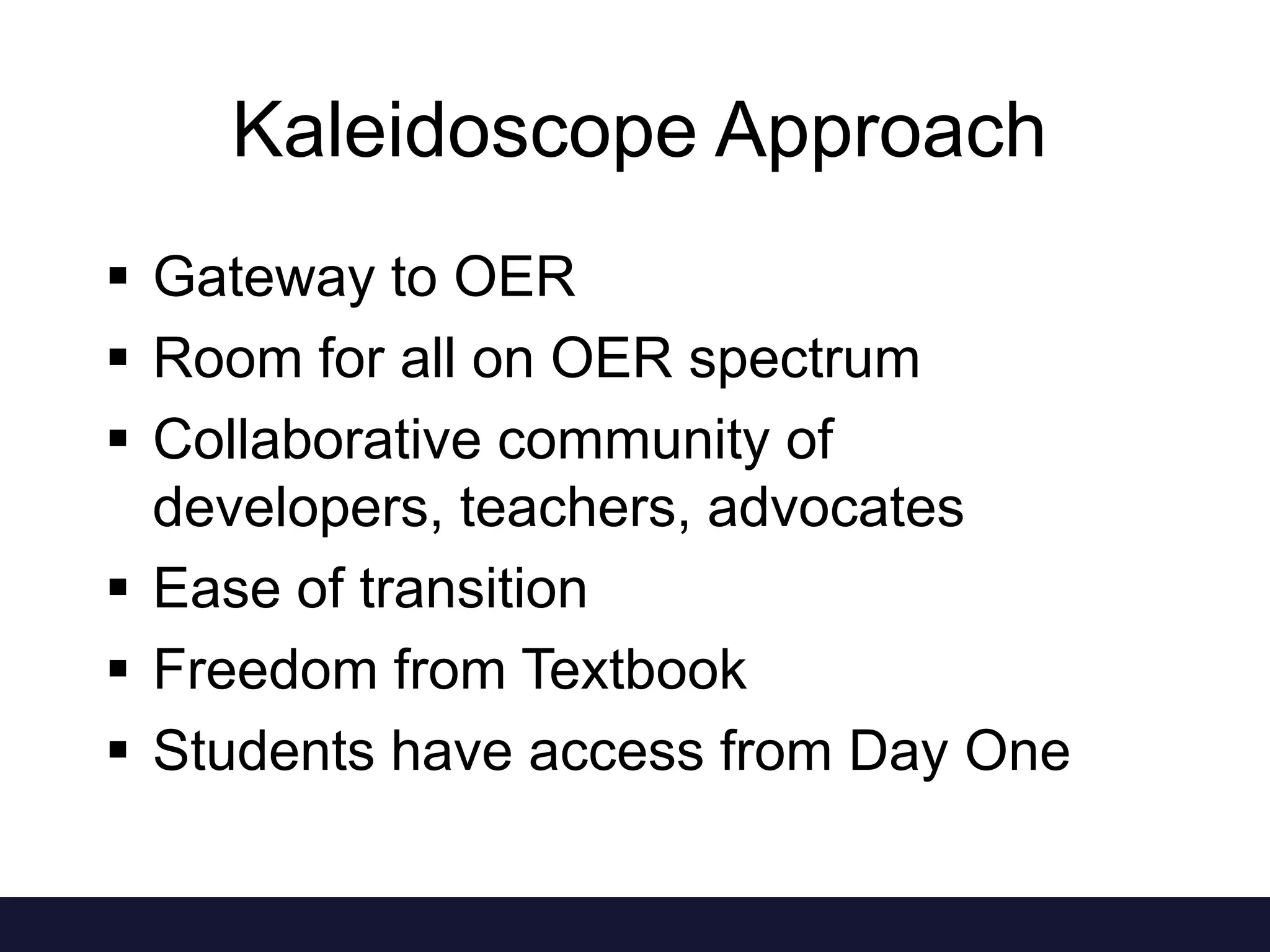
Kaleidoscope Approach
 Gateway to OER
 Room for all on OER spectrum
 Collaborative community of
developers, teachers, advocates
 Ease of transition
 Freedom from Textbook
 Students have access from Day One
Kaleidoscope Phase II
1. Support new institutions in pilots of open
course frameworks
– Micro-pilots
– Realistic evaluation of approach
2. Develop 20+ additional course
frameworks
3. Grow and mature the project
– Project governance
– Faculty leadership
www.lumenlearning.com
Kaleidoscope Phase II: Teach
Reading (dev)
Writing (dev)
Composition
Beg. Algebra (dev)
Int. Algebra (dev)
Biology
Chemistry
Physical Geography
Psychology
Fundamentals of Business
www.lumenlearning.com
Kaleidoscope Phase II: Develop
Financial Accounting
Managerial Accounting
Marketing
Intro to Information Systems
Intro to Teaching
US History to 1865
US History from 1865
Art Concepts/Art Appreciation
Music Appreciation
English Composition II
Speech Communication
Chemistry for majors
Intro to Earth Science
Intro to Political Science
Intro to Sociology
Principles of Macro-
economics
Principles of Micro-economics
US Government and Politics
Intro to Online Learning
www.lumenlearning.com
Kaleidoscope Phase II: Process
Begins with outcomes
Organize module layout for course in Lumen’s
instance of Canvas
Identify assessments w/ simple rubric
Identify OER content and check attribution
Map outcomes, assessments, and OER
content
Tailor course to preferences
Teach
www.lumenlearning.com
Opportunities
• Participate in pilots of existing frameworks
• Engage in creating new open course
frameworks
• Seek opportunities to use OER
• Support open licensing of educational materials
with Creative Commons licensing
It’s About Learning
Increasing learning by:
lowering costs
enabling and supporting faculty

Central Community College Kaleidoscope

  • 1.
    www.lumenlearning.com Kaleidoscope Open CourseInitiative Central Community College Workshop ~ 16-17 June 2013 Ronda Neugebauer Lumen Learning Student Success Lead Kaleidoscope Founding Member
  • 2.
    Agenda Why Open? Practical Definitionsand Considerations Open Educational Resources The Kaleidoscope Approach Opportunities for Project Engagement
  • 4.
    Education is Sharing teacherswith students students with teachers Shared by David Wiley under a Creative Commons Attribution 3.0 license.
  • 5.
    Successful Educators share mostcompletely with the most students
  • 6.
    If There IsNo Sharing then there is no education
  • 7.
    What can begiven without being given away? Knowledge
  • 8.
    can be givenwithout being given away Ideas are Non-rivalrous
  • 9.
    Physical Expressions AreNot to give a book, you must give it away
  • 10.
    When Expressions AreDigital they also become non-rivalrous
  • 11.
    CC licensed photohttp://www.flickr.com/photos/62693815@N03/6277209256/
  • 13.
    Unprecedented Capacity to shareand educate as never before
  • 14.
    Except We Can’t ©regulates copying, adapting, distributing
  • 15.
    © Cancels thePossibilities of digital media and the internet
  • 16.
  • 18.
    use copyright toenforce sharing
  • 19.
    Makes It Easyto Share: 4Rs • Use the content in its unaltered formReuse • Adapt, adjust, modify, improve, or alter the contentRevise • Combine the original or revised content with other OER to create something newRemix • Share copies of the original content, revisions or remixes with othersRedistribute
  • 20.
    http://creativecommons.org Creative Commons licensesprovide a simple, standardized way to grant copyright permissions to creative work. Attribute? Commercial use? Share alike?Permission:
  • 21.
    What are OpenEducational Resources (OER)? (1)Any kind of teaching materials – textbooks, syllabi, lesson plans, videos, readings, exams (2) Are free for anyone to access, and (3) Include free permission to engage in the 4R activities: reuse, revise, remix, redistribute What are Open Educational Resources (OER)?
  • 22.
    Internet Enables sharing and educatingat unprecedented scale OER Allows
  • 23.
    Why Open (notcost) Copy = no broken links Copy = no surprise changes Open = right to make changes
  • 24.
    In Education Free ofcost Improved access Customization Quality improvement Collaboration
  • 25.
    Open ≠ Digital Open≠ Free OPEN DIGITAL FREE
  • 26.
    Open Source Software “Free”like “free scotch” “Free” like “free speech” Collaboration “Release Early, Release Often” “Given enough eyeballs, all bugs are shallow” The Promise of Open
  • 27.
    For most authorsthe greatest risk is not piracy but obscurity. Why ? - Tim O’Reilly
  • 28.
    Because in theend the love you take is equal to the love you make. Why ? - John Lennon
  • 29.
    What do OERlook like?
  • 33.
  • 34.
    OER Common Concerns It’stoo time-consuming to switch to OER. If anyone can create OER, then the quality must not be as good. Publisher materials are better. I want a cohesive set of materials – from PPTs, to practice sets, to textbooks – OER doesn’t offer this.
  • 35.
    OER require onlinedelivery. That’s not my teaching style. If I’m creating materials, then I should reap the financial reward, not give it away for free. If students can’t afford textbooks, then they shouldn’t be in college. OER Common Concerns
  • 36.
    How can OERbenefit students?
  • 39.
    Kaleidoscope Project Goals 1.Eliminate textbook cost as a barrier 2. Drive assessment-driven enhancement of course designs and materials 3. Connect to a global collaborative community to share learning and investment Use Open Educational Resources to Improve Student Success
  • 40.
    There is adirect relationship between Textbook Costs and Student Success       60%+ do not purchase textbooks at some point due to cost 35% take fewer courses due to textbook cost 31% choose not to register for a course due to textbook cost 23% regularly go without textbooks due to cost 14% have dropped a course due to textbook cost 10% have withdrawn from a course due to textbook cost Source: 2012 student survey by Florida Virtual Campus
  • 41.
    The Vision  100% ofstudents have free, digital access to all materials on Day 1 Improve student success using OER- based courses that increase affordability, broaden access, and apply continuous quality improvement to course design
  • 42.
    Students Use OER and Assessments ImproveOER + Assessment Design Assessment and Behavioral Student Data Determine OER Effectiveness Predict and Intervene with At-Risk Students ImprovOER Continuous Improvement
  • 43.
    Open Course Framework Foreach student learning outcome: Complete set of open materials Summative/Formative assessments Supplemental and support resources Fully mapped course Close the assessment loop Apply knowledge for continuous improvement of course
  • 44.
    Student Ratings ofQuality of Open Texts 0 10 20 30 40 50 60 Better quality Same quality Worse quality Number of Students “It was very concise and aligned with exactly what we were working on in the class.” “Having the textbook catered to us by our teacher was perfect.” 3% 56% 41% Source: Bliss, Hilton, Wiley, Thanos (2012)
  • 45.
    Student Preference forKaleidoscope Courses 0 10 20 30 40 50 60 70 80 Prefer Kscope Prefer traditional No preference Number of Students “I enjoy having online texts provided for me because I'm poor. I spend the money I have left after rent on school, so having free online texts provided for me benefits me very much.” “GREAT WAY TO DO ONLINE CLASSES!!!!” 13% 13% 73% Source: Bliss, Hilton, Wiley, Thanos (2012)
  • 46.
    Student Success Cor Better 0 10 20 30 40 50 60 70 80 90 Historical Success Kaleidoscope
  • 47.
    Kaleidoscope Approach  Gatewayto OER  Room for all on OER spectrum  Collaborative community of developers, teachers, advocates  Ease of transition  Freedom from Textbook  Students have access from Day One
  • 48.
    Kaleidoscope Phase II 1.Support new institutions in pilots of open course frameworks – Micro-pilots – Realistic evaluation of approach 2. Develop 20+ additional course frameworks 3. Grow and mature the project – Project governance – Faculty leadership
  • 49.
    www.lumenlearning.com Kaleidoscope Phase II:Teach Reading (dev) Writing (dev) Composition Beg. Algebra (dev) Int. Algebra (dev) Biology Chemistry Physical Geography Psychology Fundamentals of Business
  • 50.
    www.lumenlearning.com Kaleidoscope Phase II:Develop Financial Accounting Managerial Accounting Marketing Intro to Information Systems Intro to Teaching US History to 1865 US History from 1865 Art Concepts/Art Appreciation Music Appreciation English Composition II Speech Communication Chemistry for majors Intro to Earth Science Intro to Political Science Intro to Sociology Principles of Macro- economics Principles of Micro-economics US Government and Politics Intro to Online Learning
  • 51.
    www.lumenlearning.com Kaleidoscope Phase II:Process Begins with outcomes Organize module layout for course in Lumen’s instance of Canvas Identify assessments w/ simple rubric Identify OER content and check attribution Map outcomes, assessments, and OER content Tailor course to preferences Teach
  • 52.
    www.lumenlearning.com Opportunities • Participate inpilots of existing frameworks • Engage in creating new open course frameworks • Seek opportunities to use OER • Support open licensing of educational materials with Creative Commons licensing
  • 53.
    It’s About Learning Increasinglearning by: lowering costs enabling and supporting faculty

Editor's Notes

  • #2 It is a distinct pleasure and honor to be here at Central Community College!On behalf of Lumen and Kaleidoscope I want to thank you for your time and willingness to learn more about the Kaleidoscope Open Course Initiative, which has been one of the most profound professional experiences of my career. I’m excited to be here and look forward to collaborating with and learning from yo for the next two days and beyond. From Agenda Notes: session can be open to all faculty members on campus; key players are: Project lead,Faculty participating in pilot,Other interested faculty,Other key stakeholdersAgenda:Brief overview of the open education landscapeReview of the Peru State College plans and opportunitiesUsing Open Educational ResourcesOpen licensing considerationsDiscovering open materialsCreating open materialsAttributionParticipating in the open education communityCollaboration tools and forumsKaleidoscope project resourcesDiscussion: Interest, needs and opportunities
  • #3 Begin with introductions: your name, discipline, etc.Brief overview of the open education landscapeReview of the Peru State College plans and opportunitiesUsing Open Educational ResourcesOpen licensing considerationsDiscovering open materialsCreating open materialsAttributionParticipating in the open education communityCollaboration tools and forumsKaleidoscope project resourcesDiscussion: Interest, needs and opportunities
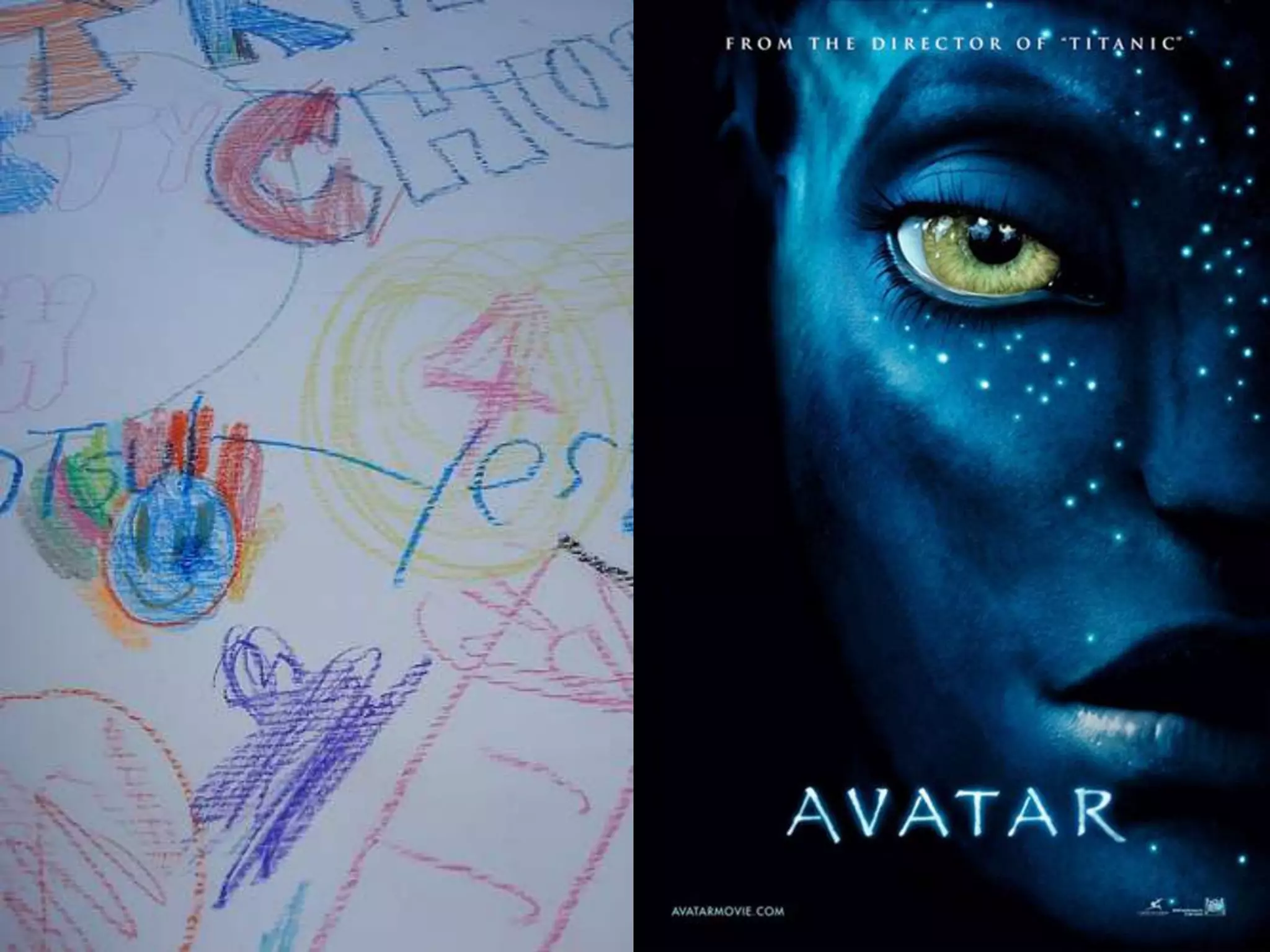
  • #4 What is the same about these? (Discussion) Possible answer: color palatte, face, creativityPoint: both are covered under the full protection of the law; have full protection of copyright law, anything I create has the same protection as the most expensive movie ever created, all copyright is pervasive...what is the impact of this? Wel, it impacts the way we share, the way we teach, the way we learn.
  • #5 What is the role of Openness in Education?Education is SharingTeacher share knowledge and skills, feedback and criticism, encouragementStudents share questions, assignments, feedback
  • #9 Knowledge. Ideas are non-rivalrous. They can be given without being given away.
  • #10 To give a book, you must give it away.Photo CC BY David Wiley
  • #12 Even with printnewspapers, ifI want section B of the of the Wall StreetJournal, and my colleagueisreadingit, we can’tsharethatsectionat the same time.CC licensedphoto http://www.flickr.com/photos/62693815@N03/6277209256/
  • #13 Because of the Internet, my colleague and I can view the same page simultaneously with millions of other people all over the world…and practically for free.Fundamental shift…we can share pervasively
  • #14 Not at an increase in cost, but at an increase in the ability to share.
  • #15 Copyright: regulates copying, distributing, editing, and adapting
  • #17 What the Internet enables, copyright forbids.We can’t share.The tension this creates is a common part of the academic life we live.
  • #18 Like a fundamental of Judo: take opponents’ strengths and use it against them
  • #20 At its core, open materials are 4RsFirst three are what impact teaching and learningBundling multiple texts is expensive:Focused on return of investment of textbookRevise: reduce the amount of materialsOpportunity for students to engage in materials…engaging students to revise and add to the textbook for their courseFree is awesome…but its just a part of whatthisis about
  • #21 Open source software community has itThere are broad global uses of CC outside of education as well(Click on hyperlink) Discuss 3 layers of licensing:Human Readable (language means I can understand it); Legal Code (legalese); Machine Readable (Google search can pick it up)Demo Advanced Google search and looking for CC logo (generally found at the bottom of webpages)Case against using CC NC for materials you create is removing the option to print materialsfor studentsCC button says it gives permissionCCBY means attribute it to the original authorCreates professional networkPersonal connectionsCommerical Use: can someone use the material Sharealike: revise but keep the same licenseNC License hurts when printing: need to have a sustainable process; CK 12 agreement under $5 per book; extra piece; we are still living in a world where we need print materialsIf Kscope is funding faculty time, materials created must be CCBY
  • #22 Openly sharing materials is powerful
  • #23 What the Internet enables, copyright forbids.We can’t share.The tension this creates is a common part of the academic life we live.
  • #24 First * there’s the practical matter of broken links. When you link to materials free online, you never know if they might suddenly disappear, or * if the owner might decide to change the material or start charging for it, or change editions on you. Most importantly, * Open gives you the right to make changesIn education, * open means:
  • #25 In education, open means:- * free of cost - saves students money - * improved access to materials (since they’re usually online)- * flexiblity for the instructor to customize/modify the content, * enabling continuous quality improvement- * ideally, can prompt conversation and collaboration around curriculum in a much richer way than is currently existing
  • #26 just to clear up some potential confusion Open does *not equal digital, and *open does not equal free.  Open materials in Education look like - * open educational resources, * open textbooks, and * open coursesMy interest in open began with * open source software …Perhaps * a Venn diagram would helpThere are free materials online that are not open, and there are open materials that are not online. *
  • #27 open source software is where the open content idea was bornfascinating. For the end user, * free is often the main driver, but for the techie, * the bigger driver is the ability to study and modify the code.  And for the big projects, * there was a community of developers, contributing to the creation of this product, often not because it was their job, but because they cared about the end product being better.  By pooling their skills, they could create a better product faster than any one person working alone.  Eric Steven Raymond’s The Cathedral and the BazaarHe discussed two fundamentally different development styles: the “cathedral” model of most of the commercial world versus the “bazaar” model of the Linux world with software debuggingTo me, this is * the promise of open.” and arguably an insight into the future not only software development, but educationThe obvious benefit is the cost in saving students money…but there are more.
  • #31 Biology textbook
  • #32 Videos, interactives, simulations
  • #33 OER can be almost anything! They are materials that are free to anyone to access and include free permission to engage in 4Rs
  • #34 Click the logo to access the site. Talk about OER. Talk about projects, and how much grant money has funded the content development…but challenge in adoption. The “if you build it they will come notion doesn’t necessarily in higher education.”
  • #35 Tim OReilly - “Obscurity is a far greater threat to authors and creative artists than piracy”If Pearson did take your CCBY OER work, then they would have to attribute it to you.
  • #36 Tim OReilly - “Obscurity is a far greater threat to authors and creative artists than piracy”If Pearson did take your CCBY OER work, then they would have to attribute it to you
  • #37 The Kaleidoscope Project, funded by a Next Generation Learning Challenges grant, began in 2011There were 8 founding institutions comprised of community colleges & open access 4-year schools from California to Nebraska to New York
  • #38 The project’s members have grown and in October 2012, the project received follow on funding again by Next Generation Learning Challenges grant.Six two-yearTwo four-year
  • #39 Top row: how to be smartMiddle: Technology and content providers larger project and matchLast: FundingShuttleworth: how we can better support learning resultsThe project’s advisors are experts from different organizations that have experience with OER, an advisory board, as well as a Kaleidoscope Leadership Team. In the first phase of Kaleidoscope, 11 Gen Ed courses were developed, over 9,000 students participated, therequired textbook cost dropped to $0, and the average change in student success (C or better in the course)reported was +14%
  • #40 Kaleidoscope Project GoalsUse OER to improve Student Business faculty are sharing with each otherWhen we started we had developers and adopters: not useful language and falseCollaboration group expandedKaleidoscope uses (OER) to improve student success. The project works by using the best of existing OER to reduce textbook costs to $0; use learning analytics analyze assessment, activity and success data to guide faculty members in continually improving the effectiveness of the open resources; supporting faculty within and across institutions to collaborate, share, and build community
  • #41 The most surprising is what we don’t see in the system: Drops and WsDavid: Recent research (conducted by the Florida Virtual Campus) quantifies the ways high textbook costs affect student persistence and success. More than 60% of students report not having purchase textbooks at some point due to the costNearly a quarter (23%) of students regularly go without textbooks due to their costDue to the high cost of textbooks:35% of students report taking fewer courses31% report not registering for a course14% have dropped a course10% have withdrawn from a courseLink to research source: http://www.openaccesstextbooks.org/pdf/2012_Exec_Sum_Student_Txtbk_Survey.pdf
  • #42 Recent research (conducted by the Florida Virtual Campus) quantifies the ways high textbook costs affect student persistence and success. More than 60% of students report not having purchase textbooks at some point due to the costNearly a quarter (23%) of students regularly go without textbooks due to their costDue to the high cost of textbooks:35% of students report taking fewer courses31% report not registering for a course14% have dropped a course10% have withdrawn from a courseLink to research source: http://www.openaccesstextbooks.org/pdf/2012_Exec_Sum_Student_Txtbk_Survey.pdfLumen led projects are giving students 100% free, digital access to all materials on the first day of the course. With this step alone, institutions have already boosted student success and retention simply by taking textbook costs out of the equation.   If that is the day 1 impact of OER, just think about the other ways we can move the needle on student success by designing, adopting, measuring success and improving OER-based courses.Start teaching from the first day of class
  • #43 ImprovOER: students use materials, analyze the results, and informs improvements
  • #44 Common outcomesAcross states bring the complete collection of outcomeslecture notes, syllabiQuality and Quantity: evolving project, where we have gaps the community is filling once on behalf of everyone; approach is a moving target; FWK had shift in business plan, so what was once open is no longer; What’s everyone using?Work with funders to understand the gapsHewlett: grant complete testbanks for 8 courses; open but controlled testbanks to share with faculty
  • #45 Created an Additional research to understand what is higher quality?
  • #46 Question was: if you had a choice…everything was the samePrefer traditional: students that prefer printed materials
  • #47 Financial Aid connectionQuality of materialsResearch method is a bit wildStudent success C or betterHistorical success: same faculty, same courseA lot of interventionsReading and writing have the worst dataOER free and open materialsfaculty engage differently, more instructional designCan’t unpack all individual materialsDev Math: diff between having materials on the first day made the difference between passing and failingmore digitial materials, layers on a second portion, found the most expensive way to deliver dev mathPearson and Alex text; lose access to system to review
  • #48 Archetypes of facultyFringe Lippmans and Sousas enjoy it in off timeUse materials but leave me aloneUse but it has to be easy, turn key, feel a lot like publisherFaculty comment: would be more open if it was part of the job; No institutional acknowledgement to use it; time is biggest problem lifting; everyone is developing; very early3 stepsHerculean lift: writing a book; evaluating materials; needs funded; better if its collaborative; tough for single faculty to do the work and share it; other faculty have seen when one does the work its seen as a threatSome group have created something complete and then I can match it to my outcomesThen taking materials and adopting; Not just materials, how do you teach differentlyWhat is the role of print?
  • #49 Archetypes of facultyFringe Lippmans and Sousas enjoy it in off timeUse materials but leave me aloneUse but it has to be easy, turn key, feel a lot like publisherFaculty comment: would be more open if it was part of the job; No institutional acknowledgement to use it; time is biggest problem lifting; everyone is developing; very early3 stepsHerculean lift: writing a book; evaluating materials; needs funded; better if its collaborative; tough for single faculty to do the work and share it; other faculty have seen when one does the work its seen as a threatSome group have created something complete and then I can match it to my outcomesThen taking materials and adopting; Not just materials, how do you teach differentlyWhat is the role of print?
  • #54 Overall…