ASSESSING SPEAKING
Carmen Mejía C.
UNIVERSIDAD TÉCNICA DE AMBATO
TEFL GRADUATE PROGRAM – 2016
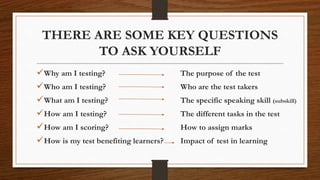
THERE ARE SOME KEY QUESTIONS
TO ASK YOURSELF
Why am I testing? The purpose of the test
Who am I testing? Who are the test takers
What am I testing? The specific speaking skill (subskill)
How am I testing? The different tasks in the test
How am I scoring? How to assign marks
How is my test benefiting learners? Impact of test in learning
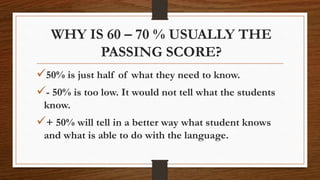
WHY IS 60 – 70 % USUALLY THE
PASSING SCORE?
50% is just half of what they need to know.
- 50% is too low. It would not tell what the students
know.
+ 50% will tell in a better way what student knows
and what is able to do with the language.
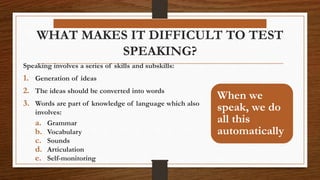
WHAT MAKES IT DIFFICULT TO TEST
SPEAKING?
Speaking involves a series of skills and subskills:
1. Generation of ideas
2. The ideas should be converted into words
3. Words are part of knowledge of language which also
involves:
a. Grammar
b. Vocabulary
c. Sounds
d. Articulation
e. Self-monitoring
When we
speak, we do
all this
automatically
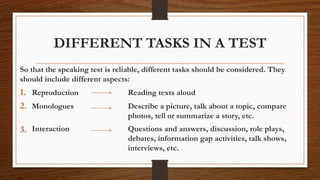
DIFFERENT TASKS IN A TEST
So that the speaking test is reliable, different tasks should be considered. They
should include different aspects:
1. Reproduction Reading texts aloud
2. Monologues Describe a picture, talk about a topic, compare
photos, tell or summarize a story, etc.
3. Interaction Questions and answers, discussion, role plays,
debates, information gap activities, talk shows,
interviews, etc.
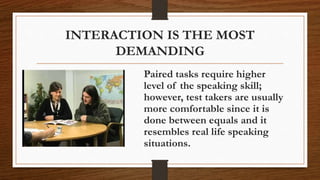
INTERACTION IS THE MOST
DEMANDING
Paired tasks require higher
level of the speaking skill;
however, test takers are usually
more comfortable since it is
done between equals and it
resembles real life speaking
situations.
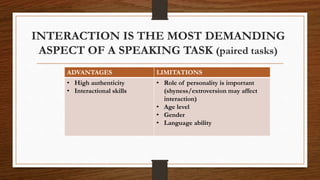
INTERACTION IS THE MOST DEMANDING
ASPECT OF A SPEAKING TASK (paired tasks)
ADVANTAGES LIMITATIONS
• High authenticity
• Interactional skills
• Role of personality is important
(shyness/extroversion may affect
interaction)
• Age level
• Gender
• Language ability
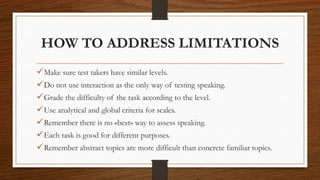
HOW TO ADDRESS LIMITATIONS
Make sure test takers have similar levels.
Do not use interaction as the only way of testing speaking.
Grade the difficulty of the task according to the level.
Use analytical and global criteria for scales.
Remember there is no «best» way to assess speaking.
Each task is good for different purposes.
Remember abstract topics are more difficult than concrete familiar topics.
FACTORS AFFECTING TASK FAIRNESS
• Clear instructions
• Clear purpose of task
• Range of tasks
• Order tasks from the easiest to the hardest.
• Assign appropriate timing for each part of the test.
• Have a clear marking criteria.
SCORING
Can be
• NORM REFERENCED when we relate the candidate’s
performance according to other candidates taking the same
test.
• CRITERION REFERENCED when we judge the
candidate based on fixed standards.
RATING SCALES AND CRITERIA
Reflect test construct Help with test reliability
It is necessary to decide on the criteria and
the weight assigned to each aspect of the
criteria
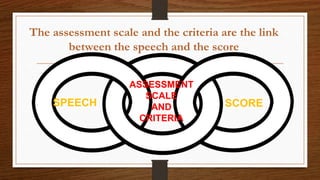
The assessment scale and the criteria are the link
between the speech and the score
SPEECH
ASSESSMENT
SCALE
AND
CRITERIA
SCORE
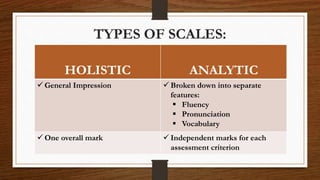
TYPES OF SCALES:
HOLISTIC ANALYTIC
 General Impression  Broken down into separate
features:
 Fluency
 Pronunciation
 Vocabulary
 One overall mark  Independent marks for each
assessment criterion
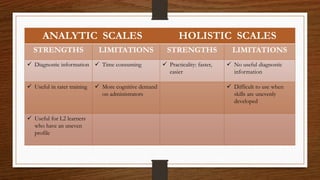
ANALYTIC SCALES HOLISTIC SCALES
STRENGTHS LIMITATIONS STRENGTHS LIMITATIONS
 Diagnostic information  Time consuming  Practicality: faster,
easier
 No useful diagnostic
information
 Useful in rater training  More cognitive demand
on administrators
 Difficult to use when
skills are unevenly
developed
 Useful for L2 learners
who have an uneven
profile
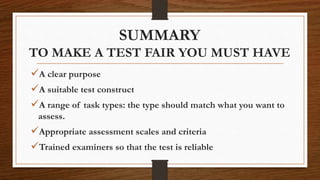
SUMMARY
TO MAKE A TEST FAIR YOU MUST HAVE
A clear purpose
A suitable test construct
A range of task types: the type should match what you want to
assess.
Appropriate assessment scales and criteria
Trained examiners so that the test is reliable

Assessing Speaking

  • 1.
    ASSESSING SPEAKING Carmen MejíaC. UNIVERSIDAD TÉCNICA DE AMBATO TEFL GRADUATE PROGRAM – 2016
  • 2.
    THERE ARE SOMEKEY QUESTIONS TO ASK YOURSELF Why am I testing? The purpose of the test Who am I testing? Who are the test takers What am I testing? The specific speaking skill (subskill) How am I testing? The different tasks in the test How am I scoring? How to assign marks How is my test benefiting learners? Impact of test in learning
  • 3.
    WHY IS 60– 70 % USUALLY THE PASSING SCORE? 50% is just half of what they need to know. - 50% is too low. It would not tell what the students know. + 50% will tell in a better way what student knows and what is able to do with the language.
  • 4.
    WHAT MAKES ITDIFFICULT TO TEST SPEAKING? Speaking involves a series of skills and subskills: 1. Generation of ideas 2. The ideas should be converted into words 3. Words are part of knowledge of language which also involves: a. Grammar b. Vocabulary c. Sounds d. Articulation e. Self-monitoring When we speak, we do all this automatically
  • 5.
    DIFFERENT TASKS INA TEST So that the speaking test is reliable, different tasks should be considered. They should include different aspects: 1. Reproduction Reading texts aloud 2. Monologues Describe a picture, talk about a topic, compare photos, tell or summarize a story, etc. 3. Interaction Questions and answers, discussion, role plays, debates, information gap activities, talk shows, interviews, etc.
  • 6.
    INTERACTION IS THEMOST DEMANDING Paired tasks require higher level of the speaking skill; however, test takers are usually more comfortable since it is done between equals and it resembles real life speaking situations.
  • 7.
    INTERACTION IS THEMOST DEMANDING ASPECT OF A SPEAKING TASK (paired tasks) ADVANTAGES LIMITATIONS • High authenticity • Interactional skills • Role of personality is important (shyness/extroversion may affect interaction) • Age level • Gender • Language ability
  • 8.
    HOW TO ADDRESSLIMITATIONS Make sure test takers have similar levels. Do not use interaction as the only way of testing speaking. Grade the difficulty of the task according to the level. Use analytical and global criteria for scales. Remember there is no «best» way to assess speaking. Each task is good for different purposes. Remember abstract topics are more difficult than concrete familiar topics.
  • 9.
    FACTORS AFFECTING TASKFAIRNESS • Clear instructions • Clear purpose of task • Range of tasks • Order tasks from the easiest to the hardest. • Assign appropriate timing for each part of the test. • Have a clear marking criteria.
  • 10.
    SCORING Can be • NORMREFERENCED when we relate the candidate’s performance according to other candidates taking the same test. • CRITERION REFERENCED when we judge the candidate based on fixed standards.
  • 11.
    RATING SCALES ANDCRITERIA Reflect test construct Help with test reliability It is necessary to decide on the criteria and the weight assigned to each aspect of the criteria
  • 12.
    The assessment scaleand the criteria are the link between the speech and the score SPEECH ASSESSMENT SCALE AND CRITERIA SCORE
  • 13.
    TYPES OF SCALES: HOLISTICANALYTIC  General Impression  Broken down into separate features:  Fluency  Pronunciation  Vocabulary  One overall mark  Independent marks for each assessment criterion
  • 14.
    ANALYTIC SCALES HOLISTICSCALES STRENGTHS LIMITATIONS STRENGTHS LIMITATIONS  Diagnostic information  Time consuming  Practicality: faster, easier  No useful diagnostic information  Useful in rater training  More cognitive demand on administrators  Difficult to use when skills are unevenly developed  Useful for L2 learners who have an uneven profile
  • 15.
    SUMMARY TO MAKE ATEST FAIR YOU MUST HAVE A clear purpose A suitable test construct A range of task types: the type should match what you want to assess. Appropriate assessment scales and criteria Trained examiners so that the test is reliable