ASSESSMENT AND EVALUATION
Full name : Ana Gabriela Marca Curillo
Nrc: 18234
Professor: Carlos Espín
Academic Period: Nov 2023- Mar 2024
Pedagogy of National and Foreign Languages.
Modalidad de Educación en Línea
STANDARDIZED TESTS
Standardized testing finds its very inception in China (1880) as a feasible alternative for the
government to assess expertise of government job applicants in terms of Confucian
philosophy and poetry (Fletcher, 2009).
Standardized tests are seen as procedurally fitting benchmarks or as per it is stated in
(Herman & Golan, 1991)“an appropriate measure of student’s, teacher’s and school’s
performance”.
Advantages and Disadvantages
Advantages
• A decent metric to gauge areas for enhancement and an objective measurement are
provided.
• Relevant data is provide by Standardized tests to reach out help to marginalized groups.
• Standardized tests constitute helpful benchmarks for teacher evaluation.
• Standardized tests can be considered as a feasible indicator for college and job success.
Disadvantages
• Standardized tests lack offering significant measure of progress and just determines which
students are skilled at taking tests.
• Standardized tests are fraught with discriminatory aspects: racism, classism and sexism.
• The data ensued from standardized tests are not accurate metrics for evaluations.
• Standardized test failed at being reliable to envisage future success.
Purpose of objective of standardized tests
The primal pursuit that the standardized-testing movement has been after over time refers
to the ease by which comparisonbetween the competences and aptitudes from an
assorted population of individuals with disparate backgrounds in terms of education may
be brought to fruition. (Sefcik, Bice, & Prerost, 2013).
❖ General description (GD): A detailed descriptionof what is to be tested.
❖ Prompt attribute (PA): This is what is to be given to the test taker; what they will see on
their screen or test paper.
❖ Response attribute (RA): This describes what the test taker will do.
❖ Sample item (SI): This provides a manifest example.
❖ Specification supplement (SS): Any additional information that is not contained in the
previous sections.
Test specifications
Test items
• Multiple choice exams
The ease this sort of test provides in terms of grading, though not that much in devising,
must be born in mind as it enables teachers to hasten this process (Center for Teaching
and Learning, s.f).
• Essay Questions
To display an overarching domain of a particular topic or in turn to assess the critical
thinking capacity of students in terms of organization, creativeness and information
management.
Reporting formats
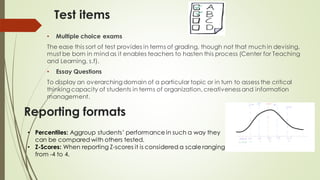
• Percentiles: Aggroup students’ performance in such a way they
can be compared with others tested.
• Z-Scores: When reporting Z-scores it is considered a scale ranging
from -4 to 4.
• T-Scores: The scale for each intervals goes from 10 up to 90 points.
• Stanine Score: The score scale employed ranges from 1 to 9, 5 is the
average.
• Scaled Scores: The general composite score is reached by means of
combining all the scores obtained from the subtests
Test items
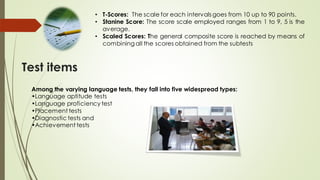
Among the varying language tests, they fall into five widespread types:
•Language aptitude tests
•Language proficiency test
•Placement tests
•Diagnostic tests and
•Achievement tests
Use of Language Test
• To get information that enables examiners to come to inferences regarding test-takers .
• The breadth reached by means of standardized tests like TOEFL or IELTS hardly manages
to assess the use of language.
• A handicap when conducting use of language test is the issueof context given that the
applicability of judgment is far more limited to multiple-choice items.
• Cambridge examinations have reduced their assessment of use of language to strictly
measure context-related completing exercises.
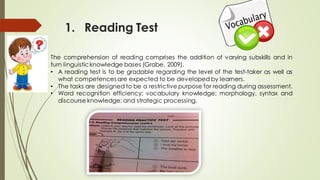
1. Reading Test
The comprehension of reading comprises the addition of varying subskills and in
turn linguisticknowledge bases (Grabe, 2009).
• A reading test is to be gradable regarding the level of the test-taker as well as
what competences are expected to be developed by learners.
• The tasks are designed to be a restrictive purpose for reading during assessment.
• Word recognition efficiency; vocabulary knowledge; morphology, syntax and
discourse knowledge; and strategic processing.
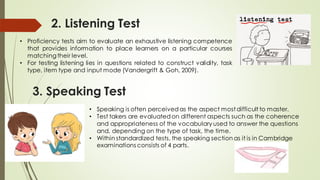
2. Listening Test
• Proficiency tests aim to evaluate an exhaustive listening competence
that provides information to place learners on a particular courses
matching their level.
• For testing listening lies in questions related to construct validity, task
type, item type and input mode (Vandergrift & Goh, 2009).
3. Speaking Test
• Speaking is often perceived as the aspect most difficult to master.
• Test takers are evaluated on different aspects such as the coherence
and appropriateness of the vocabulary used to answer the questions
and, depending on the type of task, the time.
• Within standardized tests, the speaking section as it is in Cambridge
examinations consists of 4 parts.
4. Writing test
In part one, questions related to personal informationare addressed.
In the second part, candidates are called upon comparing random pictures
while answering image-related questions.
In part three, a collaborative discussion with their partner candidate is taken
place.
in the fourth part that candidates have to elaborate further on their arguments.
• The assessment of a cognitive problem-solving
process without neglecting for the sociocultural
context in most cases.
• In L2 writing tests, descriptors cover a wide range
of topics, formats, or fixed types of writing, such
as essays, reports, letters, e-mails, and reviews.
and proposals.
Bibliography
• Bachman, L. F., & Palmer, A. S. (1996). Language Testing in Practice: Designing and
Developing Useful Language Tests. Oxford University Press.
• Center for Teaching and Learning. (s.f). Retrieved from University of Washington:
https://teaching.washington.edu/topics/preparing-to-teach/constructing-tests/
• Davidson, F., & Lynch, B. (2002). estcraft: A teacher’s guide to writing and using
language test. New Haven: Yale University Press.
• Glossary. Standardized Test. Recovered from: https://tophat.com/glossary/s/standardiz
ed-test/
• Wikipedia. Standardized Test. Recovered from: https://en.wikipedia.org/wiki/Standardized_test

Presentación.Ana.Marca.pdf

  • 1.
    ASSESSMENT AND EVALUATION Fullname : Ana Gabriela Marca Curillo Nrc: 18234 Professor: Carlos Espín Academic Period: Nov 2023- Mar 2024 Pedagogy of National and Foreign Languages. Modalidad de Educación en Línea
  • 2.
    STANDARDIZED TESTS Standardized testingfinds its very inception in China (1880) as a feasible alternative for the government to assess expertise of government job applicants in terms of Confucian philosophy and poetry (Fletcher, 2009). Standardized tests are seen as procedurally fitting benchmarks or as per it is stated in (Herman & Golan, 1991)“an appropriate measure of student’s, teacher’s and school’s performance”.
  • 3.
    Advantages and Disadvantages Advantages •A decent metric to gauge areas for enhancement and an objective measurement are provided. • Relevant data is provide by Standardized tests to reach out help to marginalized groups. • Standardized tests constitute helpful benchmarks for teacher evaluation. • Standardized tests can be considered as a feasible indicator for college and job success. Disadvantages • Standardized tests lack offering significant measure of progress and just determines which students are skilled at taking tests. • Standardized tests are fraught with discriminatory aspects: racism, classism and sexism. • The data ensued from standardized tests are not accurate metrics for evaluations. • Standardized test failed at being reliable to envisage future success.
  • 4.
    Purpose of objectiveof standardized tests The primal pursuit that the standardized-testing movement has been after over time refers to the ease by which comparisonbetween the competences and aptitudes from an assorted population of individuals with disparate backgrounds in terms of education may be brought to fruition. (Sefcik, Bice, & Prerost, 2013). ❖ General description (GD): A detailed descriptionof what is to be tested. ❖ Prompt attribute (PA): This is what is to be given to the test taker; what they will see on their screen or test paper. ❖ Response attribute (RA): This describes what the test taker will do. ❖ Sample item (SI): This provides a manifest example. ❖ Specification supplement (SS): Any additional information that is not contained in the previous sections. Test specifications
  • 5.
    Test items • Multiplechoice exams The ease this sort of test provides in terms of grading, though not that much in devising, must be born in mind as it enables teachers to hasten this process (Center for Teaching and Learning, s.f). • Essay Questions To display an overarching domain of a particular topic or in turn to assess the critical thinking capacity of students in terms of organization, creativeness and information management. Reporting formats • Percentiles: Aggroup students’ performance in such a way they can be compared with others tested. • Z-Scores: When reporting Z-scores it is considered a scale ranging from -4 to 4.
  • 6.
    • T-Scores: Thescale for each intervals goes from 10 up to 90 points. • Stanine Score: The score scale employed ranges from 1 to 9, 5 is the average. • Scaled Scores: The general composite score is reached by means of combining all the scores obtained from the subtests Test items Among the varying language tests, they fall into five widespread types: •Language aptitude tests •Language proficiency test •Placement tests •Diagnostic tests and •Achievement tests
  • 7.
    Use of LanguageTest • To get information that enables examiners to come to inferences regarding test-takers . • The breadth reached by means of standardized tests like TOEFL or IELTS hardly manages to assess the use of language. • A handicap when conducting use of language test is the issueof context given that the applicability of judgment is far more limited to multiple-choice items. • Cambridge examinations have reduced their assessment of use of language to strictly measure context-related completing exercises.
  • 8.
    1. Reading Test Thecomprehension of reading comprises the addition of varying subskills and in turn linguisticknowledge bases (Grabe, 2009). • A reading test is to be gradable regarding the level of the test-taker as well as what competences are expected to be developed by learners. • The tasks are designed to be a restrictive purpose for reading during assessment. • Word recognition efficiency; vocabulary knowledge; morphology, syntax and discourse knowledge; and strategic processing.
  • 9.
    2. Listening Test •Proficiency tests aim to evaluate an exhaustive listening competence that provides information to place learners on a particular courses matching their level. • For testing listening lies in questions related to construct validity, task type, item type and input mode (Vandergrift & Goh, 2009). 3. Speaking Test • Speaking is often perceived as the aspect most difficult to master. • Test takers are evaluated on different aspects such as the coherence and appropriateness of the vocabulary used to answer the questions and, depending on the type of task, the time. • Within standardized tests, the speaking section as it is in Cambridge examinations consists of 4 parts.
  • 10.
    4. Writing test Inpart one, questions related to personal informationare addressed. In the second part, candidates are called upon comparing random pictures while answering image-related questions. In part three, a collaborative discussion with their partner candidate is taken place. in the fourth part that candidates have to elaborate further on their arguments. • The assessment of a cognitive problem-solving process without neglecting for the sociocultural context in most cases. • In L2 writing tests, descriptors cover a wide range of topics, formats, or fixed types of writing, such as essays, reports, letters, e-mails, and reviews. and proposals.
  • 11.
    Bibliography • Bachman, L.F., & Palmer, A. S. (1996). Language Testing in Practice: Designing and Developing Useful Language Tests. Oxford University Press. • Center for Teaching and Learning. (s.f). Retrieved from University of Washington: https://teaching.washington.edu/topics/preparing-to-teach/constructing-tests/ • Davidson, F., & Lynch, B. (2002). estcraft: A teacher’s guide to writing and using language test. New Haven: Yale University Press. • Glossary. Standardized Test. Recovered from: https://tophat.com/glossary/s/standardiz ed-test/ • Wikipedia. Standardized Test. Recovered from: https://en.wikipedia.org/wiki/Standardized_test