Jacques Guillot, Guillaume Le Loc’h, Pascal Arné,
Françoise Féménia, René Chermette
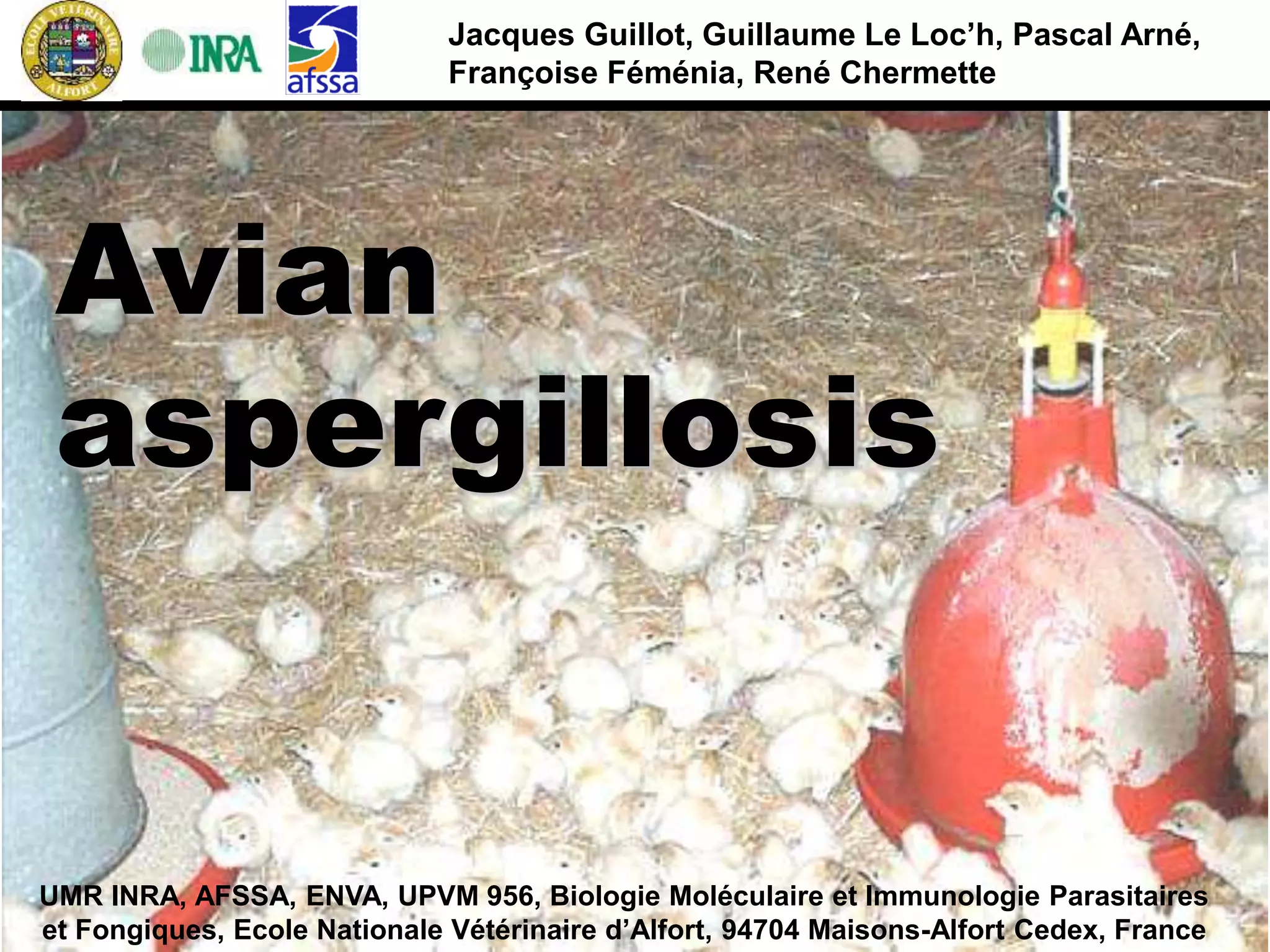
Avian
aspergillosis
UMR INRA, AFSSA, ENVA, UPVM 956, Biologie Moléculaire et Immunologie Parasitaires
et Fongiques, Ecole Nationale Vétérinaire d’Alfort, 94704 Maisons-Alfort Cedex, France
Introduction
Aspergillosis is considered as one of the most
important infectious diseases in birds
• early 1800s: first observations
scaup duck, jay, bullfinch, bustard and several swans
• 1898: first cases in turkey poults (Lignières & Petit in France)
• Since then, cases in a very wide range of avian species…
5 key questions…
Why are birds more susceptible than mammals ?
In which circumstances does aspergillosis occur in birds ?
Is it possible to make an early diagnosis in birds ?
Is it possible to treat or prevent avian aspergillosis ?
What do the main clinical signs and lesions look like ?
Susceptibility of birds
Birds are much more susceptible to aspergillosis than
mammalian species
• Environmental contamination by Aspergillus spp.
Susceptibility of birds
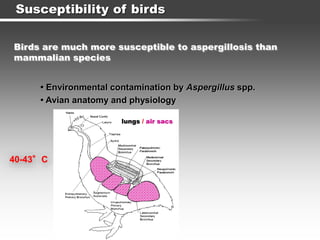
• Environmental contamination by Aspergillus spp.
• Avian anatomy and physiology
40-43°C
Birds are much more susceptible to aspergillosis than
mammalian species
lungs / air sacs
Susceptibility of birds
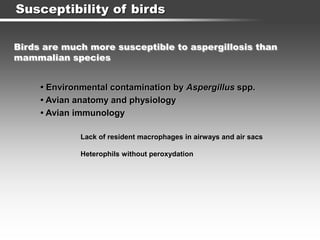
• Environmental contamination by Aspergillus spp.
• Avian anatomy and physiology
• Avian immunology
Lack of resident macrophages in airways and air sacs
Heterophils without peroxydation
Birds are much more susceptible to aspergillosis than
mammalian species
Epidemiology
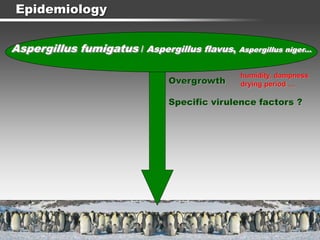
Aspergillus fumigatus / Aspergillus flavus, Aspergillus niger…
Overgrowth
Specific virulence factors ?
humidity, dampness
drying period …
Epidemiology
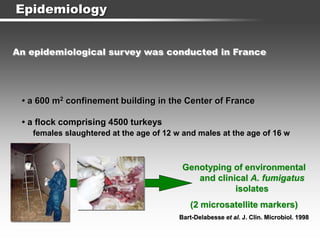
• a 600 m2 confinement building in the Center of France
• a flock comprising 4500 turkeys
females slaughtered at the age of 12 w and males at the age of 16 w
Genotyping of environmental
and clinical A. fumigatus
isolates
(2 microsatellite markers)
Bart-Delabesse et al. J. Clin. Microbiol. 1998
An epidemiological survey was conducted in France
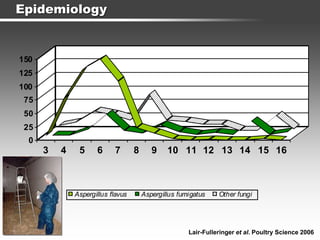
Epidemiology
0
25
50
75
100
125
150
3 4 5 6 7 8 9 10 11 12 13 14 15 16
Aspergillus flavus Aspergillus fumigatus Other fungi
Lair-Fulleringer et al. Poultry Science 2006
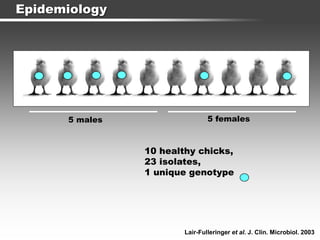
Epidemiology
5 males 5 females
10 healthy chicks,
23 isolates,
1 unique genotype
Lair-Fulleringer et al. J. Clin. Microbiol. 2003
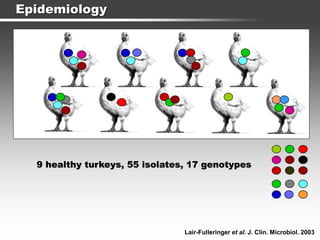
Epidemiology
9 healthy turkeys, 55 isolates, 17 genotypes
Lair-Fulleringer et al. J. Clin. Microbiol. 2003
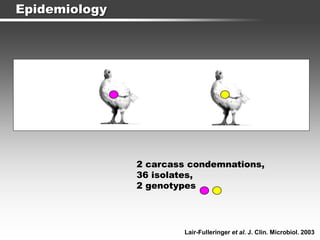
Epidemiology
2 carcass condemnations,
36 isolates,
2 genotypes
Lair-Fulleringer et al. J. Clin. Microbiol. 2003
Epidemiology
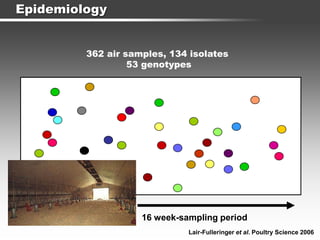
362 air samples, 134 isolates
53 genotypes
16 week-sampling period
Lair-Fulleringer et al. Poultry Science 2006
Epidemiology
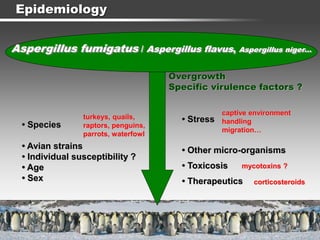
Aspergillus fumigatus / Aspergillus flavus, Aspergillus niger…
Overgrowth
Specific virulence factors ?
• Species
• Avian strains
• Individual susceptibility ?
• Age
• Sex
• Stress
• Other micro-organisms
• Toxicosis
• Therapeutics
captive environment
handling
migration…
mycotoxins ?
corticosteroids
turkeys, quails,
raptors, penguins,
parrots, waterfowl
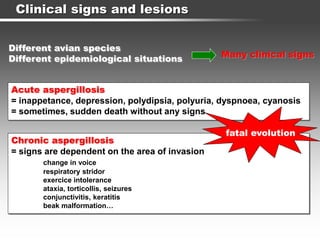
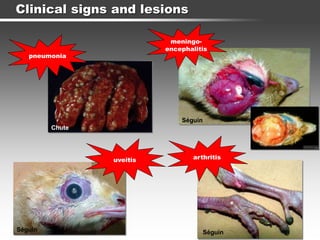
Clinical signs and lesions
Different avian species
Different epidemiological situations Many clinical signs
Acute aspergillosis
= inappetance, depression, polydipsia, polyuria, dyspnoea, cyanosis
= sometimes, sudden death without any signs
Chronic aspergillosis
= signs are dependent on the area of invasion
change in voice
respiratory stridor
exercice intolerance
ataxia, torticollis, seizures
conjunctivitis, keratitis
beak malformation…
fatal evolution
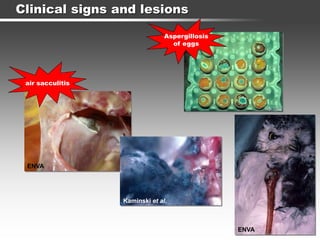
Clinical signs and lesions
ENVA
Kaminski et al.
air sacculitis
Aspergillosis
of eggs
ENVA
Clinical signs and lesions
Chute
pneumonia
meningo-
encephalitis
Séguin
arthritis
Séguin
uveitis
Séguin
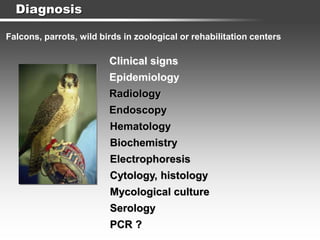
Diagnosis
Falcons, parrots, wild birds in zoological or rehabilitation centers
Clinical signs
Epidemiology
Radiology
Endoscopy
Hematology
Serology
Biochemistry
Electrophoresis
Mycological culture
PCR ?
Cytology, histology
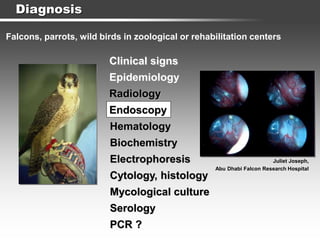
Diagnosis
Clinical signs
Epidemiology
Radiology
Endoscopy
Hematology
Serology
Juliet Joseph,
Abu Dhabi Falcon Research Hospital
Falcons, parrots, wild birds in zoological or rehabilitation centers
Biochemistry
Electrophoresis
Mycological culture
PCR ?
Cytology, histology
Hematology
Diagnosis
Clinical signs
Epidemiology
Radiology
Endoscopy
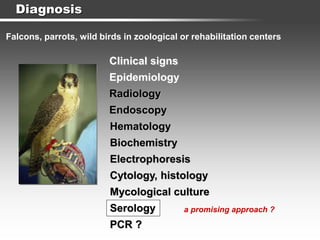
Serology
Falcons, parrots, wild birds in zoological or rehabilitation centers
Biochemistry
Electrophoresis
Mycological culture
PCR ?
Cytology, histology
a promising approach ?
Diagnosis
Serology
• Immunologically, birds respond to Aspergillus infection in
the same way as mammals and a type I response appears
most beneficial
• Birds also respond with specific antibody production
similar in its kinetics to mammals
• Serological tests that may be used in birds include the
detection of specific antibodies or fungal antigens
Diagnosis
Serology
 detection of specific antibodies
False negative results
some birds may not be able to mount an appropriate response
some infection locations result in limited antigenic stimulation
Antibody titers not necessary correlated to clinical severity
High prevalence of seropositivity in captive penguins
Low prevalence of seropositivity in wild birds
Diagnosis
Serology
 detection of galactomannan
• agglutination (Pastorex Aspergillus®)
• monoclonal sandwich ELISA (Platelia Aspergillus®)
• polyclonal sandwich ELISA
Diagnosis
Serology
 detection of galactomannan
Cray et al. ISHAM 2006 (poster P-0011)
839 serum samples (from suspected or confirmed cases)
Galactomannan in 50% of samples from penguins
in 25% of samples from other birds
Many chronic cases = negative for antibody but positive for galactomannan
But long term chronic cases = negative for both antigen and antibody !
Diagnosis
Serology
 detection of galactomannan
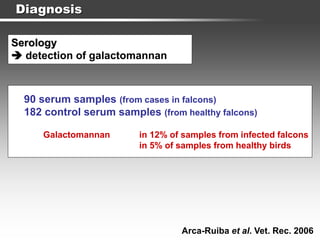
Arca-Ruiba et al. Vet. Rec. 2006
90 serum samples (from cases in falcons)
182 control serum samples (from healthy falcons)
Galactomannan in 12% of samples from infected falcons
in 5% of samples from healthy birds
Diagnosis
Serology
 detection of galactomannan
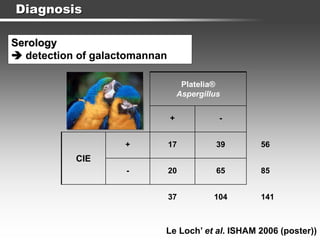
Le Loch’ et al. ISHAM 2006 (poster))
Platelia®
Aspergillus
+ -
CIE
+ 17 39 56
- 20 65 85
37 104 141
Diagnosis
Serology
 detection of galactomannan
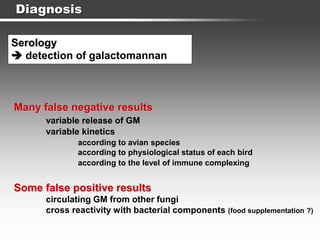
Many false negative results
variable release of GM
variable kinetics
according to avian species
according to physiological status of each bird
according to the level of immune complexing
Some false positive results
circulating GM from other fungi
cross reactivity with bacterial components (food supplementation ?)
Serology
Hematology
Diagnosis
Clinical signs
Epidemiology
Radiology
Endoscopy
Falcons, parrots, wild birds in zoological or rehabilitation centers
Biochemistry
Electrophoresis
Mycological culture
PCR ?
Cytology, histology
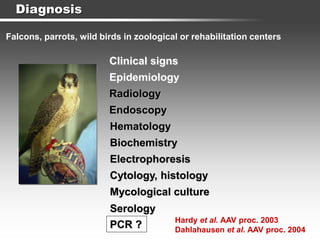
Hardy et al. AAV proc. 2003
Dahlahausen et al. AAV proc. 2004
Diagnosis
Clinical signs
Epidemiology
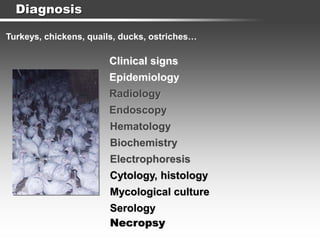
Turkeys, chickens, quails, ducks, ostriches…
Hematology
Radiology
Endoscopy
Serology
Biochemistry
Electrophoresis
Mycological culture
Necropsy
Cytology, histology
Treatment
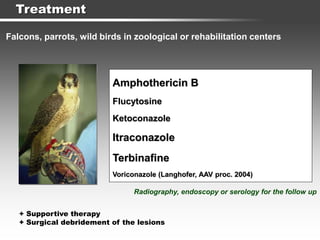
Falcons, parrots, wild birds in zoological or rehabilitation centers
Amphothericin B
Flucytosine
Ketoconazole
Itraconazole
Terbinafine
Voriconazole (Langhofer, AAV proc. 2004)
Radiography, endoscopy or serology for the follow up
+ Supportive therapy
+ Surgical debridement of the lesions
Treatment
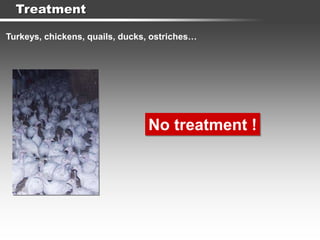
No treatment !
Turkeys, chickens, quails, ducks, ostriches…
Prevention
• Reduction of fungal contamination
• Chimioprevention ?
Vaccination with a heat-killed culture filtrate preparation has been reported
to reduce mortality in ducks and waterfowl
• Reduction of stress
• Vaccination
Richard (1984) reduced mortalities by 50% in turkey poults vaccinated with
germinated A. fumigatus conidia
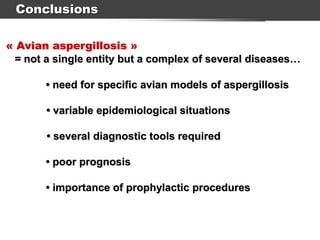
Conclusions
« Avian aspergillosis »
= not a single entity but a complex of several diseases…
• importance of prophylactic procedures
• poor prognosis
• need for specific avian models of aspergillosis
• variable epidemiological situations
• several diagnostic tools required
References
Cray, C., Rodriguez, M. & Watson, T. (2006) Aspergillus serodiagnostics in avian species. 16th Congress of the
International Society for Human and Animal Mycology (ISHAM), June 25-29th 2006, Paris (Poster).
Harmon, B. (1998). Avian heterophils in inflammation and disease resistance. Poultry Science, 77, 972-977.
Kearns, K.L. (2003). Avian aspergillosis. In: Recent advances in avian infectious diseases. Kearns KS, Loudis B
(Eds). Ithaca, International Information Service.
Klika, E., Scheuermann, D.W., De Groodt-Lasseel, M.H.A., Bazantova, I. & Switka, A. (1996). Pulmonary macrophages
in birds (barn owl, Tyto tyto alba), domestic fowl (Gallus gallus domestica), quail (Coturnix coturnix) and pigeon
(Columbia livia). Anatomy Record, 246, 87-97.
Kunkle, R.A. & Rimler, R.B. (1996). Pathology of acute aspergillosis in turkeys. Avian Diseases, 40, 875-886.
Lair-Fulleringer, S., Guillot, J., Desterque, C., Seguin, D., Warin, S., Chermette, R. & Bretagne, S. 2003. Differentiation
of Aspergillus fumigatus isolates from breeding turkeys and their environment by genotyping with microsatellite
markers. Journal of Clinical Microbiology, 41, 1798-1800.
Le Loc’h, G., Arné, P., Bougerol, C., Risi, E., Péricard, J.M., Quinton, J.F., Bretagne, S. & Guillot, J. (2006) Detection of
circulating serum galactomannan for the diagnosis of avian aspergillosis. 16th Congress of the International
Society for Human and Animal Mycology (ISHAM), June 25-29th 2006, Paris (Poster).
Morris, M.P. & Fletcher, O.J. (1988). Disease prevalence in Georgia turkey flocks in 1986. Avian Diseases, 32, 404-406.
Peden, W.M. & Rhoades, K.R. (1992). Pathogenicity differences of multiple isolates of Aspergillus fumigatus in
turkeys. Avian Diseases, 36, 537-542.
Redig, P.T., Post, G.S., Concannon, T.M. & Dunette, J. (1986). Development of an ELISA for the detection of
aspergillosis in avian species. Proceedings of the Association Avian Veterinarians, 165-178.
Redig, P.T. (1993). Avian aspergillosis. In: Fowler ME (Ed) Zoo and wild animals medicine. WB. Saunders Company,
Philadelphia, 178-181.
Richard, J.L. (1997). Aspergillosis. In: Diseases of poultry. Calmek B.W. (Ed), Mosby-Wolfe, London, 351-365.
Taylor, J.J. & Burroughs, E.J. (1973). Experimental avian aspergillosis. Mycopathologia Mycologia Applicata, 51, 131-
141.
Tell, L.A. (2005). Aspergillosis in mammals and birds: impact in veterinary medicine. Medical Mycology, 43, S71-S73.

Aspergillosis

  • 1.
    Jacques Guillot, GuillaumeLe Loc’h, Pascal Arné, Françoise Féménia, René Chermette Avian aspergillosis UMR INRA, AFSSA, ENVA, UPVM 956, Biologie Moléculaire et Immunologie Parasitaires et Fongiques, Ecole Nationale Vétérinaire d’Alfort, 94704 Maisons-Alfort Cedex, France
  • 2.
    Introduction Aspergillosis is consideredas one of the most important infectious diseases in birds • early 1800s: first observations scaup duck, jay, bullfinch, bustard and several swans • 1898: first cases in turkey poults (Lignières & Petit in France) • Since then, cases in a very wide range of avian species…
  • 3.
    5 key questions… Whyare birds more susceptible than mammals ? In which circumstances does aspergillosis occur in birds ? Is it possible to make an early diagnosis in birds ? Is it possible to treat or prevent avian aspergillosis ? What do the main clinical signs and lesions look like ?
  • 4.
    Susceptibility of birds Birdsare much more susceptible to aspergillosis than mammalian species • Environmental contamination by Aspergillus spp.
  • 5.
    Susceptibility of birds •Environmental contamination by Aspergillus spp. • Avian anatomy and physiology 40-43°C Birds are much more susceptible to aspergillosis than mammalian species lungs / air sacs
  • 6.
    Susceptibility of birds •Environmental contamination by Aspergillus spp. • Avian anatomy and physiology • Avian immunology Lack of resident macrophages in airways and air sacs Heterophils without peroxydation Birds are much more susceptible to aspergillosis than mammalian species
  • 7.
    Epidemiology Aspergillus fumigatus /Aspergillus flavus, Aspergillus niger… Overgrowth Specific virulence factors ? humidity, dampness drying period …
  • 8.
    Epidemiology • a 600m2 confinement building in the Center of France • a flock comprising 4500 turkeys females slaughtered at the age of 12 w and males at the age of 16 w Genotyping of environmental and clinical A. fumigatus isolates (2 microsatellite markers) Bart-Delabesse et al. J. Clin. Microbiol. 1998 An epidemiological survey was conducted in France
  • 9.
    Epidemiology 0 25 50 75 100 125 150 3 4 56 7 8 9 10 11 12 13 14 15 16 Aspergillus flavus Aspergillus fumigatus Other fungi Lair-Fulleringer et al. Poultry Science 2006
  • 10.
    Epidemiology 5 males 5females 10 healthy chicks, 23 isolates, 1 unique genotype Lair-Fulleringer et al. J. Clin. Microbiol. 2003
  • 11.
    Epidemiology 9 healthy turkeys,55 isolates, 17 genotypes Lair-Fulleringer et al. J. Clin. Microbiol. 2003
  • 12.
    Epidemiology 2 carcass condemnations, 36isolates, 2 genotypes Lair-Fulleringer et al. J. Clin. Microbiol. 2003
  • 13.
    Epidemiology 362 air samples,134 isolates 53 genotypes 16 week-sampling period Lair-Fulleringer et al. Poultry Science 2006
  • 14.
    Epidemiology Aspergillus fumigatus /Aspergillus flavus, Aspergillus niger… Overgrowth Specific virulence factors ? • Species • Avian strains • Individual susceptibility ? • Age • Sex • Stress • Other micro-organisms • Toxicosis • Therapeutics captive environment handling migration… mycotoxins ? corticosteroids turkeys, quails, raptors, penguins, parrots, waterfowl
  • 15.
    Clinical signs andlesions Different avian species Different epidemiological situations Many clinical signs Acute aspergillosis = inappetance, depression, polydipsia, polyuria, dyspnoea, cyanosis = sometimes, sudden death without any signs Chronic aspergillosis = signs are dependent on the area of invasion change in voice respiratory stridor exercice intolerance ataxia, torticollis, seizures conjunctivitis, keratitis beak malformation… fatal evolution
  • 16.
    Clinical signs andlesions ENVA Kaminski et al. air sacculitis Aspergillosis of eggs ENVA
  • 17.
    Clinical signs andlesions Chute pneumonia meningo- encephalitis Séguin arthritis Séguin uveitis Séguin
  • 18.
    Diagnosis Falcons, parrots, wildbirds in zoological or rehabilitation centers Clinical signs Epidemiology Radiology Endoscopy Hematology Serology Biochemistry Electrophoresis Mycological culture PCR ? Cytology, histology
  • 19.
    Diagnosis Clinical signs Epidemiology Radiology Endoscopy Hematology Serology Juliet Joseph, AbuDhabi Falcon Research Hospital Falcons, parrots, wild birds in zoological or rehabilitation centers Biochemistry Electrophoresis Mycological culture PCR ? Cytology, histology
  • 20.
    Hematology Diagnosis Clinical signs Epidemiology Radiology Endoscopy Serology Falcons, parrots,wild birds in zoological or rehabilitation centers Biochemistry Electrophoresis Mycological culture PCR ? Cytology, histology a promising approach ?
  • 21.
    Diagnosis Serology • Immunologically, birdsrespond to Aspergillus infection in the same way as mammals and a type I response appears most beneficial • Birds also respond with specific antibody production similar in its kinetics to mammals • Serological tests that may be used in birds include the detection of specific antibodies or fungal antigens
  • 22.
    Diagnosis Serology  detection ofspecific antibodies False negative results some birds may not be able to mount an appropriate response some infection locations result in limited antigenic stimulation Antibody titers not necessary correlated to clinical severity High prevalence of seropositivity in captive penguins Low prevalence of seropositivity in wild birds
  • 23.
    Diagnosis Serology  detection ofgalactomannan • agglutination (Pastorex Aspergillus®) • monoclonal sandwich ELISA (Platelia Aspergillus®) • polyclonal sandwich ELISA
  • 24.
    Diagnosis Serology  detection ofgalactomannan Cray et al. ISHAM 2006 (poster P-0011) 839 serum samples (from suspected or confirmed cases) Galactomannan in 50% of samples from penguins in 25% of samples from other birds Many chronic cases = negative for antibody but positive for galactomannan But long term chronic cases = negative for both antigen and antibody !
  • 25.
    Diagnosis Serology  detection ofgalactomannan Arca-Ruiba et al. Vet. Rec. 2006 90 serum samples (from cases in falcons) 182 control serum samples (from healthy falcons) Galactomannan in 12% of samples from infected falcons in 5% of samples from healthy birds
  • 26.
    Diagnosis Serology  detection ofgalactomannan Le Loch’ et al. ISHAM 2006 (poster)) Platelia® Aspergillus + - CIE + 17 39 56 - 20 65 85 37 104 141
  • 27.
    Diagnosis Serology  detection ofgalactomannan Many false negative results variable release of GM variable kinetics according to avian species according to physiological status of each bird according to the level of immune complexing Some false positive results circulating GM from other fungi cross reactivity with bacterial components (food supplementation ?)
  • 28.
    Serology Hematology Diagnosis Clinical signs Epidemiology Radiology Endoscopy Falcons, parrots,wild birds in zoological or rehabilitation centers Biochemistry Electrophoresis Mycological culture PCR ? Cytology, histology Hardy et al. AAV proc. 2003 Dahlahausen et al. AAV proc. 2004
  • 29.
    Diagnosis Clinical signs Epidemiology Turkeys, chickens,quails, ducks, ostriches… Hematology Radiology Endoscopy Serology Biochemistry Electrophoresis Mycological culture Necropsy Cytology, histology
  • 30.
    Treatment Falcons, parrots, wildbirds in zoological or rehabilitation centers Amphothericin B Flucytosine Ketoconazole Itraconazole Terbinafine Voriconazole (Langhofer, AAV proc. 2004) Radiography, endoscopy or serology for the follow up + Supportive therapy + Surgical debridement of the lesions
  • 31.
    Treatment No treatment ! Turkeys,chickens, quails, ducks, ostriches…
  • 32.
    Prevention • Reduction offungal contamination • Chimioprevention ? Vaccination with a heat-killed culture filtrate preparation has been reported to reduce mortality in ducks and waterfowl • Reduction of stress • Vaccination Richard (1984) reduced mortalities by 50% in turkey poults vaccinated with germinated A. fumigatus conidia
  • 33.
    Conclusions « Avian aspergillosis» = not a single entity but a complex of several diseases… • importance of prophylactic procedures • poor prognosis • need for specific avian models of aspergillosis • variable epidemiological situations • several diagnostic tools required
  • 34.
    References Cray, C., Rodriguez,M. & Watson, T. (2006) Aspergillus serodiagnostics in avian species. 16th Congress of the International Society for Human and Animal Mycology (ISHAM), June 25-29th 2006, Paris (Poster). Harmon, B. (1998). Avian heterophils in inflammation and disease resistance. Poultry Science, 77, 972-977. Kearns, K.L. (2003). Avian aspergillosis. In: Recent advances in avian infectious diseases. Kearns KS, Loudis B (Eds). Ithaca, International Information Service. Klika, E., Scheuermann, D.W., De Groodt-Lasseel, M.H.A., Bazantova, I. & Switka, A. (1996). Pulmonary macrophages in birds (barn owl, Tyto tyto alba), domestic fowl (Gallus gallus domestica), quail (Coturnix coturnix) and pigeon (Columbia livia). Anatomy Record, 246, 87-97. Kunkle, R.A. & Rimler, R.B. (1996). Pathology of acute aspergillosis in turkeys. Avian Diseases, 40, 875-886. Lair-Fulleringer, S., Guillot, J., Desterque, C., Seguin, D., Warin, S., Chermette, R. & Bretagne, S. 2003. Differentiation of Aspergillus fumigatus isolates from breeding turkeys and their environment by genotyping with microsatellite markers. Journal of Clinical Microbiology, 41, 1798-1800. Le Loc’h, G., Arné, P., Bougerol, C., Risi, E., Péricard, J.M., Quinton, J.F., Bretagne, S. & Guillot, J. (2006) Detection of circulating serum galactomannan for the diagnosis of avian aspergillosis. 16th Congress of the International Society for Human and Animal Mycology (ISHAM), June 25-29th 2006, Paris (Poster). Morris, M.P. & Fletcher, O.J. (1988). Disease prevalence in Georgia turkey flocks in 1986. Avian Diseases, 32, 404-406. Peden, W.M. & Rhoades, K.R. (1992). Pathogenicity differences of multiple isolates of Aspergillus fumigatus in turkeys. Avian Diseases, 36, 537-542. Redig, P.T., Post, G.S., Concannon, T.M. & Dunette, J. (1986). Development of an ELISA for the detection of aspergillosis in avian species. Proceedings of the Association Avian Veterinarians, 165-178. Redig, P.T. (1993). Avian aspergillosis. In: Fowler ME (Ed) Zoo and wild animals medicine. WB. Saunders Company, Philadelphia, 178-181. Richard, J.L. (1997). Aspergillosis. In: Diseases of poultry. Calmek B.W. (Ed), Mosby-Wolfe, London, 351-365. Taylor, J.J. & Burroughs, E.J. (1973). Experimental avian aspergillosis. Mycopathologia Mycologia Applicata, 51, 131- 141. Tell, L.A. (2005). Aspergillosis in mammals and birds: impact in veterinary medicine. Medical Mycology, 43, S71-S73.