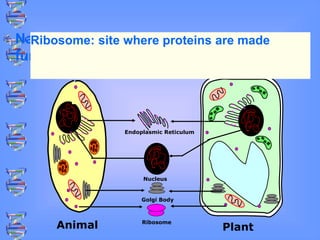
Name the organelle and give its
function.
Animal Plant
Nucleus
Ribosome
Endoplasmic Reticulum: aids in processing
carbohydrates, lipids and proteins for export
from the cell
Endoplasmic Reticulum
Golgi Body
Nucleus: control body of the cell; contains the
genetic material (DNA)
Golgi Aparatus: modifies, sorts, and packages
materials from the ER for storage in the cell or
secretion outside the cell
Ribosome: site where proteins are made
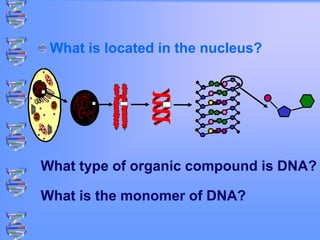
What is located in the nucleus?
What type of organic compound is DNA?
What is the monomer of DNA?
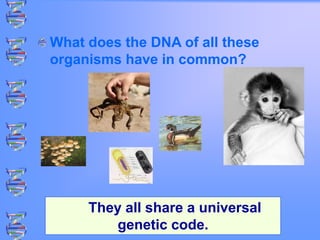
What does the DNA of all these
organisms have in common?
They all share a universal
genetic code.
The
History of Heredity
Why am I so
gorgeous?
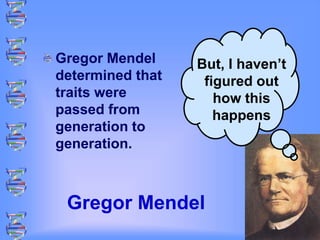
Gregor Mendel
Gregor Mendel
determined that
traits were
passed from
generation to
generation.
But, I haven’t
figured out
how this
happens
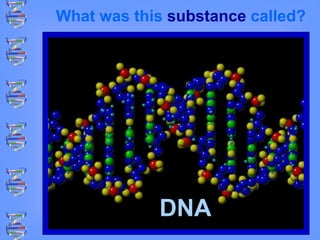
What was this substance called?
DNA
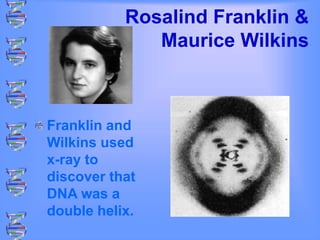
Rosalind Franklin &
Maurice Wilkins
Franklin and
Wilkins used
x-ray to
discover that
DNA was a
double helix.
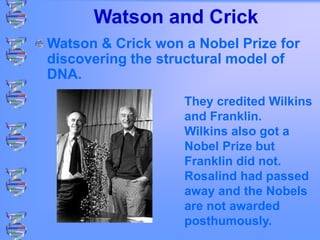
Watson and Crick
Watson & Crick won a Nobel Prize for
discovering the structural model of
DNA.
They credited Wilkins
and Franklin.
Wilkins also got a
Nobel Prize but
Franklin did not.
Rosalind had passed
away and the Nobels
are not awarded
posthumously.
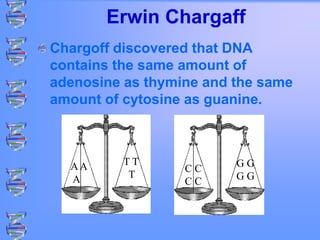
Erwin Chargaff
Chargoff discovered that DNA
contains the same amount of
adenosine as thymine and the same
amount of cytosine as guanine.
AA
A
T T
T
C C
C C
G G
G G
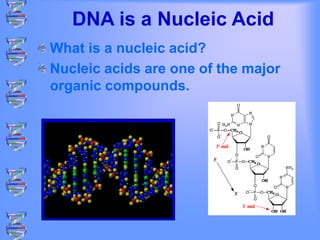
DNA is a Nucleic Acid
What is a nucleic acid?
Nucleic acids are one of the major
organic compounds.
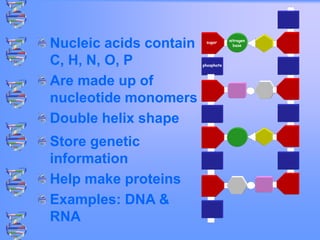
Nucleic acids contain
C, H, N, O, P
Are made up of
nucleotide monomers
Double helix shape
Store genetic
information
Help make proteins
Examples: DNA &
RNA
sugar
phosphate
nitrogen
base
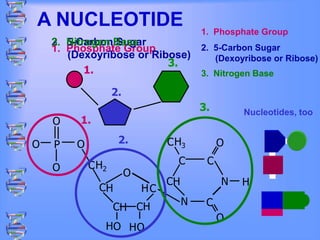
A NUCLEOTIDE
H
H2
H H
H3
H
H
H
H
H
O
O
O
C C
C
N
N
P
O
O
O
C
C
C C
C
O
O
O
C
C
1.
2.
3.
1.
2.
3.
1. Phosphate Group
2. 5-Carbon Sugar
(Dexoyribose or Ribose)
3. Nitrogen Base
1. Phosphate Group
2. 5-Carbon Sugar
(Dexoyribose or Ribose)
3. Nitrogen Base
Nucleotides, too
Nucleotides
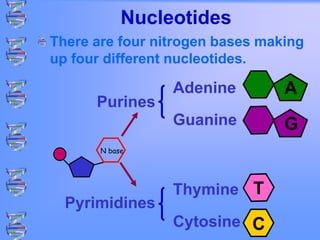
There are four nitrogen bases making
up four different nucleotides.
Adenine
Guanine
Thymine
Cytosine
Pyrimidines
Purines
A
C
G
T
N base
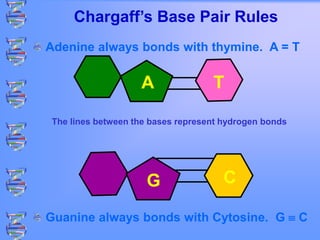
Chargaff’s Base Pair Rules
Adenine always bonds with thymine. A = T
Guanine always bonds with Cytosine. G  C
The lines between the bases represent hydrogen bonds
A
C
G
T
C
G
A
A
T
G
Nucleotide
P
S
N-b
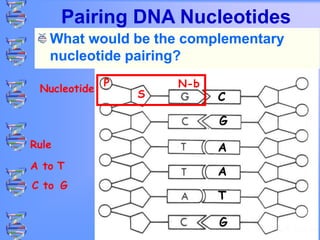
Pairing DNA Nucleotides
What is a nucleotide?
Rule
A to
C to
T
G
What is the base pairing rule?
What would be the complementary
nucleotide pairing?
3’End
3’End 5’End
5’End
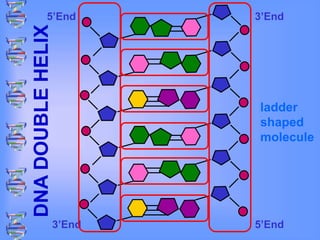
DNA
DOUBLE
HELIX
ladder
shaped
molecule
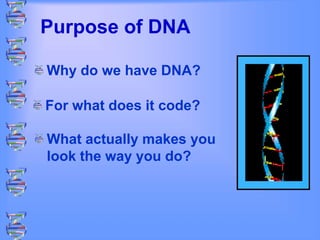
Purpose of DNA
Why do we have DNA?
For what does it code?
What actually makes you
look the way you do?
Remember that the
monomer for proteins
is amino acids!
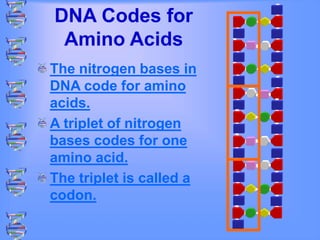
DNA Codes for
Amino Acids
The nitrogen bases in
DNA code for amino
acids.
A triplet of nitrogen
bases codes for one
amino acid.
The triplet is called a
codon.
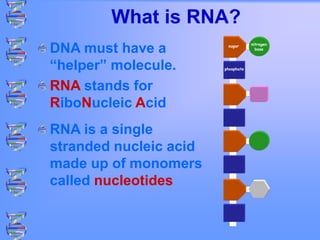
What is RNA?
DNA must have a
“helper” molecule.
RNA stands for
RiboNucleic Acid
RNA is a single
stranded nucleic acid
made up of monomers
called nucleotides
sugar
phosphate
nitrogen
base
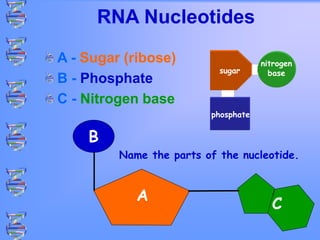
A
B
C
RNA Nucleotides
A - Sugar (ribose)
B - Phosphate
C - Nitrogen base
sugar
phosphate
nitrogen
base
Name the parts of the nucleotide.
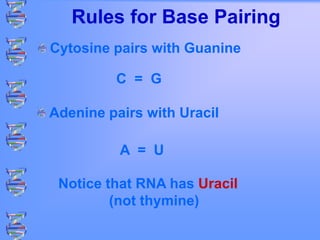
Rules for Base Pairing
Cytosine pairs with Guanine
Adenine pairs with Uracil
Notice that RNA has Uracil
(not thymine)
A = U
C = G
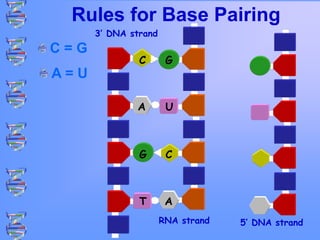
Rules for Base Pairing
C = G
A = U
3’ DNA strand
5’ DNA strand
RNA strand
C
A
T
G
G
U
C
A
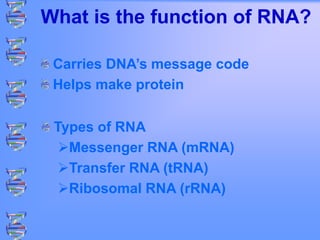
What is the function of RNA?
Carries DNA’s message code
Helps make protein
Types of RNA
Messenger RNA (mRNA)
Transfer RNA (tRNA)
Ribosomal RNA (rRNA)
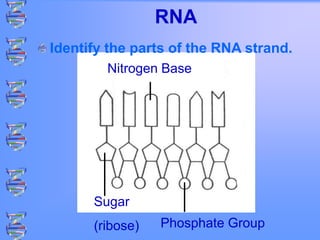
Phosphate Group
Nitrogen Base
Sugar
(ribose)
RNA
Identify the parts of the RNA strand.
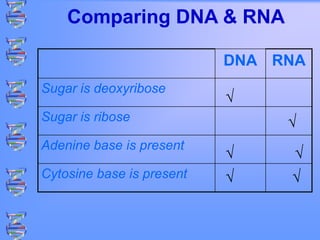
DNA RNA
Sugar is deoxyribose
Sugar is ribose
Adenine base is present
Cytosine base is present
√
√
√ √
√ √
Comparing DNA & RNA
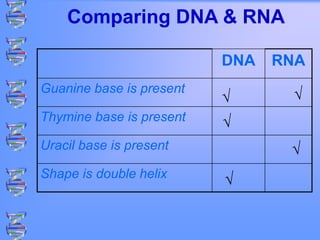
DNA RNA
Guanine base is present
Thymine base is present
Uracil base is present
Shape is double helix
√ √
√
√
√
Comparing DNA & RNA
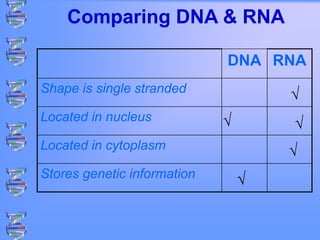
DNA RNA
Shape is single stranded
Located in nucleus
Located in cytoplasm
Stores genetic information
√
√ √
√
√
Comparing DNA & RNA
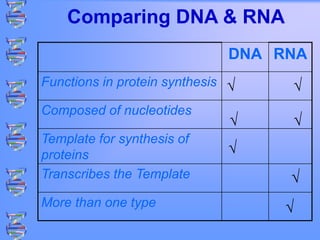
DNA RNA
Functions in protein synthesis
Composed of nucleotides
Template for synthesis of
proteins
Transcribes the Template
More than one type
√ √
√ √
√
√
√
Comparing DNA & RNA

DNA RNA-101.ppt

  • 2.
    Name the organelleand give its function. Animal Plant Nucleus Ribosome Endoplasmic Reticulum: aids in processing carbohydrates, lipids and proteins for export from the cell Endoplasmic Reticulum Golgi Body Nucleus: control body of the cell; contains the genetic material (DNA) Golgi Aparatus: modifies, sorts, and packages materials from the ER for storage in the cell or secretion outside the cell Ribosome: site where proteins are made
  • 3.
    What is locatedin the nucleus? What type of organic compound is DNA? What is the monomer of DNA?
  • 4.
    What does theDNA of all these organisms have in common? They all share a universal genetic code.
  • 5.
    The History of Heredity Whyam I so gorgeous?
  • 6.
    Gregor Mendel Gregor Mendel determinedthat traits were passed from generation to generation. But, I haven’t figured out how this happens
  • 7.
    What was thissubstance called? DNA
  • 8.
    Rosalind Franklin & MauriceWilkins Franklin and Wilkins used x-ray to discover that DNA was a double helix.
  • 9.
    Watson and Crick Watson& Crick won a Nobel Prize for discovering the structural model of DNA. They credited Wilkins and Franklin. Wilkins also got a Nobel Prize but Franklin did not. Rosalind had passed away and the Nobels are not awarded posthumously.
  • 10.
    Erwin Chargaff Chargoff discoveredthat DNA contains the same amount of adenosine as thymine and the same amount of cytosine as guanine. AA A T T T C C C C G G G G
  • 11.
    DNA is aNucleic Acid What is a nucleic acid? Nucleic acids are one of the major organic compounds.
  • 12.
    Nucleic acids contain C,H, N, O, P Are made up of nucleotide monomers Double helix shape Store genetic information Help make proteins Examples: DNA & RNA sugar phosphate nitrogen base
  • 13.
    A NUCLEOTIDE H H2 H H H3 H H H H H O O O CC C N N P O O O C C C C C O O O C C 1. 2. 3. 1. 2. 3. 1. Phosphate Group 2. 5-Carbon Sugar (Dexoyribose or Ribose) 3. Nitrogen Base 1. Phosphate Group 2. 5-Carbon Sugar (Dexoyribose or Ribose) 3. Nitrogen Base Nucleotides, too
  • 14.
    Nucleotides There are fournitrogen bases making up four different nucleotides. Adenine Guanine Thymine Cytosine Pyrimidines Purines A C G T N base
  • 15.
    Chargaff’s Base PairRules Adenine always bonds with thymine. A = T Guanine always bonds with Cytosine. G  C The lines between the bases represent hydrogen bonds A C G T
  • 16.
    C G A A T G Nucleotide P S N-b Pairing DNA Nucleotides Whatis a nucleotide? Rule A to C to T G What is the base pairing rule? What would be the complementary nucleotide pairing?
  • 17.
  • 18.
    Purpose of DNA Whydo we have DNA? For what does it code? What actually makes you look the way you do?
  • 19.
    Remember that the monomerfor proteins is amino acids!
  • 20.
    DNA Codes for AminoAcids The nitrogen bases in DNA code for amino acids. A triplet of nitrogen bases codes for one amino acid. The triplet is called a codon.
  • 21.
    What is RNA? DNAmust have a “helper” molecule. RNA stands for RiboNucleic Acid RNA is a single stranded nucleic acid made up of monomers called nucleotides sugar phosphate nitrogen base
  • 22.
    A B C RNA Nucleotides A -Sugar (ribose) B - Phosphate C - Nitrogen base sugar phosphate nitrogen base Name the parts of the nucleotide.
  • 23.
    Rules for BasePairing Cytosine pairs with Guanine Adenine pairs with Uracil Notice that RNA has Uracil (not thymine) A = U C = G
  • 24.
    Rules for BasePairing C = G A = U 3’ DNA strand 5’ DNA strand RNA strand C A T G G U C A
  • 25.
    What is thefunction of RNA? Carries DNA’s message code Helps make protein Types of RNA Messenger RNA (mRNA) Transfer RNA (tRNA) Ribosomal RNA (rRNA)
  • 26.
  • 27.
    DNA RNA Sugar isdeoxyribose Sugar is ribose Adenine base is present Cytosine base is present √ √ √ √ √ √ Comparing DNA & RNA
  • 28.
    DNA RNA Guanine baseis present Thymine base is present Uracil base is present Shape is double helix √ √ √ √ √ Comparing DNA & RNA
  • 29.
    DNA RNA Shape issingle stranded Located in nucleus Located in cytoplasm Stores genetic information √ √ √ √ √ Comparing DNA & RNA
  • 30.
    DNA RNA Functions inprotein synthesis Composed of nucleotides Template for synthesis of proteins Transcribes the Template More than one type √ √ √ √ √ √ √ Comparing DNA & RNA