Static Timing
Analysis
Part 1
Amr Adel Mohammady
/amradelm
/amradelm
Introduction - PPA
• Digital VLSI chip design has mainly 3 targets
o Performance (timing)
o Power reduction
o Area reduction
• Failing to meet the area or power requirements will lead to higher fabrication cost, higher packing cost, short battery life, etc .
However, the chip will still operate correctly
• Failing to meet the timing/performance requirements will lead to a chip that doesn’t work and will require redesign to fix[1]
• Because of this, timing analysis remains the main and first priority of all design checks
2
[1] The fix can be simple like reducing the clock frequency or complex like changing the architecture
/amradelm
Introduction - PPA
• There are many timing checks that the designer need to make sure are passing to guarantee the chip will work after fabrication.
• They are:
o Setup timing
o Hold timing
o Max timing transition
o Max load capacitance
o Min pulse width
o Max delay
o Min delay
o Skew
o Recovery timing
o Removal timing
• In this part we will go through the basic principles that are needed to understand all these checks. In the next part we will go
through each check in details
3
/amradelm
Interconnect and Cell Delays
4
/amradelm
RC Delay
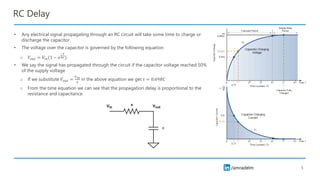
• Any electrical signal propagating through an RC circuit will take some time to charge or
discharge the capacitor
• The voltage over the capacitor is governed by the following equation
o 𝑉𝑜𝑢𝑡 = 𝑉𝑖𝑛(1 − 𝑒
−𝑡
𝑅𝐶)
• We say the signal has propagated through the circuit if the capacitor voltage reached 50%
of the supply voltage
o If we substitute 𝑉𝑜𝑢𝑡 =
𝑉𝑖𝑛
2
in the above equation we get 𝑡 = 0.69𝑅𝐶
o From the time equation we can see that the propagation delay is proportional to the
resistance and capacitance.
5
/amradelm
RC Delay – Cell Delay
• To calculate the propagation delay of a logic gate we can approximate1 it as a simple RC
circuit. We will consider a simple inverter.
• When the input 𝑽𝒊𝒏 = 𝟎 :
o The upper PMOS is ON and the lower NMOS is OFF. Current will flow from the supply to
charge the 𝐶𝐿 capacitor from low to high.
o 𝑅𝑝𝑚𝑜𝑠 =
Δ𝑉
𝐼𝑝𝑚𝑜𝑠
=
𝑉𝐷𝐷
𝑊𝑝
2𝐿
𝜇𝑝𝐶𝑜𝑥 𝑉𝐷𝐷−𝑉𝑡ℎ
2
o 𝑡𝐿𝐻 = 0.69𝑅𝑝𝑚𝑜𝑠𝐶𝐿 =
0.69 𝑉𝐷𝐷 . 𝐶𝐿
𝑊𝑝
2𝐿
𝜇𝑝𝐶𝑜𝑥 𝑉𝐷𝐷−𝑉𝑡ℎ
2
• When the input 𝑽𝒊𝒏 = 𝑽𝑫𝑫 :
o The upper PMOS is OFF and the lower NMOS is ON. Current will flow from the capacitor
to ground to discharge the 𝐶𝐿 capacitor from high to low.
o 𝑅𝑛𝑚𝑜𝑠 =
Δ𝑉
𝐼𝑛𝑚𝑜𝑠
=
𝑉𝐷𝐷
𝑊𝑛
2𝐿
𝜇𝑛𝐶𝑜𝑥 𝑉𝐷𝐷−𝑉𝑡ℎ
2
o 𝑡𝐻𝐿 = 0.69𝑅𝑛𝑚𝑜𝑠𝐶𝐿 =
0.69 𝑉𝐷𝐷 . 𝐶𝐿
𝑊𝑛
2𝐿
𝜇𝑛𝐶𝑜𝑥 𝑉𝐷𝐷−𝑉𝑡ℎ
2
6
[1] For an accurate calculations : https://classes.engineering.wustl.edu/cse463/Chapter_6_CSE463.pdf
/amradelm
RC Delay – Cell Delay
• From the equations we observe how to decrease the delay
o Increase the supply voltage 𝑽𝑫𝑫
o Decrease the threshold voltage (𝑽𝒕𝒉)
o Decrease the load capacitance (𝑪𝑳)
o Increase the transistor size 𝑾
o Decrease the transistor length (𝑳)
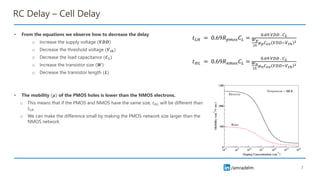
• The mobility (𝝁) of the PMOS holes is lower than the NMOS electrons.
o This means that if the PMOS and NMOS have the same size, 𝑡𝐻𝐿 will be different than
𝑡𝐿𝐻
o We can make the difference small by making the PMOS network size larger than the
NMOS network
7
𝑡𝐿𝐻 = 0.69𝑅𝑝𝑚𝑜𝑠𝐶𝐿 =
0.69 𝑉𝐷𝐷 . 𝐶𝐿
𝑊𝑝
2𝐿
𝜇𝑝𝐶𝑜𝑥 𝑉𝐷𝐷−𝑉𝑡ℎ
2
𝑡𝐻𝐿 = 0.69𝑅𝑛𝑚𝑜𝑠𝐶𝐿 =
0.69 𝑉𝐷𝐷 . 𝐶𝐿
𝑊𝑛
2𝐿
𝜇𝑛𝐶𝑜𝑥 𝑉𝐷𝐷−𝑉𝑡ℎ
2
/amradelm
Transition Time
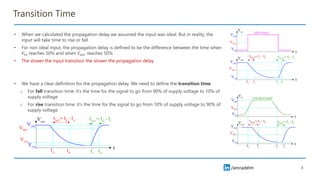
• When we calculated the propagation delay we assumed the input was ideal. But in reality, the
input will take time to rise or fall
• For non ideal input, the propagation delay is defined to be the difference between the time when
𝑉𝑖𝑛 reaches 50% and when 𝑉𝑜𝑢𝑡 reaches 50%
• The slower the input transition the slower the propagation delay
• We have a clear definition for the propagation delay. We need to define the transition time
o For fall transition time: it’s the time for the signal to go from 90% of supply voltage to 10% of
supply voltage
o For rise transition time: it’s the time for the signal to go from 10% of supply voltage to 90% of
supply voltage
8
/amradelm
Standard Cell Libraries
Timing Tables – Sizing – MTCMOS
9
/amradelm
Timing Tables
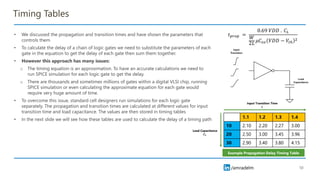
• We discussed the propagation and transition times and have shown the parameters that
controls them
• To calculate the delay of a chain of logic gates we need to substitute the parameters of each
gate in the equation to get the delay of each gate then sum them together.
• However this approach has many issues:
o The timing equation is an approximation. To have an accurate calculations we need to
run SPICE simulation for each logic gate to get the delay.
o There are thousands and sometimes millions of gates within a digital VLSI chip, running
SPICE simulation or even calculating the approximate equation for each gate would
require very huge amount of time.
• To overcome this issue, standard cell designers run simulations for each logic gate
separately. The propagation and transition times are calculated at different values for input
transition time and load capacitance. The values are then stored in timing tables
• In the next slide we will see how these tables are used to calculate the delay of a timing path
10
𝑡𝑝𝑟𝑜𝑝 =
0.69 𝑉𝐷𝐷 . 𝐶𝐿
𝑊
2𝐿
𝜇𝐶𝑜𝑥 𝑉𝐷𝐷 − 𝑉𝑡ℎ
2
1.1 1.2 1.3 1.4
10 2.10 2.20 2.27 3.00
20 2.50 3.00 3.45 3.96
30 2.90 3.40 3.80 4.15
Load Capacitance
𝑪𝑳
Example Propagation Delay Timing Table
Input Transition Time
𝒕
/amradelm
Timing Tables – Steps of Calculations
11
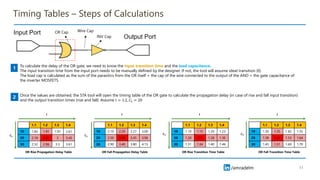
To calculate the delay of the OR gate, we need to know the input transition time and the load capacitance.
The input transition time from the input port needs to be manually defined by the designer. If not, the tool will assume ideal transition (0)
The load cap is calculated as the sum of the parasitics from the OR itself + the cap of the wire connected to the output of the AND + the gate capacitance of
the inverter MOSFETS
1
1.1 1.2 1.3 1.4
10 2.10 2.20 2.27 3.00
20 2.50 3.00 3.45 3.96
30 2.90 3.40 3.80 4.15
𝑪𝑳
𝒕
Once the values are obtained, the STA tool will open the timing table of the OR gate to calculate the propagation delay (in case of rise and fall input transition)
and the output transition times (rise and fall). Assume t = 1.2, 𝐶𝐿 = 20
2
1.1 1.2 1.3 1.4
10 1.10 1.15 1.20 1.23
20 1.20 1.25 1.28 1.30
30 1.31 1.34 1.40 1.46
𝑪𝑳
1.1 1.2 1.3 1.4
10 1.30 1.35 1.42 1.55
20 1.38 1.40 1.53 1.64
30 1.45 1.51 1.60 1.70
𝑪𝑳
Wire Cap
INV Cap
OR Cap
OR Fall Propagation Delay Table OR Rise Transition Time Table OR Fall Transition Time Table
𝒕 𝒕
1.1 1.2 1.3 1.4
10 1.83 1.91 1.97 2.61
20 2.18 2.61 3 3.45
30 2.52 2.96 3.3 3.61
𝑪𝑳
𝒕
OR Rise Propagation Delay Table
/amradelm
Timing Tables – Steps of Calculations
12
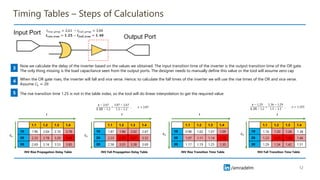
Now we calculate the delay of the inverter based on the values we obtained. The input transition time of the inverter is the output transition time of the OR gate.
The only thing missing is the load capacitance seen from the output ports. The designer needs to manually define this value or the tool will assume zero cap
3
When the OR gate rises, the inverter will fall and vice verse. Hence, to calculate the fall times of the inverter we will use the rise times of the OR and vice verse.
Assume 𝐶𝐿 = 20
4
𝑡𝑟𝑖𝑠𝑒_𝑝𝑟𝑜𝑝 = 2.61 − 𝑡𝑓𝑎𝑙𝑙_𝑝𝑟𝑜𝑝 = 3.00
𝒕𝒓𝒊𝒔𝒆_𝒕𝒓𝒂𝒏 = 𝟏. 𝟐𝟓 − 𝒕𝒇𝒂𝒍𝒍_𝒕𝒓𝒂𝒏 = 𝟏. 𝟒𝟎
1.1 1.2 1.3 1.4
10 1.87 1.96 2.02 2.67
20 2.23 2.67 3.07 3.52
30 2.58 3.03 3.38 3.69
𝑪𝑳
1.1 1.2 1.3 1.4
10 0.98 1.02 1.07 1.09
20 1.07 1.11 1.14 1.16
30 1.17 1.19 1.25 1.30
𝑪𝑳
1.1 1.2 1.3 1.4
10 1.16 1.20 1.26 1.38
20 1.23 1.29 1.36 1.46
30 1.29 1.34 1.42 1.51
𝑪𝑳
INV Fall Propagation Delay Table INV Rise Transition Time Table INV Fall Transition Time Table
1.1 1.2 1.3 1.4
10 1.96 2.04 2.10 2.78
20 2.33 2.78 3.20 3.68
30 2.69 3.16 3.53 3.85
𝑪𝑳
INV Rise Propagation Delay Table
The rise transition time 1.25 is not in the table index, so the tool will do linear interpolation to get the required value
5
𝒕 𝒕 𝒕
𝒕
𝒙 − 2.67
𝟏. 𝟐𝟓 − 1.2
=
3.07 − 2.67
1.3 − 1.2
, 𝑥 = 2.87
𝒙 − 1.29
𝟏. 𝟐𝟓 − 1.2
=
1.36 − 1.29
1.3 − 1.2
, 𝑥 = 1.325
/amradelm
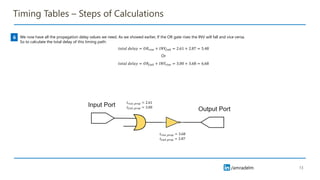
Timing Tables – Steps of Calculations
13
We now have all the propagation delay values we need. As we showed earlier, If the OR gate rises the INV will fall and vice versa.
So to calculate the total delay of this timing path:
𝑡𝑜𝑡𝑎𝑙 𝑑𝑒𝑙𝑎𝑦 = 𝑂𝑅𝑟𝑖𝑠𝑒 + 𝐼𝑁𝑉𝑓𝑎𝑙𝑙 = 2.61 + 2.87 = 5.48
Or
𝑡𝑜𝑡𝑎𝑙 𝑑𝑒𝑙𝑎𝑦 = 𝑂𝑅𝑓𝑎𝑙𝑙 + 𝐼𝑁𝑉𝑟𝑖𝑠𝑒 = 3.00 + 3.68 = 6.68
6
𝑡𝑟𝑖𝑠𝑒_𝑝𝑟𝑜𝑝 = 2.61
𝑡𝑓𝑎𝑙𝑙_𝑝𝑟𝑜𝑝 = 3.00
𝑡𝑟𝑖𝑠𝑒_𝑝𝑟𝑜𝑝 = 3.68
𝑡𝑓𝑎𝑙𝑙_𝑝𝑟𝑜𝑝 = 2.87
/amradelm
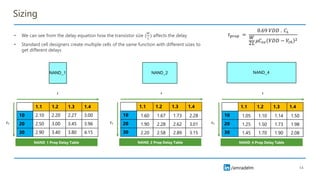
Sizing
• We can see from the delay equation how the transistor size (
𝑊
𝐿
) affects the delay
• Standard cell designers create multiple cells of the same function with different sizes to
get different delays
14
𝑡𝑝𝑟𝑜𝑝 =
0.69 𝑉𝐷𝐷 . 𝐶𝐿
𝑊
2𝐿
𝜇𝐶𝑜𝑥 𝑉𝐷𝐷 − 𝑉𝑡ℎ
2
1.1 1.2 1.3 1.4
10 2.10 2.20 2.27 3.00
20 2.50 3.00 3.45 3.96
30 2.90 3.40 3.80 4.15
𝑪𝑳
NAND_1 Prop Delay Table
𝒕
1.1 1.2 1.3 1.4
10 1.60 1.67 1.73 2.28
20 1.90 2.28 2.62 3.01
30 2.20 2.58 2.89 3.15
𝑪𝑳
NAND_2 Prop Delay Table
𝒕
1.1 1.2 1.3 1.4
10 1.05 1.10 1.14 1.50
20 1.25 1.50 1.73 1.98
30 1.45 1.70 1.90 2.08
𝑪𝑳
NAND_4 Prop Delay Table
𝒕
/amradelm
MTCMOS
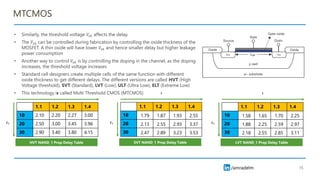
• Similarly, the threshold voltage 𝑉𝑡ℎ affects the delay.
• The 𝑉𝑡ℎ can be controlled during fabrication by controlling the oxide thickness of the
MOSFET. A thin oxide will have lower 𝑉𝑡ℎ and hence smaller delay but higher leakage
power consumption
• Another way to control 𝑉𝑡ℎ is by controlling the doping in the channel, as the doping
increases, the threshold voltage increases
• Standard cell designers create multiple cells of the same function with different
oxide thickness to get different delays. The different versions are called HVT (High
Voltage threshold), SVT (Standard), LVT (Low), ULT (Ultra Low), ELT (Extreme Low)
• This technology is called Multi Threshold CMOS (MTCMOS)
15
1.1 1.2 1.3 1.4
10 2.10 2.20 2.27 3.00
20 2.50 3.00 3.45 3.96
30 2.90 3.40 3.80 4.15
𝑪𝑳
HVT NAND_1 Prop Delay Table
𝒕
1.1 1.2 1.3 1.4
10 1.79 1.87 1.93 2.55
20 2.13 2.55 2.93 3.37
30 2.47 2.89 3.23 3.53
𝑪𝑳
SVT NAND_1 Prop Delay Table
𝒕
1.1 1.2 1.3 1.4
10 1.58 1.65 1.70 2.25
20 1.88 2.25 2.59 2.97
30 2.18 2.55 2.85 3.11
𝑪𝑳
LVT NAND_1 Prop Delay Table
𝒕
/amradelm
Flip Flop Times
Setup – Hold – Tcq
16
/amradelm
Flip Flop Internal Operation
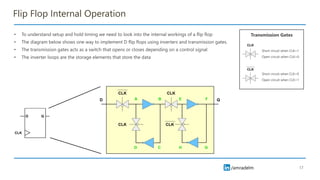
• To understand setup and hold timing we need to look into the internal workings of a flip flop
• The diagram below shows one way to implement D flip flops using inverters and transmission gates.
• The transmission gates acts as a switch that opens or closes depending on a control signal
• The inverter loops are the storage elements that store the data
17
Short circuit when CLK=1
Open circuit when CLK=0
Short circuit when CLK=0
Open circuit when CLK=1
Transmission Gates
/amradelm
Flip Flop Internal Operation
18
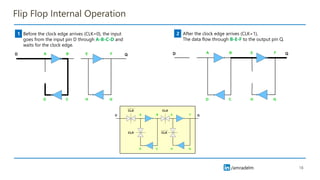
Before the clock edge arrives (CLK=0), the input
goes from the input pin D through A-B-C-D and
waits for the clock edge.
After the clock edge arrives (CLK=1),
The data flow through B-E-F to the output pin Q.
1 2
/amradelm
Setup Time
19
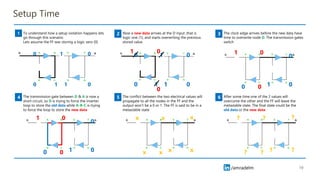
To understand how a setup violation happens lets
go through this scenario:
Lets assume the FF was storing a logic zero (0)
1
0
0
1
1
0
0
1
Now a new data arrives at the D input ,that is
logic one (1), and starts overwriting the previous
stored value
2
0
0
1
1
0
0
1
1 0
0
The clock edge arrives before the new data have
time to overwrite node D. The transmission gates
switch
3
0 1
0
0
0
1 0
The transmission gate between D & A is now a
short circuit, so D is trying to force the inverter
loop to store the old data while A-B-C is trying
to force the loop to store the new data
4
0 1
0
0
0
1 0
The conflict between the two electrical values will
propagate to all the nodes in the FF and the
output won’t be a 0 or 1. The FF is said to be in a
metastable state
5
x x
x
x
x
x x
After some time one of the 2 values will
overcome the other and the FF will leave the
metastable state. The final state could be the
old data or the new data
6
? ?
?
?
?
? ?
/amradelm
Setup Time
20
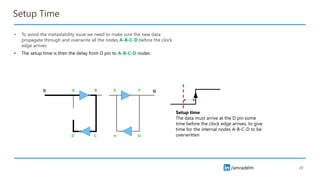
• To avoid the metastability issue we need to make sure the new data
propagate through and overwrite all the nodes A-B-C-D before the clock
edge arrives
• The setup time is then the delay from D pin to A-B-C-D nodes
Setup time
The data must arrive at the D pin some
time before the clock edge arrives, to give
time for the internal nodes A-B-C-D to be
overwritten
/amradelm
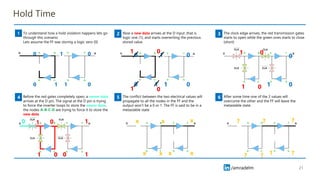
Hold Time
21
To understand how a hold violation happens lets go
through this scenario:
Lets assume the FF was storing a logic zero (0)
1
0
0
1
1
0
0
1
Now a new data arrives at the D input ,that is
logic one (1), and starts overwriting the previous
stored value
2
0
0
1
1
0
0
1
1 0
0
The clock edge arrives, the red transmission gates
starts to open while the green ones starts to close
(short)
3
1 1
0
0
0
1 0
Before the red gates completely open, a newer data
arrives at the D pin, The signal at the D pin is trying
to force the inverter loops to store the newer data,
the nodes A-B-C-D are trying to force it to store the
new data
4 The conflict between the two electrical values will
propagate to all the nodes in the FF and the
output won’t be a 0 or 1. The FF is said to be in a
metastable state
5
x x
x
x
x
x x
After some time one of the 2 values will
overcome the other and the FF will leave the
metastable state.
6
? ?
?
?
?
? ?
1
1 0
1
1
0
1 0
0
/amradelm
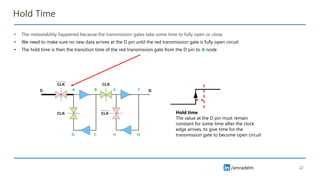
Hold Time
22
• The metastability happened because the transmission gates take some time to fully open or close.
• We need to make sure no new data arrives at the D pin until the red transmission gate is fully open circuit
• The hold time is then the transition time of the red transmission gate from the D pin to A node
Hold time
The value at the D pin must remain
constant for some time after the clock
edge arrives, to give time for the
transmission gate to become open circuit
/amradelm
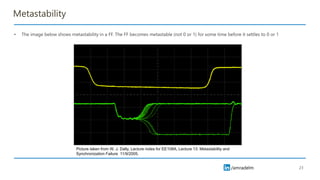
Metastability
23
• The image below shows metastability in a FF. The FF becomes metastable (not 0 or 1) for some time before it settles to 0 or 1
Picture taken from W. J. Dally, Lecture notes for EE108A, Lecture 13: Metastability and
Synchronization Failure 11/9/2005.
/amradelm
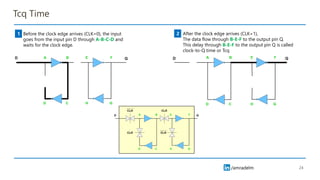
Tcq Time
24
Before the clock edge arrives (CLK=0), the input
goes from the input pin D through A-B-C-D and
waits for the clock edge.
After the clock edge arrives (CLK=1),
The data flow through B-E-F to the output pin Q.
This delay through B-E-F to the output pin Q is called
clock-to-Q time or Tcq
1 2
/amradelm
References
• [1] https://classes.engineering.wustl.edu/cse463/Chapter_6_CSE463.pdf
• [2] https://www.iue.tuwien.ac.at/phd/park/node30.html
• [3] https://www.electronics-tutorials.ws/rc/rc_1.html
• [4] http://web.mit.edu/6.012/www/SP07-L13.pdf
• [5] https://www.linkedin.com/pulse/understanding-power-performance-area-ppa-analysis-vlsi-priya-pandey/
• [6] https://citeseerx.ist.psu.edu/document?repid=rep1&type=pdf&doi=ecc04789069f3e19bebe5814ce3608aa609e4403
25
/amradelm
Thank You!
26

VLSI Static Timing Analysis Intro Part 1

  • 1.
    Static Timing Analysis Part 1 AmrAdel Mohammady /amradelm
  • 2.
    /amradelm Introduction - PPA •Digital VLSI chip design has mainly 3 targets o Performance (timing) o Power reduction o Area reduction • Failing to meet the area or power requirements will lead to higher fabrication cost, higher packing cost, short battery life, etc . However, the chip will still operate correctly • Failing to meet the timing/performance requirements will lead to a chip that doesn’t work and will require redesign to fix[1] • Because of this, timing analysis remains the main and first priority of all design checks 2 [1] The fix can be simple like reducing the clock frequency or complex like changing the architecture
  • 3.
    /amradelm Introduction - PPA •There are many timing checks that the designer need to make sure are passing to guarantee the chip will work after fabrication. • They are: o Setup timing o Hold timing o Max timing transition o Max load capacitance o Min pulse width o Max delay o Min delay o Skew o Recovery timing o Removal timing • In this part we will go through the basic principles that are needed to understand all these checks. In the next part we will go through each check in details 3
  • 4.
  • 5.
    /amradelm RC Delay • Anyelectrical signal propagating through an RC circuit will take some time to charge or discharge the capacitor • The voltage over the capacitor is governed by the following equation o 𝑉𝑜𝑢𝑡 = 𝑉𝑖𝑛(1 − 𝑒 −𝑡 𝑅𝐶) • We say the signal has propagated through the circuit if the capacitor voltage reached 50% of the supply voltage o If we substitute 𝑉𝑜𝑢𝑡 = 𝑉𝑖𝑛 2 in the above equation we get 𝑡 = 0.69𝑅𝐶 o From the time equation we can see that the propagation delay is proportional to the resistance and capacitance. 5
  • 6.
    /amradelm RC Delay –Cell Delay • To calculate the propagation delay of a logic gate we can approximate1 it as a simple RC circuit. We will consider a simple inverter. • When the input 𝑽𝒊𝒏 = 𝟎 : o The upper PMOS is ON and the lower NMOS is OFF. Current will flow from the supply to charge the 𝐶𝐿 capacitor from low to high. o 𝑅𝑝𝑚𝑜𝑠 = Δ𝑉 𝐼𝑝𝑚𝑜𝑠 = 𝑉𝐷𝐷 𝑊𝑝 2𝐿 𝜇𝑝𝐶𝑜𝑥 𝑉𝐷𝐷−𝑉𝑡ℎ 2 o 𝑡𝐿𝐻 = 0.69𝑅𝑝𝑚𝑜𝑠𝐶𝐿 = 0.69 𝑉𝐷𝐷 . 𝐶𝐿 𝑊𝑝 2𝐿 𝜇𝑝𝐶𝑜𝑥 𝑉𝐷𝐷−𝑉𝑡ℎ 2 • When the input 𝑽𝒊𝒏 = 𝑽𝑫𝑫 : o The upper PMOS is OFF and the lower NMOS is ON. Current will flow from the capacitor to ground to discharge the 𝐶𝐿 capacitor from high to low. o 𝑅𝑛𝑚𝑜𝑠 = Δ𝑉 𝐼𝑛𝑚𝑜𝑠 = 𝑉𝐷𝐷 𝑊𝑛 2𝐿 𝜇𝑛𝐶𝑜𝑥 𝑉𝐷𝐷−𝑉𝑡ℎ 2 o 𝑡𝐻𝐿 = 0.69𝑅𝑛𝑚𝑜𝑠𝐶𝐿 = 0.69 𝑉𝐷𝐷 . 𝐶𝐿 𝑊𝑛 2𝐿 𝜇𝑛𝐶𝑜𝑥 𝑉𝐷𝐷−𝑉𝑡ℎ 2 6 [1] For an accurate calculations : https://classes.engineering.wustl.edu/cse463/Chapter_6_CSE463.pdf
  • 7.
    /amradelm RC Delay –Cell Delay • From the equations we observe how to decrease the delay o Increase the supply voltage 𝑽𝑫𝑫 o Decrease the threshold voltage (𝑽𝒕𝒉) o Decrease the load capacitance (𝑪𝑳) o Increase the transistor size 𝑾 o Decrease the transistor length (𝑳) • The mobility (𝝁) of the PMOS holes is lower than the NMOS electrons. o This means that if the PMOS and NMOS have the same size, 𝑡𝐻𝐿 will be different than 𝑡𝐿𝐻 o We can make the difference small by making the PMOS network size larger than the NMOS network 7 𝑡𝐿𝐻 = 0.69𝑅𝑝𝑚𝑜𝑠𝐶𝐿 = 0.69 𝑉𝐷𝐷 . 𝐶𝐿 𝑊𝑝 2𝐿 𝜇𝑝𝐶𝑜𝑥 𝑉𝐷𝐷−𝑉𝑡ℎ 2 𝑡𝐻𝐿 = 0.69𝑅𝑛𝑚𝑜𝑠𝐶𝐿 = 0.69 𝑉𝐷𝐷 . 𝐶𝐿 𝑊𝑛 2𝐿 𝜇𝑛𝐶𝑜𝑥 𝑉𝐷𝐷−𝑉𝑡ℎ 2
  • 8.
    /amradelm Transition Time • Whenwe calculated the propagation delay we assumed the input was ideal. But in reality, the input will take time to rise or fall • For non ideal input, the propagation delay is defined to be the difference between the time when 𝑉𝑖𝑛 reaches 50% and when 𝑉𝑜𝑢𝑡 reaches 50% • The slower the input transition the slower the propagation delay • We have a clear definition for the propagation delay. We need to define the transition time o For fall transition time: it’s the time for the signal to go from 90% of supply voltage to 10% of supply voltage o For rise transition time: it’s the time for the signal to go from 10% of supply voltage to 90% of supply voltage 8
  • 9.
    /amradelm Standard Cell Libraries TimingTables – Sizing – MTCMOS 9
  • 10.
    /amradelm Timing Tables • Wediscussed the propagation and transition times and have shown the parameters that controls them • To calculate the delay of a chain of logic gates we need to substitute the parameters of each gate in the equation to get the delay of each gate then sum them together. • However this approach has many issues: o The timing equation is an approximation. To have an accurate calculations we need to run SPICE simulation for each logic gate to get the delay. o There are thousands and sometimes millions of gates within a digital VLSI chip, running SPICE simulation or even calculating the approximate equation for each gate would require very huge amount of time. • To overcome this issue, standard cell designers run simulations for each logic gate separately. The propagation and transition times are calculated at different values for input transition time and load capacitance. The values are then stored in timing tables • In the next slide we will see how these tables are used to calculate the delay of a timing path 10 𝑡𝑝𝑟𝑜𝑝 = 0.69 𝑉𝐷𝐷 . 𝐶𝐿 𝑊 2𝐿 𝜇𝐶𝑜𝑥 𝑉𝐷𝐷 − 𝑉𝑡ℎ 2 1.1 1.2 1.3 1.4 10 2.10 2.20 2.27 3.00 20 2.50 3.00 3.45 3.96 30 2.90 3.40 3.80 4.15 Load Capacitance 𝑪𝑳 Example Propagation Delay Timing Table Input Transition Time 𝒕
  • 11.
    /amradelm Timing Tables –Steps of Calculations 11 To calculate the delay of the OR gate, we need to know the input transition time and the load capacitance. The input transition time from the input port needs to be manually defined by the designer. If not, the tool will assume ideal transition (0) The load cap is calculated as the sum of the parasitics from the OR itself + the cap of the wire connected to the output of the AND + the gate capacitance of the inverter MOSFETS 1 1.1 1.2 1.3 1.4 10 2.10 2.20 2.27 3.00 20 2.50 3.00 3.45 3.96 30 2.90 3.40 3.80 4.15 𝑪𝑳 𝒕 Once the values are obtained, the STA tool will open the timing table of the OR gate to calculate the propagation delay (in case of rise and fall input transition) and the output transition times (rise and fall). Assume t = 1.2, 𝐶𝐿 = 20 2 1.1 1.2 1.3 1.4 10 1.10 1.15 1.20 1.23 20 1.20 1.25 1.28 1.30 30 1.31 1.34 1.40 1.46 𝑪𝑳 1.1 1.2 1.3 1.4 10 1.30 1.35 1.42 1.55 20 1.38 1.40 1.53 1.64 30 1.45 1.51 1.60 1.70 𝑪𝑳 Wire Cap INV Cap OR Cap OR Fall Propagation Delay Table OR Rise Transition Time Table OR Fall Transition Time Table 𝒕 𝒕 1.1 1.2 1.3 1.4 10 1.83 1.91 1.97 2.61 20 2.18 2.61 3 3.45 30 2.52 2.96 3.3 3.61 𝑪𝑳 𝒕 OR Rise Propagation Delay Table
  • 12.
    /amradelm Timing Tables –Steps of Calculations 12 Now we calculate the delay of the inverter based on the values we obtained. The input transition time of the inverter is the output transition time of the OR gate. The only thing missing is the load capacitance seen from the output ports. The designer needs to manually define this value or the tool will assume zero cap 3 When the OR gate rises, the inverter will fall and vice verse. Hence, to calculate the fall times of the inverter we will use the rise times of the OR and vice verse. Assume 𝐶𝐿 = 20 4 𝑡𝑟𝑖𝑠𝑒_𝑝𝑟𝑜𝑝 = 2.61 − 𝑡𝑓𝑎𝑙𝑙_𝑝𝑟𝑜𝑝 = 3.00 𝒕𝒓𝒊𝒔𝒆_𝒕𝒓𝒂𝒏 = 𝟏. 𝟐𝟓 − 𝒕𝒇𝒂𝒍𝒍_𝒕𝒓𝒂𝒏 = 𝟏. 𝟒𝟎 1.1 1.2 1.3 1.4 10 1.87 1.96 2.02 2.67 20 2.23 2.67 3.07 3.52 30 2.58 3.03 3.38 3.69 𝑪𝑳 1.1 1.2 1.3 1.4 10 0.98 1.02 1.07 1.09 20 1.07 1.11 1.14 1.16 30 1.17 1.19 1.25 1.30 𝑪𝑳 1.1 1.2 1.3 1.4 10 1.16 1.20 1.26 1.38 20 1.23 1.29 1.36 1.46 30 1.29 1.34 1.42 1.51 𝑪𝑳 INV Fall Propagation Delay Table INV Rise Transition Time Table INV Fall Transition Time Table 1.1 1.2 1.3 1.4 10 1.96 2.04 2.10 2.78 20 2.33 2.78 3.20 3.68 30 2.69 3.16 3.53 3.85 𝑪𝑳 INV Rise Propagation Delay Table The rise transition time 1.25 is not in the table index, so the tool will do linear interpolation to get the required value 5 𝒕 𝒕 𝒕 𝒕 𝒙 − 2.67 𝟏. 𝟐𝟓 − 1.2 = 3.07 − 2.67 1.3 − 1.2 , 𝑥 = 2.87 𝒙 − 1.29 𝟏. 𝟐𝟓 − 1.2 = 1.36 − 1.29 1.3 − 1.2 , 𝑥 = 1.325
  • 13.
    /amradelm Timing Tables –Steps of Calculations 13 We now have all the propagation delay values we need. As we showed earlier, If the OR gate rises the INV will fall and vice versa. So to calculate the total delay of this timing path: 𝑡𝑜𝑡𝑎𝑙 𝑑𝑒𝑙𝑎𝑦 = 𝑂𝑅𝑟𝑖𝑠𝑒 + 𝐼𝑁𝑉𝑓𝑎𝑙𝑙 = 2.61 + 2.87 = 5.48 Or 𝑡𝑜𝑡𝑎𝑙 𝑑𝑒𝑙𝑎𝑦 = 𝑂𝑅𝑓𝑎𝑙𝑙 + 𝐼𝑁𝑉𝑟𝑖𝑠𝑒 = 3.00 + 3.68 = 6.68 6 𝑡𝑟𝑖𝑠𝑒_𝑝𝑟𝑜𝑝 = 2.61 𝑡𝑓𝑎𝑙𝑙_𝑝𝑟𝑜𝑝 = 3.00 𝑡𝑟𝑖𝑠𝑒_𝑝𝑟𝑜𝑝 = 3.68 𝑡𝑓𝑎𝑙𝑙_𝑝𝑟𝑜𝑝 = 2.87
  • 14.
    /amradelm Sizing • We cansee from the delay equation how the transistor size ( 𝑊 𝐿 ) affects the delay • Standard cell designers create multiple cells of the same function with different sizes to get different delays 14 𝑡𝑝𝑟𝑜𝑝 = 0.69 𝑉𝐷𝐷 . 𝐶𝐿 𝑊 2𝐿 𝜇𝐶𝑜𝑥 𝑉𝐷𝐷 − 𝑉𝑡ℎ 2 1.1 1.2 1.3 1.4 10 2.10 2.20 2.27 3.00 20 2.50 3.00 3.45 3.96 30 2.90 3.40 3.80 4.15 𝑪𝑳 NAND_1 Prop Delay Table 𝒕 1.1 1.2 1.3 1.4 10 1.60 1.67 1.73 2.28 20 1.90 2.28 2.62 3.01 30 2.20 2.58 2.89 3.15 𝑪𝑳 NAND_2 Prop Delay Table 𝒕 1.1 1.2 1.3 1.4 10 1.05 1.10 1.14 1.50 20 1.25 1.50 1.73 1.98 30 1.45 1.70 1.90 2.08 𝑪𝑳 NAND_4 Prop Delay Table 𝒕
  • 15.
    /amradelm MTCMOS • Similarly, thethreshold voltage 𝑉𝑡ℎ affects the delay. • The 𝑉𝑡ℎ can be controlled during fabrication by controlling the oxide thickness of the MOSFET. A thin oxide will have lower 𝑉𝑡ℎ and hence smaller delay but higher leakage power consumption • Another way to control 𝑉𝑡ℎ is by controlling the doping in the channel, as the doping increases, the threshold voltage increases • Standard cell designers create multiple cells of the same function with different oxide thickness to get different delays. The different versions are called HVT (High Voltage threshold), SVT (Standard), LVT (Low), ULT (Ultra Low), ELT (Extreme Low) • This technology is called Multi Threshold CMOS (MTCMOS) 15 1.1 1.2 1.3 1.4 10 2.10 2.20 2.27 3.00 20 2.50 3.00 3.45 3.96 30 2.90 3.40 3.80 4.15 𝑪𝑳 HVT NAND_1 Prop Delay Table 𝒕 1.1 1.2 1.3 1.4 10 1.79 1.87 1.93 2.55 20 2.13 2.55 2.93 3.37 30 2.47 2.89 3.23 3.53 𝑪𝑳 SVT NAND_1 Prop Delay Table 𝒕 1.1 1.2 1.3 1.4 10 1.58 1.65 1.70 2.25 20 1.88 2.25 2.59 2.97 30 2.18 2.55 2.85 3.11 𝑪𝑳 LVT NAND_1 Prop Delay Table 𝒕
  • 16.
  • 17.
    /amradelm Flip Flop InternalOperation • To understand setup and hold timing we need to look into the internal workings of a flip flop • The diagram below shows one way to implement D flip flops using inverters and transmission gates. • The transmission gates acts as a switch that opens or closes depending on a control signal • The inverter loops are the storage elements that store the data 17 Short circuit when CLK=1 Open circuit when CLK=0 Short circuit when CLK=0 Open circuit when CLK=1 Transmission Gates
  • 18.
    /amradelm Flip Flop InternalOperation 18 Before the clock edge arrives (CLK=0), the input goes from the input pin D through A-B-C-D and waits for the clock edge. After the clock edge arrives (CLK=1), The data flow through B-E-F to the output pin Q. 1 2
  • 19.
    /amradelm Setup Time 19 To understandhow a setup violation happens lets go through this scenario: Lets assume the FF was storing a logic zero (0) 1 0 0 1 1 0 0 1 Now a new data arrives at the D input ,that is logic one (1), and starts overwriting the previous stored value 2 0 0 1 1 0 0 1 1 0 0 The clock edge arrives before the new data have time to overwrite node D. The transmission gates switch 3 0 1 0 0 0 1 0 The transmission gate between D & A is now a short circuit, so D is trying to force the inverter loop to store the old data while A-B-C is trying to force the loop to store the new data 4 0 1 0 0 0 1 0 The conflict between the two electrical values will propagate to all the nodes in the FF and the output won’t be a 0 or 1. The FF is said to be in a metastable state 5 x x x x x x x After some time one of the 2 values will overcome the other and the FF will leave the metastable state. The final state could be the old data or the new data 6 ? ? ? ? ? ? ?
  • 20.
    /amradelm Setup Time 20 • Toavoid the metastability issue we need to make sure the new data propagate through and overwrite all the nodes A-B-C-D before the clock edge arrives • The setup time is then the delay from D pin to A-B-C-D nodes Setup time The data must arrive at the D pin some time before the clock edge arrives, to give time for the internal nodes A-B-C-D to be overwritten
  • 21.
    /amradelm Hold Time 21 To understandhow a hold violation happens lets go through this scenario: Lets assume the FF was storing a logic zero (0) 1 0 0 1 1 0 0 1 Now a new data arrives at the D input ,that is logic one (1), and starts overwriting the previous stored value 2 0 0 1 1 0 0 1 1 0 0 The clock edge arrives, the red transmission gates starts to open while the green ones starts to close (short) 3 1 1 0 0 0 1 0 Before the red gates completely open, a newer data arrives at the D pin, The signal at the D pin is trying to force the inverter loops to store the newer data, the nodes A-B-C-D are trying to force it to store the new data 4 The conflict between the two electrical values will propagate to all the nodes in the FF and the output won’t be a 0 or 1. The FF is said to be in a metastable state 5 x x x x x x x After some time one of the 2 values will overcome the other and the FF will leave the metastable state. 6 ? ? ? ? ? ? ? 1 1 0 1 1 0 1 0 0
  • 22.
    /amradelm Hold Time 22 • Themetastability happened because the transmission gates take some time to fully open or close. • We need to make sure no new data arrives at the D pin until the red transmission gate is fully open circuit • The hold time is then the transition time of the red transmission gate from the D pin to A node Hold time The value at the D pin must remain constant for some time after the clock edge arrives, to give time for the transmission gate to become open circuit
  • 23.
    /amradelm Metastability 23 • The imagebelow shows metastability in a FF. The FF becomes metastable (not 0 or 1) for some time before it settles to 0 or 1 Picture taken from W. J. Dally, Lecture notes for EE108A, Lecture 13: Metastability and Synchronization Failure 11/9/2005.
  • 24.
    /amradelm Tcq Time 24 Before theclock edge arrives (CLK=0), the input goes from the input pin D through A-B-C-D and waits for the clock edge. After the clock edge arrives (CLK=1), The data flow through B-E-F to the output pin Q. This delay through B-E-F to the output pin Q is called clock-to-Q time or Tcq 1 2
  • 25.
    /amradelm References • [1] https://classes.engineering.wustl.edu/cse463/Chapter_6_CSE463.pdf •[2] https://www.iue.tuwien.ac.at/phd/park/node30.html • [3] https://www.electronics-tutorials.ws/rc/rc_1.html • [4] http://web.mit.edu/6.012/www/SP07-L13.pdf • [5] https://www.linkedin.com/pulse/understanding-power-performance-area-ppa-analysis-vlsi-priya-pandey/ • [6] https://citeseerx.ist.psu.edu/document?repid=rep1&type=pdf&doi=ecc04789069f3e19bebe5814ce3608aa609e4403 25
  • 26.