Ahmed Abdelazeem
Ahmed Abdelazeem
Ahmed Abdelazeem
Ahmed Abdelazeem
STA Basic Concepts
{ Concepts } + { Technique }
Ahmed Abdelazeem
Ahmed Abdelazeem
Ahmed Abdelazeem
Agenda
What is STA? 01
Delay
Calculation
02
Constraints
Develop
03
Timing
Verification
04
Special Timing
Checks
05
Crosstalk & Noise
06
STA
Methodology
07
Signoff
Checklist
08
Ahmed Abdelazeem
Ahmed Abdelazeem
Practice in Mind
1
2
3
Establish Key concepts used in STA
Correctly constrain ASIC design using SDC
Interperate most common timing report
4 Basic timing closure approach
Ahmed Abdelazeem
Ahmed Abdelazeem
Goal of this course
DC/FC and Primetime
We made up some examples for industry standard backend tool
Design/Fusion Compiler and Primetime.
Both has built-in STA engine while DC/FC is more emphasis on
implementation side and PT is more on timing verification side.
28 Special Topics
We go over as many as 28 different special topics to extend the key knowledge
point discussed.
These topics are also made to be easily understood and very practical.
Rules of thumb
We introduce a number of rules to certain knowledge point so it clarifies un-
defined conceptual confusion.
You are welcome to test out these rules in your real-life example.
Ahmed Abdelazeem
Ahmed Abdelazeem 4
✓ Static Timing Analysis Definition
✓ Limitation of STA
✓ Operation Condition
✓ Library Scaling
✓ Inputs to STA analysis
What is STA ?
01
Ahmed Abdelazeem
Ahmed Abdelazeem
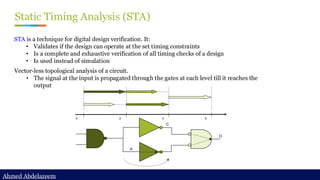
Static Timing Analysis (STA)
STA is a technique for digital design verification. It:
• Validates if the design can operate at the set timing constraints
• Is a complete and exhaustive verification of all timing checks of a design
• Is used instead of simulation
0 2 4 6
A
C
O
Vector-less topological analysis of a circuit.
• The signal at the input is propagated through the gates at each level till it reaches the
output
Ahmed Abdelazeem
Ahmed Abdelazeem
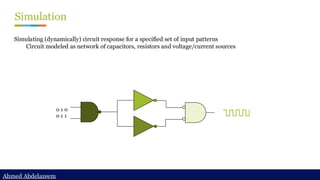
Simulation
Simulating (dynamically) circuit response for a specified set of input patterns
Circuit modeled as network of capacitors, resistors and voltage/current sources
0 1 0
0 1 1
Ahmed Abdelazeem
Ahmed Abdelazeem
Why we need STA?
Static Timing Analysis
We need a fast method that produce relatively accurate timing results compared
to SPICE simulation
SPICE simulation
Accurate, but can be computational expensive and take too much time for today’s million
gate ASIC design.
Timing Problem
Given a circuit design, find if path delay could meet system timing requirement.
Ahmed Abdelazeem
Ahmed Abdelazeem
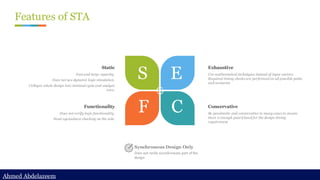
S E
F C
Static
Fast and large capacity.
Does not use dynamic logic simulation.
Collapse whole design into minimal cycle and analyze
once.
Functionality
Does not verify logic functionality.
Need equivalence checking on the side.
Exhaustive
Use mathematical techniques instead of input vectors.
Required timing checks are performed on all possible paths
and scenarios
Conservative
Be pessimistic and conservative in many cases to ensure
there is enough guard band for the design timing
requirement
Features of STA
Synchronous Design Only
Does not verify asynchronous part of the
design
Ahmed Abdelazeem
Ahmed Abdelazeem
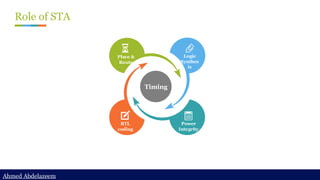
Place &
Route
Logic
Synthes
is
RTL
coding
Power
Integrity
Timing
Role of STA
Ahmed Abdelazeem
Ahmed Abdelazeem
Limitation of STA
1
2
3
Conservative & Pessimistic
Flag false paths
Not suitable for asynchronous design
Ahmed Abdelazeem
Ahmed Abdelazeem
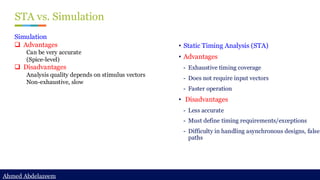
STA vs. Simulation
Simulation
❑ Advantages
Can be very accurate
(Spice-level)
❑ Disadvantages
Analysis quality depends on stimulus vectors
Non-exhaustive, slow
• Static Timing Analysis (STA)
• Advantages
- Exhaustive timing coverage
- Does not require input vectors
- Faster operation
• Disadvantages
- Less accurate
- Must define timing requirements/exceptions
- Difficulty in handling asynchronous designs, false
paths
Ahmed Abdelazeem
Ahmed Abdelazeem
Problem Variability
Other variables affect circuit timing, thus need to be considered during design
❑ Operating Conditions
Process, Voltage, Temperature variations
❑ Unstable clock frequency (jitter, skew)
Instability of clock frequency requires design margin
❑ On-chip variation (OCV)
Device/Interconnect
Ahmed Abdelazeem
Ahmed Abdelazeem
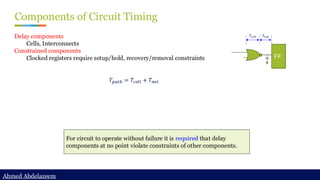
Components of Circuit Timing
Delay components
Cells, Interconnects
Constrained components
Clocked registers require setup/hold, recovery/removal constraints
For circuit to operate without failure it is required that delay
components at no point violate constraints of other components.
FF
𝑇𝑐𝑒𝑙𝑙 𝑇𝑛𝑒𝑡
𝑇𝑝𝑎𝑡ℎ = 𝑇𝑐𝑒𝑙𝑙 + 𝑇𝑛𝑒𝑡
Ahmed Abdelazeem
Ahmed Abdelazeem
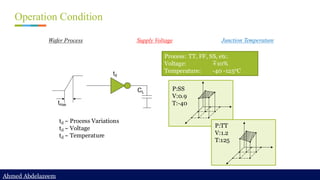
Operation Condition
Wafer Process Supply Voltage Junction Temperature
Process: TT, FF, SS, etc.
Voltage: ∓10%
Temperature: -40 -1250C
P:SS
V:0.9
T:-40
P:TT
V:1.2
T:125
td ~ Process Variations
td ~ Voltage
td ~ Temperature
trise
CL
td
Ahmed Abdelazeem
Ahmed Abdelazeem
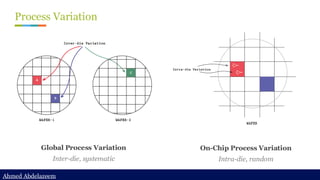
Global Process Variation
Inter-die, systematic
Process Variation
On-Chip Process Variation
Intra-die, random
Ahmed Abdelazeem
Ahmed Abdelazeem
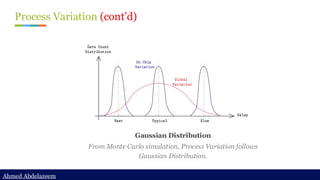
Process Variation (cont’d)
Gaussian Distribution
From Monte Carlo simulation, Process Variation follows
Gaussian Distribution.
Ahmed Abdelazeem
Ahmed Abdelazeem
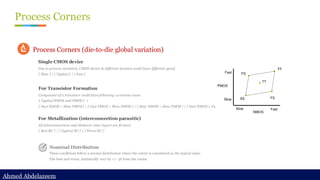
Process Corners
Single CMOS device
Due to process variation, CMOS device in different location could have different speed.
{ Slow } | { Typical } | { Fast }
Process Corners (die-to-die global variation)
For Transistor Formation
Component of a transistor could have following 4 extreme cases:
{ Typical NMOS and PMOS } +
{ Fast NMOS + Slow PMOS } | { Fast PMOS + Slow NMOS } | { Slow NMOS + Slow PMOS } | { Fast NMOS + Fast PMOS }
For Metallization (interconnection parasitic)
All interconnections and dielectric inter layers are formed
{ Best RC } | { Typical RC } | { Worst RC }
Nominal Distribution
These conditions follow a normal distribution where the center is considered as the typical value.
The best and worst, statistically vary by +/- 3ẟ from the center.
Ahmed Abdelazeem
Ahmed Abdelazeem
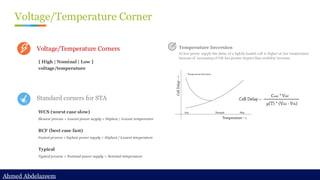
Voltage/Temperature Corner
Voltage/Temperature Corners
{ High | Nominal | Low }
voltage/temperature
Standard corners for STA
WCS (worst case slow)
Slowest process + Lowest power supply + Highest / Lowest temperature
BCF (best case fast)
Fastest process + highest power supply + Highest / Lowest temperature
Typical
Typical process + Nominal power supply + Nominal temperature
Temperature Inversion
At low power supply the delay of a lightly loaded cell is higher at low temperature
because of increasing of Vth has greater impact than mobility increase.
Ahmed Abdelazeem
Ahmed Abdelazeem
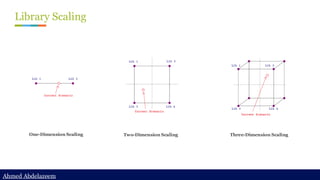
Library Scaling
One-Dimension Scaling Two-Dimension Scaling Three-Dimension Scaling
Ahmed Abdelazeem
Ahmed Abdelazeem
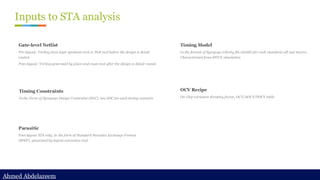
Inputs to STA analysis
Gate-level Netlist
Pre-layout: Verilog from logic synthesis tool or PnR tool before the design is detail
routed.
Post-layout: Verilog generated by place and route tool after the design is detail routed.
Timing Constraints
In the Form of Synopsys Design Constraint (SDC), one SDC for each timing scenario
Parasitic
Post-layout STA only, in the form of Standard Parasitic Exchange Format
(SPEF), generated by layout extraction tool.
Timing Model
In the format of Synopsys Liberty file (dotlib) for each standard cell and macro.
Characterized from SPICE simulation
OCV Recipe
On-chip variation derating factor, OCV/AOCV/POCV table
Ahmed Abdelazeem
Ahmed Abdelazeem
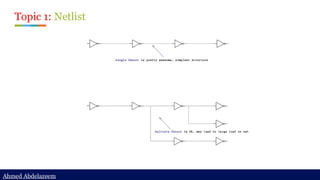
Topic 1: Netlist
Ahmed Abdelazeem
Ahmed Abdelazeem
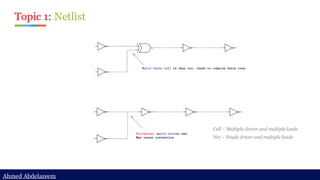
Topic 1: Netlist
Cell – Multiple driver and multiple loads
Net – Single driver and multiple loads
Ahmed Abdelazeem
Ahmed Abdelazeem
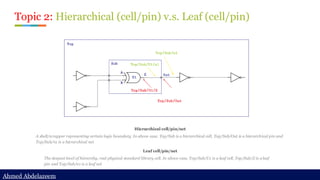
Topic 2: Hierarchical (cell/pin) v.s. Leaf (cell/pin)
Hierarchical cell/pin/net
A shell/wrapper representing certain logic boundary. In above case, Top/Sub is a hierarchical cell, Top/Sub/Out is a hierarchical pin and
Top/Sub/n1 is a hierarchical net
Leaf cell/pin/net
The deepest level of hierarchy, real physical standard library cell. In above case, Top/Sub/U1 is a leaf cell, Top/Sub/Z is aleaf
pin and Top/Sub/n1 is a leaf net
Ahmed Abdelazeem
Ahmed Abdelazeem
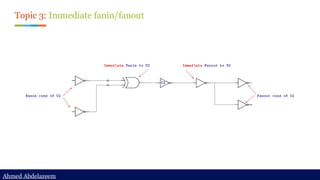
Topic 3: Immediate fanin/fanout
Ahmed Abdelazeem
Ahmed Abdelazeem
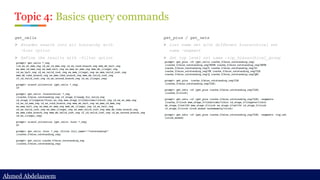
Topic 4: Basics query commands
get_cells
➢ Broaden search into all hierarchy with
-hier option
➢ Refine the results with -filter option
get_pins / get_nets
➢ List same net with different hierarchical net
name -segment
➢ Get top level net name -top_hierarchical_group
Ahmed Abdelazeem
Ahmed Abdelazeem
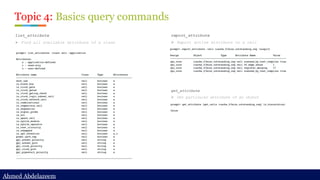
report_attribute
➢ Report active attribute on a cell
list_attribute
➢ Find all available attribute of a class
Topic 4: Basics query commands
get_attribute
➢ Get particular attribute of an object
Ahmed Abdelazeem
Ahmed Abdelazeem
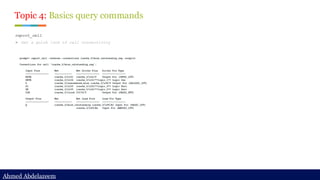
report_cell
➢ Get a quick look of cell connectivity
Topic 4: Basics query commands
Ahmed Abdelazeem
Ahmed Abdelazeem
Topic 5: Basics tracing commands
all_connected [<pin/net object>]
➢ Usually we only care about leaf cell, so get leaf cell with
option –leaf
➢ Argument must be a valid database object, not a plain text
➢ Get immediate fanin/fanout
Ahmed Abdelazeem
Ahmed Abdelazeem
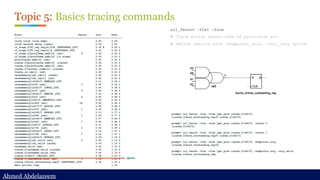
all_fanout -flat -from
➢ Trace entire fanout-cone of particular pin
➢ Refine results with –endpoints_only, -cell_only option
Topic 5: Basics tracing commands
Ahmed Abdelazeem
Ahmed Abdelazeem
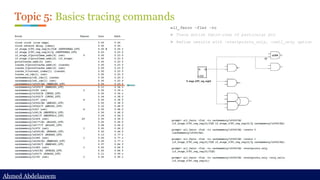
all_fanin -flat -to
➢ Trace entire fanin-cone of particular pin
➢ Refine results with –startpoints_only, -cell_only option
Topic 5: Basics tracing commands
Ahmed Abdelazeem
Ahmed Abdelazeem
Topic 6: Synopsys object
query_object
➢ Return the object name rather than internal object
variable _sel*
get_object_name
➢ Translate design object to text sting in a list
Trick: split output into multiple lines
join [lsort -dict -unique [split [get_object_name $arg] "
" ]] "n“
Trick: [debug feature] proc_body
proc_body shows the content of a procedure. You can use it
to reveal unprotected procedure bodies for debug.
Ahmed Abdelazeem
Ahmed Abdelazeem
Chapter Summary
✓ Static Timing Analysis Definition
✓ Limitation of STA
✓ Operation Condition
✓ Library Scaling
✓ Inputs to STA analysis
Ahmed Abdelazeem
Ahmed Abdelazeem
Ahmed Abdelazeem
Ahmed Abdelazeem
Thank You ☺

[Back2School] STA Basic Concepts- Chapter 1.pdf

  • 1.
    Ahmed Abdelazeem Ahmed Abdelazeem AhmedAbdelazeem Ahmed Abdelazeem STA Basic Concepts { Concepts } + { Technique } Ahmed Abdelazeem
  • 2.
    Ahmed Abdelazeem Ahmed Abdelazeem Agenda Whatis STA? 01 Delay Calculation 02 Constraints Develop 03 Timing Verification 04 Special Timing Checks 05 Crosstalk & Noise 06 STA Methodology 07 Signoff Checklist 08
  • 3.
    Ahmed Abdelazeem Ahmed Abdelazeem Practicein Mind 1 2 3 Establish Key concepts used in STA Correctly constrain ASIC design using SDC Interperate most common timing report 4 Basic timing closure approach
  • 4.
    Ahmed Abdelazeem Ahmed Abdelazeem Goalof this course DC/FC and Primetime We made up some examples for industry standard backend tool Design/Fusion Compiler and Primetime. Both has built-in STA engine while DC/FC is more emphasis on implementation side and PT is more on timing verification side. 28 Special Topics We go over as many as 28 different special topics to extend the key knowledge point discussed. These topics are also made to be easily understood and very practical. Rules of thumb We introduce a number of rules to certain knowledge point so it clarifies un- defined conceptual confusion. You are welcome to test out these rules in your real-life example.
  • 5.
    Ahmed Abdelazeem Ahmed Abdelazeem4 ✓ Static Timing Analysis Definition ✓ Limitation of STA ✓ Operation Condition ✓ Library Scaling ✓ Inputs to STA analysis What is STA ? 01
  • 6.
    Ahmed Abdelazeem Ahmed Abdelazeem StaticTiming Analysis (STA) STA is a technique for digital design verification. It: • Validates if the design can operate at the set timing constraints • Is a complete and exhaustive verification of all timing checks of a design • Is used instead of simulation 0 2 4 6 A C O Vector-less topological analysis of a circuit. • The signal at the input is propagated through the gates at each level till it reaches the output
  • 7.
    Ahmed Abdelazeem Ahmed Abdelazeem Simulation Simulating(dynamically) circuit response for a specified set of input patterns Circuit modeled as network of capacitors, resistors and voltage/current sources 0 1 0 0 1 1
  • 8.
    Ahmed Abdelazeem Ahmed Abdelazeem Whywe need STA? Static Timing Analysis We need a fast method that produce relatively accurate timing results compared to SPICE simulation SPICE simulation Accurate, but can be computational expensive and take too much time for today’s million gate ASIC design. Timing Problem Given a circuit design, find if path delay could meet system timing requirement.
  • 9.
    Ahmed Abdelazeem Ahmed Abdelazeem SE F C Static Fast and large capacity. Does not use dynamic logic simulation. Collapse whole design into minimal cycle and analyze once. Functionality Does not verify logic functionality. Need equivalence checking on the side. Exhaustive Use mathematical techniques instead of input vectors. Required timing checks are performed on all possible paths and scenarios Conservative Be pessimistic and conservative in many cases to ensure there is enough guard band for the design timing requirement Features of STA Synchronous Design Only Does not verify asynchronous part of the design
  • 10.
    Ahmed Abdelazeem Ahmed Abdelazeem Place& Route Logic Synthes is RTL coding Power Integrity Timing Role of STA
  • 11.
    Ahmed Abdelazeem Ahmed Abdelazeem Limitationof STA 1 2 3 Conservative & Pessimistic Flag false paths Not suitable for asynchronous design
  • 12.
    Ahmed Abdelazeem Ahmed Abdelazeem STAvs. Simulation Simulation ❑ Advantages Can be very accurate (Spice-level) ❑ Disadvantages Analysis quality depends on stimulus vectors Non-exhaustive, slow • Static Timing Analysis (STA) • Advantages - Exhaustive timing coverage - Does not require input vectors - Faster operation • Disadvantages - Less accurate - Must define timing requirements/exceptions - Difficulty in handling asynchronous designs, false paths
  • 13.
    Ahmed Abdelazeem Ahmed Abdelazeem ProblemVariability Other variables affect circuit timing, thus need to be considered during design ❑ Operating Conditions Process, Voltage, Temperature variations ❑ Unstable clock frequency (jitter, skew) Instability of clock frequency requires design margin ❑ On-chip variation (OCV) Device/Interconnect
  • 14.
    Ahmed Abdelazeem Ahmed Abdelazeem Componentsof Circuit Timing Delay components Cells, Interconnects Constrained components Clocked registers require setup/hold, recovery/removal constraints For circuit to operate without failure it is required that delay components at no point violate constraints of other components. FF 𝑇𝑐𝑒𝑙𝑙 𝑇𝑛𝑒𝑡 𝑇𝑝𝑎𝑡ℎ = 𝑇𝑐𝑒𝑙𝑙 + 𝑇𝑛𝑒𝑡
  • 15.
    Ahmed Abdelazeem Ahmed Abdelazeem OperationCondition Wafer Process Supply Voltage Junction Temperature Process: TT, FF, SS, etc. Voltage: ∓10% Temperature: -40 -1250C P:SS V:0.9 T:-40 P:TT V:1.2 T:125 td ~ Process Variations td ~ Voltage td ~ Temperature trise CL td
  • 16.
    Ahmed Abdelazeem Ahmed Abdelazeem GlobalProcess Variation Inter-die, systematic Process Variation On-Chip Process Variation Intra-die, random
  • 17.
    Ahmed Abdelazeem Ahmed Abdelazeem ProcessVariation (cont’d) Gaussian Distribution From Monte Carlo simulation, Process Variation follows Gaussian Distribution.
  • 18.
    Ahmed Abdelazeem Ahmed Abdelazeem ProcessCorners Single CMOS device Due to process variation, CMOS device in different location could have different speed. { Slow } | { Typical } | { Fast } Process Corners (die-to-die global variation) For Transistor Formation Component of a transistor could have following 4 extreme cases: { Typical NMOS and PMOS } + { Fast NMOS + Slow PMOS } | { Fast PMOS + Slow NMOS } | { Slow NMOS + Slow PMOS } | { Fast NMOS + Fast PMOS } For Metallization (interconnection parasitic) All interconnections and dielectric inter layers are formed { Best RC } | { Typical RC } | { Worst RC } Nominal Distribution These conditions follow a normal distribution where the center is considered as the typical value. The best and worst, statistically vary by +/- 3ẟ from the center.
  • 19.
    Ahmed Abdelazeem Ahmed Abdelazeem Voltage/TemperatureCorner Voltage/Temperature Corners { High | Nominal | Low } voltage/temperature Standard corners for STA WCS (worst case slow) Slowest process + Lowest power supply + Highest / Lowest temperature BCF (best case fast) Fastest process + highest power supply + Highest / Lowest temperature Typical Typical process + Nominal power supply + Nominal temperature Temperature Inversion At low power supply the delay of a lightly loaded cell is higher at low temperature because of increasing of Vth has greater impact than mobility increase.
  • 20.
    Ahmed Abdelazeem Ahmed Abdelazeem LibraryScaling One-Dimension Scaling Two-Dimension Scaling Three-Dimension Scaling
  • 21.
    Ahmed Abdelazeem Ahmed Abdelazeem Inputsto STA analysis Gate-level Netlist Pre-layout: Verilog from logic synthesis tool or PnR tool before the design is detail routed. Post-layout: Verilog generated by place and route tool after the design is detail routed. Timing Constraints In the Form of Synopsys Design Constraint (SDC), one SDC for each timing scenario Parasitic Post-layout STA only, in the form of Standard Parasitic Exchange Format (SPEF), generated by layout extraction tool. Timing Model In the format of Synopsys Liberty file (dotlib) for each standard cell and macro. Characterized from SPICE simulation OCV Recipe On-chip variation derating factor, OCV/AOCV/POCV table
  • 22.
  • 23.
    Ahmed Abdelazeem Ahmed Abdelazeem Topic1: Netlist Cell – Multiple driver and multiple loads Net – Single driver and multiple loads
  • 24.
    Ahmed Abdelazeem Ahmed Abdelazeem Topic2: Hierarchical (cell/pin) v.s. Leaf (cell/pin) Hierarchical cell/pin/net A shell/wrapper representing certain logic boundary. In above case, Top/Sub is a hierarchical cell, Top/Sub/Out is a hierarchical pin and Top/Sub/n1 is a hierarchical net Leaf cell/pin/net The deepest level of hierarchy, real physical standard library cell. In above case, Top/Sub/U1 is a leaf cell, Top/Sub/Z is aleaf pin and Top/Sub/n1 is a leaf net
  • 25.
    Ahmed Abdelazeem Ahmed Abdelazeem Topic3: Immediate fanin/fanout
  • 26.
    Ahmed Abdelazeem Ahmed Abdelazeem Topic4: Basics query commands get_cells ➢ Broaden search into all hierarchy with -hier option ➢ Refine the results with -filter option get_pins / get_nets ➢ List same net with different hierarchical net name -segment ➢ Get top level net name -top_hierarchical_group
  • 27.
    Ahmed Abdelazeem Ahmed Abdelazeem report_attribute ➢Report active attribute on a cell list_attribute ➢ Find all available attribute of a class Topic 4: Basics query commands get_attribute ➢ Get particular attribute of an object
  • 28.
    Ahmed Abdelazeem Ahmed Abdelazeem report_cell ➢Get a quick look of cell connectivity Topic 4: Basics query commands
  • 29.
    Ahmed Abdelazeem Ahmed Abdelazeem Topic5: Basics tracing commands all_connected [<pin/net object>] ➢ Usually we only care about leaf cell, so get leaf cell with option –leaf ➢ Argument must be a valid database object, not a plain text ➢ Get immediate fanin/fanout
  • 30.
    Ahmed Abdelazeem Ahmed Abdelazeem all_fanout-flat -from ➢ Trace entire fanout-cone of particular pin ➢ Refine results with –endpoints_only, -cell_only option Topic 5: Basics tracing commands
  • 31.
    Ahmed Abdelazeem Ahmed Abdelazeem all_fanin-flat -to ➢ Trace entire fanin-cone of particular pin ➢ Refine results with –startpoints_only, -cell_only option Topic 5: Basics tracing commands
  • 32.
    Ahmed Abdelazeem Ahmed Abdelazeem Topic6: Synopsys object query_object ➢ Return the object name rather than internal object variable _sel* get_object_name ➢ Translate design object to text sting in a list Trick: split output into multiple lines join [lsort -dict -unique [split [get_object_name $arg] " " ]] "n“ Trick: [debug feature] proc_body proc_body shows the content of a procedure. You can use it to reveal unprotected procedure bodies for debug.
  • 33.
    Ahmed Abdelazeem Ahmed Abdelazeem ChapterSummary ✓ Static Timing Analysis Definition ✓ Limitation of STA ✓ Operation Condition ✓ Library Scaling ✓ Inputs to STA analysis
  • 34.
    Ahmed Abdelazeem Ahmed Abdelazeem AhmedAbdelazeem Ahmed Abdelazeem Thank You ☺