culture and democracy
Overview What are the key arguments surrounding the “Asian Values” debate? Who are the main proponents of “Asian Values”? What are the implications of this debate on the practice of liberal democracy?
The Asian Values Debate Primarily emphasized the role of  culture  in the economic success of East Asian countries Centered around the proposition that certain cultural traits were conducive to economic growth and development Proponents: Lee Kwan Yew, Mahathir Mohammad, etc. Has implications on politics as well.
Context Associating political/economic realities with cultural characteristics is nothing new Arguably, the first social philosopher to have done so in a coherent manner was Max Weber in  The Protestant Ethic and the Spirit of Capitalism
Context In the late 1970s to the early 1980s, countries in East Asia experienced rapid economic growth and development These countries achieved in mere decades what Western countries took over centuries to accomplish Pundits credited the remarkable occurrence to cultural characteristics of East Asian countries
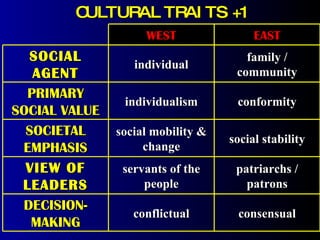
CULTURAL TRAITS +1 consensual conflictual DECISION-MAKING patriarchs / patrons servants of the people VIEW OF LEADERS social stability social mobility & change SOCIETAL EMPHASIS conformity individualism PRIMARY SOCIAL VALUE family / community individual SOCIAL AGENT EAST WEST
The Cultural Critique Liberal democracy is primarily a Western phenomenon applicable only in the West Its value orientations are ultimately incompatible with those of other cultures
The Cultural Critique What matters is not the kind of government a country possesses, but whether government gets the job done People basically desire the same things of their government Governments can only work if they are suited to specific cultural contexts
It is problematic to “transplant” democracy to other cultures The practice is imperialistic The West does not possess a monopoly over what form of government is proper to individual countries The Cultural Critique
Shortcomings  Cultures are complex They encompass a broad gamut of characteristics and social phenomena They are not absolute in and of themselves
Shortcomings  As explanatory variables, culture is problematic Causality is unclear: whether it is deterministic remains uncertain It is used to explain phenomenon either way
Shortcomings  Whether cultures are irreconcilably different is debatable There are commonalities across cultures Cultural values may be seen as generally the same, but the emphasis on these values differs

Asian Values

  • 1.
  • 2.
    Overview What arethe key arguments surrounding the “Asian Values” debate? Who are the main proponents of “Asian Values”? What are the implications of this debate on the practice of liberal democracy?
  • 3.
    The Asian ValuesDebate Primarily emphasized the role of culture in the economic success of East Asian countries Centered around the proposition that certain cultural traits were conducive to economic growth and development Proponents: Lee Kwan Yew, Mahathir Mohammad, etc. Has implications on politics as well.
  • 4.
    Context Associating political/economicrealities with cultural characteristics is nothing new Arguably, the first social philosopher to have done so in a coherent manner was Max Weber in The Protestant Ethic and the Spirit of Capitalism
  • 5.
    Context In thelate 1970s to the early 1980s, countries in East Asia experienced rapid economic growth and development These countries achieved in mere decades what Western countries took over centuries to accomplish Pundits credited the remarkable occurrence to cultural characteristics of East Asian countries
  • 6.
    CULTURAL TRAITS +1consensual conflictual DECISION-MAKING patriarchs / patrons servants of the people VIEW OF LEADERS social stability social mobility & change SOCIETAL EMPHASIS conformity individualism PRIMARY SOCIAL VALUE family / community individual SOCIAL AGENT EAST WEST
  • 7.
    The Cultural CritiqueLiberal democracy is primarily a Western phenomenon applicable only in the West Its value orientations are ultimately incompatible with those of other cultures
  • 8.
    The Cultural CritiqueWhat matters is not the kind of government a country possesses, but whether government gets the job done People basically desire the same things of their government Governments can only work if they are suited to specific cultural contexts
  • 9.
    It is problematicto “transplant” democracy to other cultures The practice is imperialistic The West does not possess a monopoly over what form of government is proper to individual countries The Cultural Critique
  • 10.
    Shortcomings Culturesare complex They encompass a broad gamut of characteristics and social phenomena They are not absolute in and of themselves
  • 11.
    Shortcomings Asexplanatory variables, culture is problematic Causality is unclear: whether it is deterministic remains uncertain It is used to explain phenomenon either way
  • 12.
    Shortcomings Whethercultures are irreconcilably different is debatable There are commonalities across cultures Cultural values may be seen as generally the same, but the emphasis on these values differs

Editor's Notes

  • #2 Learning Objectives: 1.) To become acquainted with the Asian Values debate. 2.) To understand the broader “cultural” critique on the applicability of liberal democracy (as a form of rule).