Interest Groups
The Role of Interest Groups
 Interest group: an organization of people
with shared policy goals entering the policy
process at several points to try to achieve
those goals
 Interest groups pursue their goals in many
arenas.
 Interest groups distinguishable from parties.
• Political parties fight election battles; interest
groups do not field candidates for office but may
choose sides.
• Interest groups are policy specialists; political
parties are policy generalists.
WHY ORGANIZE?
• Individuals form interest groups to increase
the chance that their views will be heard and
their interests treated favorably by the
government.
• Interest groups enhance political
participation.
• An enormous number of groups operate in
the United States.
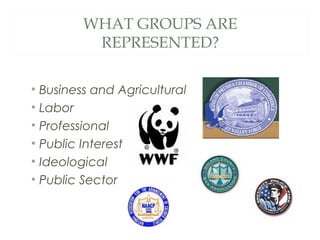
WHAT GROUPS ARE
REPRESENTED?
• Business and Agricultural
• Labor
• Professional
• Public Interest
• Ideological
• Public Sector
WHY JOIN?
• Informational
benefits
• Material benefits
• Solidary benefits
• Purposive benefits
What Makes an Interest Group
Successful?
THE CHARACTERISTICS OF MEMBERS
• Group members
generally have higher
incomes, higher levels
of education, and work
in management or
professional positions.
• Group membership has
a very pronounced
upper-class bias.
THE EXPANSION OF GOVERNMENT
• Over the past twenty-five years, there has
been a tremendous growth in the number
of interest groups.
• This corresponds to the rapid expansion of
the federal government.
THEORIES OF INTEREST GROUP
POLITICS
• Suppose Madison's
decedents were
studying American
Government in order
to assess how well the
system controls the
power of special
interests. They could
draw different
conclusions
• Pluralist
• Elitist
• Hyper-pluralist
Theories of Interest Group
Politics
 Pluralist Theory
 Politics is mainly a competition among
groups, each one pressing for its own
preferred policies.
 Elite Theory
 Societies are divided along class lines and
an upper-class elite rules, regardless of the
formal niceties of governmental organization.
 Hyperpluralist Theory
 Groups are so varied and strong that
government is weakened. This is an
extreme, exaggerated form of pluralism.
Theories of Interest Group
Politics
 Pluralism and Group Theory
Groups provide a key link between the
people and the government.
Groups compete and no one group
will become too dominant.
Groups play by the “rules of the
game.”
Groups weak in one resource may
use another.
Lobbying is open to all so is not
problematical.
 AP60x Pluralism
 AP60X Buckley v Valeo
Theories of Interest Group
Politics
 Elites and the Denial of Pluralism
 Real power is held by the relatively few.
 The largest corporations hold the most
power.
 Other groups may win many minor policy
battles, but elites prevail when it comes to
big policy decisions.
 Lobbying is a problem because it benefits
the few at the expense of the many.
Theories of Interest Group
Politics
 Hyperpluralism and Interest Group
Liberalism
 Subgovernments consist of a network of
groups that exercise a great deal of control
over specific policy areas.
• Also known as iron triangles
• Consist of interest groups, government agency,
and congressional committees that handle
particular policies
 The hyperpluralist critique
• Groups have become too powerful as the
government tries to appease every interest.
• Trying to please every group results in weak
or contradictory policies.
Interest Groups
 Why are interest groups important in
the US Today?
 How might the activities of interest
groups not be in the best interest of
many Americans.
What Makes an Interest Group
Successful?
 The Surprising Ineffectiveness of
Large Groups
Potential group: all the people who
might be interest group members
because they share a common
interest
Actual group: the part of the potential
group consisting of members who
actually join
Collective good: something of value
that cannot be withheld from a group
member
What Makes an Interest
Group Successful?
Free-Rider problem: Some people
don’t join interest groups because
they benefit from the group’s activities
without officially joining.
• Bigger the group, larger the
problem
• Large groups are difficult to
organize
The Free Rider
 Group benefits may be available to the public
(a collective benefit).
 No reason to join the group
 Creates a “free rider” problem
Olson’s Law of Large
Groups
 The bigger the group the more serious
the free rider problem
 Overcome Olson’s law by providing
selective benefits:
 Goods that a group can restrict to those
who pay their annual dues
 AARP - One of the most powerful interest groups in Washington D.C., and
according to some, the strongest lobbying group in the U.S. It is certainly the nations
largest interest group, with a membership of about 36 million.
What Makes an Interest
Group Successful?
Small groups are better organized and
more focused on the group’s goals.
• Consumer groups have a difficult time
getting significant policy gains because
the benefits are spread over the entire
population.
• Public interest lobbies seek “a collective good,
the achievement of which will not selectively
and materially benefit the membership
activities of the organization.”
What Makes an Interest Group
Successful?
 Intensity
Single-Issue groups: groups that focus
on a narrow interest, dislike
compromise, and often draw
membership from people new to
politics
Intensity encourages non-
conventional means of participation.-
protests
What Makes an Interest
Group Successful?
 Financial Resources
Not all groups have equal amounts of
money.
Monetary donations usually translate
into access to the politicians, such as
a phone call, meeting, or support for
policy.
Wealthier groups have more
resources—and presumably more
access—but they do not always win
on policy.
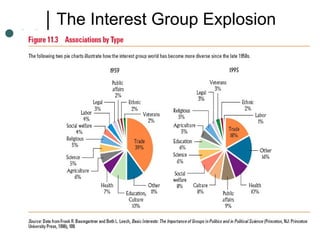
The Interest Group Explosion
Strategies: The Quest for
Political Power
 Lobbying
 Gaining Access
 Using the Courts
 Going Public
 Using Electoral
Politics
Lobbying
 Lobbying is a
strategy by which
Interest groups
seek to influence
the passage of
legislation by
exerting pressure
on members of
the legislature.
How Groups Try to Shape
Policy
 Lobbying
“communication by someone other
than a citizen acting on his own
behalf, directed to a governmental
decision maker with the hope of
influencing his decision” (Lester
Milbrath)
Two basic types of lobbyists:
• Regular, paid employees of a group
• Temporary hires – Professional lobbyist
How Groups Try to Shape
Policy
 Lobbying
Lobbyists:
• are a source of information
• help politicians plan political strategies for
legislation
• help politicians plan political strategies for
reelection campaigns
• are a source of ideas and innovations
• American Medical Association
Gaining Access
 Groups must maintain
access to the decision
making process
through relationships
with Congress and
agencies.
— Iron triangle
— Issue network
— Influence peddling
American Tobacco
Association
Iron Triangle
Stress for the Test
Using the Courts
 Groups sometimes turn to litigation when they
lack access or when they are dissatisfied with
governmental decisions.
 They finance litigation, provide attorneys, or file
amicus curiae briefs in support of a particular
position.
How Groups Try to Shape
Policy
 Litigation
 If an interest group fails in one arena, the
courts may be able to provide a remedy.
 Interest groups can file amicus curiae briefs
to influence a court’s decision.
• amicus curiae: briefs submitted by a “friend of the
court” to raise additional points of view and
present information not contained in the briefs of
the formal parties
 Class Action lawsuits permit a small number
of people to sue on behalf of all other people
similar situated.
 NAACP
Going Public
 Going public is a strategy that attempts to
mobilize the public to support the groups
objective.
— Institutional advertising
— Social movements
— Grassroots mobilization
Going Public
 NRA
How Groups Try to Shape
Policy
 Going Public
Because public opinion makes its way
to policymakers, groups try to:
• cultivate a good public image to build a
reservoir of goodwill with the public
• use marketing strategies to influence
public opinion of the group and its issues
• advertise to motivate and inform the
public about an issue
• NRA
Propaganda
 Plain folks
 Transfer
 Bandwagon
 Name Calling
 Testimonial
 Card stacking
 Glittering generalities
Propaganda
 Plain Folks: Propagandists use this
approach to convince the audience
that the spokesperson is from humble
origins, someone they can trust and
who has their interests at heart.
 ordinary language and mannerisms
Propaganda
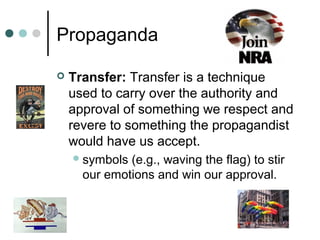
 Transfer: Transfer is a technique
used to carry over the authority and
approval of something we respect and
revere to something the propagandist
would have us accept.
symbols (e.g., waving the flag) to stir
our emotions and win our approval.
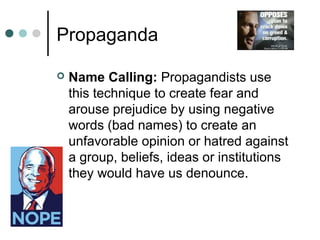
Propaganda
 Name Calling: Propagandists use
this technique to create fear and
arouse prejudice by using negative
words (bad names) to create an
unfavorable opinion or hatred against
a group, beliefs, ideas or institutions
they would have us denounce.
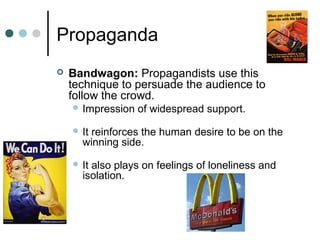
Propaganda
 Bandwagon: Propagandists use this
technique to persuade the audience to
follow the crowd.
 Impression of widespread support.
 It reinforces the human desire to be on the
winning side.
 It also plays on feelings of loneliness and
isolation.
Propaganda
 Testimonial: Propagandists use this
technique to associate a respected
person or someone with experience to
endorse a product or cause by giving
it their stamp of approval hoping that
the intended audience will follow their
example.
Propaganda
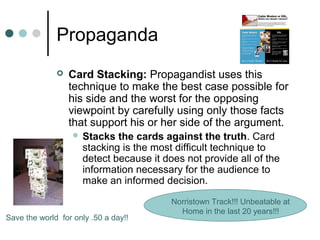
 Card Stacking: Propagandist uses this
technique to make the best case possible for
his side and the worst for the opposing
viewpoint by carefully using only those facts
that support his or her side of the argument.
 Stacks the cards against the truth. Card
stacking is the most difficult technique to
detect because it does not provide all of the
information necessary for the audience to
make an informed decision.
Norristown Track!!! Unbeatable at
Home in the last 20 years!!!
Save the world for only .50 a day!!
Propaganda
 Glittering Generalities: Propagandists employ vague,
sweeping statements (often slogans or simple
catchphrases)
 They appeal to such notions as honor, glory, love of
country, desire for peace, freedom, and family values.
 The words and phrases are vague and suggest
different things to different people but the implication
is always favorable.
 It cannot be proved true or false because it really
says little or nothing at all.
A Vote for Ian Morris is a Vote
for a New Tomorrow!!!!
Using Electoral Politics
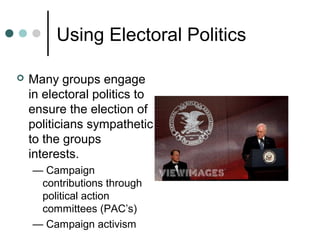
 Many groups engage
in electoral politics to
ensure the election of
politicians sympathetic
to the groups
interests.
— Campaign
contributions through
political action
committees (PAC’s)
— Campaign activism
Greenpeace Video
How Groups Try to Shape
Policy
 Electioneering
 Direct group involvement in the election
process
• Groups can help fund campaigns, provide
testimony, and get members to work for
candidates; some form PACs.
 Political Action Committee (PAC): Political
funding vehicles created by 1974 campaign
finance reforms, PACs are used by interest
groups to donate money to candidates.
• PACs help pay the bill for increasing campaign
costs.
• Most PAC money goes to incumbents.
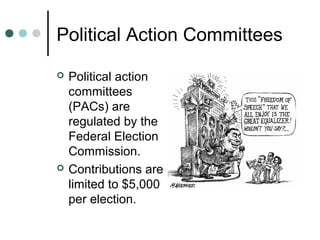
Political Action Committees
 Political action
committees
(PACs) are
regulated by the
Federal Election
Commission.
 Contributions are
limited to $5,000
per election.
What Makes an Interest Group Successful?
Interest Groups a Summary
 What do I
remember?
 ?????
Goals of Interest Groups
 Influence public opinion
 Influence parties and elections, often by the
use of PACs or lobbying
 Supply the public with information that
supports groups’ interests
 Build a positive image for the group
 Create public attitudes by using propaganda
 Promote a particular public policy
NRA –
National Rifle
Association
NAACP –
National
Association for
the Advancement
NEA –
National
Education
Association
AARP –
American
Association of
Retired Persons
PETA – People for the
Ethical Treatment of
Animals
Types of Interest Groups
 Economic Interests
Labor
Agriculture
Business
 Environmental Interests
 Equality Interests
 Consumer and Public Interest Lobbies
.
Understanding Interest
Groups
 Interest Groups and Democracy
 Pluralists believe that the public interest
would prevail from this competition.
 Elite theorists point to the proliferation of
business PACs as evidence of interest group
corruption.
 Hyperpluralists maintain that group influence
has led to policy gridlock.
Understanding Interest
Groups
 Interest Groups and the Scope of
Government
Interest groups seek to maintain
policies and programs that benefit
them.
Interest groups continue to pressure
government to do more things.
As the government does more, does
this cause the formation of more
groups?
Summary
 A number of factors influence a
group’s success. Size, intensity, $
 Interest groups affect policy process
through lobbying, electioneering,
litigation, and going public.

Interest Groups

  • 1.
  • 2.
    The Role ofInterest Groups  Interest group: an organization of people with shared policy goals entering the policy process at several points to try to achieve those goals  Interest groups pursue their goals in many arenas.  Interest groups distinguishable from parties. • Political parties fight election battles; interest groups do not field candidates for office but may choose sides. • Interest groups are policy specialists; political parties are policy generalists.
  • 3.
    WHY ORGANIZE? • Individualsform interest groups to increase the chance that their views will be heard and their interests treated favorably by the government. • Interest groups enhance political participation. • An enormous number of groups operate in the United States.
  • 4.
    WHAT GROUPS ARE REPRESENTED? •Business and Agricultural • Labor • Professional • Public Interest • Ideological • Public Sector
  • 5.
    WHY JOIN? • Informational benefits •Material benefits • Solidary benefits • Purposive benefits
  • 6.
    What Makes anInterest Group Successful?
  • 7.
    THE CHARACTERISTICS OFMEMBERS • Group members generally have higher incomes, higher levels of education, and work in management or professional positions. • Group membership has a very pronounced upper-class bias.
  • 8.
    THE EXPANSION OFGOVERNMENT • Over the past twenty-five years, there has been a tremendous growth in the number of interest groups. • This corresponds to the rapid expansion of the federal government.
  • 9.
    THEORIES OF INTERESTGROUP POLITICS • Suppose Madison's decedents were studying American Government in order to assess how well the system controls the power of special interests. They could draw different conclusions • Pluralist • Elitist • Hyper-pluralist
  • 10.
    Theories of InterestGroup Politics  Pluralist Theory  Politics is mainly a competition among groups, each one pressing for its own preferred policies.  Elite Theory  Societies are divided along class lines and an upper-class elite rules, regardless of the formal niceties of governmental organization.  Hyperpluralist Theory  Groups are so varied and strong that government is weakened. This is an extreme, exaggerated form of pluralism.
  • 11.
    Theories of InterestGroup Politics  Pluralism and Group Theory Groups provide a key link between the people and the government. Groups compete and no one group will become too dominant. Groups play by the “rules of the game.” Groups weak in one resource may use another. Lobbying is open to all so is not problematical.
  • 12.
     AP60x Pluralism AP60X Buckley v Valeo
  • 13.
    Theories of InterestGroup Politics  Elites and the Denial of Pluralism  Real power is held by the relatively few.  The largest corporations hold the most power.  Other groups may win many minor policy battles, but elites prevail when it comes to big policy decisions.  Lobbying is a problem because it benefits the few at the expense of the many.
  • 14.
    Theories of InterestGroup Politics  Hyperpluralism and Interest Group Liberalism  Subgovernments consist of a network of groups that exercise a great deal of control over specific policy areas. • Also known as iron triangles • Consist of interest groups, government agency, and congressional committees that handle particular policies  The hyperpluralist critique • Groups have become too powerful as the government tries to appease every interest. • Trying to please every group results in weak or contradictory policies.
  • 15.
    Interest Groups  Whyare interest groups important in the US Today?  How might the activities of interest groups not be in the best interest of many Americans.
  • 16.
    What Makes anInterest Group Successful?  The Surprising Ineffectiveness of Large Groups Potential group: all the people who might be interest group members because they share a common interest Actual group: the part of the potential group consisting of members who actually join Collective good: something of value that cannot be withheld from a group member
  • 17.
    What Makes anInterest Group Successful? Free-Rider problem: Some people don’t join interest groups because they benefit from the group’s activities without officially joining. • Bigger the group, larger the problem • Large groups are difficult to organize
  • 18.
    The Free Rider Group benefits may be available to the public (a collective benefit).  No reason to join the group  Creates a “free rider” problem
  • 19.
    Olson’s Law ofLarge Groups  The bigger the group the more serious the free rider problem  Overcome Olson’s law by providing selective benefits:  Goods that a group can restrict to those who pay their annual dues  AARP - One of the most powerful interest groups in Washington D.C., and according to some, the strongest lobbying group in the U.S. It is certainly the nations largest interest group, with a membership of about 36 million.
  • 20.
    What Makes anInterest Group Successful? Small groups are better organized and more focused on the group’s goals. • Consumer groups have a difficult time getting significant policy gains because the benefits are spread over the entire population. • Public interest lobbies seek “a collective good, the achievement of which will not selectively and materially benefit the membership activities of the organization.”
  • 21.
    What Makes anInterest Group Successful?  Intensity Single-Issue groups: groups that focus on a narrow interest, dislike compromise, and often draw membership from people new to politics Intensity encourages non- conventional means of participation.- protests
  • 22.
    What Makes anInterest Group Successful?  Financial Resources Not all groups have equal amounts of money. Monetary donations usually translate into access to the politicians, such as a phone call, meeting, or support for policy. Wealthier groups have more resources—and presumably more access—but they do not always win on policy.
  • 23.
  • 24.
    Strategies: The Questfor Political Power  Lobbying  Gaining Access  Using the Courts  Going Public  Using Electoral Politics
  • 25.
    Lobbying  Lobbying isa strategy by which Interest groups seek to influence the passage of legislation by exerting pressure on members of the legislature.
  • 26.
    How Groups Tryto Shape Policy  Lobbying “communication by someone other than a citizen acting on his own behalf, directed to a governmental decision maker with the hope of influencing his decision” (Lester Milbrath) Two basic types of lobbyists: • Regular, paid employees of a group • Temporary hires – Professional lobbyist
  • 27.
    How Groups Tryto Shape Policy  Lobbying Lobbyists: • are a source of information • help politicians plan political strategies for legislation • help politicians plan political strategies for reelection campaigns • are a source of ideas and innovations • American Medical Association
  • 28.
    Gaining Access  Groupsmust maintain access to the decision making process through relationships with Congress and agencies. — Iron triangle — Issue network — Influence peddling American Tobacco Association
  • 29.
  • 30.
    Using the Courts Groups sometimes turn to litigation when they lack access or when they are dissatisfied with governmental decisions.  They finance litigation, provide attorneys, or file amicus curiae briefs in support of a particular position.
  • 31.
    How Groups Tryto Shape Policy  Litigation  If an interest group fails in one arena, the courts may be able to provide a remedy.  Interest groups can file amicus curiae briefs to influence a court’s decision. • amicus curiae: briefs submitted by a “friend of the court” to raise additional points of view and present information not contained in the briefs of the formal parties  Class Action lawsuits permit a small number of people to sue on behalf of all other people similar situated.  NAACP
  • 32.
    Going Public  Goingpublic is a strategy that attempts to mobilize the public to support the groups objective. — Institutional advertising — Social movements — Grassroots mobilization
  • 33.
  • 34.
    How Groups Tryto Shape Policy  Going Public Because public opinion makes its way to policymakers, groups try to: • cultivate a good public image to build a reservoir of goodwill with the public • use marketing strategies to influence public opinion of the group and its issues • advertise to motivate and inform the public about an issue • NRA
  • 35.
    Propaganda  Plain folks Transfer  Bandwagon  Name Calling  Testimonial  Card stacking  Glittering generalities
  • 36.
    Propaganda  Plain Folks:Propagandists use this approach to convince the audience that the spokesperson is from humble origins, someone they can trust and who has their interests at heart.  ordinary language and mannerisms
  • 37.
    Propaganda  Transfer: Transferis a technique used to carry over the authority and approval of something we respect and revere to something the propagandist would have us accept. symbols (e.g., waving the flag) to stir our emotions and win our approval.
  • 38.
    Propaganda  Name Calling:Propagandists use this technique to create fear and arouse prejudice by using negative words (bad names) to create an unfavorable opinion or hatred against a group, beliefs, ideas or institutions they would have us denounce.
  • 39.
    Propaganda  Bandwagon: Propagandistsuse this technique to persuade the audience to follow the crowd.  Impression of widespread support.  It reinforces the human desire to be on the winning side.  It also plays on feelings of loneliness and isolation.
  • 40.
    Propaganda  Testimonial: Propagandistsuse this technique to associate a respected person or someone with experience to endorse a product or cause by giving it their stamp of approval hoping that the intended audience will follow their example.
  • 41.
    Propaganda  Card Stacking:Propagandist uses this technique to make the best case possible for his side and the worst for the opposing viewpoint by carefully using only those facts that support his or her side of the argument.  Stacks the cards against the truth. Card stacking is the most difficult technique to detect because it does not provide all of the information necessary for the audience to make an informed decision. Norristown Track!!! Unbeatable at Home in the last 20 years!!! Save the world for only .50 a day!!
  • 42.
    Propaganda  Glittering Generalities:Propagandists employ vague, sweeping statements (often slogans or simple catchphrases)  They appeal to such notions as honor, glory, love of country, desire for peace, freedom, and family values.  The words and phrases are vague and suggest different things to different people but the implication is always favorable.  It cannot be proved true or false because it really says little or nothing at all. A Vote for Ian Morris is a Vote for a New Tomorrow!!!!
  • 43.
    Using Electoral Politics Many groups engage in electoral politics to ensure the election of politicians sympathetic to the groups interests. — Campaign contributions through political action committees (PAC’s) — Campaign activism
  • 44.
  • 45.
    How Groups Tryto Shape Policy  Electioneering  Direct group involvement in the election process • Groups can help fund campaigns, provide testimony, and get members to work for candidates; some form PACs.  Political Action Committee (PAC): Political funding vehicles created by 1974 campaign finance reforms, PACs are used by interest groups to donate money to candidates. • PACs help pay the bill for increasing campaign costs. • Most PAC money goes to incumbents.
  • 46.
    Political Action Committees Political action committees (PACs) are regulated by the Federal Election Commission.  Contributions are limited to $5,000 per election.
  • 47.
    What Makes anInterest Group Successful?
  • 48.
    Interest Groups aSummary  What do I remember?  ?????
  • 49.
    Goals of InterestGroups  Influence public opinion  Influence parties and elections, often by the use of PACs or lobbying  Supply the public with information that supports groups’ interests  Build a positive image for the group  Create public attitudes by using propaganda  Promote a particular public policy NRA – National Rifle Association NAACP – National Association for the Advancement NEA – National Education Association AARP – American Association of Retired Persons PETA – People for the Ethical Treatment of Animals
  • 50.
    Types of InterestGroups  Economic Interests Labor Agriculture Business  Environmental Interests  Equality Interests  Consumer and Public Interest Lobbies .
  • 51.
    Understanding Interest Groups  InterestGroups and Democracy  Pluralists believe that the public interest would prevail from this competition.  Elite theorists point to the proliferation of business PACs as evidence of interest group corruption.  Hyperpluralists maintain that group influence has led to policy gridlock.
  • 52.
    Understanding Interest Groups  InterestGroups and the Scope of Government Interest groups seek to maintain policies and programs that benefit them. Interest groups continue to pressure government to do more things. As the government does more, does this cause the formation of more groups?
  • 53.
    Summary  A numberof factors influence a group’s success. Size, intensity, $  Interest groups affect policy process through lobbying, electioneering, litigation, and going public.

Editor's Notes