What is Democracy?
 Why Democracy?


         LIJIN GOLDEN
Background (previous chapter)

ď‚— Some stories related with Democracy
ď‚— Difference- Democratic and Non Democratic
ď‚— This Chapter- What is Democracy? And its features.
ď‚— After that we can distinguish- Democratic and Non
  Democratic country
ď‚— Democracy- is the most prevalent form of Govt, and
  expanding more cuntries.
ď‚— What are the reasons behind this?
Major Aspects


ď‚— Where did the word Democracy originate?
ď‚— What is Democracy?- Meaning and Definition.
ď‚— Features of Democracy
ď‚— Merits and Demerits of Democracy
ď‚— Difference between Democratic and Non Democratic
  form government.
ď‚— Democracy- Direct & Indirect Democracy
Case Studies about different nations.


  Myanmar -       Army rule
  Chile           Pinochet
  Nepal & Saudi - Monarchy
  Pakistan     -  Military (Parvez Musharraf)
  Poland &Iraq-   USSR & USA (external)
  China-          Communist party (One party)
  Mexico     -    PRI(Insti- Revo-party) (,,)
  Zimbabwe -      Mugabe (president)
Broader meaning of Democracy

ď‚— Minimum understanding- we can identify
  Democratic or Non Democratic country
 But – Democracy and good Democracy
ď‚— Features of good Democracy


ď‚— Conclusion
ď‚— Consolidation
From where the word democracy is
             derived
ď‚— The word democracy is derived from the Greek word
           Demos- People
           Kratos- Power or rule
Meaning of Democracy

ď‚— Democracy is a form of government in which the
    rulers are elected by the people.
ď‚—   Who are the rulers?
ď‚—   What kind of election?
ď‚—   Who are the people?
ď‚—   What kind of form of government?
ď‚—   Abraham Linkon- Democracy is a government of the
    people, by the people and for the people.
Features of Democracy

ď‚— In a democracy the final decision making power must rest
    with those who elected by the people.
ď‚—   A democracy must be based on a free and fair election
    where those currently in power have a fair chance of
    losing.
ď‚—   In a democracy, each adult citizen must have one vote
    and each vote must have one value.
ď‚—   A democratic government rules within limits sets by
    constitutional law and citizen’s right.
ď‚—   The opposition parties are allowed to function freely
    before and after the elections.
ď‚—   The democratic governments are based on fundamental
    principles of political equality.
Merits of Democracy

ď‚— A democratic government is a better government because
  it is a more accountable form of government.
ď‚— Democracy improves the quality of decision making.
ď‚— Democracy provides a method to deal with differences
  and conflicts. It is suitable the countries like India. India
  having diversity of language, religion and cultures.
  Democracy in India made it possible to keep unity in
  diversity.
ď‚— In a democracy no one is a permanent winner or loser.
ď‚— Democracy is better than other forms of government
  because it allows us to correct its own mistakes.
ď‚— Democracy enhances the dignity of citizens, because
  it is based on the principle of political equality, on
  recognizing that the poorest and least educated have
  the same status as the rich and the educated.
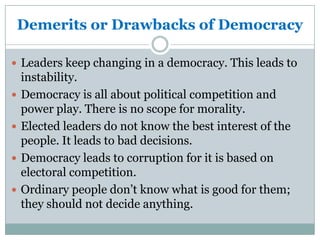
Demerits or Drawbacks of Democracy

ď‚— Leaders keep changing in a democracy. This leads to
    instability.
ď‚—   Democracy is all about political competition and
    power play. There is no scope for morality.
ď‚—   Elected leaders do not know the best interest of the
    people. It leads to bad decisions.
ď‚—   Democracy leads to corruption for it is based on
    electoral competition.
   Ordinary people don’t know what is good for them;
    they should not decide anything.
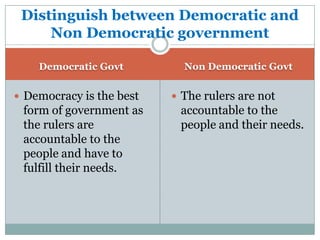
Distinguish between Democratic and
     Non Democratic government

    Democratic Govt         Non Democratic Govt


ď‚— Democracy is the best   ď‚— The rulers are not
 form of government as     accountable to the
 the rulers are            people and their needs.
 accountable to the
 people and have to
 fulfill their needs.
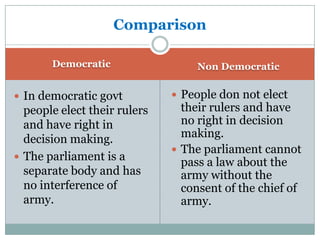
Comparison

       Democratic                  Non Democratic


ď‚— In democratic govt          ď‚— People don not elect
  people elect their rulers     their rulers and have
  and have right in             no right in decision
  decision making.              making.
                              ď‚— The parliament cannot
ď‚— The parliament is a
                                pass a law about the
  separate body and has         army without the
  no interference of            consent of the chief of
  army.                         army.
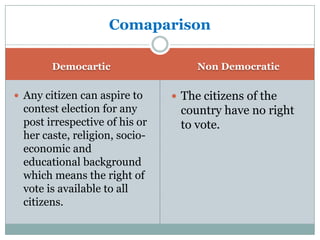
Comaparison

        Democartic                   Non Democratic

ď‚— Any citizen can aspire to     ď‚— The citizens of the
  contest election for any       country have no right
  post irrespective of his or    to vote.
  her caste, religion, socio-
  economic and
  educational background
  which means the right of
  vote is available to all
  citizens.
Comparison

       Democratic                   Non Demcratic

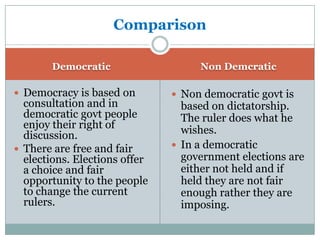
ď‚— Democracy is based on        ď‚— Non democratic govt is
  consultation and in            based on dictatorship.
  democratic govt people         The ruler does what he
  enjoy their right of           wishes.
  discussion.
ď‚— There are free and fair      ď‚— In a democratic
  elections. Elections offer     government elections are
  a choice and fair              either not held and if
  opportunity to the people      held they are not fair
  to change the current          enough rather they are
  rulers.                        imposing.
Comparison

       Democratic             Non Democratic


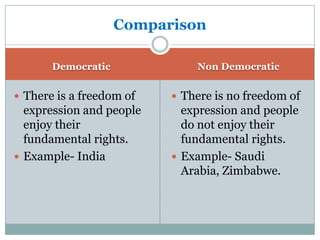
ď‚— There is a freedom of   ď‚— There is no freedom of
  expression and people     expression and people
  enjoy their               do not enjoy their
  fundamental rights.       fundamental rights.
ď‚— Example- India          ď‚— Example- Saudi
                            Arabia, Zimbabwe.
Two Types of Democracy- Direct &Indirect

                   Direct Democracy
It is a political setup, where the people themselves
  makes the laws and parliament directly in the
  functioning of the govt.
Decisions are taken on the base of the majority of
  opinion.
It is suitable for the geographically small countries with
  less population.
Eg : Ancient Greek/ Rome and India
Modern period- Switzerland
In Direct Democracy
ď‚— In the modern world most of the countries are
  following the in direct democracy.
ď‚— It is system, in which the representatives are
  elected by the people and they act on behalf of the
  people.
ď‚— They are so sensitive to cater the needs and opinion of
  the people.
 Eg ; India/ France/ USA
CASE STUDIES
PAKISTAN   SAUDI ARABIA
  CHINA      ESTONIA
    MEXICO     FIJI
 ZIMBABWE SRI LANKA
PAKISTAN
ď‚— General Parvez Mushraff led a military coup in oct
    1999.
ď‚—   He overthrew the democratically elected govt.
ď‚—   He declared the chief executive of the country.
ď‚—   In 2002 he changed his position to president
ď‚—   Then held a referendum- five years extension
ď‚—   Media, Human right organisations and democratic
    activist said- referendum was based on malpractices
    and fraud.
ď‚—   In Aug 2002- he issued Legal Frame Work order-
    amended the constitution of Pakistan.
ď‚—   According to this order- president can dismiss the
    national or provisional assemblies.
ď‚— The work of civilian cabinet supervised by national
  Security Council dominated by military officers.
ď‚— After passing this law the election held to the national
  and state assemblies.
ď‚— The elected representatives have some powers.
ď‚— But final power rest with military officers and General
  Parvez Mushrraf

(Check this incidents along with the features of Democracy
  and find out which aspects violated)
CHINA
ď‚— In China elections are regularly held after every five years
    for electing the Country’s parliament- Quanguo Renmin
    Diabiao Dahui (National peoples congress)
ď‚—   They have the power to appoint the president
ď‚—   It have nearly 3ooo peoples elected from all parts
ď‚—   Some members are elected by the army
ď‚—   Before contesting the elections the candidates needs the
    approval of Chinese Communist party.
ď‚—   Only those who member in communist party or eight
    smaller parties allied to it were allowed to contest election
    held in 2002-2003.
ď‚—   The government is always formed by the communist party

(Check this incidents along with the features of Democracy and
  find out which aspects violated)
MEXICO
ď‚— Since its independence in 1930, Mexico holds
    elections after every six tears to elect its president.
ď‚—   The country has never been under military rule or
    dictator rule.
ď‚—   But until 2000 all election was won by a party called
    PRI (Institutional Revolutionary Party)
ď‚—   Opposition parties did contest the elections but
    never win the election
ď‚—   The PRI use many dirty tricks to win the election
ď‚—   All those who employed in govt offices had to attend
    its party meetings.
ď‚—   Teachers of govt school forced parents to vote PRI
ď‚— Media ignored the activities of opposition parties
  except to criticise them.
ď‚— Some times the polling booths were shifted from one
  place to another place in the last minutes, which made
  difficult to the people cast their votes.
ď‚— The PRI spent a large sum of money in the campaign
  for its candidates

 (Check this incidents along with the features of
 Democracy and find out which aspects violated)
Saudi Arabia/ Estonia/ Fiji
ď‚— Saudi Arabia women do not have the right to vote.
ď‚— Estonia made its citizenship rules in such a way that
  people belonging to Russian minority find it difficult
  to get the right to vote.
ď‚— In Fiji, the electoral system such that the vote of an
  indigenous Fiji has more value than that of an Indian
  Fijian
 (Check this incidents along with the features of
  Democracy and find out which aspects violated)
Zimbabwe
ď‚— Attained independence from white minority- 1980
ď‚— Since then the country has been ruled by ZANU-PF, the
    party led the freedom struggle.
ď‚—   Leader- Robert Mugabe, has been ruling the country since
    independence.
ď‚—   Elections have been held regularly- always won- ZANU
ď‚—   President is popular- but uses unfair practices in election
ď‚—   Changed the constitution and increased the power of
    president and makes him less accountable.
ď‚—   Opposition party workers harassed and disrupted.
ď‚—   There is a law that limits the right to criticise the president
ď‚— T V and radio were controlled by govt and give only
  ruling party version.
ď‚— There are independent news papers but the govt
  harasses those journalists who go against this.
ď‚— The govt has ignored some court judgments and went
  against it and has pressurised judges.

(Check this incidents along with the features of
 Democracy and find out which aspects violated)
Try to find out on which aspects are violated
   in Democracy and which are preserved

ď‚— Bhutan- King declared that in future he will be guided
  by the advice given to him by elected representatives.
ď‚— Sri Lanka- Many Tamil workers migrated from India
  were not given to the right to vote.
ď‚— Nepal- King imposed a ban on political gatherings,
  demonstrations and rallies.
ď‚— Bihar- The Indian Supreme Court held that the
  dissolution of Bihar assembly was unconstitutional
ď‚— Bangladesh- Political parties agreed that a neutral
  govt should rule the country at the time of elections
ď‚— Major decision by elected leaders.
ď‚— One person, One vote and one value
ď‚— Respect for rights
ď‚— Rule of law
ď‚— Free and fair electoral competitions.
BROADER MEANING OF
    DEMOCRACY


            LIJIN
ď‚— On this chapter we understood the meaning of
    Democracy in a limited and descriptive sense.
ď‚—   We have understood Democracy is a form of govt.
ď‚—   The most common form that democracy takes in our
    times is that of a representative democracy.
ď‚—   In the countries we call democracy, all the people do
    not rule.
ď‚—   A majority is allowed to take decisions on behalf of all
    the people.
ď‚—   Even majority does not rule directly.
In Democracy majority of people rule through
     their elected representatives- Why?
 ď‚— Modern democracies involves such a large number of
   people that it is physically impossible for them to sit
   together and take a collective decision.
 ď‚— Even if they could, the citizen does not have the time,
   the desire or the skills to take part in all the decisions.
Aims of Good Democracy

ď‚— True democracy will come to this country only when
  no one goes hungry to bed.
ď‚— In a democracy every citizen must be able to play
  equal role in decision making. For this you don’t
  need just an equal right to vote. Every citizen needs
  to have equal information, basic education, equal
  resources and a lot of commitment.

What is democracy and Why democracy?

  • 1.
    What is Democracy? Why Democracy? LIJIN GOLDEN
  • 3.
    Background (previous chapter) ď‚—Some stories related with Democracy ď‚— Difference- Democratic and Non Democratic ď‚— This Chapter- What is Democracy? And its features. ď‚— After that we can distinguish- Democratic and Non Democratic country ď‚— Democracy- is the most prevalent form of Govt, and expanding more cuntries. ď‚— What are the reasons behind this?
  • 4.
    Major Aspects ď‚— Wheredid the word Democracy originate? ď‚— What is Democracy?- Meaning and Definition. ď‚— Features of Democracy ď‚— Merits and Demerits of Democracy ď‚— Difference between Democratic and Non Democratic form government. ď‚— Democracy- Direct & Indirect Democracy
  • 5.
    Case Studies aboutdifferent nations. Myanmar - Army rule Chile Pinochet Nepal & Saudi - Monarchy Pakistan - Military (Parvez Musharraf) Poland &Iraq- USSR & USA (external) China- Communist party (One party) Mexico - PRI(Insti- Revo-party) (,,) Zimbabwe - Mugabe (president)
  • 6.
    Broader meaning ofDemocracy  Minimum understanding- we can identify Democratic or Non Democratic country  But – Democracy and good Democracy  Features of good Democracy  Conclusion  Consolidation
  • 7.
    From where theword democracy is derived ď‚— The word democracy is derived from the Greek word Demos- People Kratos- Power or rule
  • 8.
    Meaning of Democracy ď‚—Democracy is a form of government in which the rulers are elected by the people. ď‚— Who are the rulers? ď‚— What kind of election? ď‚— Who are the people? ď‚— What kind of form of government? ď‚— Abraham Linkon- Democracy is a government of the people, by the people and for the people.
  • 9.
    Features of Democracy In a democracy the final decision making power must rest with those who elected by the people.  A democracy must be based on a free and fair election where those currently in power have a fair chance of losing.  In a democracy, each adult citizen must have one vote and each vote must have one value.  A democratic government rules within limits sets by constitutional law and citizen’s right.  The opposition parties are allowed to function freely before and after the elections.  The democratic governments are based on fundamental principles of political equality.
  • 10.
    Merits of Democracy ď‚—A democratic government is a better government because it is a more accountable form of government. ď‚— Democracy improves the quality of decision making. ď‚— Democracy provides a method to deal with differences and conflicts. It is suitable the countries like India. India having diversity of language, religion and cultures. Democracy in India made it possible to keep unity in diversity. ď‚— In a democracy no one is a permanent winner or loser.
  • 11.
    ď‚— Democracy isbetter than other forms of government because it allows us to correct its own mistakes. ď‚— Democracy enhances the dignity of citizens, because it is based on the principle of political equality, on recognizing that the poorest and least educated have the same status as the rich and the educated.
  • 12.
    Demerits or Drawbacksof Democracy  Leaders keep changing in a democracy. This leads to instability.  Democracy is all about political competition and power play. There is no scope for morality.  Elected leaders do not know the best interest of the people. It leads to bad decisions.  Democracy leads to corruption for it is based on electoral competition.  Ordinary people don’t know what is good for them; they should not decide anything.
  • 13.
    Distinguish between Democraticand Non Democratic government Democratic Govt Non Democratic Govt ď‚— Democracy is the best ď‚— The rulers are not form of government as accountable to the the rulers are people and their needs. accountable to the people and have to fulfill their needs.
  • 14.
    Comparison Democratic Non Democratic ď‚— In democratic govt ď‚— People don not elect people elect their rulers their rulers and have and have right in no right in decision decision making. making. ď‚— The parliament cannot ď‚— The parliament is a pass a law about the separate body and has army without the no interference of consent of the chief of army. army.
  • 15.
    Comaparison Democartic Non Democratic ď‚— Any citizen can aspire to ď‚— The citizens of the contest election for any country have no right post irrespective of his or to vote. her caste, religion, socio- economic and educational background which means the right of vote is available to all citizens.
  • 16.
    Comparison Democratic Non Demcratic ď‚— Democracy is based on ď‚— Non democratic govt is consultation and in based on dictatorship. democratic govt people The ruler does what he enjoy their right of wishes. discussion. ď‚— There are free and fair ď‚— In a democratic elections. Elections offer government elections are a choice and fair either not held and if opportunity to the people held they are not fair to change the current enough rather they are rulers. imposing.
  • 17.
    Comparison Democratic Non Democratic ď‚— There is a freedom of ď‚— There is no freedom of expression and people expression and people enjoy their do not enjoy their fundamental rights. fundamental rights. ď‚— Example- India ď‚— Example- Saudi Arabia, Zimbabwe.
  • 18.
    Two Types ofDemocracy- Direct &Indirect Direct Democracy It is a political setup, where the people themselves makes the laws and parliament directly in the functioning of the govt. Decisions are taken on the base of the majority of opinion. It is suitable for the geographically small countries with less population. Eg : Ancient Greek/ Rome and India Modern period- Switzerland
  • 19.
    In Direct Democracy ď‚—In the modern world most of the countries are following the in direct democracy. ď‚— It is system, in which the representatives are elected by the people and they act on behalf of the people. ď‚— They are so sensitive to cater the needs and opinion of the people. Eg ; India/ France/ USA
  • 20.
    CASE STUDIES PAKISTAN SAUDI ARABIA CHINA ESTONIA MEXICO FIJI ZIMBABWE SRI LANKA
  • 21.
    PAKISTAN ď‚— General ParvezMushraff led a military coup in oct 1999. ď‚— He overthrew the democratically elected govt. ď‚— He declared the chief executive of the country. ď‚— In 2002 he changed his position to president ď‚— Then held a referendum- five years extension ď‚— Media, Human right organisations and democratic activist said- referendum was based on malpractices and fraud. ď‚— In Aug 2002- he issued Legal Frame Work order- amended the constitution of Pakistan. ď‚— According to this order- president can dismiss the national or provisional assemblies.
  • 22.
    ď‚— The workof civilian cabinet supervised by national Security Council dominated by military officers. ď‚— After passing this law the election held to the national and state assemblies. ď‚— The elected representatives have some powers. ď‚— But final power rest with military officers and General Parvez Mushrraf (Check this incidents along with the features of Democracy and find out which aspects violated)
  • 23.
    CHINA  In Chinaelections are regularly held after every five years for electing the Country’s parliament- Quanguo Renmin Diabiao Dahui (National peoples congress)  They have the power to appoint the president  It have nearly 3ooo peoples elected from all parts  Some members are elected by the army  Before contesting the elections the candidates needs the approval of Chinese Communist party.  Only those who member in communist party or eight smaller parties allied to it were allowed to contest election held in 2002-2003.  The government is always formed by the communist party (Check this incidents along with the features of Democracy and find out which aspects violated)
  • 24.
    MEXICO ď‚— Since itsindependence in 1930, Mexico holds elections after every six tears to elect its president. ď‚— The country has never been under military rule or dictator rule. ď‚— But until 2000 all election was won by a party called PRI (Institutional Revolutionary Party) ď‚— Opposition parties did contest the elections but never win the election ď‚— The PRI use many dirty tricks to win the election ď‚— All those who employed in govt offices had to attend its party meetings. ď‚— Teachers of govt school forced parents to vote PRI
  • 25.
    ď‚— Media ignoredthe activities of opposition parties except to criticise them. ď‚— Some times the polling booths were shifted from one place to another place in the last minutes, which made difficult to the people cast their votes. ď‚— The PRI spent a large sum of money in the campaign for its candidates (Check this incidents along with the features of Democracy and find out which aspects violated)
  • 26.
    Saudi Arabia/ Estonia/Fiji ď‚— Saudi Arabia women do not have the right to vote. ď‚— Estonia made its citizenship rules in such a way that people belonging to Russian minority find it difficult to get the right to vote. ď‚— In Fiji, the electoral system such that the vote of an indigenous Fiji has more value than that of an Indian Fijian (Check this incidents along with the features of Democracy and find out which aspects violated)
  • 27.
    Zimbabwe ď‚— Attained independencefrom white minority- 1980 ď‚— Since then the country has been ruled by ZANU-PF, the party led the freedom struggle. ď‚— Leader- Robert Mugabe, has been ruling the country since independence. ď‚— Elections have been held regularly- always won- ZANU ď‚— President is popular- but uses unfair practices in election ď‚— Changed the constitution and increased the power of president and makes him less accountable. ď‚— Opposition party workers harassed and disrupted. ď‚— There is a law that limits the right to criticise the president
  • 28.
    ď‚— T Vand radio were controlled by govt and give only ruling party version. ď‚— There are independent news papers but the govt harasses those journalists who go against this. ď‚— The govt has ignored some court judgments and went against it and has pressurised judges. (Check this incidents along with the features of Democracy and find out which aspects violated)
  • 29.
    Try to findout on which aspects are violated in Democracy and which are preserved ď‚— Bhutan- King declared that in future he will be guided by the advice given to him by elected representatives. ď‚— Sri Lanka- Many Tamil workers migrated from India were not given to the right to vote. ď‚— Nepal- King imposed a ban on political gatherings, demonstrations and rallies.
  • 30.
    ď‚— Bihar- TheIndian Supreme Court held that the dissolution of Bihar assembly was unconstitutional ď‚— Bangladesh- Political parties agreed that a neutral govt should rule the country at the time of elections
  • 31.
    ď‚— Major decisionby elected leaders. ď‚— One person, One vote and one value ď‚— Respect for rights ď‚— Rule of law ď‚— Free and fair electoral competitions.
  • 32.
    BROADER MEANING OF DEMOCRACY LIJIN
  • 33.
    ď‚— On thischapter we understood the meaning of Democracy in a limited and descriptive sense. ď‚— We have understood Democracy is a form of govt. ď‚— The most common form that democracy takes in our times is that of a representative democracy. ď‚— In the countries we call democracy, all the people do not rule. ď‚— A majority is allowed to take decisions on behalf of all the people. ď‚— Even majority does not rule directly.
  • 34.
    In Democracy majorityof people rule through their elected representatives- Why? ď‚— Modern democracies involves such a large number of people that it is physically impossible for them to sit together and take a collective decision. ď‚— Even if they could, the citizen does not have the time, the desire or the skills to take part in all the decisions.
  • 35.
    Aims of GoodDemocracy  True democracy will come to this country only when no one goes hungry to bed.  In a democracy every citizen must be able to play equal role in decision making. For this you don’t need just an equal right to vote. Every citizen needs to have equal information, basic education, equal resources and a lot of commitment.