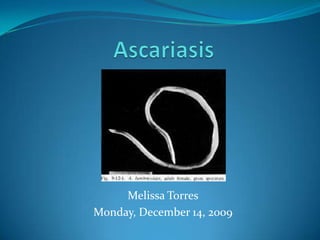
AscariasisMelissa TorresMonday, December 14, 2009
Defining relationships between humans and ascariasisOverviewPrevalenceSymptomsAscarislifecycleImmunosuppressive activityRole of IL-10Role of PAS-1Hygiene hypothesisEvolution of the hypothesis and helminthsFuture implications
AscariasisMost common helminthInfecting 25% of the world populationMost prevalent in childrenHighest prevalence = 2 – 10 y/oldsHighest intensity = 5 – 15 y/olds*Intensity due to co-infections
Warm, moist climatesBethony, S.B., et al. (2006). Soil transmitted helminth infections: ascariaisis, trichuriasis, and hookworm.  The lancet 2006; 367, 1521-1532
SymptomsMay manifest into
Growth retardation
Pneumonitis/ verminous pneumonia
Intestinal obstruction
Hepatobiliary and pancreatic injury
Eosinophilia*AscarislumbricoidesBethony, S.B., et al. (2006). Soil transmitted helminth infections: ascariaisis, trichuriasis, and hookworm. The lancet 2006; 367: 1521-1532.
Life cycle
Conflicting reportsReports indicating ascariasisInduced inflamatory response (AHR) Suppressed AHRIncreased versus suppressed AHRMore cases in which suppression occursNovel genes provide insight…Maizels, R.M., et al. (2004).  Helminth parasites—masters of regulation.  Immunological Reviews; 201: 89-116.
Immunosuppressive activity1977 discovery of MW of nematode allergen10,000 – 50,000 MW1986 expanded weight range components14,000 – 410,000 MWResulting in two distinct componentsLower weight component (PIII)IgE-potentiating activityHigher weight component (PI)Protective antigen
Immunosuppressive activityIn 1998 immunosuppression is confirmedFor high molecular weight components (PI)Faquim-Mauro, E.L., & Macedo, M.S.. (1998). The immunosuppressive activity of Ascarissuum is due to highmolecular weight components.  Clin Exp Immunol; 114: 245-251.
CytokinesIn 2004, cytokines affected by Ascariswere starting to be confirmed.Th2 cytokinesIL-4IL-5IL-10Th1 cytokineIFN-gammaCooper, P.J., Chico, M.E., Sandoval, C., & Nutman, T.B.. (2004).  Atopic phenotype is an important determinant of immunoglobulin E-mediated inflammation and expression of T helper cell type 2 cytokines to Ascarisantigens in children exposed to Ascariasis.  The Journal of Infectious Diseases; 190: 1338-1346.
Th1 and Th2 cytokinesRomagnani, S.. (2004). The increased presence o fallergy and the hygiene hypothesis: missing immune deviation, reduced immune suppression, or both?. Immunology; 112: 352-363.
Conditioned or Th2 like responseMacedo, M.S., et al.  (1998).  Immumomudulation induced by Ascarissuum extract in mice: Effect of anti-interleukin-4 an inti-interleukin-10 andtibodies.  Scand. J. Immunol; 47: 10-18
Protein component of A. suumIn 2005, PAS-1 was a strong candidate as a suppressive protein componentOshiro, T.M., Macedo, M.S., & Macedo-Soares, M.F.. (2005). Anti-inflammatory activity of PAS-1, a protein component of Ascarissuum.  Inflammation Research; 54: 17-21.
PAS-1Further confirmed in 2006Oshiro, T.M., et al. (2006). PAS-1, a protein affinity purified from Ascarissuum worms, maintains the ability to modulate the immune response to a bystander antigen.  Immunology and Cell Biology; 84: 138-144.
The goalUsing what we knowIt has been demonstrated that nullifying T-cell activity can “cure” chronic helminth infection.By allowing immune system to operate at full potentialAre there trade-offs?
The hygiene hypothesisMuch of what is known now is owed to this hypothesis~1998 – presentAlthough its definition has evolved…
By definition:A hypothesis that states that exposure to allergens in the environment early in life reduces the risk of developing allergies by boosting immune system activity. Conversely, relatively clean environment in early life would sway the immune system towards allergy-promoting responses.

Ascariasis

  • 1.
  • 2.
    Defining relationships betweenhumans and ascariasisOverviewPrevalenceSymptomsAscarislifecycleImmunosuppressive activityRole of IL-10Role of PAS-1Hygiene hypothesisEvolution of the hypothesis and helminthsFuture implications
  • 3.
    AscariasisMost common helminthInfecting25% of the world populationMost prevalent in childrenHighest prevalence = 2 – 10 y/oldsHighest intensity = 5 – 15 y/olds*Intensity due to co-infections
  • 4.
    Warm, moist climatesBethony,S.B., et al. (2006). Soil transmitted helminth infections: ascariaisis, trichuriasis, and hookworm. The lancet 2006; 367, 1521-1532
  • 5.
  • 6.
  • 7.
  • 8.
  • 9.
  • 10.
    Eosinophilia*AscarislumbricoidesBethony, S.B., etal. (2006). Soil transmitted helminth infections: ascariaisis, trichuriasis, and hookworm. The lancet 2006; 367: 1521-1532.
  • 11.
  • 12.
    Conflicting reportsReports indicatingascariasisInduced inflamatory response (AHR) Suppressed AHRIncreased versus suppressed AHRMore cases in which suppression occursNovel genes provide insight…Maizels, R.M., et al. (2004). Helminth parasites—masters of regulation. Immunological Reviews; 201: 89-116.
  • 13.
    Immunosuppressive activity1977 discoveryof MW of nematode allergen10,000 – 50,000 MW1986 expanded weight range components14,000 – 410,000 MWResulting in two distinct componentsLower weight component (PIII)IgE-potentiating activityHigher weight component (PI)Protective antigen
  • 14.
    Immunosuppressive activityIn 1998immunosuppression is confirmedFor high molecular weight components (PI)Faquim-Mauro, E.L., & Macedo, M.S.. (1998). The immunosuppressive activity of Ascarissuum is due to highmolecular weight components. Clin Exp Immunol; 114: 245-251.
  • 15.
    CytokinesIn 2004, cytokinesaffected by Ascariswere starting to be confirmed.Th2 cytokinesIL-4IL-5IL-10Th1 cytokineIFN-gammaCooper, P.J., Chico, M.E., Sandoval, C., & Nutman, T.B.. (2004). Atopic phenotype is an important determinant of immunoglobulin E-mediated inflammation and expression of T helper cell type 2 cytokines to Ascarisantigens in children exposed to Ascariasis. The Journal of Infectious Diseases; 190: 1338-1346.
  • 16.
    Th1 and Th2cytokinesRomagnani, S.. (2004). The increased presence o fallergy and the hygiene hypothesis: missing immune deviation, reduced immune suppression, or both?. Immunology; 112: 352-363.
  • 17.
    Conditioned or Th2like responseMacedo, M.S., et al. (1998). Immumomudulation induced by Ascarissuum extract in mice: Effect of anti-interleukin-4 an inti-interleukin-10 andtibodies. Scand. J. Immunol; 47: 10-18
  • 18.
    Protein component ofA. suumIn 2005, PAS-1 was a strong candidate as a suppressive protein componentOshiro, T.M., Macedo, M.S., & Macedo-Soares, M.F.. (2005). Anti-inflammatory activity of PAS-1, a protein component of Ascarissuum. Inflammation Research; 54: 17-21.
  • 19.
    PAS-1Further confirmed in2006Oshiro, T.M., et al. (2006). PAS-1, a protein affinity purified from Ascarissuum worms, maintains the ability to modulate the immune response to a bystander antigen. Immunology and Cell Biology; 84: 138-144.
  • 20.
    The goalUsing whatwe knowIt has been demonstrated that nullifying T-cell activity can “cure” chronic helminth infection.By allowing immune system to operate at full potentialAre there trade-offs?
  • 21.
    The hygiene hypothesisMuchof what is known now is owed to this hypothesis~1998 – presentAlthough its definition has evolved…
  • 22.
    By definition:A hypothesisthat states that exposure to allergens in the environment early in life reduces the risk of developing allergies by boosting immune system activity. Conversely, relatively clean environment in early life would sway the immune system towards allergy-promoting responses.

Editor's Notes

  • #8 There are two defined areas as to where ascaris comes in direct contact with mucosal linings. It is known that Treg cells can be preferentially induced at mucosal surfaces, in particular gut and respiratory tract. (32)