ARTIFICIALLY ENDUCED
PRECIPITATION
 Weather Modification/Weather Control -general term for efforts to
alter the natural meteorological phenomena of the atmosphere.
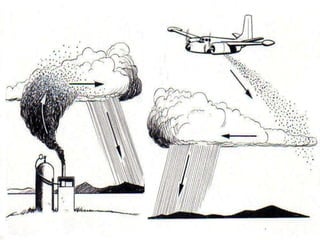
 Cloud modification/Cloud seeding - is the attempt to change the
amount or type of precipitation that falls from clouds, by dispersing
substances into the air that serve as cloud condensation or ice nuclei,
which alter the microphysical processes within the cloud.
- the most common chemicals used for cloud seeding include:
silver iodide, potassium iodide and dry ice( solid carbon dioxide).
INTENSITY OF RAINFALL
 Intensity of Rainfall -is defined as the ratio of the total amount of rain
(rainfall depth) falling during a given period to the duration of the period. It
is expressed in depth units per unit time, usually as mm per hour (mm/h).
•Rainfall intensities
1. Light-when the precipitation rate is < 2.5 mm (0.098 in) per hour
2. Moderate-when the precipitation rate is between 2.5 mm (0.098 in) - 7.6
mm (0.30 in) or 10 mm (0.39 in) per hour
3. Heavy-when the precipitation rate is > 7.6 mm (0.30 in) per hour or
between 10 mm (0.39 in) and 50 mm (2.0 in) per hour.
Rain Gauges -also known as an udometer, pluviometer, or an
ombrometer is a type of instrument used to gather and measure
the amount of liquid precipitation over a set period of time.
•Most commonly used recording rain gauge:
1. Standard rain gauge-consists of a funnel emptying into a
graduated cylinder, 2 cm in diameter, which fits inside a larger
container which is 20 cm in diameter and 50 cm tall.
2. Tipping bucket rain gauge-consist of a plastic
collector balanced over a pivot. When it tips, it actuates a
switch which is then electronically recorded or
transmitted to a remote collection station. The tipping
bucket rain gauge is not as accurate as the standard rain
gauge because the rainfall may stop before the lever has
tipped.
3. Natural siphon rain gauge(float type rain gauge) -A class
of rain gage in which the level of the collected rainwater is
measured by the position of a float resting on the surface of the
water; frequently used as a recording rain gage by connecting the
float through a linkage to a pen which records on a clock-driven
chart.
4. Weight Bucket rain gauge

Artificially Enduced Precipitation

  • 1.
  • 2.
     Weather Modification/WeatherControl -general term for efforts to alter the natural meteorological phenomena of the atmosphere.  Cloud modification/Cloud seeding - is the attempt to change the amount or type of precipitation that falls from clouds, by dispersing substances into the air that serve as cloud condensation or ice nuclei, which alter the microphysical processes within the cloud. - the most common chemicals used for cloud seeding include: silver iodide, potassium iodide and dry ice( solid carbon dioxide).
  • 4.
  • 5.
     Intensity ofRainfall -is defined as the ratio of the total amount of rain (rainfall depth) falling during a given period to the duration of the period. It is expressed in depth units per unit time, usually as mm per hour (mm/h). •Rainfall intensities 1. Light-when the precipitation rate is < 2.5 mm (0.098 in) per hour 2. Moderate-when the precipitation rate is between 2.5 mm (0.098 in) - 7.6 mm (0.30 in) or 10 mm (0.39 in) per hour 3. Heavy-when the precipitation rate is > 7.6 mm (0.30 in) per hour or between 10 mm (0.39 in) and 50 mm (2.0 in) per hour.
  • 6.
    Rain Gauges -alsoknown as an udometer, pluviometer, or an ombrometer is a type of instrument used to gather and measure the amount of liquid precipitation over a set period of time. •Most commonly used recording rain gauge: 1. Standard rain gauge-consists of a funnel emptying into a graduated cylinder, 2 cm in diameter, which fits inside a larger container which is 20 cm in diameter and 50 cm tall.
  • 7.
    2. Tipping bucketrain gauge-consist of a plastic collector balanced over a pivot. When it tips, it actuates a switch which is then electronically recorded or transmitted to a remote collection station. The tipping bucket rain gauge is not as accurate as the standard rain gauge because the rainfall may stop before the lever has tipped.
  • 8.
    3. Natural siphonrain gauge(float type rain gauge) -A class of rain gage in which the level of the collected rainwater is measured by the position of a float resting on the surface of the water; frequently used as a recording rain gage by connecting the float through a linkage to a pen which records on a clock-driven chart. 4. Weight Bucket rain gauge