PT.RAVISHANKAR SHUKLA
UNIVERSITY
RAIPUR CG
SOS IN BIOTECHNOLOGY
SEMINAR ON
TISSUE ENGINEERING : ARTIFICIAL SKIN
SYNOPSIS
Introduction
Artificial skin
Invention
Structure of human skin
Importance of skin
Key development
Biomaterials
Methods to produce artificial skin
Application
Problems
Future development
Conclusions
references
INTRODUCTION
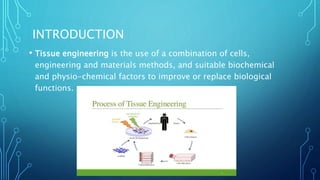
• Tissue engineering is the use of a combination of cells,
engineering and materials methods, and suitable biochemical
and physio-chemical factors to improve or replace biological
functions.
ARTIFICIAL SKIN
• Artificial skin is a synthetic (laboratory produced) substitute
for human skin.
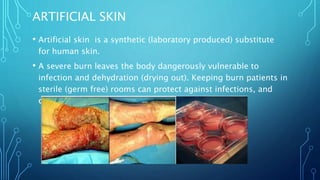
• A severe burn leaves the body dangerously vulnerable to
infection and dehydration (drying out). Keeping burn patients in
sterile (germ free) rooms can protect against infections, and
covering burned areas with grafts.
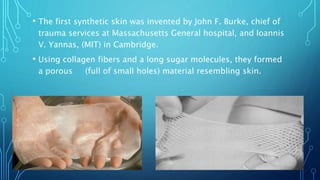
• The first synthetic skin was invented by John F. Burke, chief of
trauma services at Massachusetts General hospital, and Ioannis
V. Yannas, (MIT) in Cambridge.
• Using collagen fibers and a long sugar molecules, they formed
a porous (full of small holes) material resembling skin.
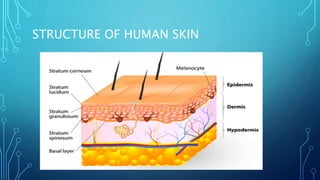
STRUCTURE OF HUMAN SKIN
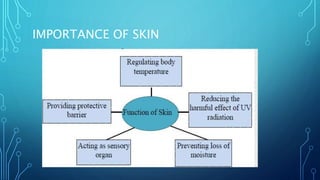
IMPORTANCE OF SKIN
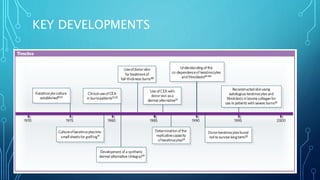
KEY DEVELOPMENTS
WHAT IS IT ?
• About thirty years ago, surgeons determined that badly burned
skin should be removed as quickly as possible, followed by
immediate and permanent replacement of the lost skin.
• Doctors are able to take a postage stamp-sized piece of skin
from the patient and grow the skin under special tissue culture
conditions.
• From this small piece of skin, technicians can grow enough skin
to cover nearly the entire body in just 3 weeks.
WHY IT IS NEEDED?
• When skin is damaged or lost due to injury or burns, bacteria
and other microorganisms have easy access to warm, nutrient-
rich body fluid.
• To treat a burn skin, surgeons first remove the burned skin and
then quickly cover the underlying tissue, usually with a
combination of laboratory-grown skin cells and artificial skin.
BIOMATERIALS
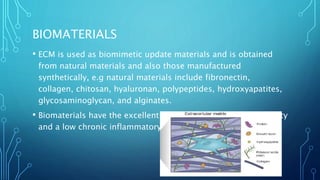
• ECM is used as biomimetic update materials and is obtained
from natural materials and also those manufactured
synthetically, e.g natural materials include fibronectin,
collagen, chitosan, hyaluronan, polypeptides, hydroxyapatites,
glycosaminoglycan, and alginates.
• Biomaterials have the excellent advantage of having low toxicity
and a low chronic inflammatory response
• Natural materials- a number of natural materials have excellent
properties that have led to their use in skin tissue engineering
because of similar cellular properties to human skin tissues,
including those pertaining to adhesion and infilteration .
Biomaterials such as collagen are characterized by low mechanical
strength, good biocompatibility, and low antigenicity.
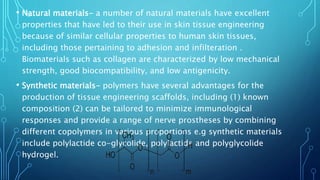
• Synthetic materials- polymers have several advantages for the
production of tissue engineering scaffolds, including (1) known
composition (2) can be tailored to minimize immunological
responses and provide a range of nerve prostheses by combining
different copolymers in various proportions e.g synthetic materials
include polylactide co-glycolide, polylactide and polyglycolide
hydrogel.
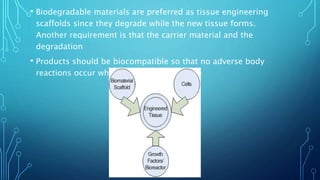
• Biodegradable materials are preferred as tissue engineering
scaffolds since they degrade while the new tissue forms.
Another requirement is that the carrier material and the
degradation
• Products should be biocompatible so that no adverse body
reactions occur when the material degrade
MANUFACTURE PROCESS OF ARTIFICIAL
SKIN
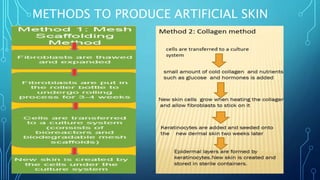
• (1) Mesh scaffolding method
• (a)fibroblasts are thawed and expanded; the fibroblasts are
transferred from the vials into roller bottles. The bottles are
rotated on their side for 3-4 weeks. The rolling action allows
the circulation of oxygen which is essential for the growth
process.
• (b) cells are transferred to culture system: the cells are removed
from roller bottles, combined with a nutrient rich media; flowed
through tubes into thin cassette like bioreactors housing the
biodegradable mesh scaffolding, they adhere to the mesh and
begin to grow.
• (c) growth cycle completed: when cell growth mesh is
completed, the tissue is rinsed with more nutrient rich media
and stored.
(2) COLLAGEN METHOD
• (a)cells are transferred to culture system: a small amount of
cold collagen and nutrient media appro.12% of the combined
solution is added to fibroblasts. The mixture is dispensed into
the molds and allowed to come to room temperature. As the
collagen warms, it gels, trapping the fibroblast and generating
the growth of new skin.
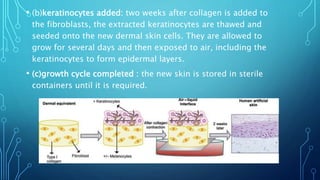
• (b)keratinocytes added: two weeks after collagen is added to
the fibroblasts, the extracted keratinocytes are thawed and
seeded onto the new dermal skin cells. They are allowed to
grow for several days and then exposed to air, including the
keratinocytes to form epidermal layers.
• (c)growth cycle completed : the new skin is stored in sterile
containers until it is required.
METHODS TO PRODUCE ARTIFICIAL SKIN
APPLICATION
• Artificial skin is used to restores the depth and elasticity of the
skin through restoration of the dermis with no significant
morbidity.
• Alternatives to animal testing and regulations
• Pharmacological applications
CASE STUDY
PROBLEMS
• 1) Reduced vascularization
• 2) Scarring
• 3) Absence of differentiated structures
FUTURE DEVELOPMENT
 Growing skin from stem cells in human hair
 Producing a fully functional, lab produced artificial skin graft
 Creating an automated production line process for
manufacture
REFERENCES
• Culture of animal cells- sixth edition
R.IAN FRESHNEY
ANIMAL TISSUE CULTURE
• INTERNET
SOURCE:https://www.encyclopedia.com/medicine/anatomy-
and-physiology/anatomy-and-physiology/artificial-skin.

artificial skin

  • 1.
    PT.RAVISHANKAR SHUKLA UNIVERSITY RAIPUR CG SOSIN BIOTECHNOLOGY SEMINAR ON TISSUE ENGINEERING : ARTIFICIAL SKIN
  • 2.
    SYNOPSIS Introduction Artificial skin Invention Structure ofhuman skin Importance of skin Key development Biomaterials Methods to produce artificial skin Application Problems Future development Conclusions references
  • 3.
    INTRODUCTION • Tissue engineeringis the use of a combination of cells, engineering and materials methods, and suitable biochemical and physio-chemical factors to improve or replace biological functions.
  • 4.
    ARTIFICIAL SKIN • Artificialskin is a synthetic (laboratory produced) substitute for human skin. • A severe burn leaves the body dangerously vulnerable to infection and dehydration (drying out). Keeping burn patients in sterile (germ free) rooms can protect against infections, and covering burned areas with grafts.
  • 5.
    • The firstsynthetic skin was invented by John F. Burke, chief of trauma services at Massachusetts General hospital, and Ioannis V. Yannas, (MIT) in Cambridge. • Using collagen fibers and a long sugar molecules, they formed a porous (full of small holes) material resembling skin.
  • 6.
  • 7.
  • 8.
  • 9.
    WHAT IS IT? • About thirty years ago, surgeons determined that badly burned skin should be removed as quickly as possible, followed by immediate and permanent replacement of the lost skin. • Doctors are able to take a postage stamp-sized piece of skin from the patient and grow the skin under special tissue culture conditions. • From this small piece of skin, technicians can grow enough skin to cover nearly the entire body in just 3 weeks.
  • 10.
    WHY IT ISNEEDED? • When skin is damaged or lost due to injury or burns, bacteria and other microorganisms have easy access to warm, nutrient- rich body fluid. • To treat a burn skin, surgeons first remove the burned skin and then quickly cover the underlying tissue, usually with a combination of laboratory-grown skin cells and artificial skin.
  • 11.
    BIOMATERIALS • ECM isused as biomimetic update materials and is obtained from natural materials and also those manufactured synthetically, e.g natural materials include fibronectin, collagen, chitosan, hyaluronan, polypeptides, hydroxyapatites, glycosaminoglycan, and alginates. • Biomaterials have the excellent advantage of having low toxicity and a low chronic inflammatory response
  • 12.
    • Natural materials-a number of natural materials have excellent properties that have led to their use in skin tissue engineering because of similar cellular properties to human skin tissues, including those pertaining to adhesion and infilteration . Biomaterials such as collagen are characterized by low mechanical strength, good biocompatibility, and low antigenicity. • Synthetic materials- polymers have several advantages for the production of tissue engineering scaffolds, including (1) known composition (2) can be tailored to minimize immunological responses and provide a range of nerve prostheses by combining different copolymers in various proportions e.g synthetic materials include polylactide co-glycolide, polylactide and polyglycolide hydrogel.
  • 13.
    • Biodegradable materialsare preferred as tissue engineering scaffolds since they degrade while the new tissue forms. Another requirement is that the carrier material and the degradation • Products should be biocompatible so that no adverse body reactions occur when the material degrade
  • 14.
    MANUFACTURE PROCESS OFARTIFICIAL SKIN • (1) Mesh scaffolding method • (a)fibroblasts are thawed and expanded; the fibroblasts are transferred from the vials into roller bottles. The bottles are rotated on their side for 3-4 weeks. The rolling action allows the circulation of oxygen which is essential for the growth process.
  • 15.
    • (b) cellsare transferred to culture system: the cells are removed from roller bottles, combined with a nutrient rich media; flowed through tubes into thin cassette like bioreactors housing the biodegradable mesh scaffolding, they adhere to the mesh and begin to grow. • (c) growth cycle completed: when cell growth mesh is completed, the tissue is rinsed with more nutrient rich media and stored.
  • 16.
    (2) COLLAGEN METHOD •(a)cells are transferred to culture system: a small amount of cold collagen and nutrient media appro.12% of the combined solution is added to fibroblasts. The mixture is dispensed into the molds and allowed to come to room temperature. As the collagen warms, it gels, trapping the fibroblast and generating the growth of new skin.
  • 17.
    • (b)keratinocytes added:two weeks after collagen is added to the fibroblasts, the extracted keratinocytes are thawed and seeded onto the new dermal skin cells. They are allowed to grow for several days and then exposed to air, including the keratinocytes to form epidermal layers. • (c)growth cycle completed : the new skin is stored in sterile containers until it is required.
  • 18.
    METHODS TO PRODUCEARTIFICIAL SKIN
  • 19.
    APPLICATION • Artificial skinis used to restores the depth and elasticity of the skin through restoration of the dermis with no significant morbidity. • Alternatives to animal testing and regulations • Pharmacological applications
  • 20.
  • 21.
    PROBLEMS • 1) Reducedvascularization • 2) Scarring • 3) Absence of differentiated structures
  • 22.
    FUTURE DEVELOPMENT  Growingskin from stem cells in human hair  Producing a fully functional, lab produced artificial skin graft  Creating an automated production line process for manufacture
  • 23.
    REFERENCES • Culture ofanimal cells- sixth edition R.IAN FRESHNEY ANIMAL TISSUE CULTURE • INTERNET SOURCE:https://www.encyclopedia.com/medicine/anatomy- and-physiology/anatomy-and-physiology/artificial-skin.