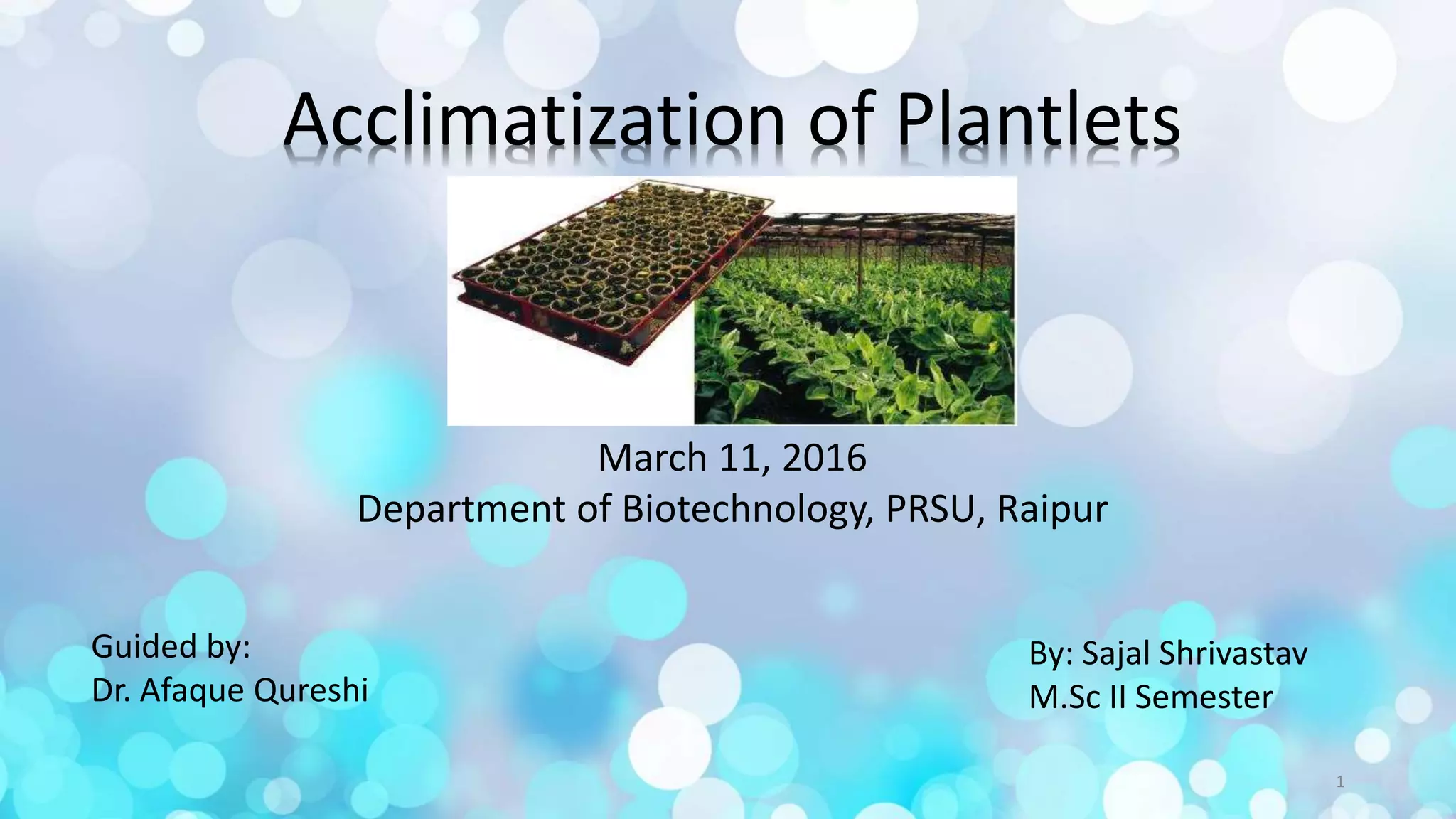
Acclimatization of Plantlets
March 11, 2016
Department of Biotechnology, PRSU, Raipur
By: Sajal Shrivastav
M.Sc II Semester
Guided by:
Dr. Afaque Qureshi
1
• Introduction
• Transplantation and Acclimatization
• Difference in growth conditions : in vitro & ex
vitro
• Deficiencies of in-vitro grown plants
Morphological Deficiencies
Anatomical Deficiencies
Physiological Deficiencies
• Steps in Acclimatization
• In-vitro Acclimatization
• Significance of Acclimatization
• Conclusion
• Reference
Synopsis
2
The ultimate purpose of plant tissue culture technology will not be
achieved if plantlets grown in vitro do not survive in harsh and
uncontrolled environment of the field.
This technique of transferring the lab grown plantlets into field is
TRANSPLANTATION or Stage IV.
Transplantation is the crucial and utmost care appealing stage.
Acclimatization is the principle that governs Transplantation.
INTRODUCTION
3
Definition
“Acclimatization is the phenomenon whereby plants
morphologically, physiologically and anatomically adjusts from in-
vitro to ex-vitro environmental growth conditions.”
“It is the process during which plants become adapted and gets
accustomed to a new culture and environmental ambience.”
Acclimatization is also known as hardening off.
4
Etymology of acclimatization :
• Root word is climate.
• Derived from ancient greek word “klima” means “inclination”
or “slope”.
Ac + climate+ ization.
• Acclimatization word is also used for other living systems.
Eg. Acclimatization at high altitudes
Acclimatization after heibernation.
5
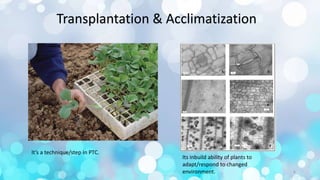
Transplantation & Acclimatization
It’s a technique/step in PTC.
Its inbuild ability of plants to
adapt/respond to changed
environment. 6
Difference of growth conditions : In-vitro & ex-vitro
In-vitro
• High conc. Of organic and
inorganic nutrients.
• Presence of Growth Regulators
• High Relative Humidity.
• Low Light Intensity.
• Low Temperature.
• Poor gaseous exchange.
• Utmost physical care is taken.
Ex-vitro
• Photoautotrophic nutrition
allowed only.
• No growth regulators.
• Low relative humidity.
• High light intensity.
• High Temperature
• Gaseous Exchange must be done.
• Chances of physical tragedy like
wind flow, water currents etc.
7
Deficiencies in in-vitro grown plants
Deficiencies are due to the fact that in-vitro regeneration focuses
only at providing the optimal growth conditions required for the
explant to grow rapidly.
There are three types of deficiencies observed :
• Morphological Deficiencies
• Physiological Deficiencies
• Anatomical Deficiencies
8
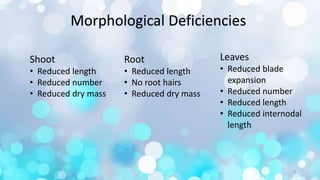
Morphological Deficiencies
Shoot
• Reduced length
• Reduced number
• Reduced dry mass
Root
• Reduced length
• No root hairs
• Reduced dry mass
Leaves
• Reduced blade
expansion
• Reduced number
• Reduced length
• Reduced internodal
length
9
Anatomical deficiencies
• No/Reduced formation of cuticle and epicuticular wax.
• Thinner epidermal layer
• Thin Cell wall
• Reduced Sclerenchyma/Collenchyma formation
10
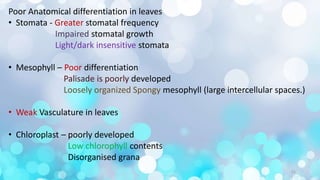
Poor Anatomical differentiation in leaves
• Stomata - Greater stomatal frequency
Impaired stomatal growth
Light/dark insensitive stomata
• Mesophyll – Poor differentiation
Palisade is poorly developed
Loosely organized Spongy mesophyll (large intercellular spaces.)
• Weak Vasculature in leaves
• Chloroplast – poorly developed
Low chlorophyll contents
Disorganised grana
11
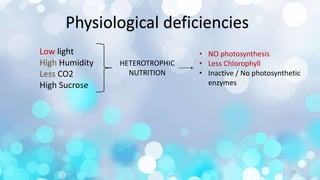
Physiological deficiencies
Low light
High Humidity
Less CO2
High Sucrose
HETEROTROPHIC
NUTRITION
• NO photosynthesis
• Less Chlorophyll
• Inactive / No photosynthetic
enzymes
12
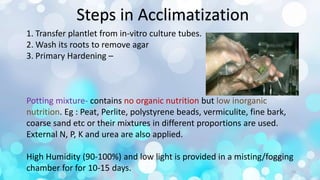
Steps in Acclimatization
1. Transfer plantlet from in-vitro culture tubes.
2. Wash its roots to remove agar
3. Primary Hardening –
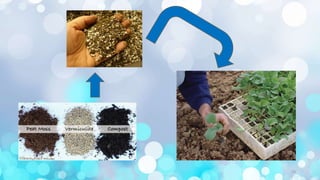
Potting mixture- contains no organic nutrition but low inorganic
nutrition. Eg : Peat, Perlite, polystyrene beads, vermiculite, fine bark,
coarse sand etc or their mixtures in different proportions are used.
External N, P, K and urea are also applied.
High Humidity (90-100%) and low light is provided in a misting/fogging
chamber for for 10-15 days. 13
14
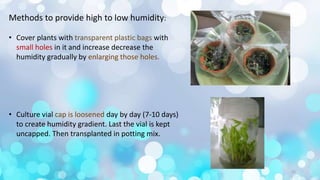
Methods to provide high to low humidity:
• Cover plants with transparent plastic bags with
small holes in it and increase decrease the
humidity gradually by enlarging those holes.
• Culture vial cap is loosened day by day (7-10 days)
to create humidity gradient. Last the vial is kept
uncapped. Then transplanted in potting mix.
15
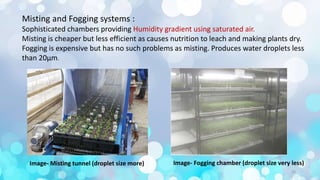
Misting and Fogging systems :
Sophisticated chambers providing Humidity gradient using saturated air.
Misting is cheaper but less efficient as causes nutrition to leach and making plants dry.
Fogging is expensive but has no such problems as misting. Produces water droplets less
than 20µm.
Image- Misting tunnel (droplet size more) Image- Fogging chamber (droplet size very less)
16
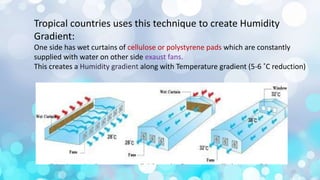
Tropical countries uses this technique to create Humidity
Gradient:
One side has wet curtains of cellulose or polystyrene pads which are constantly
supplied with water on other side exaust fans.
This creates a Humidity gradient along with Temperature gradient (5-6 ˚C reduction)
17
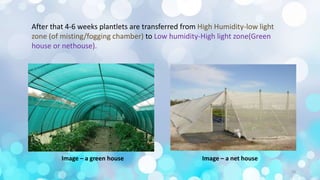
After that 4-6 weeks plantlets are transferred from High Humidity-low light
zone (of misting/fogging chamber) to Low humidity-High light zone(Green
house or nethouse).
Image – a green house Image – a net house
18
Use of Anti-transpirant to reduce water loss during transpiration:
• Leaf-surface covering agents such as glycerol, paraffin and grease
promoted ex-vitro survival of several herbaceous species (Selvapandiyan
et al.)
• Stomatal transpiration of micro-propagated cauliflower plantlets were
reduced with a leaf spray of 10mM ABA (Wardle et al.)
19
In-vitro acclimatization
Why its done?
• Ex-vitro acclimatization is labour
intensive
• High capital required
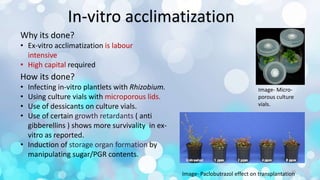
How its done?
• Infecting in-vitro plantlets with Rhizobium.
• Using culture vials with microporous lids.
• Use of dessicants on culture vials.
• Use of certain growth retardants ( anti
gibberellins ) shows more survivality in ex-
vitro as reported.
• Induction of storage organ formation by
manipulating sugar/PGR contents.
Image- Paclobutrazol effect on transplantation
Image- Micro-
porous culture
vials.
20
Significance of Acclimatization
• Allows plants to regain its actual tolerant capacity.
• Necessary for higher survival rates of in-vitro plantlets.
• In-vitro acclimatization can help reduce the time
requiring criteria of ex-vitro hardening.
21
Conclusion
22
References
• Plant Tissue Culture Theory and Practice, S S Bhojwani
and M K Razdan.
• https://www.academia.edu/2514456/Acclimatization_of_
tissue_cultured_plantlets_from_laboratory_to_land
• http://www.iisc.ernet.in/currsci/dec252003/1704.pdf
• http://www.isaet.org/images/extraimages/P315405.pdf
• http://digitool.library.mcgill.ca/webclient/StreamGate?fol
der_id=0&dvs=1457636214994~299
• http://www.scielo.br/img/revistas/babt/v57n5//1516-
8913-babt-57-05-00636-gf01.jpg
23
24

Acclimatization of plantlets

  • 1.
    Acclimatization of Plantlets March11, 2016 Department of Biotechnology, PRSU, Raipur By: Sajal Shrivastav M.Sc II Semester Guided by: Dr. Afaque Qureshi 1
  • 2.
    • Introduction • Transplantationand Acclimatization • Difference in growth conditions : in vitro & ex vitro • Deficiencies of in-vitro grown plants Morphological Deficiencies Anatomical Deficiencies Physiological Deficiencies • Steps in Acclimatization • In-vitro Acclimatization • Significance of Acclimatization • Conclusion • Reference Synopsis 2
  • 3.
    The ultimate purposeof plant tissue culture technology will not be achieved if plantlets grown in vitro do not survive in harsh and uncontrolled environment of the field. This technique of transferring the lab grown plantlets into field is TRANSPLANTATION or Stage IV. Transplantation is the crucial and utmost care appealing stage. Acclimatization is the principle that governs Transplantation. INTRODUCTION 3
  • 4.
    Definition “Acclimatization is thephenomenon whereby plants morphologically, physiologically and anatomically adjusts from in- vitro to ex-vitro environmental growth conditions.” “It is the process during which plants become adapted and gets accustomed to a new culture and environmental ambience.” Acclimatization is also known as hardening off. 4
  • 5.
    Etymology of acclimatization: • Root word is climate. • Derived from ancient greek word “klima” means “inclination” or “slope”. Ac + climate+ ization. • Acclimatization word is also used for other living systems. Eg. Acclimatization at high altitudes Acclimatization after heibernation. 5
  • 6.
    Transplantation & Acclimatization It’sa technique/step in PTC. Its inbuild ability of plants to adapt/respond to changed environment. 6
  • 7.
    Difference of growthconditions : In-vitro & ex-vitro In-vitro • High conc. Of organic and inorganic nutrients. • Presence of Growth Regulators • High Relative Humidity. • Low Light Intensity. • Low Temperature. • Poor gaseous exchange. • Utmost physical care is taken. Ex-vitro • Photoautotrophic nutrition allowed only. • No growth regulators. • Low relative humidity. • High light intensity. • High Temperature • Gaseous Exchange must be done. • Chances of physical tragedy like wind flow, water currents etc. 7
  • 8.
    Deficiencies in in-vitrogrown plants Deficiencies are due to the fact that in-vitro regeneration focuses only at providing the optimal growth conditions required for the explant to grow rapidly. There are three types of deficiencies observed : • Morphological Deficiencies • Physiological Deficiencies • Anatomical Deficiencies 8
  • 9.
    Morphological Deficiencies Shoot • Reducedlength • Reduced number • Reduced dry mass Root • Reduced length • No root hairs • Reduced dry mass Leaves • Reduced blade expansion • Reduced number • Reduced length • Reduced internodal length 9
  • 10.
    Anatomical deficiencies • No/Reducedformation of cuticle and epicuticular wax. • Thinner epidermal layer • Thin Cell wall • Reduced Sclerenchyma/Collenchyma formation 10
  • 11.
    Poor Anatomical differentiationin leaves • Stomata - Greater stomatal frequency Impaired stomatal growth Light/dark insensitive stomata • Mesophyll – Poor differentiation Palisade is poorly developed Loosely organized Spongy mesophyll (large intercellular spaces.) • Weak Vasculature in leaves • Chloroplast – poorly developed Low chlorophyll contents Disorganised grana 11
  • 12.
    Physiological deficiencies Low light HighHumidity Less CO2 High Sucrose HETEROTROPHIC NUTRITION • NO photosynthesis • Less Chlorophyll • Inactive / No photosynthetic enzymes 12
  • 13.
    Steps in Acclimatization 1.Transfer plantlet from in-vitro culture tubes. 2. Wash its roots to remove agar 3. Primary Hardening – Potting mixture- contains no organic nutrition but low inorganic nutrition. Eg : Peat, Perlite, polystyrene beads, vermiculite, fine bark, coarse sand etc or their mixtures in different proportions are used. External N, P, K and urea are also applied. High Humidity (90-100%) and low light is provided in a misting/fogging chamber for for 10-15 days. 13
  • 14.
  • 15.
    Methods to providehigh to low humidity: • Cover plants with transparent plastic bags with small holes in it and increase decrease the humidity gradually by enlarging those holes. • Culture vial cap is loosened day by day (7-10 days) to create humidity gradient. Last the vial is kept uncapped. Then transplanted in potting mix. 15
  • 16.
    Misting and Foggingsystems : Sophisticated chambers providing Humidity gradient using saturated air. Misting is cheaper but less efficient as causes nutrition to leach and making plants dry. Fogging is expensive but has no such problems as misting. Produces water droplets less than 20µm. Image- Misting tunnel (droplet size more) Image- Fogging chamber (droplet size very less) 16
  • 17.
    Tropical countries usesthis technique to create Humidity Gradient: One side has wet curtains of cellulose or polystyrene pads which are constantly supplied with water on other side exaust fans. This creates a Humidity gradient along with Temperature gradient (5-6 ˚C reduction) 17
  • 18.
    After that 4-6weeks plantlets are transferred from High Humidity-low light zone (of misting/fogging chamber) to Low humidity-High light zone(Green house or nethouse). Image – a green house Image – a net house 18
  • 19.
    Use of Anti-transpirantto reduce water loss during transpiration: • Leaf-surface covering agents such as glycerol, paraffin and grease promoted ex-vitro survival of several herbaceous species (Selvapandiyan et al.) • Stomatal transpiration of micro-propagated cauliflower plantlets were reduced with a leaf spray of 10mM ABA (Wardle et al.) 19
  • 20.
    In-vitro acclimatization Why itsdone? • Ex-vitro acclimatization is labour intensive • High capital required How its done? • Infecting in-vitro plantlets with Rhizobium. • Using culture vials with microporous lids. • Use of dessicants on culture vials. • Use of certain growth retardants ( anti gibberellins ) shows more survivality in ex- vitro as reported. • Induction of storage organ formation by manipulating sugar/PGR contents. Image- Paclobutrazol effect on transplantation Image- Micro- porous culture vials. 20
  • 21.
    Significance of Acclimatization •Allows plants to regain its actual tolerant capacity. • Necessary for higher survival rates of in-vitro plantlets. • In-vitro acclimatization can help reduce the time requiring criteria of ex-vitro hardening. 21
  • 22.
  • 23.
    References • Plant TissueCulture Theory and Practice, S S Bhojwani and M K Razdan. • https://www.academia.edu/2514456/Acclimatization_of_ tissue_cultured_plantlets_from_laboratory_to_land • http://www.iisc.ernet.in/currsci/dec252003/1704.pdf • http://www.isaet.org/images/extraimages/P315405.pdf • http://digitool.library.mcgill.ca/webclient/StreamGate?fol der_id=0&dvs=1457636214994~299 • http://www.scielo.br/img/revistas/babt/v57n5//1516- 8913-babt-57-05-00636-gf01.jpg 23
  • 24.

Editor's Notes

  • #11 In vitro- enough water due to humidity, plants donot feel to deposit cuticle as it don’t need to save water. Saturated water makes less accumulation of dry matter per area.
  • #12 Palisade development is reduced due to low light intensity Weak vasculature is due to reluctancy of plant to withdraw nutrition via xylem and phloem vessels.
  • #14 Primary hardening recommissions the photosynthetic machinery to take over its function enabling them to withstand the subsequent reduction in RH and survive under field conditions.
  • #20 Anti transpirant spray has not proved so effective in ex vitro hardening.
  • #21 Rhizobium symbiotic association withplants so that in field it can switch from hetero to phototrophism. Dessicants CaSO4 / silica gel ,,,adsorb water vapours and reduces relative Humidity. Growth retardants – paclobutrazole and ancymidol causes reduced shoot growth but enhanced chlorophyll content and leaf broadning. Storage organs are formed in tubers , bulbs, rhizomes etc.
  • #23 Acclimatization is important for obtaining higher survival rates. But its time and labour intensive so now a days in-vitro acclimatization is given importance. In near future we hope to develop antitranspirants for higher survival rates and growth regulators which can oversimplify this process.