PRP Update
From basic science to clinical
application
John J. Klimkiewicz, MD
Washington Orthopedics and Sports Medicine
Head Team Physician
Washington Capitals Hockey Club & Georgetown University Hoyas
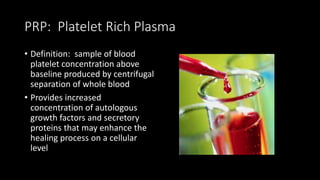
PRP: Platelet Rich Plasma
• Definition: sample of blood
platelet concentration above
baseline produced by centrifugal
separation of whole blood
• Provides increased
concentration of autologous
growth factors and secretory
proteins that may enhance the
healing process on a cellular
level
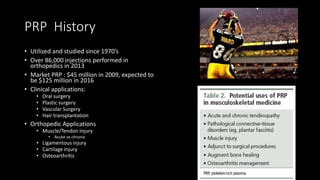
PRP History
• Utilized and studied since 1970’s
• Over 86,000 injections performed in
orthopedics in 2013
• Market PRP : $45 million in 2009, expected to
be $125 million in 2016
• Clinical applications:
• Oral surgery
• Plastic surgery
• Vascular Surgery
• Hair transplantation
• Orthopedic Applications
• Muscle/Tendon injury
• Acute vs chronic
• Ligamentous injury
• Cartilage injury
• Osteoarthritis
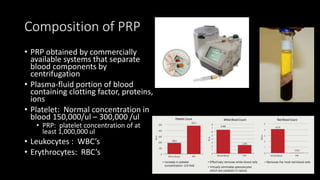
Composition of PRP
• PRP obtained by commercially
available systems that separate
blood components by
centrifugation
• Plasma-fluid portion of blood
containing clotting factor, proteins,
ions
• Platelet: Normal concentration in
blood 150,000/ul – 300,000 /ul
• PRP: platelet concentration of at
least 1,000,000 ul
• Leukocytes : WBC’s
• Erythrocytes: RBC’s
Regulation
• World Anti-doping agency
temporarily banned PRP injections in
2009-2011.
• Currently not a banned substance,
individual growth factors however still
banned
• No Regulation by NCAA, NHL,
NBA,NFL
• FDA approved for use with Bone graft
substitutes, office use is “off label”
• Currently not covered under
insurance for orthopedic application
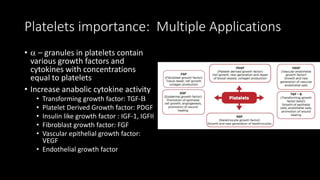
Platelets importance: Multiple Applications
• a – granules in platelets contain
various growth factors and
cytokines with concentrations
equal to platelets
• Increase anabolic cytokine activity
• Transforming growth factor: TGF-B
• Platelet Derived Growth factor: PDGF
• Insulin like growth factor : IGF-1, IGFII
• Fibroblast growth factor: FGF
• Vascular epithelial growth factor:
VEGF
• Endothelial growth factor
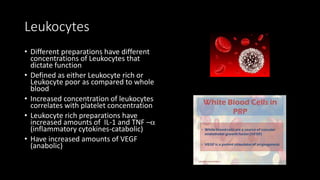
Leukocytes
• Different preparations have different
concentrations of Leukocytes that
dictate function
• Defined as either Leukocyte rich or
Leukocyte poor as compared to whole
blood
• Increased concentration of leukocytes
correlates with platelet concentration
• Leukocyte rich preparations have
increased amounts of IL-1 and TNF –a
(inflammatory cytokines-catabolic)
• Have increased amounts of VEGF
(anabolic)
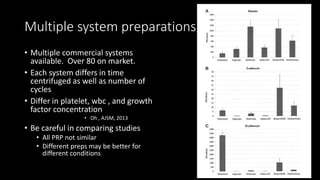
Multiple system preparations
• Multiple commercial systems
available. Over 80 on market.
• Each system differs in time
centrifuged as well as number of
cycles
• Differ in platelet, wbc , and growth
factor concentration
• Oh , AJSM, 2013
• Be careful in comparing studies
• All PRP not similar
• Different preps may be better for
different conditions
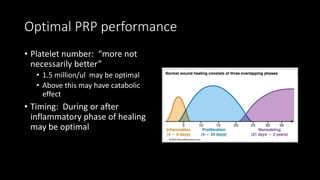
Optimal PRP performance
• Platelet number: “more not
necessarily better”
• 1.5 million/ul may be optimal
• Above this may have catabolic
effect
• Timing: During or after
inflammatory phase of healing
may be optimal
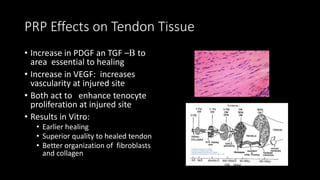
PRP Effects on Tendon Tissue
• Increase in PDGF an TGF –B to
area essential to healing
• Increase in VEGF: increases
vascularity at injured site
• Both act to enhance tenocyte
proliferation at injured site
• Results in Vitro:
• Earlier healing
• Superior quality to healed tendon
• Better organization of fibroblasts
and collagen
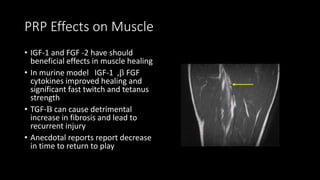
PRP Effects on Muscle
• IGF-1 and FGF -2 have should
beneficial effects in muscle healing
• In murine model IGF-1 ,b FGF
cytokines improved healing and
significant fast twitch and tetanus
strength
• TGF-B can cause detrimental
increase in fibrosis and lead to
recurrent injury
• Anecdotal reports report decrease
in time to return to play
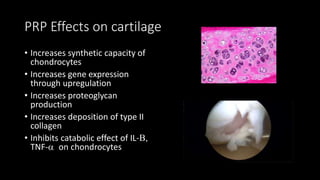
PRP Effects on cartilage
• Increases synthetic capacity of
chondrocytes
• Increases gene expression
through upregulation
• Increases proteoglycan
production
• Increases deposition of type II
collagen
• Inhibits catabolic effect of IL-B,
TNF-a on chondrocytes
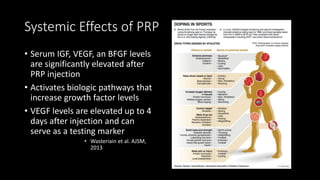
Systemic Effects of PRP
• Serum IGF, VEGF, an BFGF levels
are significantly elevated after
PRP injection
• Activates biologic pathways that
increase growth factor levels
• VEGF levels are elevated up to 4
days after injection and can
serve as a testing marker
• Wasteriain et al. AJSM,
2013
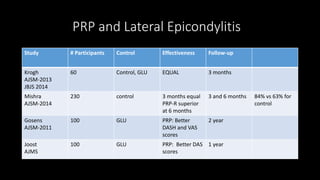
PRP and Lateral Epicondylitis
Study # Participants Control Effectiveness Follow-up
Krogh
AJSM-2013
JBJS 2014
60 Control, GLU EQUAL 3 months
Mishra
AJSM-2014
230 control 3 months equal
PRP-R superior
at 6 months
3 and 6 months 84% vs 63% for
control
Gosens
AJSM-2011
100 GLU PRP: Better
DASH and VAS
scores
2 year
Joost
AJMS
100 GLU PRP: Better DAS
scores
1 year
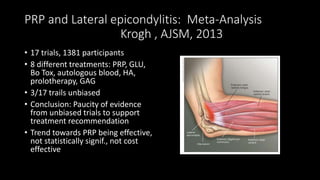
PRP and Lateral epicondylitis: Meta-Analysis
Krogh , AJSM, 2013
• 17 trials, 1381 participants
• 8 different treatments: PRP, GLU,
Bo Tox, autologous blood, HA,
prolotherapy, GAG
• 3/17 trails unbiased
• Conclusion: Paucity of evidence
from unbiased trials to support
treatment recommendation
• Trend towards PRP being effective,
not statistically signif., not cost
effective
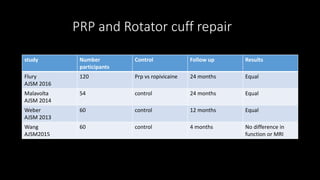
PRP and Rotator cuff repair
study Number
participants
Control Follow up Results
Flury
AJSM 2016
120 Prp vs ropivicaine 24 months Equal
Malavolta
AJSM 2014
54 control 24 months Equal
Weber
AJSM 2013
60 control 12 months Equal
Wang
AJSM2015
60 control 4 months No difference in
function or MRI
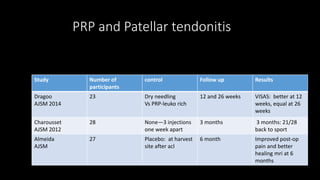
PRP and Patellar tendonitis
Study Number of
participants
control Follow up Results
Dragoo
AJSM 2014
23 Dry needling
Vs PRP-leuko rich
12 and 26 weeks VISAS: better at 12
weeks, equal at 26
weeks
Charousset
AJSM 2012
28 None—3 injections
one week apart
3 months 3 months: 21/28
back to sport
Almeida
AJSM
27 Placebo: at harvest
site after acl
6 month Improved post-op
pain and better
healing mri at 6
months
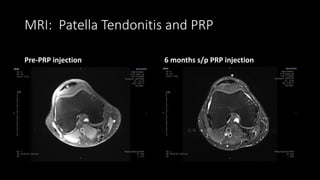
MRI: Patella Tendonitis and PRP
Pre-PRP injection 6 months s/p PRP injection
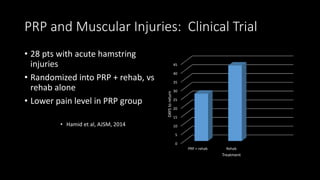
PRP and Muscular Injuries: Clinical Trial
• 28 pts with acute hamstring
injuries
• Randomized into PRP + rehab, vs
rehab alone
• Lower pain level in PRP group
• Hamid et al, AJSM, 2014
0
5
10
15
20
25
30
35
40
45
PRP + rehab Rehab
DAYStoreturn
Treatment
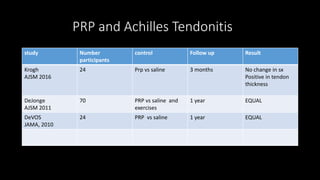
PRP and Achilles Tendonitis
study Number
participants
control Follow up Result
Krogh
AJSM 2016
24 Prp vs saline 3 months No change in sx
Positive in tendon
thickness
DeJonge
AJSM 2011
70 PRP vs saline and
exercises
1 year EQUAL
DeVOS
JAMA, 2010
24 PRP vs saline 1 year EQUAL
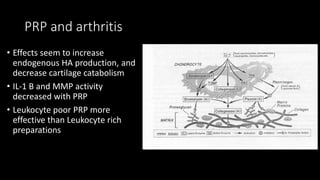
PRP and arthritis
• Effects seem to increase
endogenous HA production, and
decrease cartilage catabolism
• IL-1 B and MMP activity
decreased with PRP
• Leukocyte poor PRP more
effective than Leukocyte rich
preparations
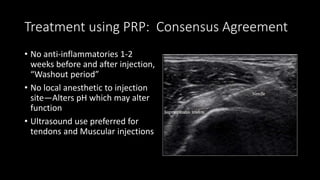
Treatment using PRP: Consensus Agreement
• No anti-inflammatories 1-2
weeks before and after injection,
“Washout period”
• No local anesthetic to injection
site—Alters pH which may alter
function
• Ultrasound use preferred for
tendons and Muscular injections
PRP Treatment : Requires more study
• Optimal conditions
• Optimal concentration of Platelets
and fractionated WBC’s
• Number and sequence of injections
• Post injection rehab routines
• Evidence still lacking to prove
definite benefit
• Appears safe when used judiciously
• Cost –Benefit analysis lacking
Efficacy of autologous Platelet Rich Plasma use for
Orthopaedic Indications: A Meta-analysis
• 33 studies that were randomized
controlled or prospective cohort
studies that compared prp with
control for orthopaedic injury
• Conclusion: The current literature
is complicated by a lack of
standardization of study protocols,
platelet separation techniques, and
outcome measures. As a result,
there is an uncertainty to support
the increasing use of prp as a
treatment modality for orthopedic
injuries Sheth et al., 2012
THANK YOU!!

PRP Update: From basic science to clinical application

  • 1.
    PRP Update From basicscience to clinical application John J. Klimkiewicz, MD Washington Orthopedics and Sports Medicine Head Team Physician Washington Capitals Hockey Club & Georgetown University Hoyas
  • 2.
    PRP: Platelet RichPlasma • Definition: sample of blood platelet concentration above baseline produced by centrifugal separation of whole blood • Provides increased concentration of autologous growth factors and secretory proteins that may enhance the healing process on a cellular level
  • 3.
    PRP History • Utilizedand studied since 1970’s • Over 86,000 injections performed in orthopedics in 2013 • Market PRP : $45 million in 2009, expected to be $125 million in 2016 • Clinical applications: • Oral surgery • Plastic surgery • Vascular Surgery • Hair transplantation • Orthopedic Applications • Muscle/Tendon injury • Acute vs chronic • Ligamentous injury • Cartilage injury • Osteoarthritis
  • 4.
    Composition of PRP •PRP obtained by commercially available systems that separate blood components by centrifugation • Plasma-fluid portion of blood containing clotting factor, proteins, ions • Platelet: Normal concentration in blood 150,000/ul – 300,000 /ul • PRP: platelet concentration of at least 1,000,000 ul • Leukocytes : WBC’s • Erythrocytes: RBC’s
  • 5.
    Regulation • World Anti-dopingagency temporarily banned PRP injections in 2009-2011. • Currently not a banned substance, individual growth factors however still banned • No Regulation by NCAA, NHL, NBA,NFL • FDA approved for use with Bone graft substitutes, office use is “off label” • Currently not covered under insurance for orthopedic application
  • 6.
    Platelets importance: MultipleApplications • a – granules in platelets contain various growth factors and cytokines with concentrations equal to platelets • Increase anabolic cytokine activity • Transforming growth factor: TGF-B • Platelet Derived Growth factor: PDGF • Insulin like growth factor : IGF-1, IGFII • Fibroblast growth factor: FGF • Vascular epithelial growth factor: VEGF • Endothelial growth factor
  • 7.
    Leukocytes • Different preparationshave different concentrations of Leukocytes that dictate function • Defined as either Leukocyte rich or Leukocyte poor as compared to whole blood • Increased concentration of leukocytes correlates with platelet concentration • Leukocyte rich preparations have increased amounts of IL-1 and TNF –a (inflammatory cytokines-catabolic) • Have increased amounts of VEGF (anabolic)
  • 8.
    Multiple system preparations •Multiple commercial systems available. Over 80 on market. • Each system differs in time centrifuged as well as number of cycles • Differ in platelet, wbc , and growth factor concentration • Oh , AJSM, 2013 • Be careful in comparing studies • All PRP not similar • Different preps may be better for different conditions
  • 9.
    Optimal PRP performance •Platelet number: “more not necessarily better” • 1.5 million/ul may be optimal • Above this may have catabolic effect • Timing: During or after inflammatory phase of healing may be optimal
  • 10.
    PRP Effects onTendon Tissue • Increase in PDGF an TGF –B to area essential to healing • Increase in VEGF: increases vascularity at injured site • Both act to enhance tenocyte proliferation at injured site • Results in Vitro: • Earlier healing • Superior quality to healed tendon • Better organization of fibroblasts and collagen
  • 11.
    PRP Effects onMuscle • IGF-1 and FGF -2 have should beneficial effects in muscle healing • In murine model IGF-1 ,b FGF cytokines improved healing and significant fast twitch and tetanus strength • TGF-B can cause detrimental increase in fibrosis and lead to recurrent injury • Anecdotal reports report decrease in time to return to play
  • 12.
    PRP Effects oncartilage • Increases synthetic capacity of chondrocytes • Increases gene expression through upregulation • Increases proteoglycan production • Increases deposition of type II collagen • Inhibits catabolic effect of IL-B, TNF-a on chondrocytes
  • 13.
    Systemic Effects ofPRP • Serum IGF, VEGF, an BFGF levels are significantly elevated after PRP injection • Activates biologic pathways that increase growth factor levels • VEGF levels are elevated up to 4 days after injection and can serve as a testing marker • Wasteriain et al. AJSM, 2013
  • 14.
    PRP and LateralEpicondylitis Study # Participants Control Effectiveness Follow-up Krogh AJSM-2013 JBJS 2014 60 Control, GLU EQUAL 3 months Mishra AJSM-2014 230 control 3 months equal PRP-R superior at 6 months 3 and 6 months 84% vs 63% for control Gosens AJSM-2011 100 GLU PRP: Better DASH and VAS scores 2 year Joost AJMS 100 GLU PRP: Better DAS scores 1 year
  • 15.
    PRP and Lateralepicondylitis: Meta-Analysis Krogh , AJSM, 2013 • 17 trials, 1381 participants • 8 different treatments: PRP, GLU, Bo Tox, autologous blood, HA, prolotherapy, GAG • 3/17 trails unbiased • Conclusion: Paucity of evidence from unbiased trials to support treatment recommendation • Trend towards PRP being effective, not statistically signif., not cost effective
  • 16.
    PRP and Rotatorcuff repair study Number participants Control Follow up Results Flury AJSM 2016 120 Prp vs ropivicaine 24 months Equal Malavolta AJSM 2014 54 control 24 months Equal Weber AJSM 2013 60 control 12 months Equal Wang AJSM2015 60 control 4 months No difference in function or MRI
  • 17.
    PRP and Patellartendonitis Study Number of participants control Follow up Results Dragoo AJSM 2014 23 Dry needling Vs PRP-leuko rich 12 and 26 weeks VISAS: better at 12 weeks, equal at 26 weeks Charousset AJSM 2012 28 None—3 injections one week apart 3 months 3 months: 21/28 back to sport Almeida AJSM 27 Placebo: at harvest site after acl 6 month Improved post-op pain and better healing mri at 6 months
  • 18.
    MRI: Patella Tendonitisand PRP Pre-PRP injection 6 months s/p PRP injection
  • 19.
    PRP and MuscularInjuries: Clinical Trial • 28 pts with acute hamstring injuries • Randomized into PRP + rehab, vs rehab alone • Lower pain level in PRP group • Hamid et al, AJSM, 2014 0 5 10 15 20 25 30 35 40 45 PRP + rehab Rehab DAYStoreturn Treatment
  • 20.
    PRP and AchillesTendonitis study Number participants control Follow up Result Krogh AJSM 2016 24 Prp vs saline 3 months No change in sx Positive in tendon thickness DeJonge AJSM 2011 70 PRP vs saline and exercises 1 year EQUAL DeVOS JAMA, 2010 24 PRP vs saline 1 year EQUAL
  • 21.
    PRP and arthritis •Effects seem to increase endogenous HA production, and decrease cartilage catabolism • IL-1 B and MMP activity decreased with PRP • Leukocyte poor PRP more effective than Leukocyte rich preparations
  • 22.
    Treatment using PRP:Consensus Agreement • No anti-inflammatories 1-2 weeks before and after injection, “Washout period” • No local anesthetic to injection site—Alters pH which may alter function • Ultrasound use preferred for tendons and Muscular injections
  • 23.
    PRP Treatment :Requires more study • Optimal conditions • Optimal concentration of Platelets and fractionated WBC’s • Number and sequence of injections • Post injection rehab routines • Evidence still lacking to prove definite benefit • Appears safe when used judiciously • Cost –Benefit analysis lacking
  • 24.
    Efficacy of autologousPlatelet Rich Plasma use for Orthopaedic Indications: A Meta-analysis • 33 studies that were randomized controlled or prospective cohort studies that compared prp with control for orthopaedic injury • Conclusion: The current literature is complicated by a lack of standardization of study protocols, platelet separation techniques, and outcome measures. As a result, there is an uncertainty to support the increasing use of prp as a treatment modality for orthopedic injuries Sheth et al., 2012
  • 25.