Ground water Arsenic contamination:
Extent, related research and remediation
measures in India
-by
Dr. Sayan Das
MPH 8th Cohort, ICMR-SPH,NIE
Overview
 Chemistry of Arsenic
 Extent of ground water poisoning with arsenic
 Related research on this ground
 Remedial measures for it: India and global
perspective
Chemistry of Arsenic (1/4)
• Atomic number: 33
• Atomic wt.: 74.9
• Isotope: 3 (73,74,75)
• Electron configuration: [Ar] 3d10 4s2 4p3
• Non-magnetic, semi-metal
• Colour: Gray and Black
• Hardness: 3.5
• Oxidation state: 5, 3, -3
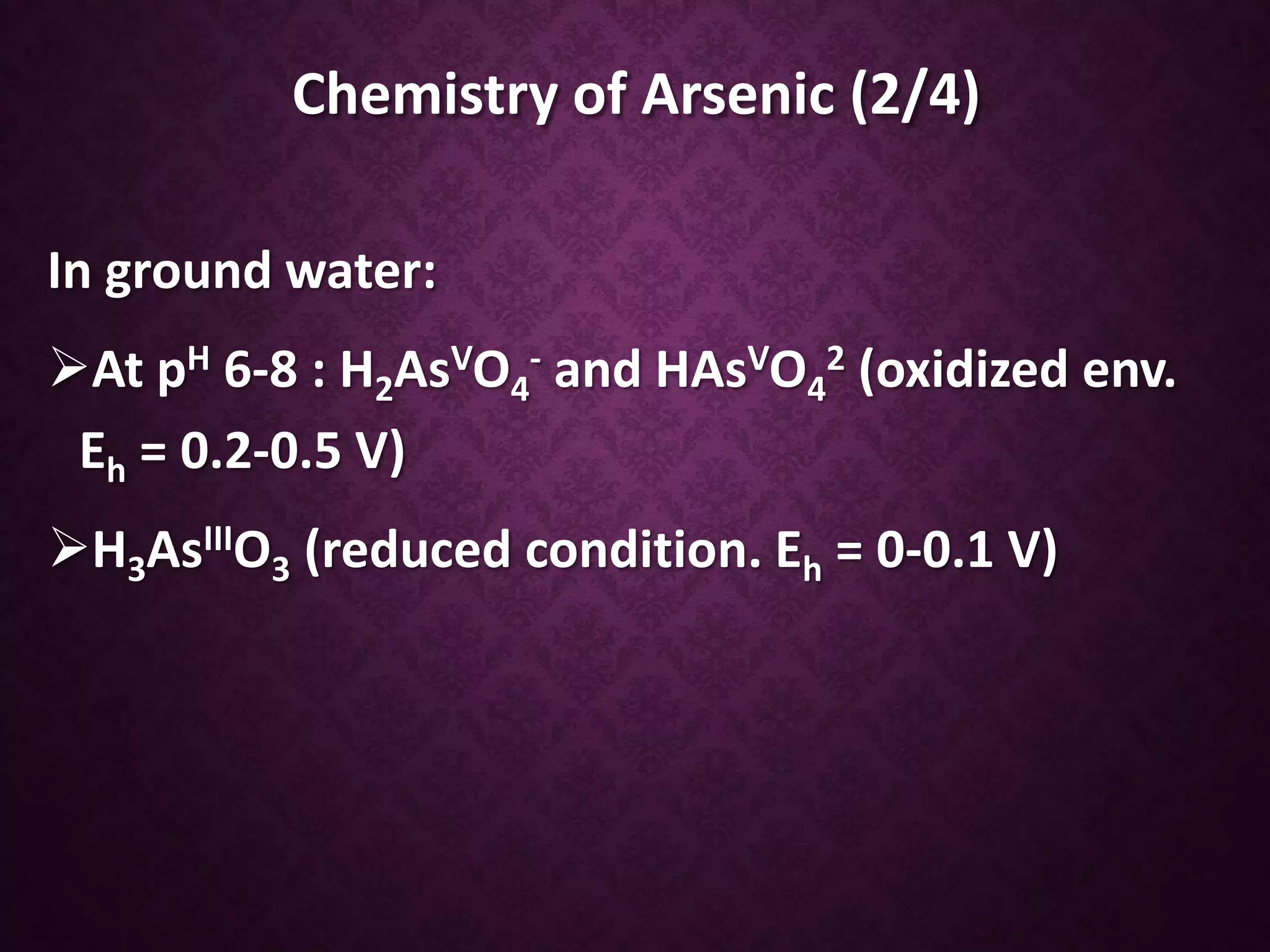
Chemistry of Arsenic (2/4)
In ground water:
At pH 6-8 : H2AsVO4
- and HAsVO4
2 (oxidized env.
Eh = 0.2-0.5 V)
H3AsIIIO3 (reduced condition. Eh = 0-0.1 V)
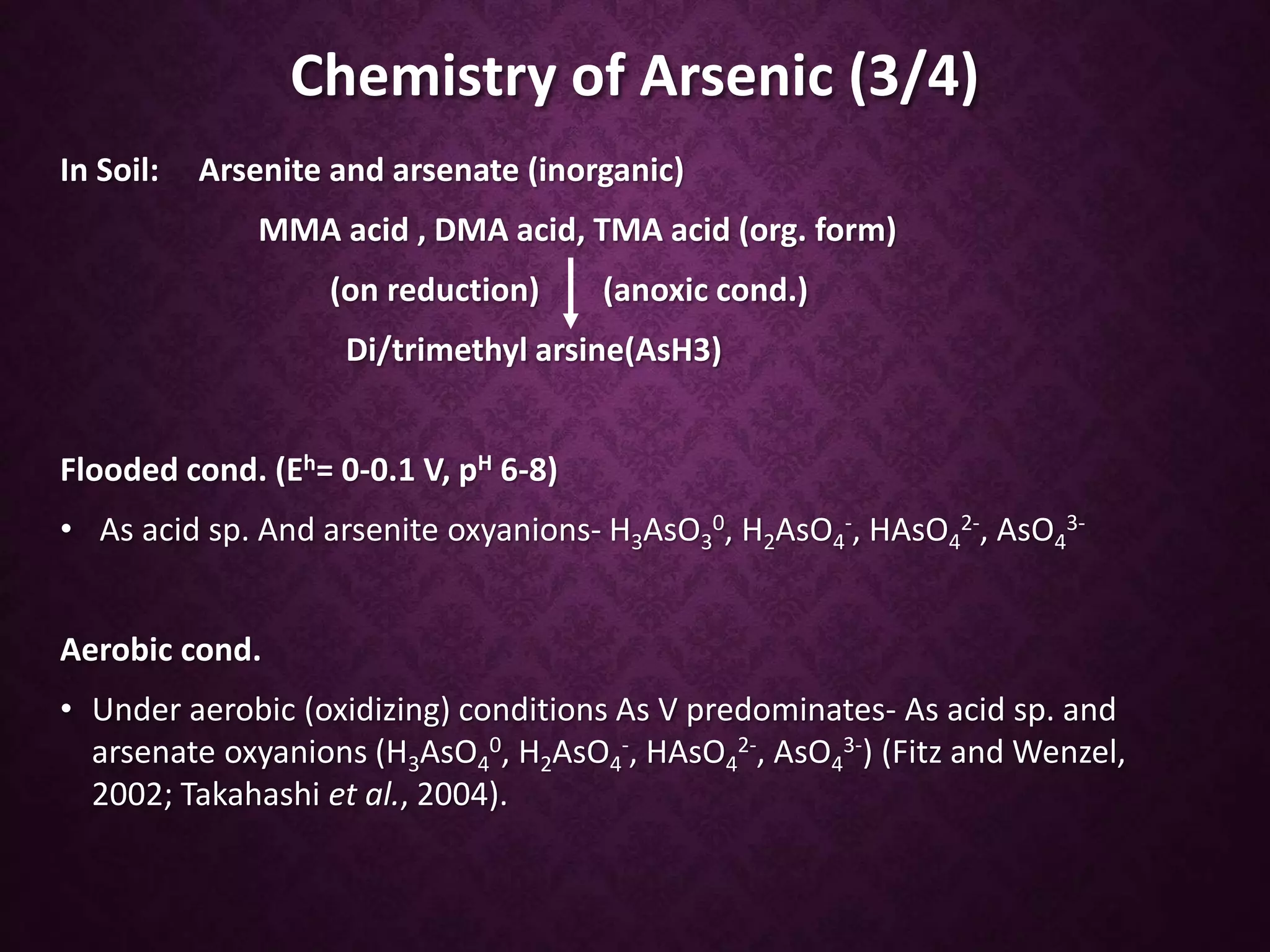
Chemistry of Arsenic (3/4)
In Soil: Arsenite and arsenate (inorganic)
MMA acid , DMA acid, TMA acid (org. form)
(on reduction) (anoxic cond.)
Di/trimethyl arsine(AsH3)
Flooded cond. (Eh= 0-0.1 V, pH 6-8)
• As acid sp. And arsenite oxyanions- H3AsO3
0, H2AsO4
-, HAsO4
2-, AsO4
3-
Aerobic cond.
• Under aerobic (oxidizing) conditions As V predominates- As acid sp. and
arsenate oxyanions (H3AsO4
0, H2AsO4
-, HAsO4
2-, AsO4
3-) (Fitz and Wenzel,
2002; Takahashi et al., 2004).
Chemistry of Arsenic (4/4)
In Rhizosphere:
Micro-organisms oxidized rhizosphere
Precipitation of FeOOH
(Fe plaques on root of wetland crops)
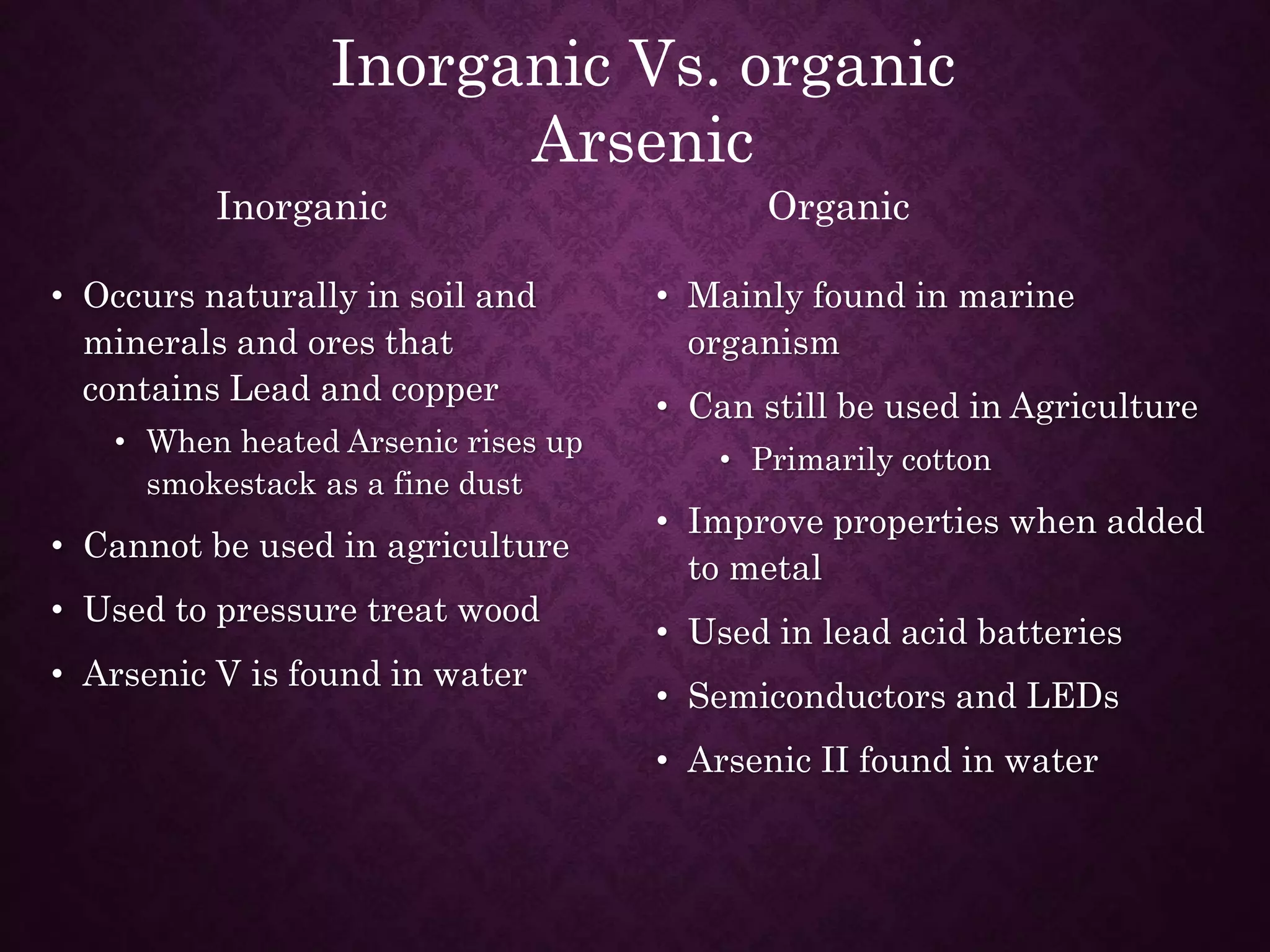
• Occurs naturally in soil and
minerals and ores that
contains Lead and copper
• When heated Arsenic rises up
smokestack as a fine dust
• Cannot be used in agriculture
• Used to pressure treat wood
• Arsenic V is found in water
• Mainly found in marine
organism
• Can still be used in Agriculture
• Primarily cotton
• Improve properties when added
to metal
• Used in lead acid batteries
• Semiconductors and LEDs
• Arsenic II found in water
Inorganic Vs. organic
Arsenic
Inorganic Organic
Sources of Arsenic in Ground Water
Two hypotheses: Geogenic origin
1. Oxidation of pyrite(FeS2) & solubilisation of As
FeS2 + 2H2O + 502 = FeSO4 + 2H2SO4
As liberated in aquifers
2. Reduction of As rich FeOOH in anoxic(depleted dissolved
O2) g.water (due to microbial oxidation of sedimentary
organic matter, paddy cultivation, high WT)
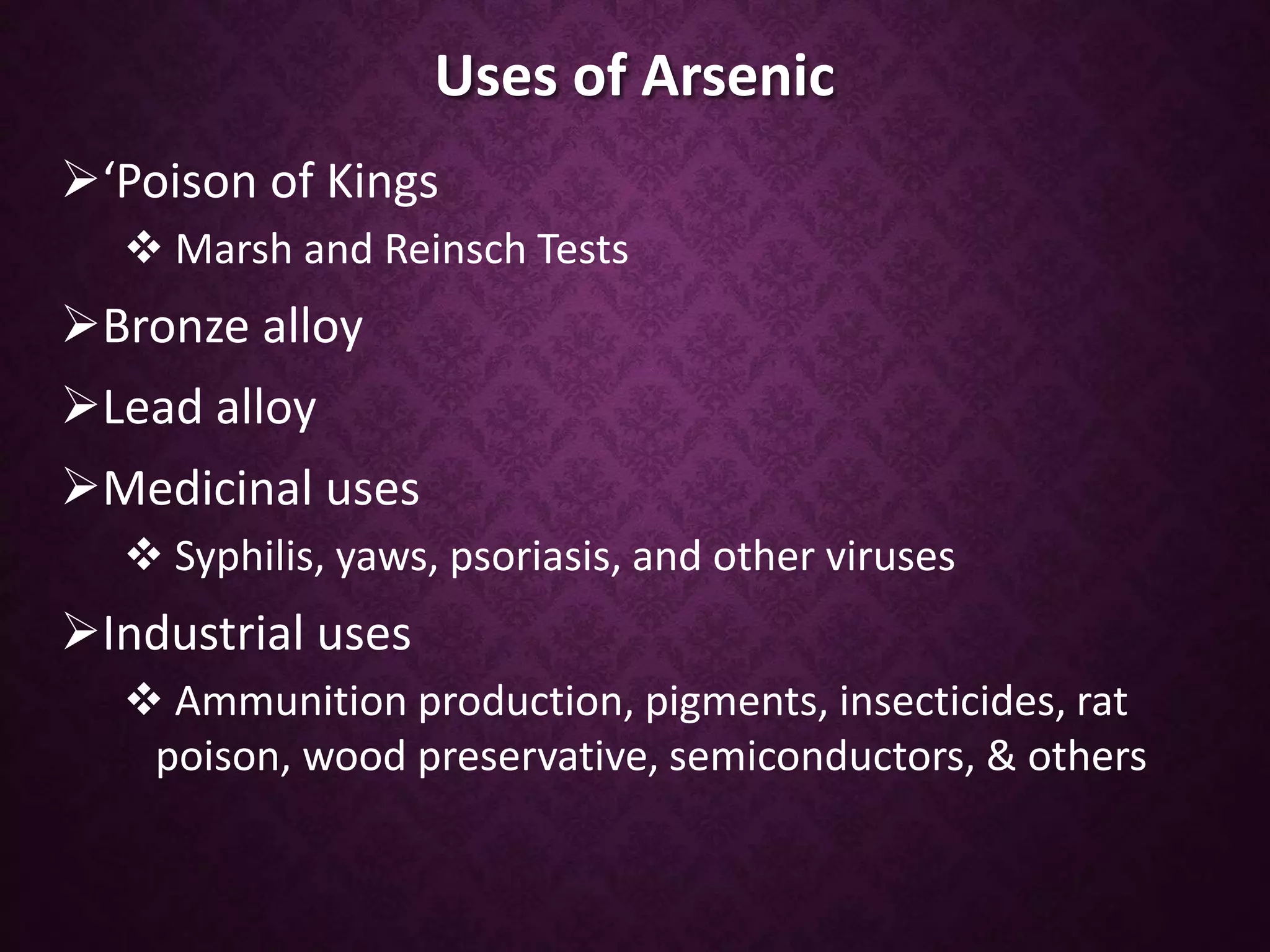
Uses of Arsenic
‘Poison of Kings
 Marsh and Reinsch Tests
Bronze alloy
Lead alloy
Medicinal uses
 Syphilis, yaws, psoriasis, and other viruses
Industrial uses
 Ammunition production, pigments, insecticides, rat
poison, wood preservative, semiconductors, & others
Guideline value for Arsenic contamination
WHO (1993) permissible limit for drinking purpose- 0.01 mg/L
Permissible limit in absence of alternate source- 0.05 mg/L4
Proposal by WHO in 2001- 0.001 mg/L
PMTDI inorganic As- 0.002 mg/kg of body wt.(JECFA, 1983)
PTWI inorganic As- 0.015 mg/kg of body wt.(FAO/WHO, 1989)
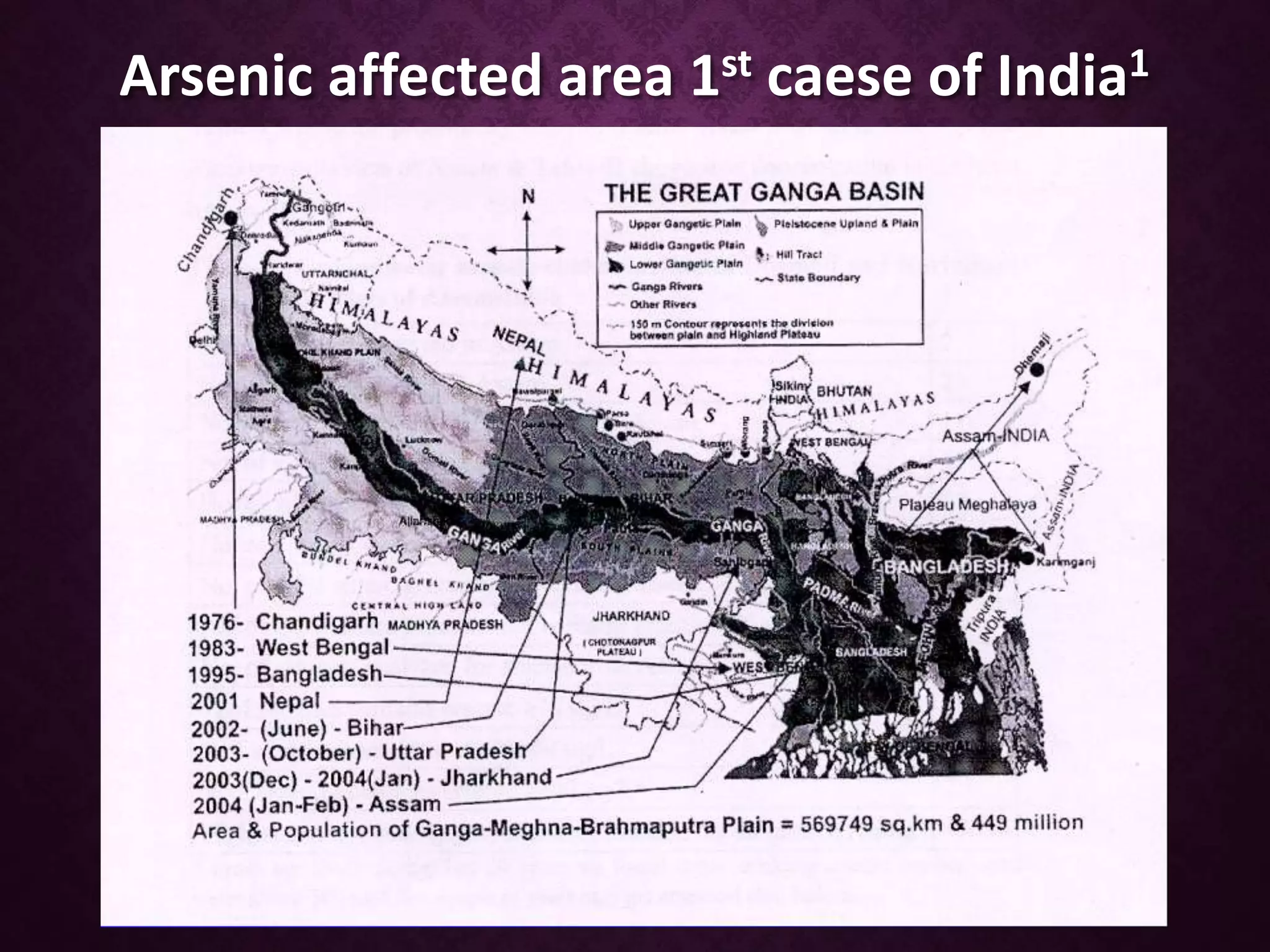
Arsenic affected area 1st caese of India1
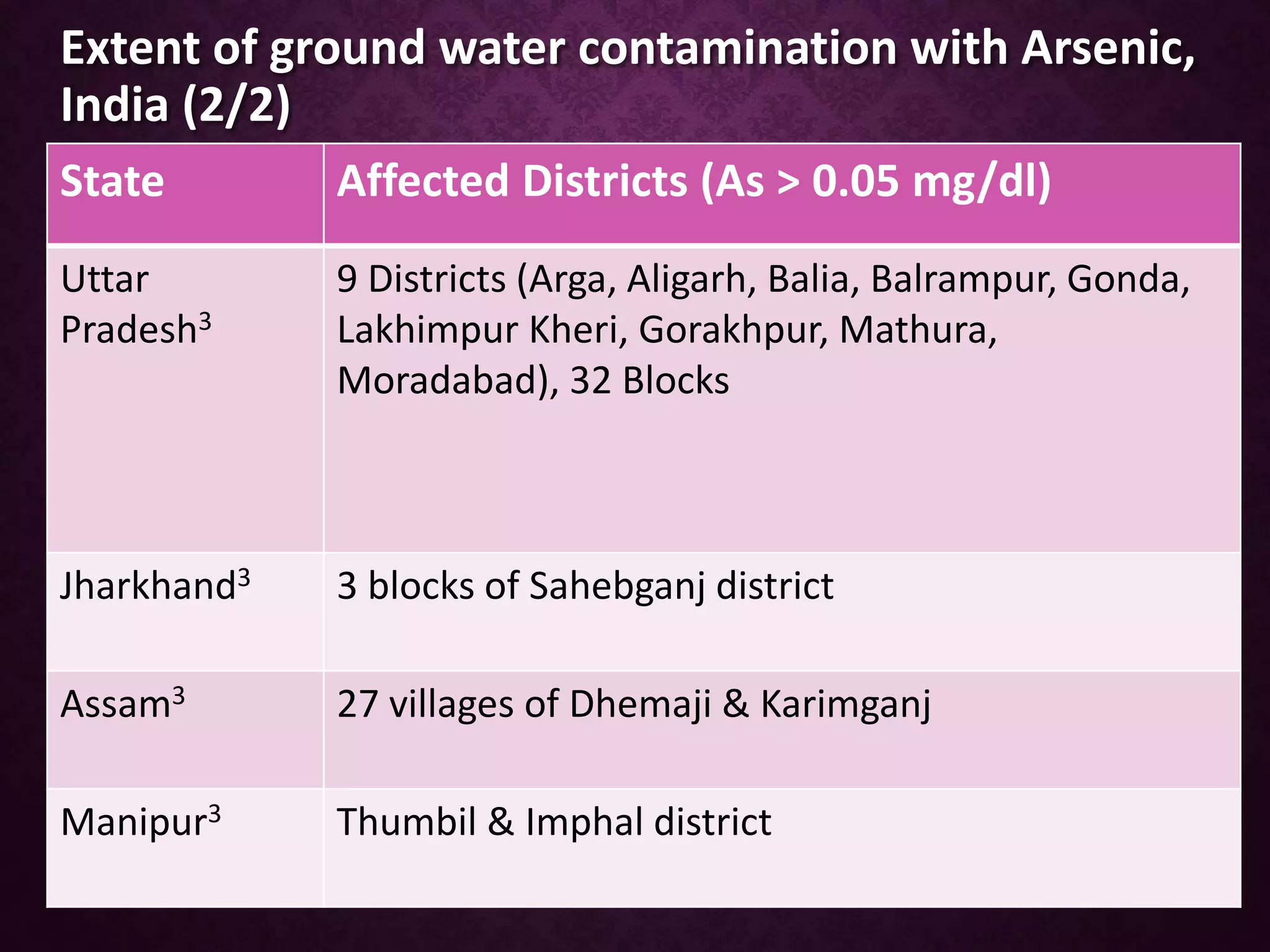
Extent of ground water contamination with Arsenic,
India (1/2)
State Affected Districts (As > 0.05 mg/dl)
West Bengal3 12 districts ( Murshidabad, Maldah, Nadia, N & S
24 parganas, Burdwan, Howrah, Hooghly, Kolkata,
Coochbehar, N. Dinajpur & S. Dinajpur), 111 Blocks
Bihar2 13 Districts (Begusarai, Bhagalpur, Bhojpur, Buxar,
Darbhanga, Katihar, Khagaria, Lakhisarai, Munger,
Patna, Samastipur, Saran, Vaishali), 50 Blocks
Chhattisgarh3 Ambagarh Chowki block of Rajnandgaon district
Extent of ground water contamination with Arsenic,
India (2/2)
State Affected Districts (As > 0.05 mg/dl)
Uttar
Pradesh3
9 Districts (Arga, Aligarh, Balia, Balrampur, Gonda,
Lakhimpur Kheri, Gorakhpur, Mathura,
Moradabad), 32 Blocks
Jharkhand3 3 blocks of Sahebganj district
Assam3 27 villages of Dhemaji & Karimganj
Manipur3 Thumbil & Imphal district
Related research (1/8)
 Description of Arsenic ground water contaminated
areas of India and effects of Arsenic contaminated
drinking water on human biological system- In India,
seven states namely, West-Bengal, Jharkhand, Bihar,
Uttar Pradesh in the flood plain of Ganga River; Assam
and Manipur in the flood plain of Brahamaputra and
Imphal rivers and Rajnandgaon village in Chhattisgarh
state have so far been reported affected by arsenic
contamination in groundwater above the permissible
limit of 50 µg/L. 5
Related research (2/8)
Description of Arsenic ground water contaminated
area of Rajnandgaon District, Madhya Pradesh
(Now it comes under Chhattisgarh). Arsenic
calamity in West Bengal was known during 19708-
80 and officially documented by K.C.Saha from
School of tropical Medicine Calcutta, 1983. Though
skin lesions in Koudikasa villagers were noticed in
early seventies, there were officially confirmed to
be due to Arsenic toxicity only 6 months ago. 7
Related research (3/8)
 Arsenic exposure in drinking water and mortality from Cardio-
vascular disease in Bangladesh: prospective cohort study. There
is a dose-response relationship in Arsenic and cardiovascular
disease, specially heart disease (at a much lower level of
exposure than previously reported). There is also synergistic
effect with cigarate smoking to ischemic heart disease 11
 Description of ground water contamination in Bangladesh 12
Arsenic in Groundwater: A Summary of Sources and the
Biogeochemical and Hydrogeologic Factors Affecting Arsenic
Occurrence and Mobility 13
Related research (4/8)
 Arsenic contamination of ground water and its impact on
population of District of Nadia, West Bengal India 8
Ground water Arsenic contamination in Bangladesh and West
Bengal, India. Describe the affected area of Ganga-Brahmaputra-
Meghna basin that comes under Bangladesh and west Bengal,
India 9
Low-level environmental arsenic exposure correlates with
unexplained male infertility risk. Higher Asi
V levels were more
likely to exhibit UMI with increasing adjusted odds ratios14
Related research (5/8)
 Exposed individuals are at higher risk of developing
liver and cardiovascular disease, as indicated by
elevated serum levels of liver injury biomarkers
and inflammatory cytokines. Increase of
autoimmune markers in the serum suggests that
arsenic exposure also induces autoimmune
diseases such as rheumatoid arthritis. Both
rheumatoid arthritis and liver disease are risk
factors for cardiovascular disease.6
Related research (6/8)
 Low doses of arsenic exposure mitigate or mask
p53 function and further perturb intracellular redox
state, which triggers persistent endoplasmic
reticulum (ER) stress and activates UPR (unfolded
protein response), leading to transformation or
tumorigenesis. Thus, the results suggest that low
doses of arsenic exposure, through attenuating p53-
regulated tumor suppressive function, change the
state of intracellular redox and create a
microenvironment for tumorigenesis. 15
Related research (7/8)
Arsenic exposure and risk of preeclampsia in a
Mexican mestizo population- Exposure
to arsenic in drinking water has been associated
with various complications of pregnancy including
fetal loss, low birth weight, anemia, gestational
diabetes and spontaneous abortion. The study
showed for the first time that at these lower levels
of exposure there is no association with
preeclampsia. 16
Related research (8/8)
Arsenic in Drinking Water and Lung Cancer Mortality in the United
States: An Analysis Based on US Counties and 30 Years of
Observation (1950-1979)- Cancer risks (slopes) were found to be
indistinguishable from zero for males and females. The addition
of arsenic level did not significantly increase the explanatory power of
the models. Stratified, or categorical, analysis yielded relative risks
that hover about 1.00. The unit risk estimates were nonpositive and
not significantly different from zero, and the maximum (95% UCL) unit
risk estimates for lung cancer were lower than those in US EPA (2010).
Conclusions. These results are consistent with a recent metaregression
that indicated no increased lung cancer risk for arsenic exposures
below 100-150 µg/L. 17
Remedial measures for Arsenic removal from
water20 - Methods
Oxidation
Coagulation, precipitation and filtration
Adsorption (Sorptive filtration)
Ion exchange
Membrane technologies
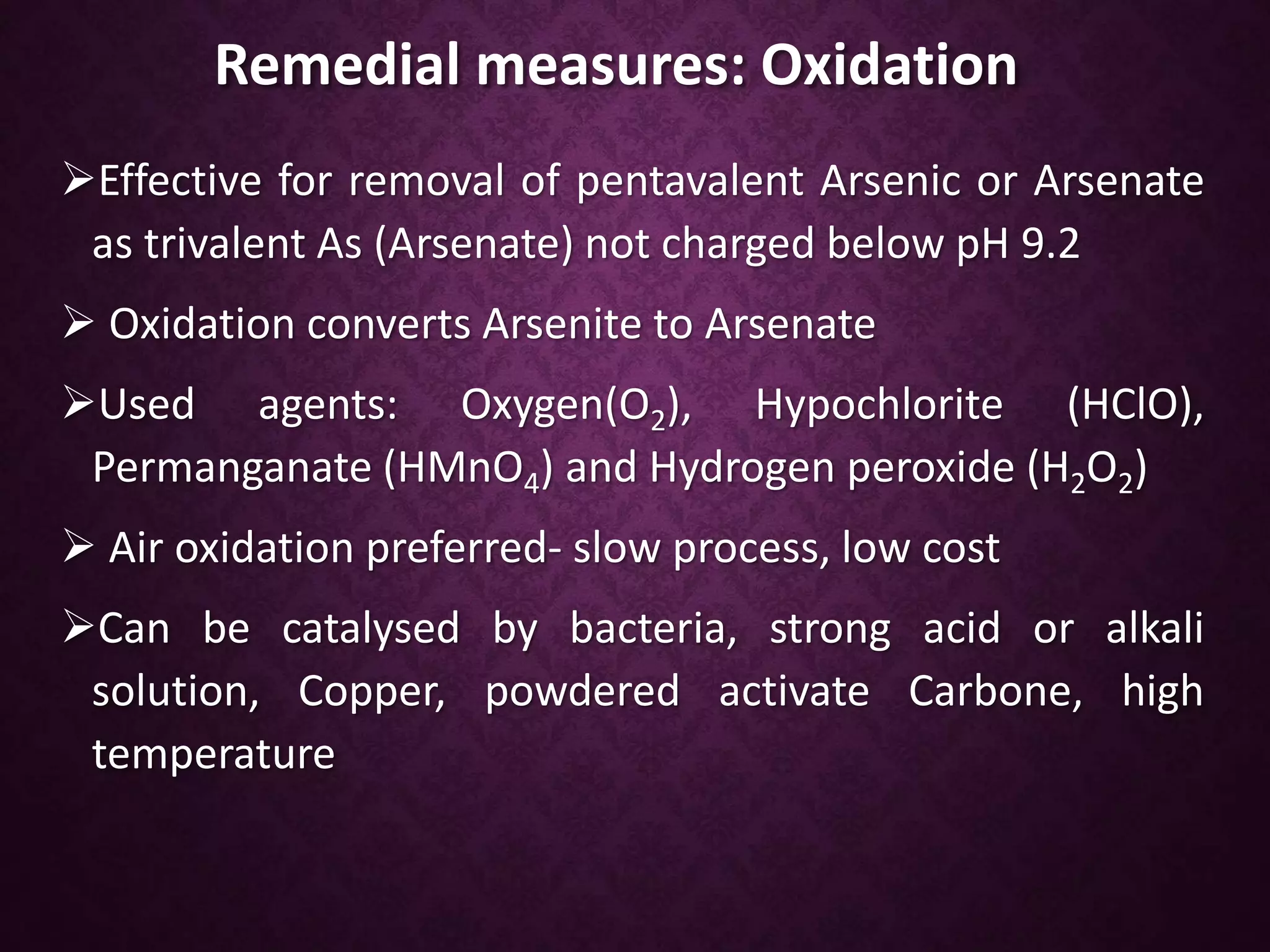
Remedial measures: Oxidation
Effective for removal of pentavalent Arsenic or Arsenate
as trivalent As (Arsenate) not charged below pH 9.2
 Oxidation converts Arsenite to Arsenate
Used agents: Oxygen(O2), Hypochlorite (HClO),
Permanganate (HMnO4) and Hydrogen peroxide (H2O2)
 Air oxidation preferred- slow process, low cost
Can be catalysed by bacteria, strong acid or alkali
solution, Copper, powdered activate Carbone, high
temperature
Remedial measures: Coagulation, precipitation and
filtration
 Done by metal salt and lime
3 steps:
 Precipitation-by formation of insoluble compound
 Co-precipitation- Incorporation of soluble Arsenic
species into growing metal hydroxide phases (using
Fe3+)
 Adsorption: Electrostatic binding of soluble Arsenic
to external surfaces of the insoluble metal
hydroxide
Remedial measures: Coagulation, precipitation and
filtration
 1st used for drinking water in 1970 in northern Chile:
reduce from 400 µg/L to 10 µg/L at the rate of 500 L/sec
(pH, oxidizing and coagulating agents are in strict control)
 Coagulation & flocculation
 Process use Alarm(pH 6-8), ferric chloride(pH <8) or ferric
sulfate
 Removal done by sedimentation followed by filtration
Remedial measures: Coagulation, precipitation and
filtration
 Bucket treatment unit
 20 lit two bucket placed one above other
 Aluminum, sulphate, potassium permanganate powder
mixed with water in upper bucket & stirred for 30-60 secs
 Water then allowed to flow from upper to lower bucket by a
plastic tube via sand filter installed in lower bucket
Stevens Institute Technology
 Chemical used: Iron sulphate & Calcium hypochlorite
 flocs separation: sedimentation followed by filtration
The Bucket treatment unit and Stevens Institute
Technology
Remedial measures: Use of naturally occurring iron in
ground water
No chemical added
 Dissolved Iron oxidized and precipitated –with arsenic
 This method use- oxidation, coagulation, adsorption,
sedimentation and filtration
 Increasing contact time helps this method
 Depends on iron and arsenic contents of water
Remedial measures: Coagulation with lime
 Chemical used: Quick lime (CaO) or hydrated lime [Ca(OH)2]
 Process: similar like metal slat process of coagulation
 Calcium hydroxide acts as a sorptive flocculant for arsenic
 Excess lime and precipitate removed: sedimentation & filtration
 Works in pH 10.6-11.4
 Removes 40-70% arsenic
 Better to use pre-treatment process for alum & iron coagulation
Remedial measures: Solar oxidation & precipitation of
Iron(III) with adsorbed Arsenic(V) [SORAS]
 Photochemical oxidation: Irradiation of water in PET or
other UV-A transparent bottle- coverts As(III) to As(V)
 Precipitation or filtration of adsorbed As(V) on Fe(III)-
oxides [Fe naturally present or added]
A household method where ground water naturally
contains Fe(II) and Fe(III)
Remedial measures: Adsorption (Sorptive
filtration)
 Activated alumina
 Granular Ferric hydroxide
 Hydrous Cerium Oxide
 Iron coated sand and brick chips
Remedial measures: Adsorption (Sorptive
filtration) using activated alumina [Al2O3]
 Good sorptive surface: 200-300 m2/gm
 water passed through packed column of
alumina- impurities and As retaians
 Caustic soda (NaOH) used to regenerate
saturated packed column of alumina
Example: BUET Activated Alumina, Alcan
Enhanced Activate Alumina, Apyron Arsenic
Treatment Unit
Remedial measures: Adsorption (Sorptive
filtration) using Granular Ferric hydroxide
 Used for removal of Arsenate, Arsenite and
phosphate from water
 Water pass through adsorption bed containing
granular ferric hydroxide
 Operates like conventional filter with downward
water movement
 Water containing high dissolved iron and
suspended matters- to be aerated and filtered by
sand/gravel filter as pre-treatment process to
prevent clogging of adsorption bed
Remedial measures: Adsorption (Sorptive
filtration) using Hydrous Cerium Oxide
 Has good adsorbent surface
 Laboratory and field level testing done in
different sites
 Method: Same as granular ferric oxide method
 Highly efficient in removal Arsenic from ground
water
Remedial measures: Adsorption (Sorptive
filtration) using Iron coated sand and brick chips
 Iron coated sand and ferrous sulphate coated
brick chips used
 Water of contaminate well or other source
allowed to pass though a filter with a
underneath drainage system
 May be used at school level or institutional
level or village level
Household level Arsenic filters
 Water allowed to pass through partly oxidized zero
valent iron, sand, brick chips and wood cake
 Combination of slow sand filtration and
adsorption on iron hydroxide- Typical biosand
filter(sand & gravel) with an extra open chamber on
top containing iron nails
 Iron oxidized to Ferrous hydroxide in presence of air
and water
Surface complexation reaction occur- arsenic rapidly
trapped onto the surface of Fe(OH)2
Remedial measures: Ion exchange
Similar to activated alumina
Medium- synthetic resin of better defined ion
exchange capacity
Less dependent of water pH
Requires oxidation process as a pre-step
 Resin become exhausted after some time- can
be recharged by washing with Sodium chloride
(NaCl) solution
Remedial measures: Membrane technologies
Two type of membrane-
 low-pressure membrane: microfiltration and
ultrafiltration
High-pressure membrane: nanofiltration and reverse
osmosis
 Independent of pH and other solutes.
Affected by presence of colloids
Pre-treatment of suspended material and colloids
are required
Membrane can not be backwashed
Remedial measures: Sludge disposal
 All Arsenic removal technology generates high
concentrated sorption media, sludge or liquid
media
 Bio-methylation by fresh cow dung21
 Blending of contaminated waste with brick,
cement or concrete
Remedial measures
Chemical controls on abiotic and biotic release of
geogenic arsenic from Pleistocene aquifer sediments to
groundwater- The mode of As release was impacted by the
source of DOC supplied to the sediments, with biological
processes responsible for 81% to 85% of the total As release
following incubations with lactate and acetate but only up to
43% to 61% of the total As release following incubations with
humic and fulvic acids. Overall, cycling of key redox-active
elements and organic-carbon reactivity govern the potential
for geogenic As release to groundwater, and results here may
be used to formulate better predictions of the arsenic
pollution potential of aquifers in South and Southeast Asia. 18
Remedial measures
Pilot study on arsenic removal from groundwater using a
small-scale reverse osmosis system- Towards
sustainable drinking water production.
The arsenic removal efficiency for aerated and non-aerated
groundwater by reverse osmosis technology in combination
with an energy-saving recovery system have been studied.
It works on reverse osmosis principle. Total arsenic removal
efficiency was around 99% and the arsenic concentration in
permeate was in compliance with the WHO and National
Indian Standard of 10μg/L but not occur under anoxic
conditions with non-aerated groundwater. Re-injection of
reject water underground may offer a safe disposal
option.19
Remedial measures : Bacterial method
Biotransformation and bioaccumulation of
Arsenic by Brevibacillus brevis isolated from
Arsenic contaminated region of West Bengal
This bacteria is well adopted to arsenite and
can also transform arsenite to less toxic
arsenate 10
References (1/3)
1. Ground water Arsenic contamination in India: Vulnerability & Scope of Remedy, N.C.Gosh &
Scientist F & R.D.Singh, Director, National Institute of Hydrology, Roorke.
http://www.cgwb.gov.in/documents/ papers/incidpapers/Paper%208%20-%20Ghosh.pdf
2. SWASTH-WATSAN-Bihar: http://swasthwatsanbihar.blogspot.in/p/ground-water-quality-
affected-districts.html
3. India Water Portal: http://hindi.indiawaterportal.org/node/53060
4. Indian Standard for Drinking Water-Specification- Second version, © Bureau of Indian Standard-
2012, http://www.cgwb.gov.in/Documents/WQ-standards.pdf
5. Finger print of Arsenic contaminated area of India-A review, Chaurasia et al, J Forensic Res
2012, 3:10, http://www.omicsonline.org/2157-7145/pdfdownload.php?download=2157-7145-
3-172.pdf
6. Arsenic exposure through drinking water increases the liver and cardiovascular diseases in the
population of West Bengal, India, Das et al, BMC Public Health 2012, 12:639,
http://www.ncbi.nlm.nih.gov/pmc/articles/PMC3441389/pdf/1471-2458-12-639.pdf
7. Arsenic groundwater contamination and sufferings of people in Rajnandgaon district,
Madhya Pradesh, India, Indian Institute of Science,
http://www.iisc.ernet.in/currsci/aug25/articles15.htm
References (2/3)
8. Guah Mazumdar et. al. , Indian J Community Med. 2010 April: 35(2):351-388,
http://www.ncbi.nlm.nih.gov/pmc/articles/PMC2940197
9. Chowdhury et. al. Environmental Health Perspective, Vol. 108, No. 5, May 2000,
http://www.ncbi.nlm.nih.gov/pmc/articles/PMC1638054/pdf/envhper00306-0043.pdf
10. Banerjee et. al., IOSR Journal of Environmental Science, Toxicology and Food Technology (IOSR-
JESTFT), e-ISSN: 2319-2402, p-ISSN: 2319-2399, Volume 3, Issue 1, (Jan. to Feb. 2013), PP 01-10,
http://shodhganga.inflibnet.ac.in/bitstream/10603/105505/15/15_publications.pdf
11. Chen et. al., BKJ 2011, 342:d2431, http://www.bmj.com/content/bmj/342/bmj.d2431.full.pdf
12. Safiudiin et. al., http://eng-consult.com/pub/ArsenicIEB.pdf
13. Barringer J. and Reilly P. A., INTECH, http://cdn.intechopen.com/pdfs-wm/42035.pdf
14. Wang X et. al. Science of The Total Environment, Volume 571, 15 November 2016, Pages 307–
313, http://www.ncbi.nlm.nih.gov/pubmed/27485131
15. Ganapathy S. et al., Toxicology and Applied Pharmacology Volume 306, 1 September 2016,
Pages 98–104
References (3/3)
16. Sandoval-Carrillo A et. al. BMC Pregnancy Childbirth. 2016; 16: 153. ,
https://www.ncbi.nlm.nih.gov/pmc/articles/PMC4940694/
17. Ferdosi H et. al. , J Environ Public Health. 2016;2016:1602929. doi: 10.1155/2016/1602929.
Epub 2016 Jun 13. https://www.ncbi.nlm.nih.gov/pmc/articles/PMC4921645/pdf/JEPH2016-
1602929.pdf
18. Gillispie Elizabeth C., Environmental Science: Processes & Impacts Issue 8, 2016
19. Schmidt SA. Et. al. Journal of Hazardous Materials Volume 318, 15 November 2016, Pages 671–
678
20. Arsenic removal Technologies by Raju Shrestha, Environment and Public Health Organisation,
ENPHO, Dorothee Spuhler, Published in www.sswm.info
21. Ali et. al. (2001) Department of Low cost Technology for Removal of Arsenic, Dhaka,
Bangladesh
Thank You

Ground water Arsenic Contamination in India

  • 1.
    Ground water Arseniccontamination: Extent, related research and remediation measures in India -by Dr. Sayan Das MPH 8th Cohort, ICMR-SPH,NIE
  • 2.
    Overview  Chemistry ofArsenic  Extent of ground water poisoning with arsenic  Related research on this ground  Remedial measures for it: India and global perspective
  • 3.
    Chemistry of Arsenic(1/4) • Atomic number: 33 • Atomic wt.: 74.9 • Isotope: 3 (73,74,75) • Electron configuration: [Ar] 3d10 4s2 4p3 • Non-magnetic, semi-metal • Colour: Gray and Black • Hardness: 3.5 • Oxidation state: 5, 3, -3
  • 4.
    Chemistry of Arsenic(2/4) In ground water: At pH 6-8 : H2AsVO4 - and HAsVO4 2 (oxidized env. Eh = 0.2-0.5 V) H3AsIIIO3 (reduced condition. Eh = 0-0.1 V)
  • 5.
    Chemistry of Arsenic(3/4) In Soil: Arsenite and arsenate (inorganic) MMA acid , DMA acid, TMA acid (org. form) (on reduction) (anoxic cond.) Di/trimethyl arsine(AsH3) Flooded cond. (Eh= 0-0.1 V, pH 6-8) • As acid sp. And arsenite oxyanions- H3AsO3 0, H2AsO4 -, HAsO4 2-, AsO4 3- Aerobic cond. • Under aerobic (oxidizing) conditions As V predominates- As acid sp. and arsenate oxyanions (H3AsO4 0, H2AsO4 -, HAsO4 2-, AsO4 3-) (Fitz and Wenzel, 2002; Takahashi et al., 2004).
  • 6.
    Chemistry of Arsenic(4/4) In Rhizosphere: Micro-organisms oxidized rhizosphere Precipitation of FeOOH (Fe plaques on root of wetland crops)
  • 7.
    • Occurs naturallyin soil and minerals and ores that contains Lead and copper • When heated Arsenic rises up smokestack as a fine dust • Cannot be used in agriculture • Used to pressure treat wood • Arsenic V is found in water • Mainly found in marine organism • Can still be used in Agriculture • Primarily cotton • Improve properties when added to metal • Used in lead acid batteries • Semiconductors and LEDs • Arsenic II found in water Inorganic Vs. organic Arsenic Inorganic Organic
  • 8.
    Sources of Arsenicin Ground Water Two hypotheses: Geogenic origin 1. Oxidation of pyrite(FeS2) & solubilisation of As FeS2 + 2H2O + 502 = FeSO4 + 2H2SO4 As liberated in aquifers 2. Reduction of As rich FeOOH in anoxic(depleted dissolved O2) g.water (due to microbial oxidation of sedimentary organic matter, paddy cultivation, high WT)
  • 9.
    Uses of Arsenic ‘Poisonof Kings  Marsh and Reinsch Tests Bronze alloy Lead alloy Medicinal uses  Syphilis, yaws, psoriasis, and other viruses Industrial uses  Ammunition production, pigments, insecticides, rat poison, wood preservative, semiconductors, & others
  • 10.
    Guideline value forArsenic contamination WHO (1993) permissible limit for drinking purpose- 0.01 mg/L Permissible limit in absence of alternate source- 0.05 mg/L4 Proposal by WHO in 2001- 0.001 mg/L PMTDI inorganic As- 0.002 mg/kg of body wt.(JECFA, 1983) PTWI inorganic As- 0.015 mg/kg of body wt.(FAO/WHO, 1989)
  • 11.
    Arsenic affected area1st caese of India1
  • 12.
    Extent of groundwater contamination with Arsenic, India (1/2) State Affected Districts (As > 0.05 mg/dl) West Bengal3 12 districts ( Murshidabad, Maldah, Nadia, N & S 24 parganas, Burdwan, Howrah, Hooghly, Kolkata, Coochbehar, N. Dinajpur & S. Dinajpur), 111 Blocks Bihar2 13 Districts (Begusarai, Bhagalpur, Bhojpur, Buxar, Darbhanga, Katihar, Khagaria, Lakhisarai, Munger, Patna, Samastipur, Saran, Vaishali), 50 Blocks Chhattisgarh3 Ambagarh Chowki block of Rajnandgaon district
  • 13.
    Extent of groundwater contamination with Arsenic, India (2/2) State Affected Districts (As > 0.05 mg/dl) Uttar Pradesh3 9 Districts (Arga, Aligarh, Balia, Balrampur, Gonda, Lakhimpur Kheri, Gorakhpur, Mathura, Moradabad), 32 Blocks Jharkhand3 3 blocks of Sahebganj district Assam3 27 villages of Dhemaji & Karimganj Manipur3 Thumbil & Imphal district
  • 14.
    Related research (1/8) Description of Arsenic ground water contaminated areas of India and effects of Arsenic contaminated drinking water on human biological system- In India, seven states namely, West-Bengal, Jharkhand, Bihar, Uttar Pradesh in the flood plain of Ganga River; Assam and Manipur in the flood plain of Brahamaputra and Imphal rivers and Rajnandgaon village in Chhattisgarh state have so far been reported affected by arsenic contamination in groundwater above the permissible limit of 50 µg/L. 5
  • 15.
    Related research (2/8) Descriptionof Arsenic ground water contaminated area of Rajnandgaon District, Madhya Pradesh (Now it comes under Chhattisgarh). Arsenic calamity in West Bengal was known during 19708- 80 and officially documented by K.C.Saha from School of tropical Medicine Calcutta, 1983. Though skin lesions in Koudikasa villagers were noticed in early seventies, there were officially confirmed to be due to Arsenic toxicity only 6 months ago. 7
  • 16.
    Related research (3/8) Arsenic exposure in drinking water and mortality from Cardio- vascular disease in Bangladesh: prospective cohort study. There is a dose-response relationship in Arsenic and cardiovascular disease, specially heart disease (at a much lower level of exposure than previously reported). There is also synergistic effect with cigarate smoking to ischemic heart disease 11  Description of ground water contamination in Bangladesh 12 Arsenic in Groundwater: A Summary of Sources and the Biogeochemical and Hydrogeologic Factors Affecting Arsenic Occurrence and Mobility 13
  • 17.
    Related research (4/8) Arsenic contamination of ground water and its impact on population of District of Nadia, West Bengal India 8 Ground water Arsenic contamination in Bangladesh and West Bengal, India. Describe the affected area of Ganga-Brahmaputra- Meghna basin that comes under Bangladesh and west Bengal, India 9 Low-level environmental arsenic exposure correlates with unexplained male infertility risk. Higher Asi V levels were more likely to exhibit UMI with increasing adjusted odds ratios14
  • 18.
    Related research (5/8) Exposed individuals are at higher risk of developing liver and cardiovascular disease, as indicated by elevated serum levels of liver injury biomarkers and inflammatory cytokines. Increase of autoimmune markers in the serum suggests that arsenic exposure also induces autoimmune diseases such as rheumatoid arthritis. Both rheumatoid arthritis and liver disease are risk factors for cardiovascular disease.6
  • 19.
    Related research (6/8) Low doses of arsenic exposure mitigate or mask p53 function and further perturb intracellular redox state, which triggers persistent endoplasmic reticulum (ER) stress and activates UPR (unfolded protein response), leading to transformation or tumorigenesis. Thus, the results suggest that low doses of arsenic exposure, through attenuating p53- regulated tumor suppressive function, change the state of intracellular redox and create a microenvironment for tumorigenesis. 15
  • 20.
    Related research (7/8) Arsenicexposure and risk of preeclampsia in a Mexican mestizo population- Exposure to arsenic in drinking water has been associated with various complications of pregnancy including fetal loss, low birth weight, anemia, gestational diabetes and spontaneous abortion. The study showed for the first time that at these lower levels of exposure there is no association with preeclampsia. 16
  • 21.
    Related research (8/8) Arsenicin Drinking Water and Lung Cancer Mortality in the United States: An Analysis Based on US Counties and 30 Years of Observation (1950-1979)- Cancer risks (slopes) were found to be indistinguishable from zero for males and females. The addition of arsenic level did not significantly increase the explanatory power of the models. Stratified, or categorical, analysis yielded relative risks that hover about 1.00. The unit risk estimates were nonpositive and not significantly different from zero, and the maximum (95% UCL) unit risk estimates for lung cancer were lower than those in US EPA (2010). Conclusions. These results are consistent with a recent metaregression that indicated no increased lung cancer risk for arsenic exposures below 100-150 µg/L. 17
  • 22.
    Remedial measures forArsenic removal from water20 - Methods Oxidation Coagulation, precipitation and filtration Adsorption (Sorptive filtration) Ion exchange Membrane technologies
  • 23.
    Remedial measures: Oxidation Effectivefor removal of pentavalent Arsenic or Arsenate as trivalent As (Arsenate) not charged below pH 9.2  Oxidation converts Arsenite to Arsenate Used agents: Oxygen(O2), Hypochlorite (HClO), Permanganate (HMnO4) and Hydrogen peroxide (H2O2)  Air oxidation preferred- slow process, low cost Can be catalysed by bacteria, strong acid or alkali solution, Copper, powdered activate Carbone, high temperature
  • 24.
    Remedial measures: Coagulation,precipitation and filtration  Done by metal salt and lime 3 steps:  Precipitation-by formation of insoluble compound  Co-precipitation- Incorporation of soluble Arsenic species into growing metal hydroxide phases (using Fe3+)  Adsorption: Electrostatic binding of soluble Arsenic to external surfaces of the insoluble metal hydroxide
  • 25.
    Remedial measures: Coagulation,precipitation and filtration  1st used for drinking water in 1970 in northern Chile: reduce from 400 µg/L to 10 µg/L at the rate of 500 L/sec (pH, oxidizing and coagulating agents are in strict control)  Coagulation & flocculation  Process use Alarm(pH 6-8), ferric chloride(pH <8) or ferric sulfate  Removal done by sedimentation followed by filtration
  • 26.
    Remedial measures: Coagulation,precipitation and filtration  Bucket treatment unit  20 lit two bucket placed one above other  Aluminum, sulphate, potassium permanganate powder mixed with water in upper bucket & stirred for 30-60 secs  Water then allowed to flow from upper to lower bucket by a plastic tube via sand filter installed in lower bucket Stevens Institute Technology  Chemical used: Iron sulphate & Calcium hypochlorite  flocs separation: sedimentation followed by filtration
  • 27.
    The Bucket treatmentunit and Stevens Institute Technology
  • 28.
    Remedial measures: Useof naturally occurring iron in ground water No chemical added  Dissolved Iron oxidized and precipitated –with arsenic  This method use- oxidation, coagulation, adsorption, sedimentation and filtration  Increasing contact time helps this method  Depends on iron and arsenic contents of water
  • 29.
    Remedial measures: Coagulationwith lime  Chemical used: Quick lime (CaO) or hydrated lime [Ca(OH)2]  Process: similar like metal slat process of coagulation  Calcium hydroxide acts as a sorptive flocculant for arsenic  Excess lime and precipitate removed: sedimentation & filtration  Works in pH 10.6-11.4  Removes 40-70% arsenic  Better to use pre-treatment process for alum & iron coagulation
  • 30.
    Remedial measures: Solaroxidation & precipitation of Iron(III) with adsorbed Arsenic(V) [SORAS]  Photochemical oxidation: Irradiation of water in PET or other UV-A transparent bottle- coverts As(III) to As(V)  Precipitation or filtration of adsorbed As(V) on Fe(III)- oxides [Fe naturally present or added] A household method where ground water naturally contains Fe(II) and Fe(III)
  • 31.
    Remedial measures: Adsorption(Sorptive filtration)  Activated alumina  Granular Ferric hydroxide  Hydrous Cerium Oxide  Iron coated sand and brick chips
  • 32.
    Remedial measures: Adsorption(Sorptive filtration) using activated alumina [Al2O3]  Good sorptive surface: 200-300 m2/gm  water passed through packed column of alumina- impurities and As retaians  Caustic soda (NaOH) used to regenerate saturated packed column of alumina Example: BUET Activated Alumina, Alcan Enhanced Activate Alumina, Apyron Arsenic Treatment Unit
  • 33.
    Remedial measures: Adsorption(Sorptive filtration) using Granular Ferric hydroxide  Used for removal of Arsenate, Arsenite and phosphate from water  Water pass through adsorption bed containing granular ferric hydroxide  Operates like conventional filter with downward water movement  Water containing high dissolved iron and suspended matters- to be aerated and filtered by sand/gravel filter as pre-treatment process to prevent clogging of adsorption bed
  • 34.
    Remedial measures: Adsorption(Sorptive filtration) using Hydrous Cerium Oxide  Has good adsorbent surface  Laboratory and field level testing done in different sites  Method: Same as granular ferric oxide method  Highly efficient in removal Arsenic from ground water
  • 35.
    Remedial measures: Adsorption(Sorptive filtration) using Iron coated sand and brick chips  Iron coated sand and ferrous sulphate coated brick chips used  Water of contaminate well or other source allowed to pass though a filter with a underneath drainage system  May be used at school level or institutional level or village level
  • 36.
    Household level Arsenicfilters  Water allowed to pass through partly oxidized zero valent iron, sand, brick chips and wood cake  Combination of slow sand filtration and adsorption on iron hydroxide- Typical biosand filter(sand & gravel) with an extra open chamber on top containing iron nails  Iron oxidized to Ferrous hydroxide in presence of air and water Surface complexation reaction occur- arsenic rapidly trapped onto the surface of Fe(OH)2
  • 37.
    Remedial measures: Ionexchange Similar to activated alumina Medium- synthetic resin of better defined ion exchange capacity Less dependent of water pH Requires oxidation process as a pre-step  Resin become exhausted after some time- can be recharged by washing with Sodium chloride (NaCl) solution
  • 38.
    Remedial measures: Membranetechnologies Two type of membrane-  low-pressure membrane: microfiltration and ultrafiltration High-pressure membrane: nanofiltration and reverse osmosis  Independent of pH and other solutes. Affected by presence of colloids Pre-treatment of suspended material and colloids are required Membrane can not be backwashed
  • 39.
    Remedial measures: Sludgedisposal  All Arsenic removal technology generates high concentrated sorption media, sludge or liquid media  Bio-methylation by fresh cow dung21  Blending of contaminated waste with brick, cement or concrete
  • 40.
    Remedial measures Chemical controlson abiotic and biotic release of geogenic arsenic from Pleistocene aquifer sediments to groundwater- The mode of As release was impacted by the source of DOC supplied to the sediments, with biological processes responsible for 81% to 85% of the total As release following incubations with lactate and acetate but only up to 43% to 61% of the total As release following incubations with humic and fulvic acids. Overall, cycling of key redox-active elements and organic-carbon reactivity govern the potential for geogenic As release to groundwater, and results here may be used to formulate better predictions of the arsenic pollution potential of aquifers in South and Southeast Asia. 18
  • 41.
    Remedial measures Pilot studyon arsenic removal from groundwater using a small-scale reverse osmosis system- Towards sustainable drinking water production. The arsenic removal efficiency for aerated and non-aerated groundwater by reverse osmosis technology in combination with an energy-saving recovery system have been studied. It works on reverse osmosis principle. Total arsenic removal efficiency was around 99% and the arsenic concentration in permeate was in compliance with the WHO and National Indian Standard of 10μg/L but not occur under anoxic conditions with non-aerated groundwater. Re-injection of reject water underground may offer a safe disposal option.19
  • 42.
    Remedial measures :Bacterial method Biotransformation and bioaccumulation of Arsenic by Brevibacillus brevis isolated from Arsenic contaminated region of West Bengal This bacteria is well adopted to arsenite and can also transform arsenite to less toxic arsenate 10
  • 43.
    References (1/3) 1. Groundwater Arsenic contamination in India: Vulnerability & Scope of Remedy, N.C.Gosh & Scientist F & R.D.Singh, Director, National Institute of Hydrology, Roorke. http://www.cgwb.gov.in/documents/ papers/incidpapers/Paper%208%20-%20Ghosh.pdf 2. SWASTH-WATSAN-Bihar: http://swasthwatsanbihar.blogspot.in/p/ground-water-quality- affected-districts.html 3. India Water Portal: http://hindi.indiawaterportal.org/node/53060 4. Indian Standard for Drinking Water-Specification- Second version, © Bureau of Indian Standard- 2012, http://www.cgwb.gov.in/Documents/WQ-standards.pdf 5. Finger print of Arsenic contaminated area of India-A review, Chaurasia et al, J Forensic Res 2012, 3:10, http://www.omicsonline.org/2157-7145/pdfdownload.php?download=2157-7145- 3-172.pdf 6. Arsenic exposure through drinking water increases the liver and cardiovascular diseases in the population of West Bengal, India, Das et al, BMC Public Health 2012, 12:639, http://www.ncbi.nlm.nih.gov/pmc/articles/PMC3441389/pdf/1471-2458-12-639.pdf 7. Arsenic groundwater contamination and sufferings of people in Rajnandgaon district, Madhya Pradesh, India, Indian Institute of Science, http://www.iisc.ernet.in/currsci/aug25/articles15.htm
  • 44.
    References (2/3) 8. GuahMazumdar et. al. , Indian J Community Med. 2010 April: 35(2):351-388, http://www.ncbi.nlm.nih.gov/pmc/articles/PMC2940197 9. Chowdhury et. al. Environmental Health Perspective, Vol. 108, No. 5, May 2000, http://www.ncbi.nlm.nih.gov/pmc/articles/PMC1638054/pdf/envhper00306-0043.pdf 10. Banerjee et. al., IOSR Journal of Environmental Science, Toxicology and Food Technology (IOSR- JESTFT), e-ISSN: 2319-2402, p-ISSN: 2319-2399, Volume 3, Issue 1, (Jan. to Feb. 2013), PP 01-10, http://shodhganga.inflibnet.ac.in/bitstream/10603/105505/15/15_publications.pdf 11. Chen et. al., BKJ 2011, 342:d2431, http://www.bmj.com/content/bmj/342/bmj.d2431.full.pdf 12. Safiudiin et. al., http://eng-consult.com/pub/ArsenicIEB.pdf 13. Barringer J. and Reilly P. A., INTECH, http://cdn.intechopen.com/pdfs-wm/42035.pdf 14. Wang X et. al. Science of The Total Environment, Volume 571, 15 November 2016, Pages 307– 313, http://www.ncbi.nlm.nih.gov/pubmed/27485131 15. Ganapathy S. et al., Toxicology and Applied Pharmacology Volume 306, 1 September 2016, Pages 98–104
  • 45.
    References (3/3) 16. Sandoval-CarrilloA et. al. BMC Pregnancy Childbirth. 2016; 16: 153. , https://www.ncbi.nlm.nih.gov/pmc/articles/PMC4940694/ 17. Ferdosi H et. al. , J Environ Public Health. 2016;2016:1602929. doi: 10.1155/2016/1602929. Epub 2016 Jun 13. https://www.ncbi.nlm.nih.gov/pmc/articles/PMC4921645/pdf/JEPH2016- 1602929.pdf 18. Gillispie Elizabeth C., Environmental Science: Processes & Impacts Issue 8, 2016 19. Schmidt SA. Et. al. Journal of Hazardous Materials Volume 318, 15 November 2016, Pages 671– 678 20. Arsenic removal Technologies by Raju Shrestha, Environment and Public Health Organisation, ENPHO, Dorothee Spuhler, Published in www.sswm.info 21. Ali et. al. (2001) Department of Low cost Technology for Removal of Arsenic, Dhaka, Bangladesh
  • 46.