Arsenic
Introduction
Arsenic (As), is a major threat to the lives of millions of people whose primary
water source for drinking and farming.
Responsible for groundwater pollution.
Long-term exposure to trace levels of arsenic (As) in shallow groundwater used
for drinking and irrigation puts millions of people at risk of chronic disease.
Arsenic is found in the natural environment in some abundance in the Earth's
crust and in small quantities in rock, soil, water and air.
contd...
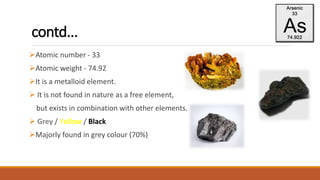
Atomic number - 33
Atomic weight - 74.92
It is a metalloid element.
 It is not found in nature as a free element,
but exists in combination with other elements.
 Grey / Yellow / Black
Majorly found in grey colour (70%)
Speciation
Inorganic form
As2O3 ( arsenite) and As2O5 ( arsenate) which are soluble in water.
Arsenate used in agriculture
Commonly found state: -3,0,+3,+5
-3 and 0 are non exit form.
+5 is the most stable form in presence of oxidizing condition (adsorbs strongly
into clay).
+3 is most dominant in presence of reducing condition.
contd..
Organic form
Monomethylarsonic acid
Dimethylarsinic acid
Trimethylarsine acid
Most toxic form is +3
History
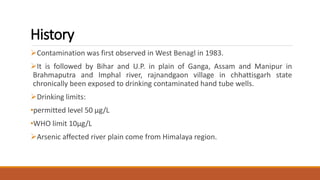
Contamination was first observed in West Benagl in 1983.
It is followed by Bihar and U.P. in plain of Ganga, Assam and Manipur in
Brahmaputra and Imphal river, rajnandgaon village in chhattisgarh state
chronically been exposed to drinking contaminated hand tube wells.
Drinking limits:
•permitted level 50 μg/L
•WHO limit 10μg/L
Arsenic affected river plain come from Himalaya region.
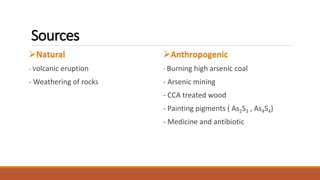
Sources
Natural
- Volcanic eruption
- Weathering of rocks
Anthropogenic
- Burning high arsenic coal
- Arsenic mining
- CCA treated wood
- Painting pigments ( As2S3 , As4S4)
- Medicine and antibiotic
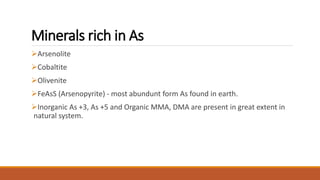
Minerals rich in As
Arsenolite
Cobaltite
Olivenite
FeAsS (Arsenopyrite) - most abundunt form As found in earth.
Inorganic As +3, As +5 and Organic MMA, DMA are present in great extent in
natural system.
contd...
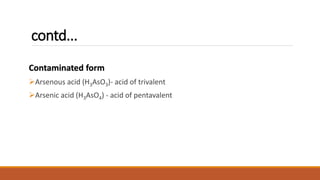
Contaminated form
Arsenous acid (H3AsO3)- acid of trivalent
Arsenic acid (H3AsO4) - acid of pentavalent
Factors affecting mobility
pH
Redox potential
Dissolve organic matter
Adsorbents, oxide and hydroxide of Fe (III) , Al (III), Mn (III)
Humic substances
There are some bacteria that can mobilize As from sediments.
examples: Shewanella algae, Shewanella oneidensis, Geobacter metallireducens
contd.
There is an inverse relationship between As mobilization and pH.
Carbonate and bicarbonate ions substitute As from sediment and As become
mobilize.
If pH is <2, Arsenious acid.
If pH is 2-11, H2AsO4-, HAsO42-
If pH is 4-10
• As(V) is -ve charged
• As(III) is neutral in charge.
Mobilization process
Reductive dissolution ( anoxic pH-7)
Alkali desorption (pH 8)
Geothermal high temperature
Sulphur oxidation (oxic pH greater than 7)
contd..
Bacteria - T. ferrooxidants work as catalyst.
FeASs oxidized when exported to atmosphere releasing soluble As III, Sulphate
SO4
2-
FeAsS + 13Fe3 + + 8H2O = 14Fe2+ + SO4
2- + 13H+ + H3AsO4
Biological action
Arsenic interferes with cellular longevity by allosteric inhibition of an essential
metabolic enzyme pyruvate dehydrogenase (PDH) complex, which catalyzes the
oxidation of pyruvate to acetyl-CoA by NAD+. With the enzyme inhibited, the
energy system of the cell is disrupted resulting in a cellular apoptosis.
Trivalent toxicity- As can bind with thiol group (-SH), So cysteine rich proteins
are vulnerable to As.
Removal Methods
Coagulation/Filtration
Adsorption through iron oxide- get adsorbed on it
Activated alumina - remove both +3 and +5
Ion exchange
Reverse osmosis
Elecyrodialysis
Effects
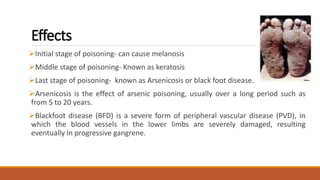
Initial stage of poisoning- can cause melanosis
Middle stage of poisoning- Known as keratosis
Last stage of poisoning- known as Arsenicosis or black foot disease.
Arsenicosis is the effect of arsenic poisoning, usually over a long period such as
from 5 to 20 years.
Blackfoot disease (BFD) is a severe form of peripheral vascular disease (PVD), in
which the blood vessels in the lower limbs are severely damaged, resulting
eventually in progressive gangrene.
Thank you!

Arsenic.pptx

  • 1.
  • 2.
    Introduction Arsenic (As), isa major threat to the lives of millions of people whose primary water source for drinking and farming. Responsible for groundwater pollution. Long-term exposure to trace levels of arsenic (As) in shallow groundwater used for drinking and irrigation puts millions of people at risk of chronic disease. Arsenic is found in the natural environment in some abundance in the Earth's crust and in small quantities in rock, soil, water and air.
  • 3.
    contd... Atomic number -33 Atomic weight - 74.92 It is a metalloid element.  It is not found in nature as a free element, but exists in combination with other elements.  Grey / Yellow / Black Majorly found in grey colour (70%)
  • 4.
    Speciation Inorganic form As2O3 (arsenite) and As2O5 ( arsenate) which are soluble in water. Arsenate used in agriculture Commonly found state: -3,0,+3,+5 -3 and 0 are non exit form. +5 is the most stable form in presence of oxidizing condition (adsorbs strongly into clay). +3 is most dominant in presence of reducing condition.
  • 5.
    contd.. Organic form Monomethylarsonic acid Dimethylarsinicacid Trimethylarsine acid Most toxic form is +3
  • 6.
    History Contamination was firstobserved in West Benagl in 1983. It is followed by Bihar and U.P. in plain of Ganga, Assam and Manipur in Brahmaputra and Imphal river, rajnandgaon village in chhattisgarh state chronically been exposed to drinking contaminated hand tube wells. Drinking limits: •permitted level 50 μg/L •WHO limit 10μg/L Arsenic affected river plain come from Himalaya region.
  • 7.
    Sources Natural - Volcanic eruption -Weathering of rocks Anthropogenic - Burning high arsenic coal - Arsenic mining - CCA treated wood - Painting pigments ( As2S3 , As4S4) - Medicine and antibiotic
  • 8.
    Minerals rich inAs Arsenolite Cobaltite Olivenite FeAsS (Arsenopyrite) - most abundunt form As found in earth. Inorganic As +3, As +5 and Organic MMA, DMA are present in great extent in natural system.
  • 9.
    contd... Contaminated form Arsenous acid(H3AsO3)- acid of trivalent Arsenic acid (H3AsO4) - acid of pentavalent
  • 10.
    Factors affecting mobility pH Redoxpotential Dissolve organic matter Adsorbents, oxide and hydroxide of Fe (III) , Al (III), Mn (III) Humic substances There are some bacteria that can mobilize As from sediments. examples: Shewanella algae, Shewanella oneidensis, Geobacter metallireducens
  • 11.
    contd. There is aninverse relationship between As mobilization and pH. Carbonate and bicarbonate ions substitute As from sediment and As become mobilize. If pH is <2, Arsenious acid. If pH is 2-11, H2AsO4-, HAsO42- If pH is 4-10 • As(V) is -ve charged • As(III) is neutral in charge.
  • 12.
    Mobilization process Reductive dissolution( anoxic pH-7) Alkali desorption (pH 8) Geothermal high temperature Sulphur oxidation (oxic pH greater than 7)
  • 13.
    contd.. Bacteria - T.ferrooxidants work as catalyst. FeASs oxidized when exported to atmosphere releasing soluble As III, Sulphate SO4 2- FeAsS + 13Fe3 + + 8H2O = 14Fe2+ + SO4 2- + 13H+ + H3AsO4
  • 14.
    Biological action Arsenic interfereswith cellular longevity by allosteric inhibition of an essential metabolic enzyme pyruvate dehydrogenase (PDH) complex, which catalyzes the oxidation of pyruvate to acetyl-CoA by NAD+. With the enzyme inhibited, the energy system of the cell is disrupted resulting in a cellular apoptosis. Trivalent toxicity- As can bind with thiol group (-SH), So cysteine rich proteins are vulnerable to As.
  • 15.
    Removal Methods Coagulation/Filtration Adsorption throughiron oxide- get adsorbed on it Activated alumina - remove both +3 and +5 Ion exchange Reverse osmosis Elecyrodialysis
  • 16.
    Effects Initial stage ofpoisoning- can cause melanosis Middle stage of poisoning- Known as keratosis Last stage of poisoning- known as Arsenicosis or black foot disease. Arsenicosis is the effect of arsenic poisoning, usually over a long period such as from 5 to 20 years. Blackfoot disease (BFD) is a severe form of peripheral vascular disease (PVD), in which the blood vessels in the lower limbs are severely damaged, resulting eventually in progressive gangrene.
  • 17.