Nucleophilic
Aromatic Substitution
Reaction:
Kingdom of saudi arabia
Ministry of education
University of Tabuk
Faculty of science-
Chemistry department
What is NAS reaction:
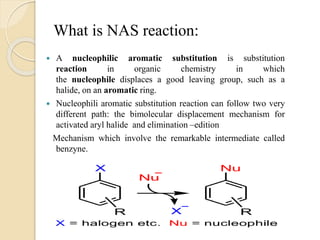
 A nucleophilic aromatic substitution is substitution
reaction in organic chemistry in which
the nucleophile displaces a good leaving group, such as a
halide, on an aromatic ring.
 Nucleophili aromatic substitution reaction can follow two very
different path: the bimolecular displacement mechanism for
activated aryl halide and elimination –edition
Mechanism which involve the remarkable intermediate called
benzyne.
Mechanism of NAS reactions:
 Elimination-Addition mechanism
 Addition-Elimination mechanism
Elimination-Addition
mechanism:
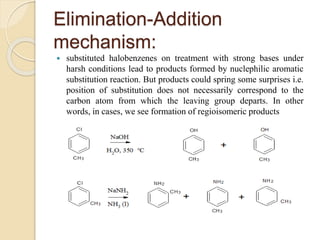
 substituted halobenzenes on treatment with strong bases under
harsh conditions lead to products formed by nuclephilic aromatic
substitution reaction. But products could spring some surprises i.e.
position of substitution does not necessarily correspond to the
carbon atom from which the leaving group departs. In other
words, in cases, we see formation of regioisomeric products
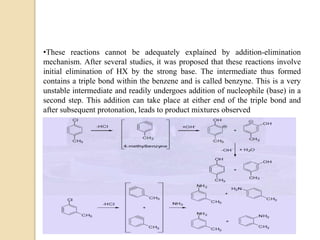
•These reactions cannot be adequately explained by addition-elimination
mechanism. After several studies, it was proposed that these reactions involve
initial elimination of HX by the strong base. The intermediate thus formed
contains a triple bond within the benzene and is called benzyne. This is a very
unstable intermediate and readily undergoes addition of nucleophile (base) in a
second step. This addition can take place at either end of the triple bond and
after subsequent protonation, leads to product mixtures observed
Addition-Elimination
mechanism:
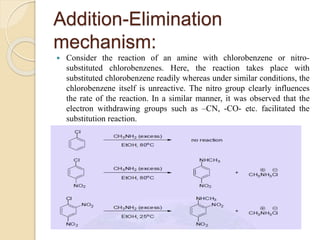
 Consider the reaction of an amine with chlorobenzene or nitro-
substituted chlorobenzenes. Here, the reaction takes place with
substituted chlorobenzene readily whereas under similar conditions, the
chlorobenzene itself is unreactive. The nitro group clearly influences
the rate of the reaction. In a similar manner, it was observed that the
electron withdrawing groups such as –CN, -CO- etc. facilitated the
substitution reaction.
Mechanism:
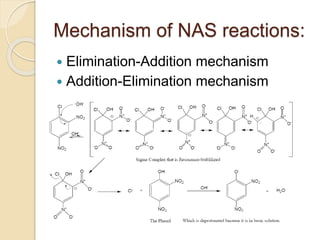
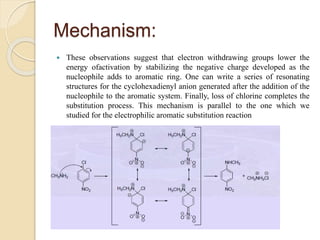
 These observations suggest that electron withdrawing groups lower the
energy ofactivation by stabilizing the negative charge developed as the
nucleophile adds to aromatic ring. One can write a series of resonating
structures for the cyclohexadienyl anion generated after the addition of the
nucleophile to the aromatic system. Finally, loss of chlorine completes the
substitution process. This mechanism is parallel to the one which we
studied for the electrophilic aromatic substitution reaction

Nucleophilic_Aromatic_Substitution_Reaction.pptx

  • 1.
    Nucleophilic Aromatic Substitution Reaction: Kingdom ofsaudi arabia Ministry of education University of Tabuk Faculty of science- Chemistry department
  • 2.
    What is NASreaction:  A nucleophilic aromatic substitution is substitution reaction in organic chemistry in which the nucleophile displaces a good leaving group, such as a halide, on an aromatic ring.  Nucleophili aromatic substitution reaction can follow two very different path: the bimolecular displacement mechanism for activated aryl halide and elimination –edition Mechanism which involve the remarkable intermediate called benzyne.
  • 3.
    Mechanism of NASreactions:  Elimination-Addition mechanism  Addition-Elimination mechanism
  • 4.
    Elimination-Addition mechanism:  substituted halobenzeneson treatment with strong bases under harsh conditions lead to products formed by nuclephilic aromatic substitution reaction. But products could spring some surprises i.e. position of substitution does not necessarily correspond to the carbon atom from which the leaving group departs. In other words, in cases, we see formation of regioisomeric products
  • 5.
    •These reactions cannotbe adequately explained by addition-elimination mechanism. After several studies, it was proposed that these reactions involve initial elimination of HX by the strong base. The intermediate thus formed contains a triple bond within the benzene and is called benzyne. This is a very unstable intermediate and readily undergoes addition of nucleophile (base) in a second step. This addition can take place at either end of the triple bond and after subsequent protonation, leads to product mixtures observed
  • 6.
    Addition-Elimination mechanism:  Consider thereaction of an amine with chlorobenzene or nitro- substituted chlorobenzenes. Here, the reaction takes place with substituted chlorobenzene readily whereas under similar conditions, the chlorobenzene itself is unreactive. The nitro group clearly influences the rate of the reaction. In a similar manner, it was observed that the electron withdrawing groups such as –CN, -CO- etc. facilitated the substitution reaction.
  • 7.
    Mechanism:  These observationssuggest that electron withdrawing groups lower the energy ofactivation by stabilizing the negative charge developed as the nucleophile adds to aromatic ring. One can write a series of resonating structures for the cyclohexadienyl anion generated after the addition of the nucleophile to the aromatic system. Finally, loss of chlorine completes the substitution process. This mechanism is parallel to the one which we studied for the electrophilic aromatic substitution reaction