BUDGET
 FPE 3253
 DR ZUL ARIFF ABDUL LATIFF
What are the organizational functions
of budgets?
1. Budgets as a planning process
2. Budgets as a priority setting process
3. Budgets as a resource allocation process
4. Budgets as a responsibility allocating
process
5. Budgets as an evaluation process
Uses of Budgets
Budgets can be useful
 To provide overview
 To help allocate resources
 To determine leverage points
 In financial control
Budgets reflect industry type
1. Governmental agencies & non-profits
2. For-profits
3. Startups
For-profit enterprises
1. Two flavors of money: revenue and
investment.
2. Budgets do not allocate "money," but allocate
revenue projections.
3. Quarterly review of revenue vs. projections,
continuous evaluation and problem solving.
4. Performance against the budget determines
rewards.
“Flavors of money”
 Source and restrictions
 One time and recurring
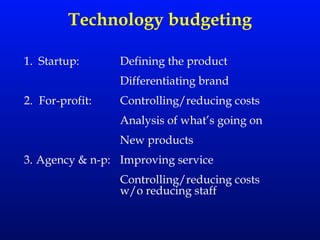
Technology budgeting
1. Startup: Defining the product
Differentiating brand
2. For-profit: Controlling/reducing costs
Analysis of what’s going on
New products
3. Agency & n-p: Improving service
Controlling/reducing costs
w/o reducing staff
Planning horizon: motivation
1. Startup: differentiating brand
creating market
2. For-profit: controlling costs and
maximizing profit for
shareholders
3. Agency & n-p: Quality of service, as
defined by professionals, not
customers
Incentives
1.Startup: Valuation of options
2.For-profit: Bonus
Raises
Promotion
3.Agency & n-p: Professional ethics, job
security
D. The Role of Accounting
 Provide useful information to
 Owners
 Managers
 Potential investors
 Regulators
What would be in the introductory parts
of a financial management course
• Background/Objectives
• Key Financial Accounting
Concepts
• The Financial Statements
• Interpretation and Analysis
What Are We Talking About?
What do accountants do? How do they do it?
Who cares about what they do and how it’s done?
• Financial Accounting
– Preparation of financial
statements
– Audit
– Control
• Managerial (or Cost) Accounting
– Budgets and variances
– Analysis for management
decisions
– Cost and profitability
assessment
QUESTION
 1. What is a budget?
 2. Tips for developing budget?

Ch 10 budget

  • 1.
    BUDGET  FPE 3253 DR ZUL ARIFF ABDUL LATIFF
  • 6.
    What are theorganizational functions of budgets? 1. Budgets as a planning process 2. Budgets as a priority setting process 3. Budgets as a resource allocation process 4. Budgets as a responsibility allocating process 5. Budgets as an evaluation process
  • 7.
    Uses of Budgets Budgetscan be useful  To provide overview  To help allocate resources  To determine leverage points  In financial control
  • 8.
    Budgets reflect industrytype 1. Governmental agencies & non-profits 2. For-profits 3. Startups
  • 9.
    For-profit enterprises 1. Twoflavors of money: revenue and investment. 2. Budgets do not allocate "money," but allocate revenue projections. 3. Quarterly review of revenue vs. projections, continuous evaluation and problem solving. 4. Performance against the budget determines rewards.
  • 10.
    “Flavors of money” Source and restrictions  One time and recurring
  • 11.
    Technology budgeting 1. Startup:Defining the product Differentiating brand 2. For-profit: Controlling/reducing costs Analysis of what’s going on New products 3. Agency & n-p: Improving service Controlling/reducing costs w/o reducing staff
  • 12.
    Planning horizon: motivation 1.Startup: differentiating brand creating market 2. For-profit: controlling costs and maximizing profit for shareholders 3. Agency & n-p: Quality of service, as defined by professionals, not customers
  • 13.
    Incentives 1.Startup: Valuation ofoptions 2.For-profit: Bonus Raises Promotion 3.Agency & n-p: Professional ethics, job security
  • 14.
    D. The Roleof Accounting  Provide useful information to  Owners  Managers  Potential investors  Regulators
  • 15.
    What would bein the introductory parts of a financial management course • Background/Objectives • Key Financial Accounting Concepts • The Financial Statements • Interpretation and Analysis
  • 16.
    What Are WeTalking About? What do accountants do? How do they do it? Who cares about what they do and how it’s done? • Financial Accounting – Preparation of financial statements – Audit – Control • Managerial (or Cost) Accounting – Budgets and variances – Analysis for management decisions – Cost and profitability assessment
  • 17.
    QUESTION  1. Whatis a budget?  2. Tips for developing budget?