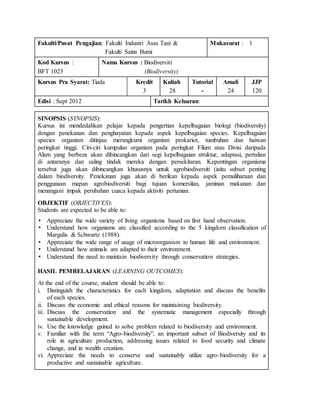
Fakulti/Pusat Pengajian: Fakulti Industri Asas Tani &
Fakulti Sains Bumi
Mukasurat : 1
Kod Kursus :
BFT 1023
Nama Kursus : Biodiversiti
(Biodiversity)
Kursus Pra Syarat: Tiada Kredit
3
Kuliah
28
Tutorial
-
Amali
24
JJP
120
Edisi : Sept 2012 Tarikh Keluaran:
SINOPSIS (SYNOPSIS):
Kursus ini mendedahkan pelajar kepada pengertian kepelbagaian biologi (biodiversity)
dengan penekanan dan penghayatan kepada aspek kepelbagaian species. Kepelbagaian
species organism ditinjau merangkumi organism prokariot, tumbuhan dan haiwan
peringkat tinggi. Ciri-ciri kumpulan organism pada peringkat Filum atau Divisi daripada
Alam yang berbeza akan dibincangkan dari segi kepelbagaian struktur, adaptasi, pertalian
di antaranya dan saling tindak mereka dengan persekitaran. Kepentingan organisma
tersebut juga akan dibincangkan khususnya untuk agrobiodiversiti (iaitu subset penting
dalam biodiversity. Penekanan juga akan di berikan kepada aspek pemuliharaan dan
penggunaan mapan agrobiodiversiti bagi tujuan komersilan, jaminan makanan dan
menangani impak perubahan cuaca kepada aktiviti pertanian.
OBJEKTIF (OBJECTIVES):
Students are expected to be able to:
• Appreciate the wide variety of living organisms based on first hand observation.
• Understand how organisms are classified according to the 5 kingdom classification of
Margulis & Schwartz (1988).
• Appreciate the wide range of usage of microorganism to human life and environment.
• Understand how animals are adapted to their environment.
• Understand the need to maintain biodiversity through conservation strategies.
HASIL PEMBELAJARAN (LEARNING OUTCOMES):
At the end of the course, student should be able to:
i. Distinguish the characteristics for each kingdom, adaptation and discuss the benefits
of each species.
ii. Discuss the economic and ethical reasons for maintaining biodiversity.
iii. Discuss the conservation and the systematic management especially through
sustainable development.
iv. Use the knowledge gained to solve problem related to biodiversity and environment.
v. Familiar with the term “Agro-biodiversity”, an important subset of Biodiversity and its
role in agriculture production, addressing issues related to food security and climate
change, and in wealth creation.
vi. Appreciate the needs to conserve and sustainably utilize agro-biodiversity for a
productive and sustainable agriculture.
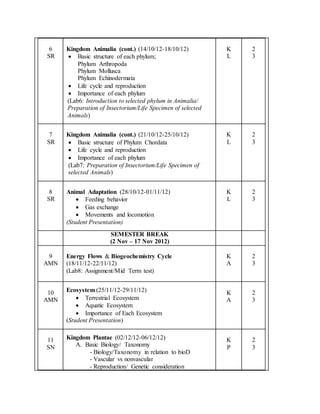
SILABUS (SYLLABUS) & RANGKA PENGAJARAN (TEACHING PLAN):
Minggu
Topics/Syllabus (K/T/L) JJP
1
FT
Basic Knowledge on Biodiversity (09/09/12-13/09/12)
 Definitions
 Classification of organisms
 Taxonomy, nomenclature and systematic
 Artificial and natural classification
 Species identification and keywords.
(Lab1: Introduction to the light microscope)
K
L
2
3
2
FT
Kingdom Monera (16/09/12-20/09/12)
 Classification of Moneran
 Basic structure of bacteria
 Reproduction
 Diversity of bacteria
 Importance of bacteria
(Lab2: Introduction to selected Moneran)
K
L
2
3
3
FT
Kingdom Protista (23/09/12-27/09/12)
 Classification of Protists
 Basic structure
 Reproduction
 Importance of Protists
(Lab3: Introduction to selected Protists)
K
L
2
3
4
FT
Kingdom Fungi (30/09/12-04/10/12)
 Classification of Fungi
 Basic structure
 Reproduction
 Importance of Fungi
(Lab4: Introduction to selected Fungi)
K
L
2
3
5
SR
Kingdom Animalia (07/10/12-11/10/12)
 Classification of Animalia based on phylogenetic tree
 Basic structure of each phylum;
Phylum Porifera
Phylum Cnidaria
Phylum Platyhelmenthis
Phylum Nematodea
Phylum Annelida
 Life cycle and reproduction
 Importance of each phylum
(Lab5: Introduction to selected phylum in Animalia)
2
3
6
SR
Kingdom Animalia (cont.) (14/10/12-18/10/12)
 Basic structure of each phylum;
Phylum Arthropoda
Phylum Mollusca
Phylum Echinodermata
 Life cycle and reproduction
 Importance of each phylum
(Lab6: Introduction to selected phylum in Animalia/
Preparation of Insectorium/Life Specimen of selected
Animals)
K
L
2
3
7
SR
Kingdom Animalia (cont.) (21/10/12-25/10/12)
 Basic structure of Phylum Chordata
 Life cycle and reproduction
 Importance of each phylum
(Lab7: Preparation of Insectorium/Life Specimen of
selected Animals)
K
L
2
3
8
SR
Animal Adaptation (28/10/12-01/11/12)
 Feeding behavior
 Gas exchange
 Movements and locomotion
(Student Presentation)
K
L
2
3
SEMESTER BREAK
(2 Nov – 17 Nov 2012)
9
AMN
Energy Flows & Biogeochemistry Cycle
(18/11/12-22/11/12)
(Lab8: Assignment/Mid Term test)
K
A
2
3
10
AMN
Ecosystem (25/11/12-29/11/12)
 Terrestrial Ecosystem
 Aquatic Ecosystem
 Importance of Each Ecosystem
(Student Presentation)
K
A
2
3
11
SN
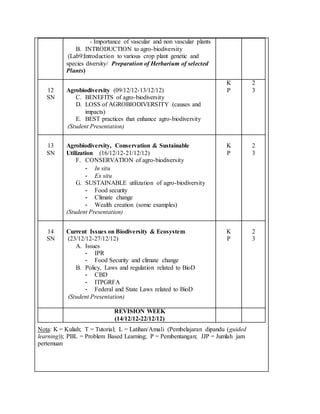
Kingdom Plantae (02/12/12-06/12/12)
A. Basic Biology/ Taxonomy
- Biology/Taxonomy in relation to bioD
- Vascular vs nonvascular
- Reproduction/ Genetic consideration
K
P
2
3
- Importance of vascular and non vascular plants
B. INTRODUCTION to agro-biodiversity
(Lab9:Introduction to various crop plant genetic and
species diversity/ Preparation of Herbarium of selected
Plants)
12
SN
Agrobiodiversity (09/12/12-13/12/12)
C. BENEFITS of agro-biodiversity
D. LOSS of AGROBIODIVERSITY (causes and
impacts)
E. BEST practices that enhance agro-biodiversity
(Student Presentation)
K
P
2
3
13
SN
Agrobiodiversity, Conservation & Sustainable
Utilization (16/12/12-21/12/12)
F. CONSERVATION of agro-biodiversity
- In situ
- Ex situ
G. SUSTAINABLE utilization of agro-biodiversity
- Food security
- Climate change
- Wealth creation (some examples)
(Student Presentation)
K
P
2
3
14
SN
Current Issues on Biodiversity & Ecosystem
(23/12/12-27/12/12)
A. Issues
- IPR
- Food Security and climate change
B. Policy, Laws and regulation related to BioD
- CBD
- ITPGRFA
- Federal and State Laws related to BioD
(Student Presentation)
K
P
2
3
REVISION WEEK
(14/12/12-22/12/12)
Nota: K = Kuliah; T = Tutorial; L = Latihan/Amali (Pembelajaran dipandu (guided
learning)); PBL = Problem Based Learning; P = Pembentangan; JJP = Jumlah jam
pertemuan
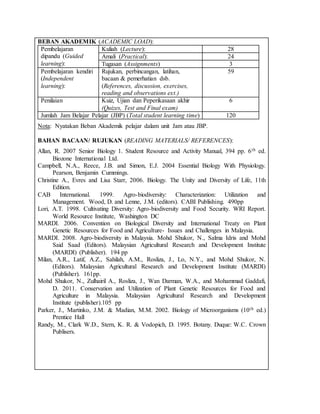
BEBAN AKADEMIK (ACADEMIC LOAD):
Pembelajaran
dipandu (Guided
learning):
Kuliah (Lecture): 28
Amali (Practical): 24
Tugasan (Assignments) 3
Pembelajaran kendiri
(Independent
learning):
Rujukan, perbincangan, latihan,
bacaan & pemerhatian dsb.
(References, discussion, exercises,
reading and observations ext.)
59
Penilaian Kuiz, Ujian dan Peperikasaan akhir
(Quizes, Test and Final exam)
6
Jumlah Jam Belajar Pelajar (JBP) (Total student learning time) 120
Nota: Nyatakan Beban Akademik pelajar dalam unit Jam atau JBP.
BAHAN BACAAN/ RUJUKAN (READING MATERIALS/ REFERENCES):
Allan, R. 2007 Senior Biology 1. Student Resource and Activity Manual, 394 pp. 6th ed.
Biozone International Ltd.
Campbell, N.A., Reece, J.B. and Simon, E.J. 2004 Essential Biology With Physiology.
Pearson, Benjamin Cummings.
Christine A., Evres and Lisa Starr, 2006. Biology. The Unity and Diversity of Life, 11th
Edition.
CAB International. 1999. Agro-biodiversity: Characterization: Utilization and
Management. Wood, D. and Lenne, J.M. (editors). CABI Publishing. 490pp
Lori, A.T. 1998. Cultivating Diversity: Agro-biodiversity and Food Security. WRI Report.
World Resource Institute, Washington DC
MARDI. 2006. Convention on Biological Diversity and International Treaty on Plant
Genetic Resources for Food and Agriculture- Issues and Challenges in Malaysia.
MARDI. 2008. Agro-biodiversity in Malaysia. Mohd Shukor, N., Salma Idris and Mohd
Said Saad (Editors). Malaysian Agricultural Research and Development Institute
(MARDI) (Publisher). 194 pp
Milan, A.R., Latif, A.Z., Sahilah, A.M., Rosliza, J., Lo, N.Y., and Mohd Shukor, N.
(Editors). Malaysian Agricultural Research and Development Institute (MARDI)
(Publisher). 161pp.
Mohd Shukor, N., Zulhairil A., Rosliza, J., Wan Darman, W.A., and Mohammad Gaddafi,
D. 2011. Conservation and Utilization of Plant Genetic Resources for Food and
Agriculture in Malaysia. Malaysian Agricultural Research and Development
Institute (publisher).105 pp
Parker, J., Martinko, J.M. & Madian, M.M. 2002. Biology of Microorganisms (10th ed.)
Prentice Hall
Randy, M., Clark W.D., Stern, K. R. & Vodopich, D. 1995. Botany. Duque: W.C. Crown
Publisers.
SKIM PENILAIAN (ASSESSMENT SCHEME):
a. Final Examination = 40%
b. Practical report = 15%
c. Mid-term/Test = 15%
d. Quizzes = 5%
e. Practical exam = 10%
f. Assignments & Presentation = 15%
JUMLAH = 100%
KEHADIRAN DAN PERATURAN KHUSUS PENGAJARAN (ATTENDANCE &
OTHER SPECIFIC REGULATIONS IN TEACHING):
Student’s attendance must not less than 80% from the contact hours to make sure they are
qualified for their final exam.
Disediakan oleh:
Tandatangan :
Nama : Dr. Fatimah Kayat
Jawatan : Pensyarah
Tarikh : 11 Jun 2012
Disahkan oleh:
Tandatangan :
Nama : Prof. Dr. Ahmad Anwar Ismail
Jawatan : Dean
Tarikh :
GRADING OF THE COURSE
The lab report grade makes up 15% of the course grade. It will be calculated from the total
marks of accumulative lab report throughout the course.
Submission of report is at the end of each lab session. (Exception if different dateline
mentioned in the class)
–1 mark for each day late and not accepted after 3 days.
Mark distribution of each lab report will be:
 Introduction 1.0/10
 Purpose/Objective 1.0/10
 Materials and Procedure 1.5/10
 Results-Discussion-Questions 6.0/10
 References 0.5/10
 (“Lab manual” as a reference is not accepted)

Bft 1023-biodiversity-sep2012

  • 1.
    Fakulti/Pusat Pengajian: FakultiIndustri Asas Tani & Fakulti Sains Bumi Mukasurat : 1 Kod Kursus : BFT 1023 Nama Kursus : Biodiversiti (Biodiversity) Kursus Pra Syarat: Tiada Kredit 3 Kuliah 28 Tutorial - Amali 24 JJP 120 Edisi : Sept 2012 Tarikh Keluaran: SINOPSIS (SYNOPSIS): Kursus ini mendedahkan pelajar kepada pengertian kepelbagaian biologi (biodiversity) dengan penekanan dan penghayatan kepada aspek kepelbagaian species. Kepelbagaian species organism ditinjau merangkumi organism prokariot, tumbuhan dan haiwan peringkat tinggi. Ciri-ciri kumpulan organism pada peringkat Filum atau Divisi daripada Alam yang berbeza akan dibincangkan dari segi kepelbagaian struktur, adaptasi, pertalian di antaranya dan saling tindak mereka dengan persekitaran. Kepentingan organisma tersebut juga akan dibincangkan khususnya untuk agrobiodiversiti (iaitu subset penting dalam biodiversity. Penekanan juga akan di berikan kepada aspek pemuliharaan dan penggunaan mapan agrobiodiversiti bagi tujuan komersilan, jaminan makanan dan menangani impak perubahan cuaca kepada aktiviti pertanian. OBJEKTIF (OBJECTIVES): Students are expected to be able to: • Appreciate the wide variety of living organisms based on first hand observation. • Understand how organisms are classified according to the 5 kingdom classification of Margulis & Schwartz (1988). • Appreciate the wide range of usage of microorganism to human life and environment. • Understand how animals are adapted to their environment. • Understand the need to maintain biodiversity through conservation strategies. HASIL PEMBELAJARAN (LEARNING OUTCOMES): At the end of the course, student should be able to: i. Distinguish the characteristics for each kingdom, adaptation and discuss the benefits of each species. ii. Discuss the economic and ethical reasons for maintaining biodiversity. iii. Discuss the conservation and the systematic management especially through sustainable development. iv. Use the knowledge gained to solve problem related to biodiversity and environment. v. Familiar with the term “Agro-biodiversity”, an important subset of Biodiversity and its role in agriculture production, addressing issues related to food security and climate change, and in wealth creation. vi. Appreciate the needs to conserve and sustainably utilize agro-biodiversity for a productive and sustainable agriculture.
  • 2.
    SILABUS (SYLLABUS) &RANGKA PENGAJARAN (TEACHING PLAN): Minggu Topics/Syllabus (K/T/L) JJP 1 FT Basic Knowledge on Biodiversity (09/09/12-13/09/12)  Definitions  Classification of organisms  Taxonomy, nomenclature and systematic  Artificial and natural classification  Species identification and keywords. (Lab1: Introduction to the light microscope) K L 2 3 2 FT Kingdom Monera (16/09/12-20/09/12)  Classification of Moneran  Basic structure of bacteria  Reproduction  Diversity of bacteria  Importance of bacteria (Lab2: Introduction to selected Moneran) K L 2 3 3 FT Kingdom Protista (23/09/12-27/09/12)  Classification of Protists  Basic structure  Reproduction  Importance of Protists (Lab3: Introduction to selected Protists) K L 2 3 4 FT Kingdom Fungi (30/09/12-04/10/12)  Classification of Fungi  Basic structure  Reproduction  Importance of Fungi (Lab4: Introduction to selected Fungi) K L 2 3 5 SR Kingdom Animalia (07/10/12-11/10/12)  Classification of Animalia based on phylogenetic tree  Basic structure of each phylum; Phylum Porifera Phylum Cnidaria Phylum Platyhelmenthis Phylum Nematodea Phylum Annelida  Life cycle and reproduction  Importance of each phylum (Lab5: Introduction to selected phylum in Animalia) 2 3
  • 3.
    6 SR Kingdom Animalia (cont.)(14/10/12-18/10/12)  Basic structure of each phylum; Phylum Arthropoda Phylum Mollusca Phylum Echinodermata  Life cycle and reproduction  Importance of each phylum (Lab6: Introduction to selected phylum in Animalia/ Preparation of Insectorium/Life Specimen of selected Animals) K L 2 3 7 SR Kingdom Animalia (cont.) (21/10/12-25/10/12)  Basic structure of Phylum Chordata  Life cycle and reproduction  Importance of each phylum (Lab7: Preparation of Insectorium/Life Specimen of selected Animals) K L 2 3 8 SR Animal Adaptation (28/10/12-01/11/12)  Feeding behavior  Gas exchange  Movements and locomotion (Student Presentation) K L 2 3 SEMESTER BREAK (2 Nov – 17 Nov 2012) 9 AMN Energy Flows & Biogeochemistry Cycle (18/11/12-22/11/12) (Lab8: Assignment/Mid Term test) K A 2 3 10 AMN Ecosystem (25/11/12-29/11/12)  Terrestrial Ecosystem  Aquatic Ecosystem  Importance of Each Ecosystem (Student Presentation) K A 2 3 11 SN Kingdom Plantae (02/12/12-06/12/12) A. Basic Biology/ Taxonomy - Biology/Taxonomy in relation to bioD - Vascular vs nonvascular - Reproduction/ Genetic consideration K P 2 3
  • 4.
    - Importance ofvascular and non vascular plants B. INTRODUCTION to agro-biodiversity (Lab9:Introduction to various crop plant genetic and species diversity/ Preparation of Herbarium of selected Plants) 12 SN Agrobiodiversity (09/12/12-13/12/12) C. BENEFITS of agro-biodiversity D. LOSS of AGROBIODIVERSITY (causes and impacts) E. BEST practices that enhance agro-biodiversity (Student Presentation) K P 2 3 13 SN Agrobiodiversity, Conservation & Sustainable Utilization (16/12/12-21/12/12) F. CONSERVATION of agro-biodiversity - In situ - Ex situ G. SUSTAINABLE utilization of agro-biodiversity - Food security - Climate change - Wealth creation (some examples) (Student Presentation) K P 2 3 14 SN Current Issues on Biodiversity & Ecosystem (23/12/12-27/12/12) A. Issues - IPR - Food Security and climate change B. Policy, Laws and regulation related to BioD - CBD - ITPGRFA - Federal and State Laws related to BioD (Student Presentation) K P 2 3 REVISION WEEK (14/12/12-22/12/12) Nota: K = Kuliah; T = Tutorial; L = Latihan/Amali (Pembelajaran dipandu (guided learning)); PBL = Problem Based Learning; P = Pembentangan; JJP = Jumlah jam pertemuan
  • 5.
    BEBAN AKADEMIK (ACADEMICLOAD): Pembelajaran dipandu (Guided learning): Kuliah (Lecture): 28 Amali (Practical): 24 Tugasan (Assignments) 3 Pembelajaran kendiri (Independent learning): Rujukan, perbincangan, latihan, bacaan & pemerhatian dsb. (References, discussion, exercises, reading and observations ext.) 59 Penilaian Kuiz, Ujian dan Peperikasaan akhir (Quizes, Test and Final exam) 6 Jumlah Jam Belajar Pelajar (JBP) (Total student learning time) 120 Nota: Nyatakan Beban Akademik pelajar dalam unit Jam atau JBP. BAHAN BACAAN/ RUJUKAN (READING MATERIALS/ REFERENCES): Allan, R. 2007 Senior Biology 1. Student Resource and Activity Manual, 394 pp. 6th ed. Biozone International Ltd. Campbell, N.A., Reece, J.B. and Simon, E.J. 2004 Essential Biology With Physiology. Pearson, Benjamin Cummings. Christine A., Evres and Lisa Starr, 2006. Biology. The Unity and Diversity of Life, 11th Edition. CAB International. 1999. Agro-biodiversity: Characterization: Utilization and Management. Wood, D. and Lenne, J.M. (editors). CABI Publishing. 490pp Lori, A.T. 1998. Cultivating Diversity: Agro-biodiversity and Food Security. WRI Report. World Resource Institute, Washington DC MARDI. 2006. Convention on Biological Diversity and International Treaty on Plant Genetic Resources for Food and Agriculture- Issues and Challenges in Malaysia. MARDI. 2008. Agro-biodiversity in Malaysia. Mohd Shukor, N., Salma Idris and Mohd Said Saad (Editors). Malaysian Agricultural Research and Development Institute (MARDI) (Publisher). 194 pp Milan, A.R., Latif, A.Z., Sahilah, A.M., Rosliza, J., Lo, N.Y., and Mohd Shukor, N. (Editors). Malaysian Agricultural Research and Development Institute (MARDI) (Publisher). 161pp. Mohd Shukor, N., Zulhairil A., Rosliza, J., Wan Darman, W.A., and Mohammad Gaddafi, D. 2011. Conservation and Utilization of Plant Genetic Resources for Food and Agriculture in Malaysia. Malaysian Agricultural Research and Development Institute (publisher).105 pp Parker, J., Martinko, J.M. & Madian, M.M. 2002. Biology of Microorganisms (10th ed.) Prentice Hall Randy, M., Clark W.D., Stern, K. R. & Vodopich, D. 1995. Botany. Duque: W.C. Crown Publisers.
  • 6.
    SKIM PENILAIAN (ASSESSMENTSCHEME): a. Final Examination = 40% b. Practical report = 15% c. Mid-term/Test = 15% d. Quizzes = 5% e. Practical exam = 10% f. Assignments & Presentation = 15% JUMLAH = 100% KEHADIRAN DAN PERATURAN KHUSUS PENGAJARAN (ATTENDANCE & OTHER SPECIFIC REGULATIONS IN TEACHING): Student’s attendance must not less than 80% from the contact hours to make sure they are qualified for their final exam. Disediakan oleh: Tandatangan : Nama : Dr. Fatimah Kayat Jawatan : Pensyarah Tarikh : 11 Jun 2012 Disahkan oleh: Tandatangan : Nama : Prof. Dr. Ahmad Anwar Ismail Jawatan : Dean Tarikh :
  • 7.
    GRADING OF THECOURSE The lab report grade makes up 15% of the course grade. It will be calculated from the total marks of accumulative lab report throughout the course. Submission of report is at the end of each lab session. (Exception if different dateline mentioned in the class) –1 mark for each day late and not accepted after 3 days. Mark distribution of each lab report will be:  Introduction 1.0/10  Purpose/Objective 1.0/10  Materials and Procedure 1.5/10  Results-Discussion-Questions 6.0/10  References 0.5/10  (“Lab manual” as a reference is not accepted)