Downloaded 32 times

![MATTHEW ARNOLD
1822-1888
“The critical power is of lower rank than
the creative. . . . It is undeniable that the
exercise of a creative power, that a free
creative activity, is the highest function
of man . . . . The critical power . . . see[s]
the object as in itself it really is. . . .”
The Function of Criticism 1385-6](https://image.slidesharecdn.com/arnoldandhiscriticismbyijs-191220072019/75/Arnold-and-his-criticism-The-Study-of-Poetry-2-2048.jpg)

![Matthew Arnold is the first critic who produced
scientific conception of reading.
Arnold initiated the formal criticism in poetry!
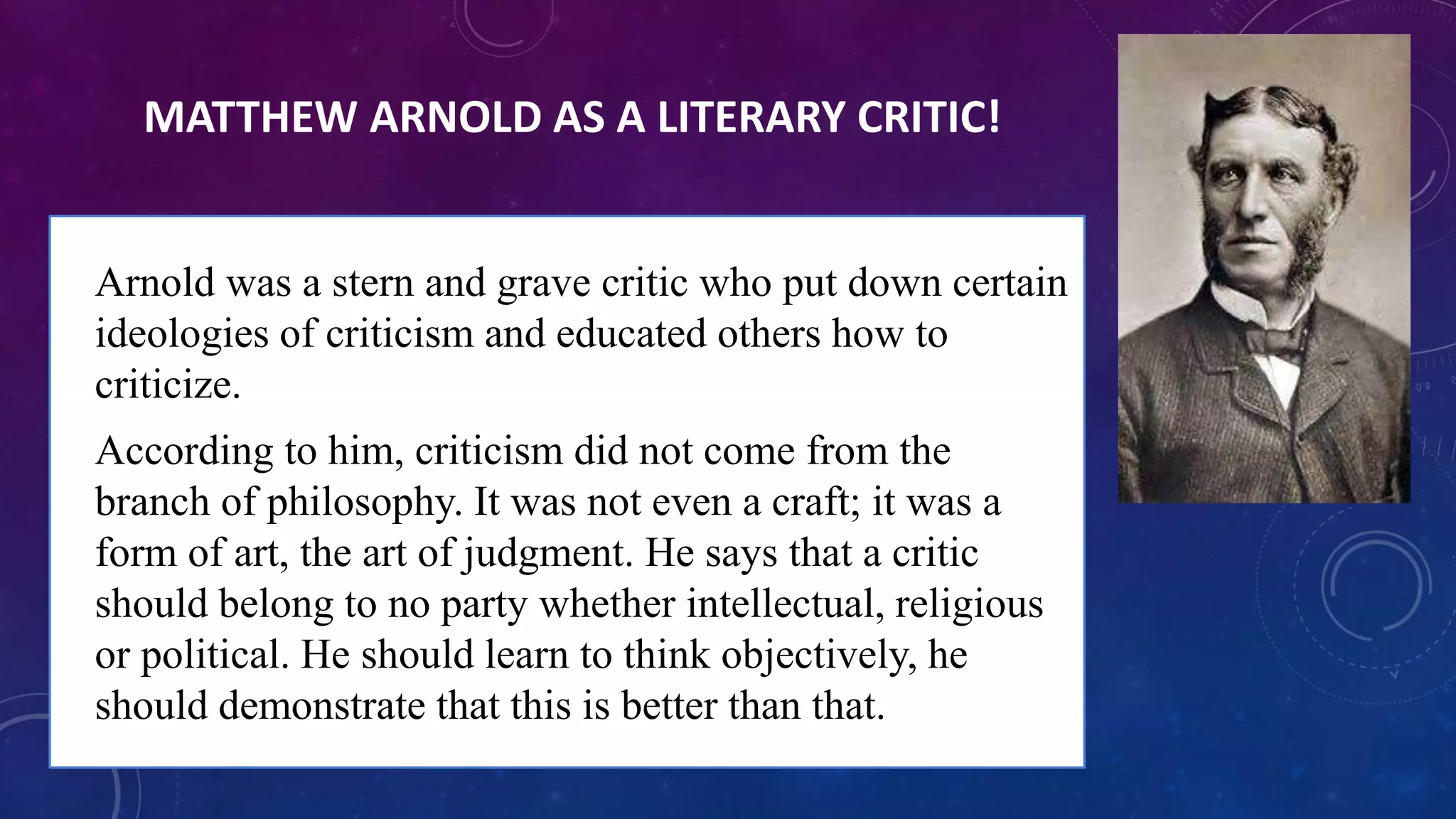
Mathew Arnold, the most influential of the Victorian critic has been
characterized by David Daiches as “the great modern critic”.
Arnold deplored [found unacceptable] the lack of firm authority and
centrality of excellence in the literature of their age and within their
criticism each has sought to establish critical standards which would be
valid independent of time and space.](https://image.slidesharecdn.com/arnoldandhiscriticismbyijs-191220072019/75/Arnold-and-his-criticism-The-Study-of-Poetry-4-2048.jpg)








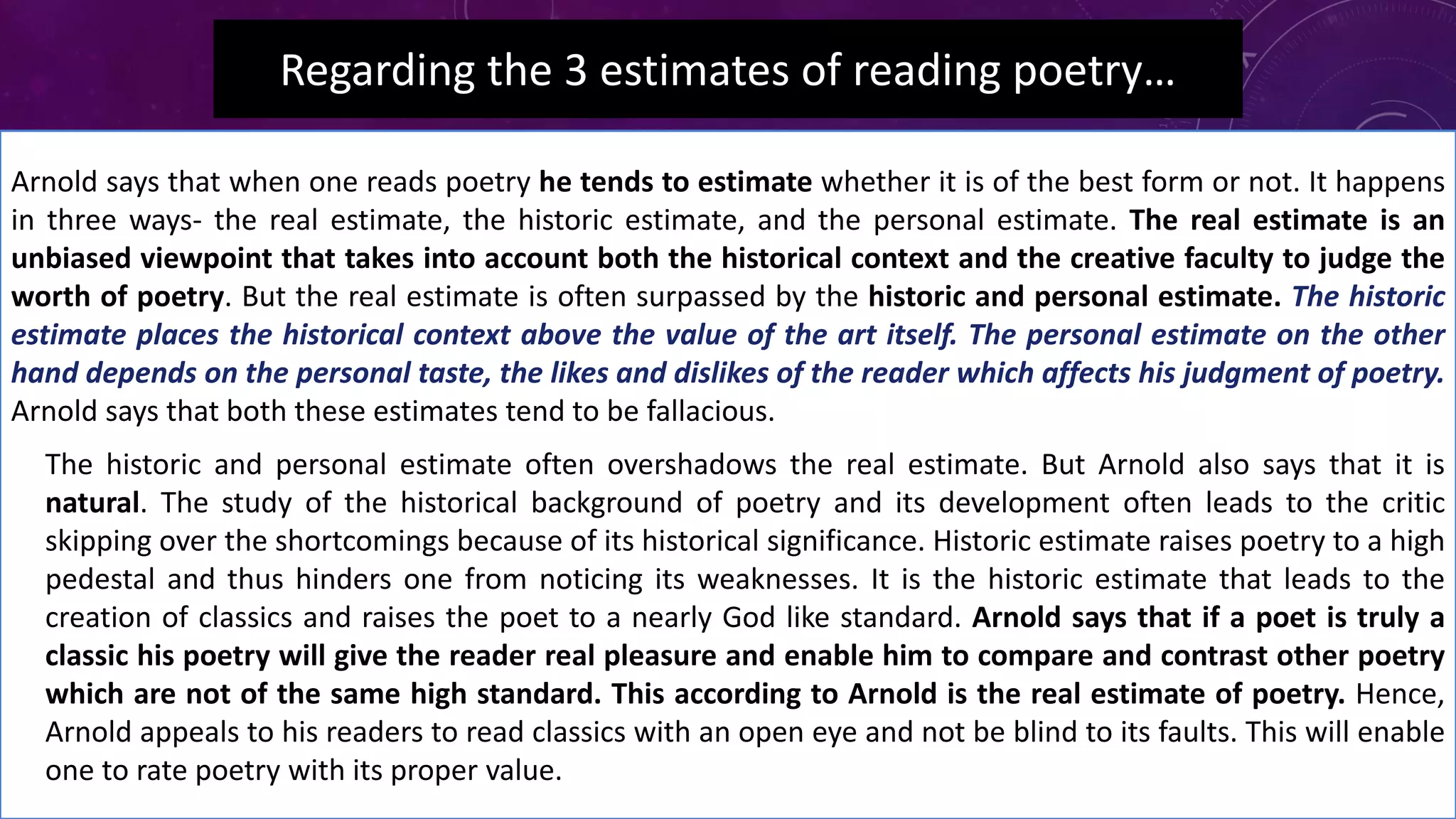


The Victorian era (1837-1901) was marked by social contrasts, technological advances, and the rise of literary criticism, most notably through Matthew Arnold, who stressed the importance of poetry as a 'criticism of life.' Arnold's critical approach emphasized objective standards in literature, distinguishing between personal and historical judgments to reveal 'real estimates' of poetic worth while imploring readers to focus on the moral and emotional depth of poetry. Despite being overshadowed by contemporaries like Tennyson and Browning, Arnold's intellectual contribution to poetry and criticism remains significant for understanding Victorian literature's transition to modernism.


