MATTHEW ARNOLD
(1822-1888)
Prepared by : Archana Dave
Introduction
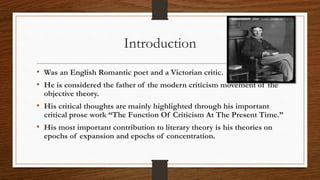
• Was an English Romantic poet and a Victorian critic.
• He is considered the father of the modern criticism movement of the
objective theory.
• His critical thoughts are mainly highlighted through his important
critical prose work “The Function Of Criticism At The Present Time.”
• His most important contribution to literary theory is his theories on
epochs of expansion and epochs of concentration.
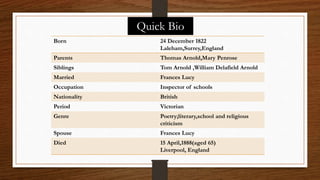
Born 24 December 1822
Laleham,Surrey,England
Parents Thomas Arnold,Mary Penrose
Siblings Tom Arnold ,William Delafield Arnold
Married Frances Lucy
Occupation Inspector of schools
Nationality British
Period Victorian
Genre Poetry;literary,school and religious
criticism
Spouse Frances Lucy
Died 15 April,1888(aged 65)
Liverpool, England
Quick Bio
Education
• He entered the school (Winchester)officially the first time than he moved
in1837 to Rugby school,which was run by his father and where he stayed
until the end of his secondary education in 1840.
• Matthew Arnold entered the University of Oxford in 1841,after receiving
a grant from the open that University,
• And in 1845 was named a fellow of the Arnold of the teaching staff of
the faculty of the university of Oxford Oriel.
Literary Biography
• Matthew Arnold took over the post of professor of poetry at Oxford
University (1857-1867) as well as its inspector general for school.
• Went on a number of missions and visitations of European Schools.
• Impressed by some of educational systems & wrote several books about
them.
Arnold’s Work
• 1850s : Large of poems appeared
• 1860s : Literary & Social criticism
• 1870s : Religious & Educational writing
• 1880s : Second set of essays on literary criticism
Poetry
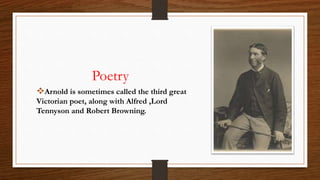
Arnold is sometimes called the third great
Victorian poet, along with Alfred ,Lord
Tennyson and Robert Browning.
Arnold’s Career
• Arnold : The Poet
• Arnold : The Critic
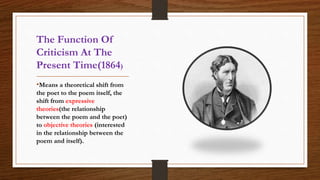
The Function Of
Criticism At The
Present Time(1864)
•Means a theoretical shift from
the poet to the poem itself, the
shift from expressive
theories(the relationship
between the poem and the poet)
to objective theories (interested
in the relationship between the
poem and itself).
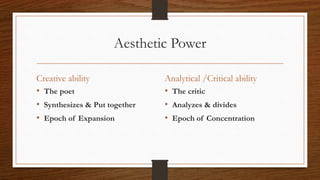
Aesthetic Power
Creative ability
• The poet
• Synthesizes & Put together
• Epoch of Expansion
Analytical /Critical ability
• The critic
• Analyzes & divides
• Epoch of Concentration
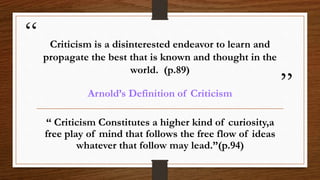
“
”
Criticism is a disinterested endeavor to learn and
propagate the best that is known and thought in the
world. (p.89)
Arnold’s Definition of Criticism
“ Criticism Constitutes a higher kind of curiosity,a
free play of mind that follows the free flow of ideas
whatever that follow may lead.”(p.94)
Function of Criticism & Critic
• “Criticism is a disinterested endeavor to learn and propagate the best that is known
and thought in the world and thus to establish a current of fresh and true ideas.”
• Thus, criticism is not merely, “Judgment in literature ”, its function is much more
noble, exalted and catholic.
• The critic’s function is that of a missionary.
• R.A.Scott James says ,“The function of Arnold’s critic in the broadest sence of the
term is to promote culture; his function as literary critic is to promote that part of
culture which depends upon knowledge of literature.”
• For Arnold, a literary critic is a propagandist not a salesman.
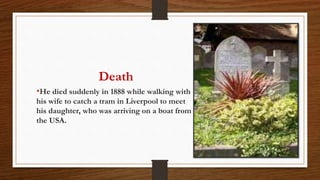
Death
•He died suddenly in 1888 while walking with
his wife to catch a tram in Liverpool to meet
his daughter, who was arriving on a boat from
the USA.

'MATTHEW ARNOLD'

  • 1.
  • 2.
    Introduction • Was anEnglish Romantic poet and a Victorian critic. • He is considered the father of the modern criticism movement of the objective theory. • His critical thoughts are mainly highlighted through his important critical prose work “The Function Of Criticism At The Present Time.” • His most important contribution to literary theory is his theories on epochs of expansion and epochs of concentration.
  • 3.
    Born 24 December1822 Laleham,Surrey,England Parents Thomas Arnold,Mary Penrose Siblings Tom Arnold ,William Delafield Arnold Married Frances Lucy Occupation Inspector of schools Nationality British Period Victorian Genre Poetry;literary,school and religious criticism Spouse Frances Lucy Died 15 April,1888(aged 65) Liverpool, England Quick Bio
  • 4.
    Education • He enteredthe school (Winchester)officially the first time than he moved in1837 to Rugby school,which was run by his father and where he stayed until the end of his secondary education in 1840.
  • 5.
    • Matthew Arnoldentered the University of Oxford in 1841,after receiving a grant from the open that University, • And in 1845 was named a fellow of the Arnold of the teaching staff of the faculty of the university of Oxford Oriel. Literary Biography • Matthew Arnold took over the post of professor of poetry at Oxford University (1857-1867) as well as its inspector general for school. • Went on a number of missions and visitations of European Schools. • Impressed by some of educational systems & wrote several books about them.
  • 6.
    Arnold’s Work • 1850s: Large of poems appeared • 1860s : Literary & Social criticism • 1870s : Religious & Educational writing • 1880s : Second set of essays on literary criticism
  • 7.
    Poetry Arnold is sometimescalled the third great Victorian poet, along with Alfred ,Lord Tennyson and Robert Browning.
  • 8.
    Arnold’s Career • Arnold: The Poet • Arnold : The Critic
  • 9.
    The Function Of CriticismAt The Present Time(1864) •Means a theoretical shift from the poet to the poem itself, the shift from expressive theories(the relationship between the poem and the poet) to objective theories (interested in the relationship between the poem and itself).
  • 10.
    Aesthetic Power Creative ability •The poet • Synthesizes & Put together • Epoch of Expansion Analytical /Critical ability • The critic • Analyzes & divides • Epoch of Concentration
  • 11.
    “ ” Criticism is adisinterested endeavor to learn and propagate the best that is known and thought in the world. (p.89) Arnold’s Definition of Criticism “ Criticism Constitutes a higher kind of curiosity,a free play of mind that follows the free flow of ideas whatever that follow may lead.”(p.94)
  • 12.
    Function of Criticism& Critic • “Criticism is a disinterested endeavor to learn and propagate the best that is known and thought in the world and thus to establish a current of fresh and true ideas.” • Thus, criticism is not merely, “Judgment in literature ”, its function is much more noble, exalted and catholic. • The critic’s function is that of a missionary. • R.A.Scott James says ,“The function of Arnold’s critic in the broadest sence of the term is to promote culture; his function as literary critic is to promote that part of culture which depends upon knowledge of literature.” • For Arnold, a literary critic is a propagandist not a salesman.
  • 13.
    Death •He died suddenlyin 1888 while walking with his wife to catch a tram in Liverpool to meet his daughter, who was arriving on a boat from the USA.