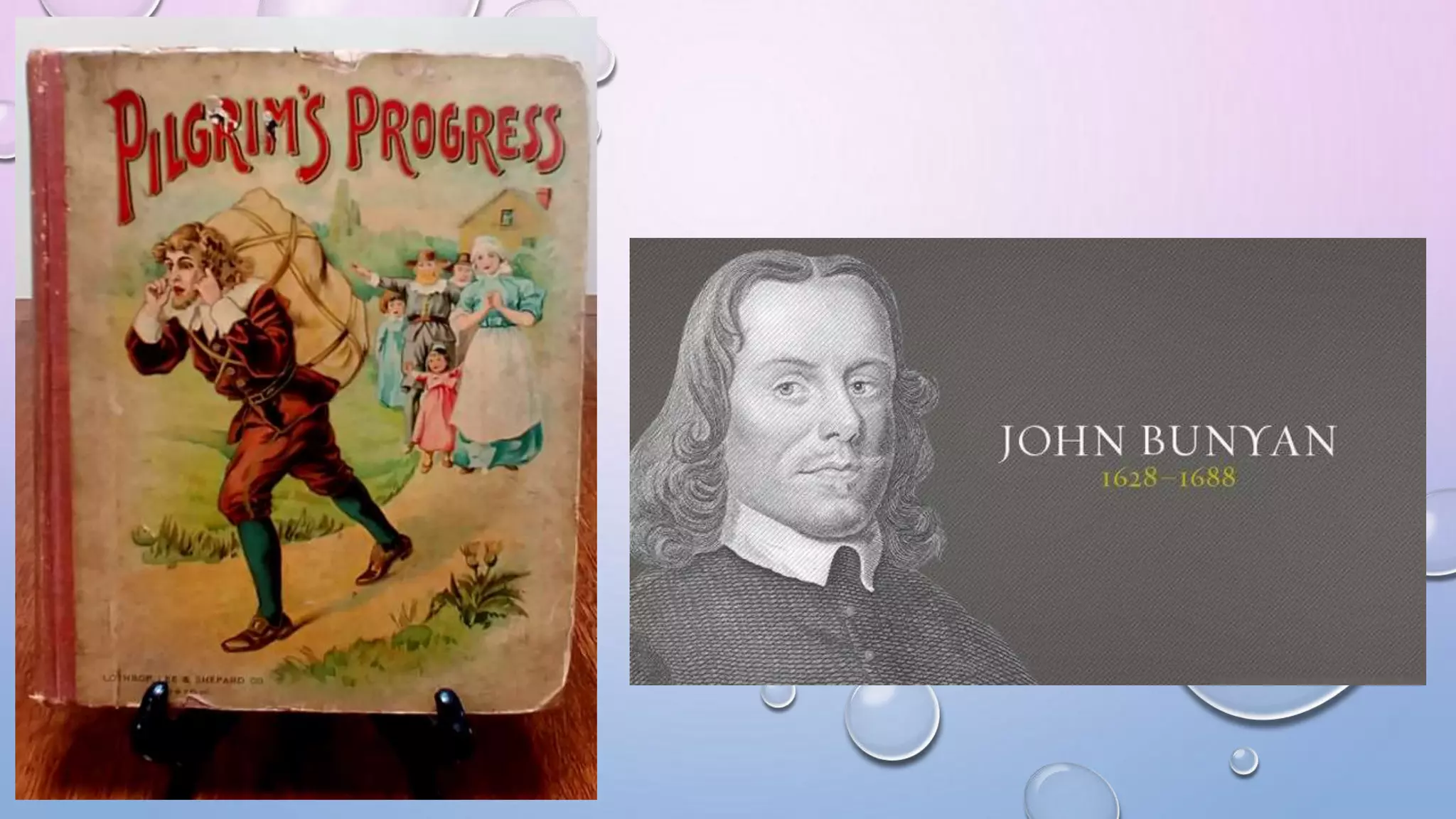
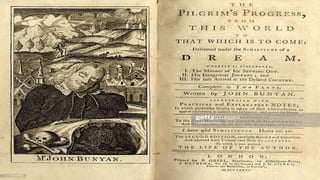
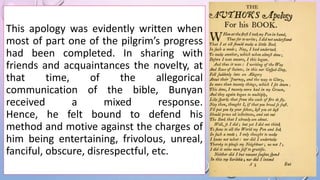
This apology was evidently written when
most of part one of the pilgrim’s progress
had been completed. In sharing with
friends and acquaintances the novelty, at
that time, of the allegorical
communication of the bible, Bunyan
received a mixed response.
Hence, he felt bound to defend his
method and motive against the charges of
him being entertaining, frivolous, unreal,
fanciful, obscure, disrespectful, etc.
BUNYAN’S APOLOGY WAS BORN OF “ANOTHER
[WRITING], . . . ALMOST DONE.”
The Pilgrim’s Progress aims to tell us the religious truths indirectly. The
author says this in his Apology when he answers those critics who
complain that religion should not tolerate storytelling.
The author, Bunyan, replies that the Bible itself contains literature and the
New Testament in particular uses many parables, or indirect illustrations,
to communicate its truths.
The book was born out of Christian journeyings
and out of self-interest.
• As John was in prison, he did not aspire to attain world-wide
literary fame, monetary gain, or approval from his pastoral
peers, but simply self-gratification born of a creative frame
of mind. It was a novel, biblical, literary challenge to his
fertile imagination.
• The book was born out of prison activity.
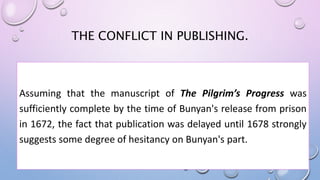
THE CONFLICT IN PUBLISHING.
Assuming that the manuscript of The Pilgrim’s Progress was
sufficiently complete by the time of Bunyan's release from prison
in 1672, the fact that publication was delayed until 1678 strongly
suggests some degree of hesitancy on Bunyan's part.
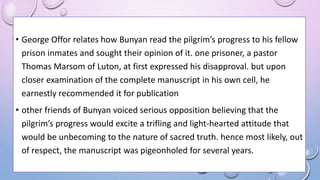
• George Offor relates how Bunyan read the pilgrim’s progress to his fellow
prison inmates and sought their opinion of it. one prisoner, a pastor
Thomas Marsom of Luton, at first expressed his disapproval. but upon
closer examination of the complete manuscript in his own cell, he
earnestly recommended it for publication
• other friends of Bunyan voiced serious opposition believing that the
pilgrim’s progress would excite a trifling and light-hearted attitude that
would be unbecoming to the nature of sacred truth. hence most likely, out
of respect, the manuscript was pigeonholed for several years.
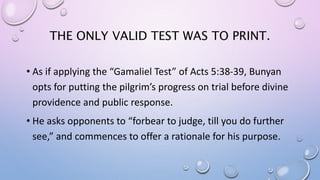
THE ONLY VALID TEST WAS TO PRINT.
• As if applying the “Gamaliel Test” of Acts 5:38-39, Bunyan
opts for putting the pilgrim’s progress on trial before divine
providence and public response.
• He asks opponents to “forbear to judge, till you do further
see,” and commences to offer a rationale for his purpose.
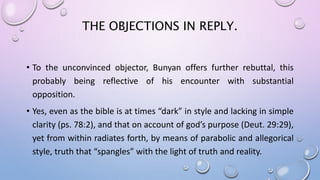
THE OBJECTIONS IN REPLY.
• To the unconvinced objector, Bunyan offers further rebuttal, this
probably being reflective of his encounter with substantial
opposition.
• Yes, even as the bible is at times “dark” in style and lacking in simple
clarity (ps. 78:2), and that on account of god’s purpose (Deut. 29:29),
yet from within radiates forth, by means of parabolic and allegorical
style, truth that “spangles” with the light of truth and reality.
The book by Bunyan is metaphorical rather than solid.
But the Bible is metaphorical.
Having been mentioned earlier, this seems to be the principal objection
which now receives an extended response. The Bible speaks of allegory,
similitude, figure, type, fable, shadow, and metaphors. Shall we then be so
bold as to find fault with the Bible?
THE BIBLE INVITES US TO BE WISE IN DISCOVERING ITS METAPHORICAL
MEANING!
…. ALLEGORY IS LIKE A GARMENT THAT
CLOTHES THE TRUTH!
• As metaphors clothe the truth of Christ and his apostles, even as
wooden cabinets encase gold, so The Pilgrim’s Progress
encapsulates the truth of scripture.
• The Bible is metaphorical and not even amusing. Nevertheless it also
has luster and radiance that dispels human gloom. So, The Pilgrim’s
Progress likewise illuminates.
HOWEVER, THE PILGRIM’S PROGRESS
ADVANCES EXCELLENT TRUTH.
• The style has propriety and taste; so let those who object nevertheless support the
cause of truth. Further let none of us be restricted by present literary fashion since the
past presents more noble expositors and supporter of this novel expression of the truth.
• Again, the various instances of allegory, similitude, metaphor, parable, figure, type,
fable, and shadow in the bible are, as a whole, offered as justification for Bunyan’s
ground-breaking style in the field of communicating evangelical truth. The intent is not
to smother truth, but rather illuminate “truth’s golden beams” in an arresting way like
unto a dawning day.
• The Pilgrim’s Progress is a plain map of the way of salvation.
• The Pilgrim’s Progress guides
the readers to an everlasting
prize, the travelers who
abandon the way and us the
holy land.
• IT GUIDES US FROM
BLINDNESS TO SIGHT.
• Bunyan gives the clearest statement of his purpose in writing the pilgrim’s progress. As a
pastor, he was only too aware of religious dabblers, that is those who allied themselves
with Christianity in general and yet remained casual, indifferent, and apathetic in their
nominal faith.
• Again, Bunyan is not averse to laying bait, so that here he confesses his enticing purpose
that is also intended to result in sobering challenge to the soul; [It = The book]
A. It entices, intrigues, as “something rare, and profitable.”
B. It goads, stimulates, as clinging burs.
C. It awakens, arouses curiosity, with novelty.
D. It evangelizes, with “sound and honest gospel-strains.”
THE FINAL INVITATION
• The bait is laid with even more tantalizing effect. Paradox upon paradox is
offered as grist for the inquisitive, as a balm for the melancholy.
• Though pleasant, yet it is wise; though a puzzle, yet it is solvable; though a
dream, yet it is for those who are awake; though amusing, yet it brings tears;
though a critique of self, yet it establishes self; though a book to be read, yet it
reads the reader.
• Both the mind, in comprehending the truth of god, and the heart, in embracing
the truth of god, are to be employed if the paradox is to be satisfactorily
resolved.
This book will make a traveler of thee
If by its counsel thou wilt ruled be;
It will direct thee to the holy land,
If though wilt its directions understand
Yea, it will make the slothful active be;
The blind also delightful things to see.
–JOHN BUNYAN, “THE AUTHOR’S APOLOGY FOR HIS BOOK,” THE PILGRIM’S
PROGRESS, 1678
The genius of the book is that it leaves the reader somewhat
unsatisfied, wanting to take his or her own “real-life” journey
to reach the same gloriously indescribable destination as
Christian.
For the readers: You’ve got to slog through yourself as best
you can if you want the veil taken away from your eyes: and
john Bunyan is here to tell you that his book is the way to
start.
REFERENCES
• HTTPS://PANORAMAOFPILGRIMSPROGRESS.WORDPRESS.COM/2012/05/24/LET-
ME-START-WITH-AN-APOLOGY/
• HTTP://WWW.BUNYANMINISTRIES.ORG/PP_COMMENTARY/00C_COM_AUTHOR%2
7S_APOLOGY.PDF
• JOHN BUNYAN, GEORGE OFFOR, ED., THE WORKS OF JOHN BUNYAN, III, P. 394.
• JOHN BUNYAN, WHAREY AND SHARROCK, EDS., THE PILGRIM’S PROGRESS, P.
312. THE HEAVENLY FOOTMAN, ALTHOUGH COMPLETED IN 1671, WAS
POSTHUMOUSLY PUBLISHED IN 1698.
• HTTPS://TEACHINGRESOURCES.ORG/2009/12/30/PILGRIM%E2%80%99S-
PROGRESS-AN-APOLOGY/

The pilgrim's progress apology by bunyan

  • 3.
    This apology wasevidently written when most of part one of the pilgrim’s progress had been completed. In sharing with friends and acquaintances the novelty, at that time, of the allegorical communication of the bible, Bunyan received a mixed response. Hence, he felt bound to defend his method and motive against the charges of him being entertaining, frivolous, unreal, fanciful, obscure, disrespectful, etc.
  • 4.
    BUNYAN’S APOLOGY WASBORN OF “ANOTHER [WRITING], . . . ALMOST DONE.” The Pilgrim’s Progress aims to tell us the religious truths indirectly. The author says this in his Apology when he answers those critics who complain that religion should not tolerate storytelling. The author, Bunyan, replies that the Bible itself contains literature and the New Testament in particular uses many parables, or indirect illustrations, to communicate its truths.
  • 5.
    The book wasborn out of Christian journeyings and out of self-interest. • As John was in prison, he did not aspire to attain world-wide literary fame, monetary gain, or approval from his pastoral peers, but simply self-gratification born of a creative frame of mind. It was a novel, biblical, literary challenge to his fertile imagination. • The book was born out of prison activity.
  • 6.
    THE CONFLICT INPUBLISHING. Assuming that the manuscript of The Pilgrim’s Progress was sufficiently complete by the time of Bunyan's release from prison in 1672, the fact that publication was delayed until 1678 strongly suggests some degree of hesitancy on Bunyan's part.
  • 7.
    • George Offorrelates how Bunyan read the pilgrim’s progress to his fellow prison inmates and sought their opinion of it. one prisoner, a pastor Thomas Marsom of Luton, at first expressed his disapproval. but upon closer examination of the complete manuscript in his own cell, he earnestly recommended it for publication • other friends of Bunyan voiced serious opposition believing that the pilgrim’s progress would excite a trifling and light-hearted attitude that would be unbecoming to the nature of sacred truth. hence most likely, out of respect, the manuscript was pigeonholed for several years.
  • 8.
    THE ONLY VALIDTEST WAS TO PRINT. • As if applying the “Gamaliel Test” of Acts 5:38-39, Bunyan opts for putting the pilgrim’s progress on trial before divine providence and public response. • He asks opponents to “forbear to judge, till you do further see,” and commences to offer a rationale for his purpose.
  • 9.
    THE OBJECTIONS INREPLY. • To the unconvinced objector, Bunyan offers further rebuttal, this probably being reflective of his encounter with substantial opposition. • Yes, even as the bible is at times “dark” in style and lacking in simple clarity (ps. 78:2), and that on account of god’s purpose (Deut. 29:29), yet from within radiates forth, by means of parabolic and allegorical style, truth that “spangles” with the light of truth and reality.
  • 10.
    The book byBunyan is metaphorical rather than solid. But the Bible is metaphorical. Having been mentioned earlier, this seems to be the principal objection which now receives an extended response. The Bible speaks of allegory, similitude, figure, type, fable, shadow, and metaphors. Shall we then be so bold as to find fault with the Bible? THE BIBLE INVITES US TO BE WISE IN DISCOVERING ITS METAPHORICAL MEANING!
  • 11.
    …. ALLEGORY ISLIKE A GARMENT THAT CLOTHES THE TRUTH! • As metaphors clothe the truth of Christ and his apostles, even as wooden cabinets encase gold, so The Pilgrim’s Progress encapsulates the truth of scripture. • The Bible is metaphorical and not even amusing. Nevertheless it also has luster and radiance that dispels human gloom. So, The Pilgrim’s Progress likewise illuminates.
  • 12.
    HOWEVER, THE PILGRIM’SPROGRESS ADVANCES EXCELLENT TRUTH. • The style has propriety and taste; so let those who object nevertheless support the cause of truth. Further let none of us be restricted by present literary fashion since the past presents more noble expositors and supporter of this novel expression of the truth. • Again, the various instances of allegory, similitude, metaphor, parable, figure, type, fable, and shadow in the bible are, as a whole, offered as justification for Bunyan’s ground-breaking style in the field of communicating evangelical truth. The intent is not to smother truth, but rather illuminate “truth’s golden beams” in an arresting way like unto a dawning day. • The Pilgrim’s Progress is a plain map of the way of salvation.
  • 13.
    • The Pilgrim’sProgress guides the readers to an everlasting prize, the travelers who abandon the way and us the holy land. • IT GUIDES US FROM BLINDNESS TO SIGHT.
  • 14.
    • Bunyan givesthe clearest statement of his purpose in writing the pilgrim’s progress. As a pastor, he was only too aware of religious dabblers, that is those who allied themselves with Christianity in general and yet remained casual, indifferent, and apathetic in their nominal faith. • Again, Bunyan is not averse to laying bait, so that here he confesses his enticing purpose that is also intended to result in sobering challenge to the soul; [It = The book] A. It entices, intrigues, as “something rare, and profitable.” B. It goads, stimulates, as clinging burs. C. It awakens, arouses curiosity, with novelty. D. It evangelizes, with “sound and honest gospel-strains.”
  • 15.
    THE FINAL INVITATION •The bait is laid with even more tantalizing effect. Paradox upon paradox is offered as grist for the inquisitive, as a balm for the melancholy. • Though pleasant, yet it is wise; though a puzzle, yet it is solvable; though a dream, yet it is for those who are awake; though amusing, yet it brings tears; though a critique of self, yet it establishes self; though a book to be read, yet it reads the reader. • Both the mind, in comprehending the truth of god, and the heart, in embracing the truth of god, are to be employed if the paradox is to be satisfactorily resolved.
  • 16.
    This book willmake a traveler of thee If by its counsel thou wilt ruled be; It will direct thee to the holy land, If though wilt its directions understand Yea, it will make the slothful active be; The blind also delightful things to see. –JOHN BUNYAN, “THE AUTHOR’S APOLOGY FOR HIS BOOK,” THE PILGRIM’S PROGRESS, 1678
  • 17.
    The genius ofthe book is that it leaves the reader somewhat unsatisfied, wanting to take his or her own “real-life” journey to reach the same gloriously indescribable destination as Christian. For the readers: You’ve got to slog through yourself as best you can if you want the veil taken away from your eyes: and john Bunyan is here to tell you that his book is the way to start.
  • 18.
    REFERENCES • HTTPS://PANORAMAOFPILGRIMSPROGRESS.WORDPRESS.COM/2012/05/24/LET- ME-START-WITH-AN-APOLOGY/ • HTTP://WWW.BUNYANMINISTRIES.ORG/PP_COMMENTARY/00C_COM_AUTHOR%2 7S_APOLOGY.PDF •JOHN BUNYAN, GEORGE OFFOR, ED., THE WORKS OF JOHN BUNYAN, III, P. 394. • JOHN BUNYAN, WHAREY AND SHARROCK, EDS., THE PILGRIM’S PROGRESS, P. 312. THE HEAVENLY FOOTMAN, ALTHOUGH COMPLETED IN 1671, WAS POSTHUMOUSLY PUBLISHED IN 1698. • HTTPS://TEACHINGRESOURCES.ORG/2009/12/30/PILGRIM%E2%80%99S- PROGRESS-AN-APOLOGY/