Matthew Arnold
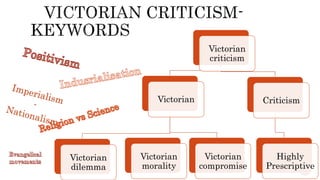
Victorian
criticism
Victorian
Victorian
dilemma
Victorian
compromise
Criticism
Highly
Prescriptive
Victorian
morality
 was an English poet and cultural critic who worked as an inspector of
schools. (https://en.wikipedia.org/wiki/Matthew_Arnold )
 English Victorian poet and literary and social critic, noted especially for his classical attacks
on the contemporary tastes and manners of the “Barbarians” (the aristocracy), the
“Philistines” (the commercial middle class), and the “Populace.” He became the apostle of
“culture” in such works as Culture and
Anarchy (1869).(https://www.britannica.com/biography/Matthew-Arnold)
 Among the major Victorian writers, Matthew Arnold is unique in that his reputation rests
equally upon his poetry and his poetry criticism. Only a quarter of his productive life was
given to writing poetry, but many of the same values, attitudes, and feelings that are
expressed in his poems achieve a fuller or more balanced formulation in his
prose. (https://www.poetryfoundation.org/)
 Although remembered now for his elegantly argued critical essays, Matthew Arnold, born in
Laleham, Middlesex, on December 24, 1822, began his career as a poet, winning early
recognition as a student (https://poets.org/poet/matthew-Arnold)
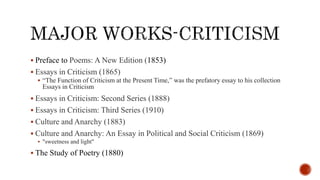
 Preface to Poems: A New Edition (1853)
 Essays in Criticism (1865)
 “The Function of Criticism at the Present Time,” was the prefatory essay to his collection
Essays in Criticism
 Essays in Criticism: Second Series (1888)
 Essays in Criticism: Third Series (1910)
 Culture and Anarchy (1883)
 Culture and Anarchy: An Essay in Political and Social Criticism (1869)
 "sweetness and light"
 The Study of Poetry (1880)
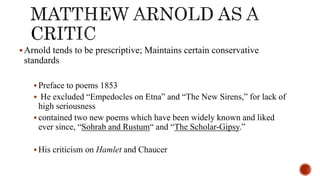
Arnold tends to be prescriptive; Maintains certain conservative
standards
 Preface to poems 1853
 He excluded “Empedocles on Etna” and “The New Sirens,” for lack of
high seriousness
 contained two new poems which have been widely known and liked
ever since, “Sohrab and Rustum“ and “The Scholar-Gipsy.”
 His criticism on Hamlet and Chaucer
 Wide and all encompassing- Cultural critic
 “Culture and Anarchy”- intertwined nature of culture, literature, religion,
philosophy
 Victorian dilemma is reflected in his works as well
 Criticism is inferior to creative literature
 Critic’s critic
 He is laying standards for both poetry and criticism
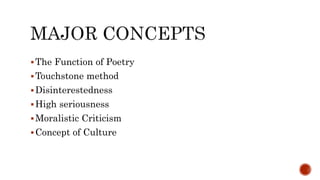
The Function of Poetry
Touchstone method
Disinterestedness
High seriousness
Moralistic Criticism
Concept of Culture
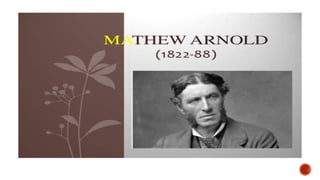
Mathew Arnold

Mathew Arnold

  • 1.
  • 2.
  • 4.
     was anEnglish poet and cultural critic who worked as an inspector of schools. (https://en.wikipedia.org/wiki/Matthew_Arnold )  English Victorian poet and literary and social critic, noted especially for his classical attacks on the contemporary tastes and manners of the “Barbarians” (the aristocracy), the “Philistines” (the commercial middle class), and the “Populace.” He became the apostle of “culture” in such works as Culture and Anarchy (1869).(https://www.britannica.com/biography/Matthew-Arnold)  Among the major Victorian writers, Matthew Arnold is unique in that his reputation rests equally upon his poetry and his poetry criticism. Only a quarter of his productive life was given to writing poetry, but many of the same values, attitudes, and feelings that are expressed in his poems achieve a fuller or more balanced formulation in his prose. (https://www.poetryfoundation.org/)  Although remembered now for his elegantly argued critical essays, Matthew Arnold, born in Laleham, Middlesex, on December 24, 1822, began his career as a poet, winning early recognition as a student (https://poets.org/poet/matthew-Arnold)
  • 6.
     Preface toPoems: A New Edition (1853)  Essays in Criticism (1865)  “The Function of Criticism at the Present Time,” was the prefatory essay to his collection Essays in Criticism  Essays in Criticism: Second Series (1888)  Essays in Criticism: Third Series (1910)  Culture and Anarchy (1883)  Culture and Anarchy: An Essay in Political and Social Criticism (1869)  "sweetness and light"  The Study of Poetry (1880)
  • 7.
    Arnold tends tobe prescriptive; Maintains certain conservative standards  Preface to poems 1853  He excluded “Empedocles on Etna” and “The New Sirens,” for lack of high seriousness  contained two new poems which have been widely known and liked ever since, “Sohrab and Rustum“ and “The Scholar-Gipsy.”  His criticism on Hamlet and Chaucer
  • 8.
     Wide andall encompassing- Cultural critic  “Culture and Anarchy”- intertwined nature of culture, literature, religion, philosophy  Victorian dilemma is reflected in his works as well  Criticism is inferior to creative literature  Critic’s critic  He is laying standards for both poetry and criticism
  • 9.
    The Function ofPoetry Touchstone method Disinterestedness High seriousness Moralistic Criticism Concept of Culture