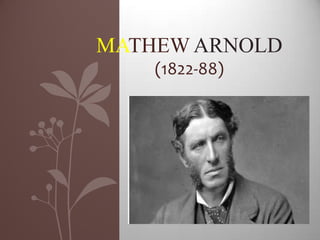
MATHEW ARNOLD
    (1822-88)
Biography
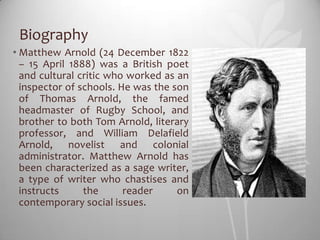
• Matthew Arnold (24 December 1822
  – 15 April 1888) was a British poet
  and cultural critic who worked as an
  inspector of schools. He was the son
  of Thomas Arnold, the famed
  headmaster of Rugby School, and
  brother to both Tom Arnold, literary
  professor, and William Delafield
  Arnold, novelist and colonial
  administrator. Matthew Arnold has
  been characterized as a sage writer,
  a type of writer who chastises and
  instructs     the      reader     on
  contemporary social issues.
Marriage and Career
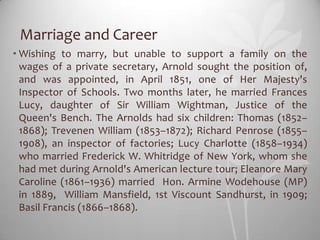
• Wishing to marry, but unable to support a family on the
  wages of a private secretary, Arnold sought the position of,
  and was appointed, in April 1851, one of Her Majesty's
  Inspector of Schools. Two months later, he married Frances
  Lucy, daughter of Sir William Wightman, Justice of the
  Queen's Bench. The Arnolds had six children: Thomas (1852–
  1868); Trevenen William (1853–1872); Richard Penrose (1855–
  1908), an inspector of factories; Lucy Charlotte (1858–1934)
  who married Frederick W. Whitridge of New York, whom she
  had met during Arnold's American lecture tour; Eleanore Mary
  Caroline (1861–1936) married Hon. Armine Wodehouse (MP)
  in 1889, William Mansfield, 1st Viscount Sandhurst, in 1909;
  Basil Francis (1866–1868).
Literary Career
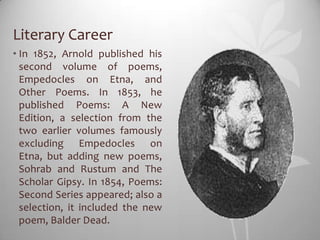
• In 1852, Arnold published his
  second volume of poems,
  Empedocles on Etna, and
  Other Poems. In 1853, he
  published Poems: A New
  Edition, a selection from the
  two earlier volumes famously
  excluding Empedocles on
  Etna, but adding new poems,
  Sohrab and Rustum and The
  Scholar Gipsy. In 1854, Poems:
  Second Series appeared; also a
  selection, it included the new
  poem, Balder Dead.
Literary Career
• Arnold was elected Professor of Poetry at Oxford in
  1857. He was the first to deliver his lectures in English
  rather than Latin. He was re-elected in 1862. On
  Translating Homer (1861) and the initial thoughts that
  Arnold would transform into Culture and Anarchy
  were among the fruits of the Oxford lectures. In
  1859, he conducted the first of three trips to the
  continent at the behest of parliament to study
  European educational practices. He self-published
  The Popular Education of France (1861), the
  introduction to which was later published under the
  title Democracy (1879).
Poetry
• Arnold is sometimes called the third great Victorian poet,
  along with Alfred, Lord Tennyson and Robert Browning
• The mood of Arnold’s poetry tends to be of plaintive
  reflection, and he is restrained in expressing emotion. He felt
  that poetry should be the 'criticism of life' and express a
  philosophy. Arnold's philosophy is that true happiness comes
  from within, and that people should seek within themselves
  for good, while being resigned in acceptance of outward
  things and avoiding the pointless turmoil of the world.
  However, he argues that we should not live in the belief that
  we shall one day inherit eternal bliss. If we are not happy on
  earth, we should moderate our desires rather than live in
  dreams of something that may never be attained.
Prose
• Arnold's career as a prose writer divided into three
  phases: 1) early literary criticism that begins with his
  preface to the 1853 edition of his poems and ends
  with the first series of Essays in Criticism (1865); 2) a
  prolonged middle period (overlapping the first and
  third phases) characterized by social, political and
  religious writing (roughly 1860–1875); 3) a return to
  literary criticism with the selecting and editing of
  collections of Wordsworth's and Byron's poetry and
  the second series of Essays in Criticism.
Literary Critic
• Arnold's work as a literary critic began with the 1853
 "Preface to the Poems". In it, he attempted to
 explain his extreme act of self-censorship in
 excluding the dramatic poem "Empedocles on Etna".
 With its emphasis on the importance of subject in
 poetry, on "clearness of arrangement, rigor of
 development, simplicity of style" learned from the
 Greeks, and in the strong imprint of Goethe and
 Wordsworth, may be observed nearly all the essential
 elements in his critical theory. George Watson
 described the preface, written by the thirty-one year
 old Arnold, as "oddly stiff and graceless when we
 think of the elegance of his later prose."
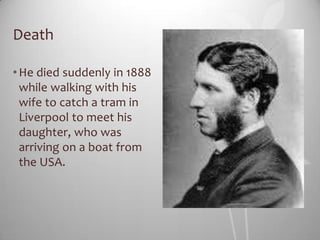
Death

• He died suddenly in 1888
  while walking with his
  wife to catch a tram in
  Liverpool to meet his
  daughter, who was
  arriving on a boat from
  the USA.
To Celia          Drink to me only with thine eyes,
                        And I will pledge with mine;
Ben Jonson            Or leave a kiss but in the cup,
                          And I'll not look for wine.
             The thirst that from the soul doth rise
                            Doth ask a drink divine;
                  But might I of Jove's nectar sup,
                      I would not change for thine.

                     I sent thee late a rosy wreath,
                       Not so much honouring thee
                     As giving it a hope, that there
                           It could not withered be.
              But thou thereon didst only breathe,
                          And sent'st it back to me;
                Since when it grows, and smells, I
                                               swear,
                              Not of itself, but thee.
Interpretation
•Ben Jonson’s “Song: To Celia” can vary in
 interpretation depending on the reader. The
 interpretation of the poem can either be that
 of a man confessing his love to a woman who
 rejects him or that of a man in love with a
 woman who he has had a previous,
 unsuccessful relationship with. Jonson’s
 diction, rhyme scheme, rhythm, and
 symbolism make “Song: To Celia” an intriguing
 piece which requires the reader to read
 creatively.
Structure and Form
•“Song: To Celia” has a consistent rhythm
 of alternating iambic tetrameter and
 trimeter throughout the poem. The
 rhyme scheme is ABCB, ABCB until a
 change in line nine to DEFE with one slant
 rhyme pair. The change in rhyme scheme
 from ABCB to DEFE represents a change
 in the tone of the poem while staying
 true to its sing-song nature.
• From lines one through eight, Jonson uses drinking
  and thirst as metaphors for love and desire. In the
  opening line when he says “drink to me, only with
  thine eyes,” Jonson is personifying Celia’s eyes and
  metaphorically suggesting that they are able to
  declare love. The recurring reference to wine and
  drinking implies that love is intoxicating and in line
  two, it is implied that a “pledge” similar to a toast
  can be made of love similarly to a promise. In line
  five, the speaker mentions the “thirst… from the
  soul” in reference to the speaker’s desire to live
  happily in love with Celia. The speaker even says that
  he will give up immortality presented to him in liquid
  form just to be with her.
• Line nine presents a change in the poem. The
  speaker’s love from line nine to the end of the poem
  is compared to a wreath. A wreath typically
  represents eternity with it’s round shape. The diction
  of this poem, however, suggests that the wreath
  represents rejection. The wreath is a gift that the
  speaker sent to Celia who returned it to him

Mathew arnold

  • 1.
    MATHEW ARNOLD (1822-88)
  • 2.
    Biography • Matthew Arnold(24 December 1822 – 15 April 1888) was a British poet and cultural critic who worked as an inspector of schools. He was the son of Thomas Arnold, the famed headmaster of Rugby School, and brother to both Tom Arnold, literary professor, and William Delafield Arnold, novelist and colonial administrator. Matthew Arnold has been characterized as a sage writer, a type of writer who chastises and instructs the reader on contemporary social issues.
  • 3.
    Marriage and Career •Wishing to marry, but unable to support a family on the wages of a private secretary, Arnold sought the position of, and was appointed, in April 1851, one of Her Majesty's Inspector of Schools. Two months later, he married Frances Lucy, daughter of Sir William Wightman, Justice of the Queen's Bench. The Arnolds had six children: Thomas (1852– 1868); Trevenen William (1853–1872); Richard Penrose (1855– 1908), an inspector of factories; Lucy Charlotte (1858–1934) who married Frederick W. Whitridge of New York, whom she had met during Arnold's American lecture tour; Eleanore Mary Caroline (1861–1936) married Hon. Armine Wodehouse (MP) in 1889, William Mansfield, 1st Viscount Sandhurst, in 1909; Basil Francis (1866–1868).
  • 4.
    Literary Career • In1852, Arnold published his second volume of poems, Empedocles on Etna, and Other Poems. In 1853, he published Poems: A New Edition, a selection from the two earlier volumes famously excluding Empedocles on Etna, but adding new poems, Sohrab and Rustum and The Scholar Gipsy. In 1854, Poems: Second Series appeared; also a selection, it included the new poem, Balder Dead.
  • 5.
    Literary Career • Arnoldwas elected Professor of Poetry at Oxford in 1857. He was the first to deliver his lectures in English rather than Latin. He was re-elected in 1862. On Translating Homer (1861) and the initial thoughts that Arnold would transform into Culture and Anarchy were among the fruits of the Oxford lectures. In 1859, he conducted the first of three trips to the continent at the behest of parliament to study European educational practices. He self-published The Popular Education of France (1861), the introduction to which was later published under the title Democracy (1879).
  • 6.
    Poetry • Arnold issometimes called the third great Victorian poet, along with Alfred, Lord Tennyson and Robert Browning • The mood of Arnold’s poetry tends to be of plaintive reflection, and he is restrained in expressing emotion. He felt that poetry should be the 'criticism of life' and express a philosophy. Arnold's philosophy is that true happiness comes from within, and that people should seek within themselves for good, while being resigned in acceptance of outward things and avoiding the pointless turmoil of the world. However, he argues that we should not live in the belief that we shall one day inherit eternal bliss. If we are not happy on earth, we should moderate our desires rather than live in dreams of something that may never be attained.
  • 7.
    Prose • Arnold's careeras a prose writer divided into three phases: 1) early literary criticism that begins with his preface to the 1853 edition of his poems and ends with the first series of Essays in Criticism (1865); 2) a prolonged middle period (overlapping the first and third phases) characterized by social, political and religious writing (roughly 1860–1875); 3) a return to literary criticism with the selecting and editing of collections of Wordsworth's and Byron's poetry and the second series of Essays in Criticism.
  • 8.
    Literary Critic • Arnold'swork as a literary critic began with the 1853 "Preface to the Poems". In it, he attempted to explain his extreme act of self-censorship in excluding the dramatic poem "Empedocles on Etna". With its emphasis on the importance of subject in poetry, on "clearness of arrangement, rigor of development, simplicity of style" learned from the Greeks, and in the strong imprint of Goethe and Wordsworth, may be observed nearly all the essential elements in his critical theory. George Watson described the preface, written by the thirty-one year old Arnold, as "oddly stiff and graceless when we think of the elegance of his later prose."
  • 9.
    Death • He diedsuddenly in 1888 while walking with his wife to catch a tram in Liverpool to meet his daughter, who was arriving on a boat from the USA.
  • 10.
    To Celia Drink to me only with thine eyes, And I will pledge with mine; Ben Jonson Or leave a kiss but in the cup, And I'll not look for wine. The thirst that from the soul doth rise Doth ask a drink divine; But might I of Jove's nectar sup, I would not change for thine. I sent thee late a rosy wreath, Not so much honouring thee As giving it a hope, that there It could not withered be. But thou thereon didst only breathe, And sent'st it back to me; Since when it grows, and smells, I swear, Not of itself, but thee.
  • 11.
    Interpretation •Ben Jonson’s “Song:To Celia” can vary in interpretation depending on the reader. The interpretation of the poem can either be that of a man confessing his love to a woman who rejects him or that of a man in love with a woman who he has had a previous, unsuccessful relationship with. Jonson’s diction, rhyme scheme, rhythm, and symbolism make “Song: To Celia” an intriguing piece which requires the reader to read creatively.
  • 12.
    Structure and Form •“Song:To Celia” has a consistent rhythm of alternating iambic tetrameter and trimeter throughout the poem. The rhyme scheme is ABCB, ABCB until a change in line nine to DEFE with one slant rhyme pair. The change in rhyme scheme from ABCB to DEFE represents a change in the tone of the poem while staying true to its sing-song nature.
  • 13.
    • From linesone through eight, Jonson uses drinking and thirst as metaphors for love and desire. In the opening line when he says “drink to me, only with thine eyes,” Jonson is personifying Celia’s eyes and metaphorically suggesting that they are able to declare love. The recurring reference to wine and drinking implies that love is intoxicating and in line two, it is implied that a “pledge” similar to a toast can be made of love similarly to a promise. In line five, the speaker mentions the “thirst… from the soul” in reference to the speaker’s desire to live happily in love with Celia. The speaker even says that he will give up immortality presented to him in liquid form just to be with her.
  • 14.
    • Line ninepresents a change in the poem. The speaker’s love from line nine to the end of the poem is compared to a wreath. A wreath typically represents eternity with it’s round shape. The diction of this poem, however, suggests that the wreath represents rejection. The wreath is a gift that the speaker sent to Celia who returned it to him