Part I: The Third
Stage,
the Fourth Stage
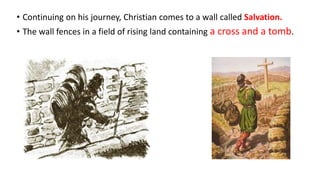
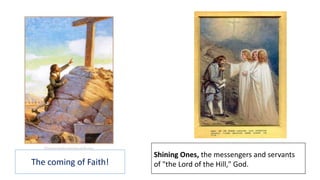
• Continuing on his journey, Christian comes to a wall called Salvation.
• The wall fences in a field of rising land containing a cross and a tomb.
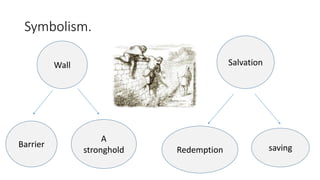
Symbolism.
Wall Salvation
Barrier
A
stronghold Redemption saving
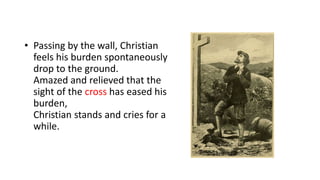
• Passing by the wall, Christian
feels his burden spontaneously
drop to the ground.
Amazed and relieved that the
sight of the cross has eased his
burden,
Christian stands and cries for a
while.
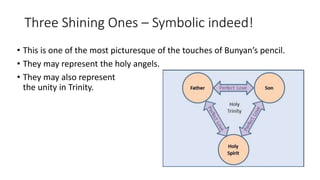
Shining Ones, the messengers and servants
of "the Lord of the Hill," God.The coming of Faith!
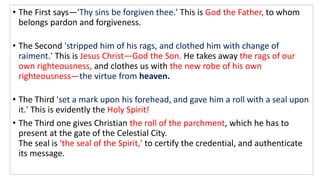
Three Shining Ones – Symbolic indeed!
• This is one of the most picturesque of the touches of Bunyan’s pencil.
• They may represent the holy angels.
• They may also represent
the unity in Trinity.
• The First says—'Thy sins be forgiven thee.' This is God the Father, to whom
belongs pardon and forgiveness.
• The Second 'stripped him of his rags, and clothed him with change of
raiment.' This is Jesus Christ—God the Son. He takes away the rags of our
own righteousness, and clothes us with the new robe of his own
righteousness—the virtue from heaven.
• The Third 'set a mark upon his forehead, and gave him a roll with a seal upon
it.' This is evidently the Holy Spirit!
• The Third one gives Christian the roll of the parchment, which he has to
present at the gate of the Celestial City.
The seal is 'the seal of the Spirit,' to certify the credential, and authenticate
its message.
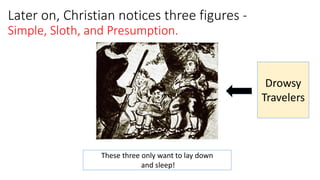
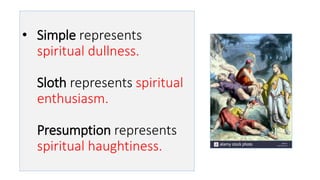
Later on, Christian notices three figures -
Simple, Sloth, and Presumption.
These three only want to lay down
and sleep!
Drowsy
Travelers
• Simple represents
spiritual dullness.
Sloth represents spiritual
enthusiasm.
Presumption represents
spiritual haughtiness.
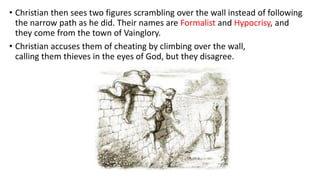
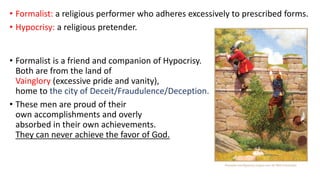
• Christian then sees two figures scrambling over the wall instead of following
the narrow path as he did. Their names are Formalist and Hypocrisy, and
they come from the town of Vainglory.
• Christian accuses them of cheating by climbing over the wall,
calling them thieves in the eyes of God, but they disagree.
• Formalist: a religious performer who adheres excessively to prescribed forms.
• Hypocrisy: a religious pretender.
• Formalist is a friend and companion of Hypocrisy.
Both are from the land of
Vainglory (excessive pride and vanity),
home to the city of Deceit/Fraudulence/Deception.
• These men are proud of their
own accomplishments and overly
absorbed in their own achievements.
They can never achieve the favor of God.
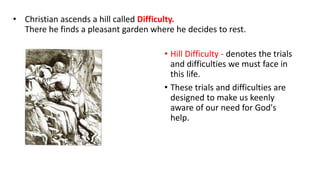
• Christian ascends a hill called Difficulty.
There he finds a pleasant garden where he decides to rest.
• Hill Difficulty - denotes the trials
and difficulties we must face in
this life.
• These trials and difficulties are
designed to make us keenly
aware of our need for God's
help.
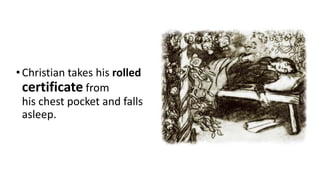
•Christian takes his rolled
certificate from
his chest pocket and falls
asleep.
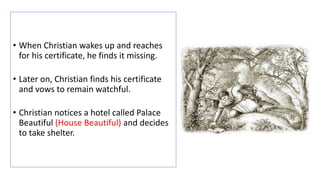
• When Christian wakes up and reaches
for his certificate, he finds it missing.
• Later on, Christian finds his certificate
and vows to remain watchful.
• Christian notices a hotel called Palace
Beautiful (House Beautiful) and decides
to take shelter.
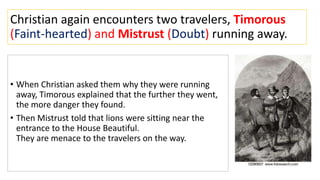
Christian again encounters two travelers, Timorous
(Faint-hearted) and Mistrust (Doubt) running away.
• When Christian asked them why they were running
away, Timorous explained that the further they went,
the more danger they found.
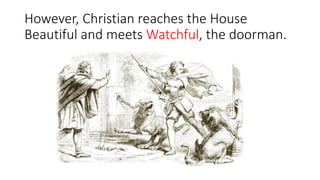
• Then Mistrust told that lions were sitting near the
entrance to the House Beautiful.
They are menace to the travelers on the way.
However, Christian reaches the House
Beautiful and meets Watchful, the doorman.
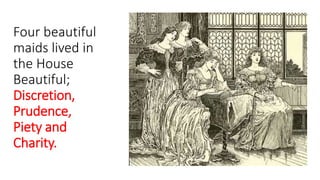
Four beautiful
maids lived in
the House
Beautiful;
Discretion,
Prudence,
Piety and
Charity.
Discretion allows Christian inside
after Christian identifies himself.
• Then Piety, Prudence, and Charity, ask about
Christian’s journey and his family. Christian tells
everything while weeping.
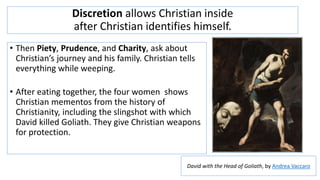
• After eating together, the four women shows
Christian mementos from the history of
Christianity, including the slingshot with which
David killed Goliath. They give Christian weapons
for protection.
David with the Head of Goliath, by Andrea Vaccaro
Goliath is described in the biblical Book of Samuel as
a Philistine giant defeated by the young David in single combat.
Original story:
•The Israelites and Philistines face each other; Goliath
makes his challenge to single combat;
•David volunteers to fight Goliath;
•David defeats Goliath, the Philistines flee the battlefield.
• ʾĀdam (Adam)
• ʾIdrīs (Enoch)
• Nūḥ (Noah)
• Hūd (Eber)
• Ṣāliḥ (Salah)
• ʾIbrāhīm (Abraham)
• Lūṭ (Lot)
• ʾIsmāʿīl (Ishmael)
• ʾIsḥāq (Issac)
• Yaʿqūb (Jacob)
• Yūsuf (Joseph)
• Ayūb (Job)
• Dhul-Kifl (Ezekiel)
• Shuʿayb (Jethro)
• Mūsā (Moses)
• Hārūn (Aaron)
• Dāūd (David)
• Sulaymān (Solomon)
• Yūnus (Jonah)
• ʾIlyās (Elijah)
• Zakarīya (Zechariah)
• Yaḥyā (John)
• ʿĪsā (Jesus)
List of people in both
the Quran and the Bible.
Christian decides to leave the House Beautiful and move
forward, then the four women
gives him food for his journey.
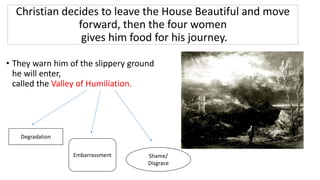
• They warn him of the slippery ground
he will enter,
called the Valley of Humiliation.
Degradation
Embarrassment Shame/
Disgrace
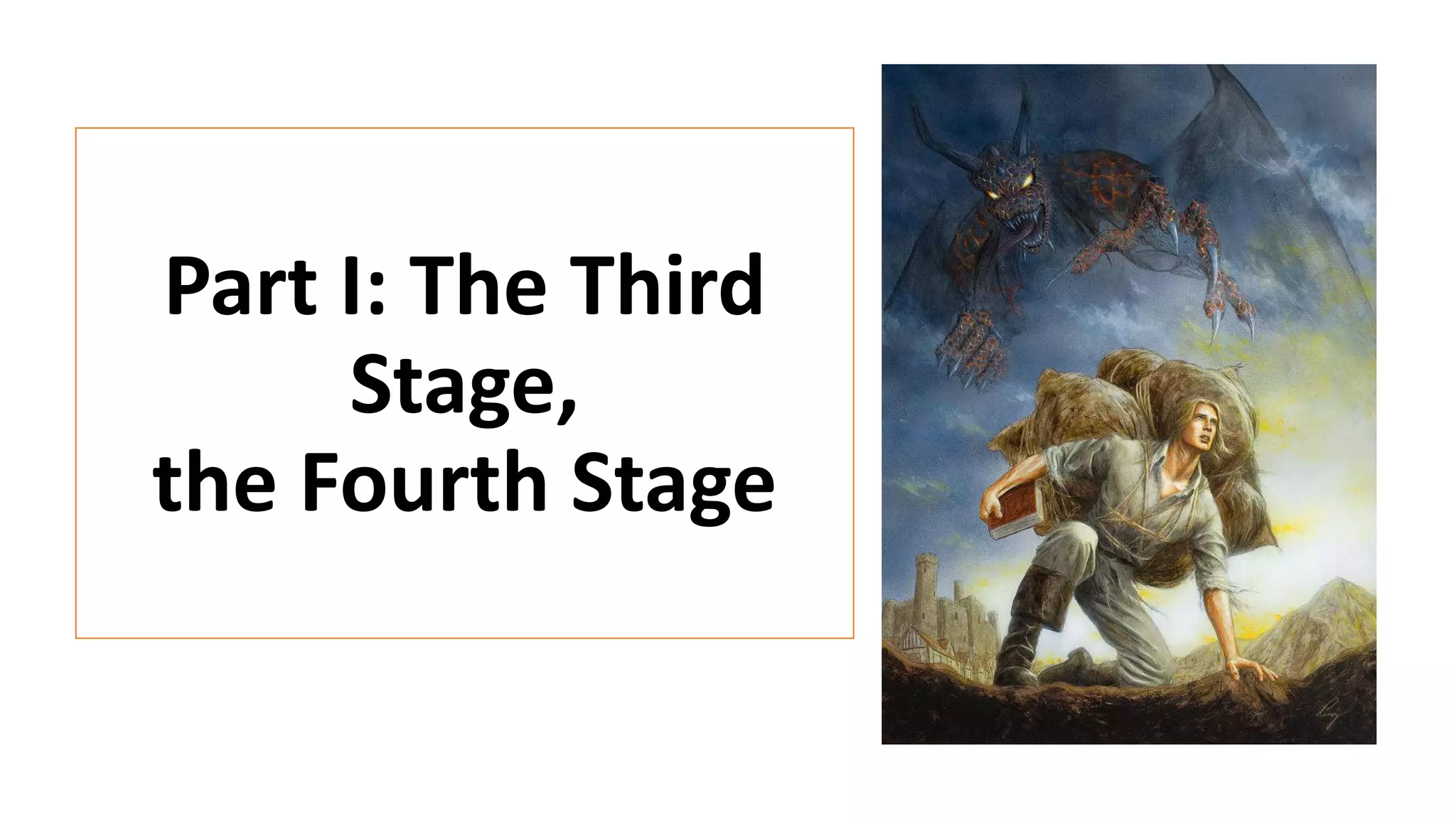
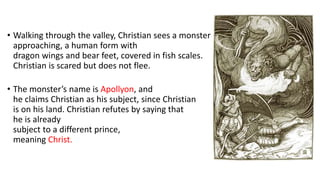
• Walking through the valley, Christian sees a monster
approaching, a human form with
dragon wings and bear feet, covered in fish scales.
Christian is scared but does not flee.
• The monster’s name is Apollyon, and
he claims Christian as his subject, since Christian
is on his land. Christian refutes by saying that
he is already
subject to a different prince,
meaning Christ.
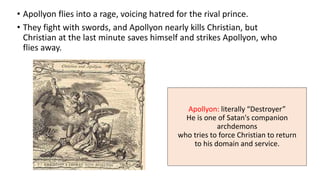
Apollyon: literally “Destroyer”
He is one of Satan's companion
archdemons
who tries to force Christian to return
to his domain and service.
• Apollyon flies into a rage, voicing hatred for the rival prince.
• They fight with swords, and Apollyon nearly kills Christian, but
Christian at the last minute saves himself and strikes Apollyon, who
flies away.
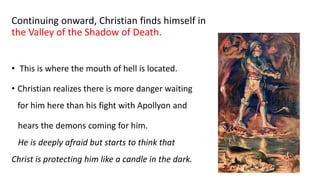
Continuing onward, Christian finds himself in
the Valley of the Shadow of Death.
• This is where the mouth of hell is located.
• Christian realizes there is more danger waiting
for him here than his fight with Apollyon and
hears the demons coming for him.
He is deeply afraid but starts to think that
Christ is protecting him like a candle in the dark.
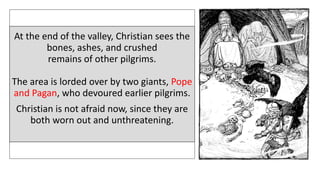
At the end of the valley, Christian sees the
bones, ashes, and crushed
remains of other pilgrims.
The area is lorded over by two giants, Pope
and Pagan, who devoured earlier pilgrims.
Christian is not afraid now, since they are
both worn out and unthreatening.
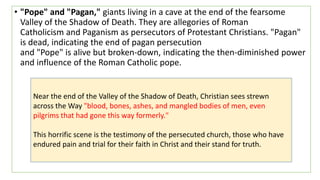
• "Pope" and "Pagan," giants living in a cave at the end of the fearsome
Valley of the Shadow of Death. They are allegories of Roman
Catholicism and Paganism as persecutors of Protestant Christians. "Pagan"
is dead, indicating the end of pagan persecution
and "Pope" is alive but broken-down, indicating the then-diminished power
and influence of the Roman Catholic pope.
Near the end of the Valley of the Shadow of Death, Christian sees strewn
across the Way "blood, bones, ashes, and mangled bodies of men, even
pilgrims that had gone this way formerly."
This horrific scene is the testimony of the persecuted church, those who have
endured pain and trial for their faith in Christ and their stand for truth.
Things to Recall
•Faith is given a deeper meaning when Christian’s burden
naturally falls from the sight of the cross in this stage.
This removal of the burden marks a new perspective on
his progress.
•The certificate that Christian receives from the three
Shining Ones has a great value, since it is the entry ticket
to the Celestial City.
• The appearance of Hypocrisy and Formalist emphasize the
religious nature of Christian’s journey.
• Apollyon has medieval overtones. The sword combat with
Christian harkens back to medieval dragon-slaying tales. When
Christian defeats him, the combat portion of his progress is
complete.
Leaving behind the old tales of physical combat, Christian is
free to go on to face more spiritual hardships.

Part one the third stage, the fourth stage

  • 1.
    Part I: TheThird Stage, the Fourth Stage
  • 2.
    • Continuing onhis journey, Christian comes to a wall called Salvation. • The wall fences in a field of rising land containing a cross and a tomb.
  • 3.
  • 4.
    • Passing bythe wall, Christian feels his burden spontaneously drop to the ground. Amazed and relieved that the sight of the cross has eased his burden, Christian stands and cries for a while.
  • 5.
    Shining Ones, themessengers and servants of "the Lord of the Hill," God.The coming of Faith!
  • 6.
    Three Shining Ones– Symbolic indeed! • This is one of the most picturesque of the touches of Bunyan’s pencil. • They may represent the holy angels. • They may also represent the unity in Trinity.
  • 7.
    • The Firstsays—'Thy sins be forgiven thee.' This is God the Father, to whom belongs pardon and forgiveness. • The Second 'stripped him of his rags, and clothed him with change of raiment.' This is Jesus Christ—God the Son. He takes away the rags of our own righteousness, and clothes us with the new robe of his own righteousness—the virtue from heaven. • The Third 'set a mark upon his forehead, and gave him a roll with a seal upon it.' This is evidently the Holy Spirit! • The Third one gives Christian the roll of the parchment, which he has to present at the gate of the Celestial City. The seal is 'the seal of the Spirit,' to certify the credential, and authenticate its message.
  • 8.
    Later on, Christiannotices three figures - Simple, Sloth, and Presumption. These three only want to lay down and sleep! Drowsy Travelers
  • 9.
    • Simple represents spiritualdullness. Sloth represents spiritual enthusiasm. Presumption represents spiritual haughtiness.
  • 10.
    • Christian thensees two figures scrambling over the wall instead of following the narrow path as he did. Their names are Formalist and Hypocrisy, and they come from the town of Vainglory. • Christian accuses them of cheating by climbing over the wall, calling them thieves in the eyes of God, but they disagree.
  • 11.
    • Formalist: areligious performer who adheres excessively to prescribed forms. • Hypocrisy: a religious pretender. • Formalist is a friend and companion of Hypocrisy. Both are from the land of Vainglory (excessive pride and vanity), home to the city of Deceit/Fraudulence/Deception. • These men are proud of their own accomplishments and overly absorbed in their own achievements. They can never achieve the favor of God.
  • 12.
    • Christian ascendsa hill called Difficulty. There he finds a pleasant garden where he decides to rest. • Hill Difficulty - denotes the trials and difficulties we must face in this life. • These trials and difficulties are designed to make us keenly aware of our need for God's help.
  • 13.
    •Christian takes hisrolled certificate from his chest pocket and falls asleep.
  • 14.
    • When Christianwakes up and reaches for his certificate, he finds it missing. • Later on, Christian finds his certificate and vows to remain watchful. • Christian notices a hotel called Palace Beautiful (House Beautiful) and decides to take shelter.
  • 15.
    Christian again encounterstwo travelers, Timorous (Faint-hearted) and Mistrust (Doubt) running away. • When Christian asked them why they were running away, Timorous explained that the further they went, the more danger they found. • Then Mistrust told that lions were sitting near the entrance to the House Beautiful. They are menace to the travelers on the way.
  • 16.
    However, Christian reachesthe House Beautiful and meets Watchful, the doorman.
  • 17.
    Four beautiful maids livedin the House Beautiful; Discretion, Prudence, Piety and Charity.
  • 18.
    Discretion allows Christianinside after Christian identifies himself. • Then Piety, Prudence, and Charity, ask about Christian’s journey and his family. Christian tells everything while weeping. • After eating together, the four women shows Christian mementos from the history of Christianity, including the slingshot with which David killed Goliath. They give Christian weapons for protection. David with the Head of Goliath, by Andrea Vaccaro
  • 19.
    Goliath is describedin the biblical Book of Samuel as a Philistine giant defeated by the young David in single combat. Original story: •The Israelites and Philistines face each other; Goliath makes his challenge to single combat; •David volunteers to fight Goliath; •David defeats Goliath, the Philistines flee the battlefield.
  • 20.
    • ʾĀdam (Adam) •ʾIdrīs (Enoch) • Nūḥ (Noah) • Hūd (Eber) • Ṣāliḥ (Salah) • ʾIbrāhīm (Abraham) • Lūṭ (Lot) • ʾIsmāʿīl (Ishmael) • ʾIsḥāq (Issac) • Yaʿqūb (Jacob) • Yūsuf (Joseph) • Ayūb (Job) • Dhul-Kifl (Ezekiel) • Shuʿayb (Jethro) • Mūsā (Moses) • Hārūn (Aaron) • Dāūd (David) • Sulaymān (Solomon) • Yūnus (Jonah) • ʾIlyās (Elijah) • Zakarīya (Zechariah) • Yaḥyā (John) • ʿĪsā (Jesus) List of people in both the Quran and the Bible.
  • 21.
    Christian decides toleave the House Beautiful and move forward, then the four women gives him food for his journey. • They warn him of the slippery ground he will enter, called the Valley of Humiliation. Degradation Embarrassment Shame/ Disgrace
  • 22.
    • Walking throughthe valley, Christian sees a monster approaching, a human form with dragon wings and bear feet, covered in fish scales. Christian is scared but does not flee. • The monster’s name is Apollyon, and he claims Christian as his subject, since Christian is on his land. Christian refutes by saying that he is already subject to a different prince, meaning Christ.
  • 23.
    Apollyon: literally “Destroyer” Heis one of Satan's companion archdemons who tries to force Christian to return to his domain and service. • Apollyon flies into a rage, voicing hatred for the rival prince. • They fight with swords, and Apollyon nearly kills Christian, but Christian at the last minute saves himself and strikes Apollyon, who flies away.
  • 24.
    Continuing onward, Christianfinds himself in the Valley of the Shadow of Death. • This is where the mouth of hell is located. • Christian realizes there is more danger waiting for him here than his fight with Apollyon and hears the demons coming for him. He is deeply afraid but starts to think that Christ is protecting him like a candle in the dark.
  • 25.
    At the endof the valley, Christian sees the bones, ashes, and crushed remains of other pilgrims. The area is lorded over by two giants, Pope and Pagan, who devoured earlier pilgrims. Christian is not afraid now, since they are both worn out and unthreatening.
  • 26.
    • "Pope" and"Pagan," giants living in a cave at the end of the fearsome Valley of the Shadow of Death. They are allegories of Roman Catholicism and Paganism as persecutors of Protestant Christians. "Pagan" is dead, indicating the end of pagan persecution and "Pope" is alive but broken-down, indicating the then-diminished power and influence of the Roman Catholic pope. Near the end of the Valley of the Shadow of Death, Christian sees strewn across the Way "blood, bones, ashes, and mangled bodies of men, even pilgrims that had gone this way formerly." This horrific scene is the testimony of the persecuted church, those who have endured pain and trial for their faith in Christ and their stand for truth.
  • 27.
    Things to Recall •Faithis given a deeper meaning when Christian’s burden naturally falls from the sight of the cross in this stage. This removal of the burden marks a new perspective on his progress. •The certificate that Christian receives from the three Shining Ones has a great value, since it is the entry ticket to the Celestial City.
  • 28.
    • The appearanceof Hypocrisy and Formalist emphasize the religious nature of Christian’s journey. • Apollyon has medieval overtones. The sword combat with Christian harkens back to medieval dragon-slaying tales. When Christian defeats him, the combat portion of his progress is complete. Leaving behind the old tales of physical combat, Christian is free to go on to face more spiritual hardships.