MICROCONTROLLER BASED SYSTEM DESIGN
“ARM ASSEMBLY LANGUAGE PROGRAMMING”
V. KALAIRAJAN M.E;
ASSISTANT PROFESSOR,
ELECTRICAL AND ELECTRONICS ENGINEERING,
KONGUNADU COLLEGE OF ENGINERING AND TECHNOLOGY, TRICHY.
1KONGUNADU COLLEGE OF ENGINERING AND TECHNOLOGY, TRICHY ARM ASSEMBLY LANGUAGE PROGRAMMING
“ARM ASSEMBLY LANGUAGE
PROGRAMMING”
VIEWS:
 ALP-ASSEMBLY LANGUAGE PROGRAMMING.
DIFFERENT INSTRUCTIONS IN ARM ALP:
 ARITHMETIC OPERATIONS
 BIT-WISE LOGICAL OPERATIONS
 REGISTER MOVEMENT OPERATION
 COMPARISON OPERATIONS
 IMMEDIATE OPERANDS
 SHIFTED REGISTER OPERANDS
 MULTIPLY INSTRUCTIONS
 DATA TRANSFER INSTRUCTIONS
 CONCLUSION.
 REFERENCES.
2KONGUNADU COLLEGE OF ENGINERING AND TECHNOLOGY, TRICHY ARM ASSEMBLY LANGUAGE PROGRAMMING
“ARM ASSEMBLY LANGUAGE
PROGRAMMING”
 ALP used to build programs for particular function by using
different instruction sets.
 ALP is application oriented programmer’s model.
 In ALP compiler used to find tje bugs in program.
DIFFERENT INSTRUCTIONS IN ARM ALP:
 Arithmetic operations
 Bit-wise logical operations
 Register movement operation
 Comparison operations
 Immediate operands
 Shifted register operands
 Multiply instructions
 Data transfer instructions
3KONGUNADU COLLEGE OF ENGINERING AND TECHNOLOGY, TRICHY ARM ASSEMBLY LANGUAGE PROGRAMMING
“ARM ASSEMBLY LANGUAGE
PROGRAMMING”
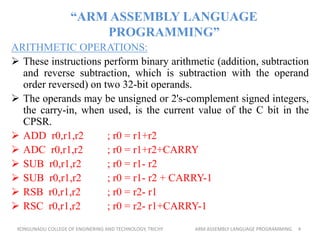
ARITHMETIC OPERATIONS:
 These instructions perform binary arithmetic (addition, subtraction
and reverse subtraction, which is subtraction with the operand
order reversed) on two 32-bit operands.
 The operands may be unsigned or 2's-complement signed integers,
the carry-in, when used, is the current value of the C bit in the
CPSR.
 ADD r0,r1,r2 ; r0 = r1+r2
 ADC r0,r1,r2 ; r0 = r1+r2+CARRY
 SUB r0,r1,r2 ; r0 = r1- r2
 SUB r0,r1,r2 ; r0 = r1- r2 + CARRY-1
 RSB r0,r1,r2 ; r0 = r2- r1
 RSC r0,r1,r2 ; r0 = r2- r1+CARRY-1
4KONGUNADU COLLEGE OF ENGINERING AND TECHNOLOGY, TRICHY ARM ASSEMBLY LANGUAGE PROGRAMMING
“ARM ASSEMBLY LANGUAGE
PROGRAMMING”
5KONGUNADU COLLEGE OF ENGINERING AND TECHNOLOGY, TRICHY ARM ASSEMBLY LANGUAGE PROGRAMMING
BIT-WISE LOGICAL OPERATIONS
 These instructions perform the specified Boolean logic
operation on each bit pair of the input operands, so in the first
case r0[i]:= r1[i] AND r2[i] for each value of i from 0 to 31
inclusive, where r0[i] is the ith bit of r0.
 Simply this instructions are used to do all logical operations.
 AND r0,r1,r2 ; r0 = r1 and r2
 ORR r0,r1,r2 ; r0 = r1 or r2
 EOR r0,r1,r2 ; r0 = r1 xor r2
 BIC r0,r1,r2 ; r0 = r1 and not r2
“ARM ASSEMBLY LANGUAGE
PROGRAMMING”
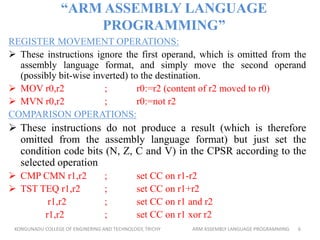
REGISTER MOVEMENT OPERATIONS:
 These instructions ignore the first operand, which is omitted from the
assembly language format, and simply move the second operand
(possibly bit-wise inverted) to the destination.
 MOV r0,r2 ; r0:=r2 (content of r2 moved to r0)
 MVN r0,r2 ; r0:=not r2
COMPARISON OPERATIONS:
 These instructions do not produce a result (which is therefore
omitted from the assembly language format) but just set the
condition code bits (N, Z, C and V) in the CPSR according to the
selected operation
 CMP CMN r1,r2 ; set CC on r1-r2
 TST TEQ r1,r2 ; set CC on r1+r2
r1,r2 ; set CC on r1 and r2
r1,r2 ; set CC on r1 xor r2
6KONGUNADU COLLEGE OF ENGINERING AND TECHNOLOGY, TRICHY ARM ASSEMBLY LANGUAGE PROGRAMMING
“ARM ASSEMBLY LANGUAGE
PROGRAMMING”
IMMEDIATE OPERANDS:
 Data is directly given in instruction itself.
 If, instead of adding two registers, we simply wish to add a
constant to a register we can replace the second source operand
with an immediate value, which is a literal constant, preceded by
'#':
ADD r3,r3 #1 ;r3=1
AND r8, r7,#&ff ;r8=r7[7:0]
SHIFTED REGISTER OPERANDS:
 A way to specify a data operation is similar to the first, but allows
the second register operand to be subject to a shift operation
before it is combined with the first operand. For example:
ADD r3,r2,r1 , LSL #3; r3:=r2+8 x r1
7KONGUNADU COLLEGE OF ENGINERING AND TECHNOLOGY, TRICHY ARM ASSEMBLY LANGUAGE PROGRAMMING
“ARM ASSEMBLY LANGUAGE
PROGRAMMING”
MULTIPLY OPERATION:
There are some important differences from the other arithmetic
instructions:
 Immediate second operands are not supported.
 The result register must not be the same as the first source register.
 If the ' s' bit is set the V flag is preserved (as for a logical instruction)
and the C flag is rendered meaningless.
MUL r4,r3,r2 ; r4:=(r3xr2)
DATA TRANSFER INSTRUCTIONS
 Data transfer instructions move data between ARM registers and
memory.
LDR r0, [r1] ;r0:= mem [r1].
STR r0,[r1] ;mem32[r1]:=r0.
LDR r0,[r1,#4] ;r0 = mem [r2]
8KONGUNADU COLLEGE OF ENGINERING AND TECHNOLOGY, TRICHY ARM ASSEMBLY LANGUAGE PROGRAMMING
“ARM ASSEMBLY LANGUAGE
PROGRAMMING”
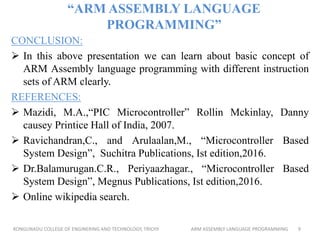
CONCLUSION:
 In this above presentation we can learn about basic concept of
ARM Assembly language programming with different instruction
sets of ARM clearly.
REFERENCES:
 Mazidi, M.A.,“PIC Microcontroller” Rollin Mckinlay, Danny
causey Printice Hall of India, 2007.
 Ravichandran,C., and Arulaalan,M., “Microcontroller Based
System Design”, Suchitra Publications, Ist edition,2016.
 Dr.Balamurugan.C.R., Periyaazhagar., “Microcontroller Based
System Design”, Megnus Publications, Ist edition,2016.
 Online wikipedia search.
9KONGUNADU COLLEGE OF ENGINERING AND TECHNOLOGY, TRICHY ARM ASSEMBLY LANGUAGE PROGRAMMING

Arm assembly language programming

  • 1.
    MICROCONTROLLER BASED SYSTEMDESIGN “ARM ASSEMBLY LANGUAGE PROGRAMMING” V. KALAIRAJAN M.E; ASSISTANT PROFESSOR, ELECTRICAL AND ELECTRONICS ENGINEERING, KONGUNADU COLLEGE OF ENGINERING AND TECHNOLOGY, TRICHY. 1KONGUNADU COLLEGE OF ENGINERING AND TECHNOLOGY, TRICHY ARM ASSEMBLY LANGUAGE PROGRAMMING
  • 2.
    “ARM ASSEMBLY LANGUAGE PROGRAMMING” VIEWS: ALP-ASSEMBLY LANGUAGE PROGRAMMING. DIFFERENT INSTRUCTIONS IN ARM ALP:  ARITHMETIC OPERATIONS  BIT-WISE LOGICAL OPERATIONS  REGISTER MOVEMENT OPERATION  COMPARISON OPERATIONS  IMMEDIATE OPERANDS  SHIFTED REGISTER OPERANDS  MULTIPLY INSTRUCTIONS  DATA TRANSFER INSTRUCTIONS  CONCLUSION.  REFERENCES. 2KONGUNADU COLLEGE OF ENGINERING AND TECHNOLOGY, TRICHY ARM ASSEMBLY LANGUAGE PROGRAMMING
  • 3.
    “ARM ASSEMBLY LANGUAGE PROGRAMMING” ALP used to build programs for particular function by using different instruction sets.  ALP is application oriented programmer’s model.  In ALP compiler used to find tje bugs in program. DIFFERENT INSTRUCTIONS IN ARM ALP:  Arithmetic operations  Bit-wise logical operations  Register movement operation  Comparison operations  Immediate operands  Shifted register operands  Multiply instructions  Data transfer instructions 3KONGUNADU COLLEGE OF ENGINERING AND TECHNOLOGY, TRICHY ARM ASSEMBLY LANGUAGE PROGRAMMING
  • 4.
    “ARM ASSEMBLY LANGUAGE PROGRAMMING” ARITHMETICOPERATIONS:  These instructions perform binary arithmetic (addition, subtraction and reverse subtraction, which is subtraction with the operand order reversed) on two 32-bit operands.  The operands may be unsigned or 2's-complement signed integers, the carry-in, when used, is the current value of the C bit in the CPSR.  ADD r0,r1,r2 ; r0 = r1+r2  ADC r0,r1,r2 ; r0 = r1+r2+CARRY  SUB r0,r1,r2 ; r0 = r1- r2  SUB r0,r1,r2 ; r0 = r1- r2 + CARRY-1  RSB r0,r1,r2 ; r0 = r2- r1  RSC r0,r1,r2 ; r0 = r2- r1+CARRY-1 4KONGUNADU COLLEGE OF ENGINERING AND TECHNOLOGY, TRICHY ARM ASSEMBLY LANGUAGE PROGRAMMING
  • 5.
    “ARM ASSEMBLY LANGUAGE PROGRAMMING” 5KONGUNADUCOLLEGE OF ENGINERING AND TECHNOLOGY, TRICHY ARM ASSEMBLY LANGUAGE PROGRAMMING BIT-WISE LOGICAL OPERATIONS  These instructions perform the specified Boolean logic operation on each bit pair of the input operands, so in the first case r0[i]:= r1[i] AND r2[i] for each value of i from 0 to 31 inclusive, where r0[i] is the ith bit of r0.  Simply this instructions are used to do all logical operations.  AND r0,r1,r2 ; r0 = r1 and r2  ORR r0,r1,r2 ; r0 = r1 or r2  EOR r0,r1,r2 ; r0 = r1 xor r2  BIC r0,r1,r2 ; r0 = r1 and not r2
  • 6.
    “ARM ASSEMBLY LANGUAGE PROGRAMMING” REGISTERMOVEMENT OPERATIONS:  These instructions ignore the first operand, which is omitted from the assembly language format, and simply move the second operand (possibly bit-wise inverted) to the destination.  MOV r0,r2 ; r0:=r2 (content of r2 moved to r0)  MVN r0,r2 ; r0:=not r2 COMPARISON OPERATIONS:  These instructions do not produce a result (which is therefore omitted from the assembly language format) but just set the condition code bits (N, Z, C and V) in the CPSR according to the selected operation  CMP CMN r1,r2 ; set CC on r1-r2  TST TEQ r1,r2 ; set CC on r1+r2 r1,r2 ; set CC on r1 and r2 r1,r2 ; set CC on r1 xor r2 6KONGUNADU COLLEGE OF ENGINERING AND TECHNOLOGY, TRICHY ARM ASSEMBLY LANGUAGE PROGRAMMING
  • 7.
    “ARM ASSEMBLY LANGUAGE PROGRAMMING” IMMEDIATEOPERANDS:  Data is directly given in instruction itself.  If, instead of adding two registers, we simply wish to add a constant to a register we can replace the second source operand with an immediate value, which is a literal constant, preceded by '#': ADD r3,r3 #1 ;r3=1 AND r8, r7,#&ff ;r8=r7[7:0] SHIFTED REGISTER OPERANDS:  A way to specify a data operation is similar to the first, but allows the second register operand to be subject to a shift operation before it is combined with the first operand. For example: ADD r3,r2,r1 , LSL #3; r3:=r2+8 x r1 7KONGUNADU COLLEGE OF ENGINERING AND TECHNOLOGY, TRICHY ARM ASSEMBLY LANGUAGE PROGRAMMING
  • 8.
    “ARM ASSEMBLY LANGUAGE PROGRAMMING” MULTIPLYOPERATION: There are some important differences from the other arithmetic instructions:  Immediate second operands are not supported.  The result register must not be the same as the first source register.  If the ' s' bit is set the V flag is preserved (as for a logical instruction) and the C flag is rendered meaningless. MUL r4,r3,r2 ; r4:=(r3xr2) DATA TRANSFER INSTRUCTIONS  Data transfer instructions move data between ARM registers and memory. LDR r0, [r1] ;r0:= mem [r1]. STR r0,[r1] ;mem32[r1]:=r0. LDR r0,[r1,#4] ;r0 = mem [r2] 8KONGUNADU COLLEGE OF ENGINERING AND TECHNOLOGY, TRICHY ARM ASSEMBLY LANGUAGE PROGRAMMING
  • 9.
    “ARM ASSEMBLY LANGUAGE PROGRAMMING” CONCLUSION: In this above presentation we can learn about basic concept of ARM Assembly language programming with different instruction sets of ARM clearly. REFERENCES:  Mazidi, M.A.,“PIC Microcontroller” Rollin Mckinlay, Danny causey Printice Hall of India, 2007.  Ravichandran,C., and Arulaalan,M., “Microcontroller Based System Design”, Suchitra Publications, Ist edition,2016.  Dr.Balamurugan.C.R., Periyaazhagar., “Microcontroller Based System Design”, Megnus Publications, Ist edition,2016.  Online wikipedia search. 9KONGUNADU COLLEGE OF ENGINERING AND TECHNOLOGY, TRICHY ARM ASSEMBLY LANGUAGE PROGRAMMING