KONGUNADU COLLEGE OF ENGINERING AND TECHNOLOGY, TRICHY PROTECTION SCHEMES
ContentsContents
IntroductionIntroduction
DefinitionDefinition
Types of loadsTypes of loads
Basic power system operationsBasic power system operations
Integrated objectivesIntegrated objectives
Operation planningOperation planning
Operation controlOperation control
Unit commitmentUnit commitment
ReferencesReferences
KONGUNADU COLLEGE OF ENGINERING AND TECHNOLOGY, TRICHY PROTECTION SCHEMES
• In 1831, Michael Faraday’s many years of efforts rewarded when he discovered
electromagnetic induction
• Later, he invented the first generator
• Today, electric energy technologies have a central role in social and economic
development at all scales
• Energy is closely linked to environmental pollution and degradation, to
economic development and quality of life
• Today, we are mostly dependent on nonrenewable fossil fuels that have been
and will continue to be a major cause of pollution and climate change
• Finding sustainable alternatives is becoming increasingly urgent
• Operation and control of power system is an extremely complex task
KONGUNADU COLLEGE OF ENGINERING AND TECHNOLOGY, TRICHY PROTECTION SCHEMES
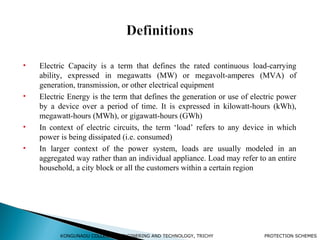
• Electric Capacity is a term that defines the rated continuous load-carrying
ability, expressed in megawatts (MW) or megavolt-amperes (MVA) of
generation, transmission, or other electrical equipment
• Electric Energy is the term that defines the generation or use of electric power
by a device over a period of time. It is expressed in kilowatt-hours (kWh),
megawatt-hours (MWh), or gigawatt-hours (GWh)
• In context of electric circuits, the term ‘load’ refers to any device in which
power is being dissipated (i.e. consumed)
• In larger context of the power system, loads are usually modeled in an
aggregated way rather than an individual appliance. Load may refer to an entire
household, a city block or all the customers within a certain region
KONGUNADU COLLEGE OF ENGINERING AND TECHNOLOGY, TRICHY PROTECTION SCHEMES
• Resistive loads (25%): Heating and lighting equipments
e.g. Toaster, iron, electric blankets, Incandescent lamps
• Motors (70%): Compressors (air conditioner, refrigerator)
Pumps (well, pool), Fans
Household appliances (washer, mixer, vacuum cleaner)
Large commercial 3-phase motors (grocery store chiller)
Power tools (hand drill, lawn mower)
Electric street cars
Basically ‘anything’ that moves!
• Electronic devices (5%):Power supplies for computers etc.
Transformers (adapter, battery charger)
KONGUNADU COLLEGE OF ENGINERING AND TECHNOLOGY, TRICHY PROTECTION SCHEMES
• The term ‘demand’ refers to physical quantity of power, NOT energy
• Serving the instantaneous demand under diverse circumstances is the central
challenge in designing and operating power systems and the one that calls for
majority of investment and effort
• Load curves (Load profiles):
Instantaneous demand varies over the course of a day and is represented by
Load profile
A load profile is drawn at any level of aggregation: for an individual user, a
distribution feeder or an entire grid
It may represent an actual day or a statistical average over typical days in a
given month or season
The maximum demand which is of greatest interest to the service provider is
termed as peak load or peak demand or simply peak
KONGUNADU COLLEGE OF ENGINERING AND TECHNOLOGY, TRICHY PROTECTION SCHEMES
• In warmer climates where air conditioning dominates electrical usage, demand
will tend to be ‘summer peaking’; conversely, heating dominated regions will
see ‘winter peaking’
• Load Duration Curves:
A different way to represent the load profile
Rearranging of the load profile in descending order of magnitude
Indicates how many hours a certain load has been required in the course of the
day
• The ratio between average and peak demand is called ‘load factor’: flat load
duration curve desired from economical standpoint
• The load factor clearly depends upon climate but also it depends upon the
diversity within the customer base or load diversity
KONGUNADU COLLEGE OF ENGINERING AND TECHNOLOGY, TRICHY PROTECTION SCHEMES
LoadConnectedTotal
DemandMaximumActual
=FactorDemand
systemtheofPeakActual
demandsmaximumindividualofSum
=FactorDiversity
periodtimesametheduringLoadPeak
periodgiven timeaoverLoadAverage
=rLoad Facto
KONGUNADU COLLEGE OF ENGINERING AND TECHNOLOGY, TRICHY PROTECTION SCHEMES
From system’s point of view, there are 5 broad category of loads: Domestic,
Commercial, Industrial, Agriculture and others
Domestic:
lights, fans, domestic appliances like heaters, refrigerators, air conditioners, mixers,
ovens, small motors etc.
Demand factor = 0.7 to 1.0; Diversity factor = 1.2 to 1.3; Load factor = 0.1 to 0.15
Commercial:
Lightings for shops, advertising hoardings, fans, AC etc.
Demand factor = 0.9 to 1.0; Diversity factor = 1.1 to 1.2; Load factor = 0.25 to 0.3
Industrial:
Small scale industries: 0-20kW
Medium scale industries: 20-100kW
Large scale industries: above 100kW
KONGUNADU COLLEGE OF ENGINERING AND TECHNOLOGY, TRICHY PROTECTION SCHEMES
Industrial loads need power over a longer period which remains fairly uniform
throughout the day
For heavy industries:
Demand factor = 0.85 to 0.9; Load factor = 0.7 to 0.8
Agriculture:
Supplying water for irrigation using pumps driven by motors
Demand factor = 0.9 to 1; Diversity factor = 1.0 to 1.5; Load factor = 0.15 to 0.25
Other Loads:
Bulk supplies, street lights, traction, government loads which have their own
peculiar characteristics
• “Load” is an externally given quantity, a variable beyond control, in a completely
unselfconscious manner.
 Jeraldin Ahila M., “Power system operation and control”, Lakshmi
Publications, 2015.
 Kundur P., ‘Power System Stability and Control, Tata McGraw Hill
Education Pvt. Ltd., New Delhi,10th reprint, 2010.
 R3. Hadi Saadat, ‘Power System Analysis’, Tata McGraw Hill Education
Pvt. Ltd., New Delhi, 21st
reprint, 2010.
 R4. Ramanathan V., “Power System Operation and Control,” Charulatha
Publications, 2015.
 R5. Gross C.A., “Power System Analysis,” Wiley India, 2011.
 Google and Wikipedia.
KONGUNADU COLLEGE OF ENGINERING AND TECHNOLOGY, TRICHY PROTECTION SCHEMES

Protection schemes

  • 1.
    KONGUNADU COLLEGE OFENGINERING AND TECHNOLOGY, TRICHY PROTECTION SCHEMES ContentsContents IntroductionIntroduction DefinitionDefinition Types of loadsTypes of loads Basic power system operationsBasic power system operations Integrated objectivesIntegrated objectives Operation planningOperation planning Operation controlOperation control Unit commitmentUnit commitment ReferencesReferences
  • 2.
    KONGUNADU COLLEGE OFENGINERING AND TECHNOLOGY, TRICHY PROTECTION SCHEMES • In 1831, Michael Faraday’s many years of efforts rewarded when he discovered electromagnetic induction • Later, he invented the first generator • Today, electric energy technologies have a central role in social and economic development at all scales • Energy is closely linked to environmental pollution and degradation, to economic development and quality of life • Today, we are mostly dependent on nonrenewable fossil fuels that have been and will continue to be a major cause of pollution and climate change • Finding sustainable alternatives is becoming increasingly urgent • Operation and control of power system is an extremely complex task
  • 3.
    KONGUNADU COLLEGE OFENGINERING AND TECHNOLOGY, TRICHY PROTECTION SCHEMES • Electric Capacity is a term that defines the rated continuous load-carrying ability, expressed in megawatts (MW) or megavolt-amperes (MVA) of generation, transmission, or other electrical equipment • Electric Energy is the term that defines the generation or use of electric power by a device over a period of time. It is expressed in kilowatt-hours (kWh), megawatt-hours (MWh), or gigawatt-hours (GWh) • In context of electric circuits, the term ‘load’ refers to any device in which power is being dissipated (i.e. consumed) • In larger context of the power system, loads are usually modeled in an aggregated way rather than an individual appliance. Load may refer to an entire household, a city block or all the customers within a certain region
  • 4.
    KONGUNADU COLLEGE OFENGINERING AND TECHNOLOGY, TRICHY PROTECTION SCHEMES • Resistive loads (25%): Heating and lighting equipments e.g. Toaster, iron, electric blankets, Incandescent lamps • Motors (70%): Compressors (air conditioner, refrigerator) Pumps (well, pool), Fans Household appliances (washer, mixer, vacuum cleaner) Large commercial 3-phase motors (grocery store chiller) Power tools (hand drill, lawn mower) Electric street cars Basically ‘anything’ that moves! • Electronic devices (5%):Power supplies for computers etc. Transformers (adapter, battery charger)
  • 5.
    KONGUNADU COLLEGE OFENGINERING AND TECHNOLOGY, TRICHY PROTECTION SCHEMES • The term ‘demand’ refers to physical quantity of power, NOT energy • Serving the instantaneous demand under diverse circumstances is the central challenge in designing and operating power systems and the one that calls for majority of investment and effort • Load curves (Load profiles): Instantaneous demand varies over the course of a day and is represented by Load profile A load profile is drawn at any level of aggregation: for an individual user, a distribution feeder or an entire grid It may represent an actual day or a statistical average over typical days in a given month or season The maximum demand which is of greatest interest to the service provider is termed as peak load or peak demand or simply peak
  • 6.
    KONGUNADU COLLEGE OFENGINERING AND TECHNOLOGY, TRICHY PROTECTION SCHEMES • In warmer climates where air conditioning dominates electrical usage, demand will tend to be ‘summer peaking’; conversely, heating dominated regions will see ‘winter peaking’ • Load Duration Curves: A different way to represent the load profile Rearranging of the load profile in descending order of magnitude Indicates how many hours a certain load has been required in the course of the day • The ratio between average and peak demand is called ‘load factor’: flat load duration curve desired from economical standpoint • The load factor clearly depends upon climate but also it depends upon the diversity within the customer base or load diversity
  • 7.
    KONGUNADU COLLEGE OFENGINERING AND TECHNOLOGY, TRICHY PROTECTION SCHEMES LoadConnectedTotal DemandMaximumActual =FactorDemand systemtheofPeakActual demandsmaximumindividualofSum =FactorDiversity periodtimesametheduringLoadPeak periodgiven timeaoverLoadAverage =rLoad Facto
  • 8.
    KONGUNADU COLLEGE OFENGINERING AND TECHNOLOGY, TRICHY PROTECTION SCHEMES From system’s point of view, there are 5 broad category of loads: Domestic, Commercial, Industrial, Agriculture and others Domestic: lights, fans, domestic appliances like heaters, refrigerators, air conditioners, mixers, ovens, small motors etc. Demand factor = 0.7 to 1.0; Diversity factor = 1.2 to 1.3; Load factor = 0.1 to 0.15 Commercial: Lightings for shops, advertising hoardings, fans, AC etc. Demand factor = 0.9 to 1.0; Diversity factor = 1.1 to 1.2; Load factor = 0.25 to 0.3 Industrial: Small scale industries: 0-20kW Medium scale industries: 20-100kW Large scale industries: above 100kW
  • 9.
    KONGUNADU COLLEGE OFENGINERING AND TECHNOLOGY, TRICHY PROTECTION SCHEMES Industrial loads need power over a longer period which remains fairly uniform throughout the day For heavy industries: Demand factor = 0.85 to 0.9; Load factor = 0.7 to 0.8 Agriculture: Supplying water for irrigation using pumps driven by motors Demand factor = 0.9 to 1; Diversity factor = 1.0 to 1.5; Load factor = 0.15 to 0.25 Other Loads: Bulk supplies, street lights, traction, government loads which have their own peculiar characteristics • “Load” is an externally given quantity, a variable beyond control, in a completely unselfconscious manner.
  • 10.
     Jeraldin AhilaM., “Power system operation and control”, Lakshmi Publications, 2015.  Kundur P., ‘Power System Stability and Control, Tata McGraw Hill Education Pvt. Ltd., New Delhi,10th reprint, 2010.  R3. Hadi Saadat, ‘Power System Analysis’, Tata McGraw Hill Education Pvt. Ltd., New Delhi, 21st reprint, 2010.  R4. Ramanathan V., “Power System Operation and Control,” Charulatha Publications, 2015.  R5. Gross C.A., “Power System Analysis,” Wiley India, 2011.  Google and Wikipedia. KONGUNADU COLLEGE OF ENGINERING AND TECHNOLOGY, TRICHY PROTECTION SCHEMES