CONCEPTS OF CITIZENSHIP Presented by: MARIA WENDY MENDOZA-SOLOMO
THE MEANING OF CITIZENSHIP
Ancient Concepts of Citizenship   Citizenship is being touted to have originated in Greece, which originated from the concept of democracy.
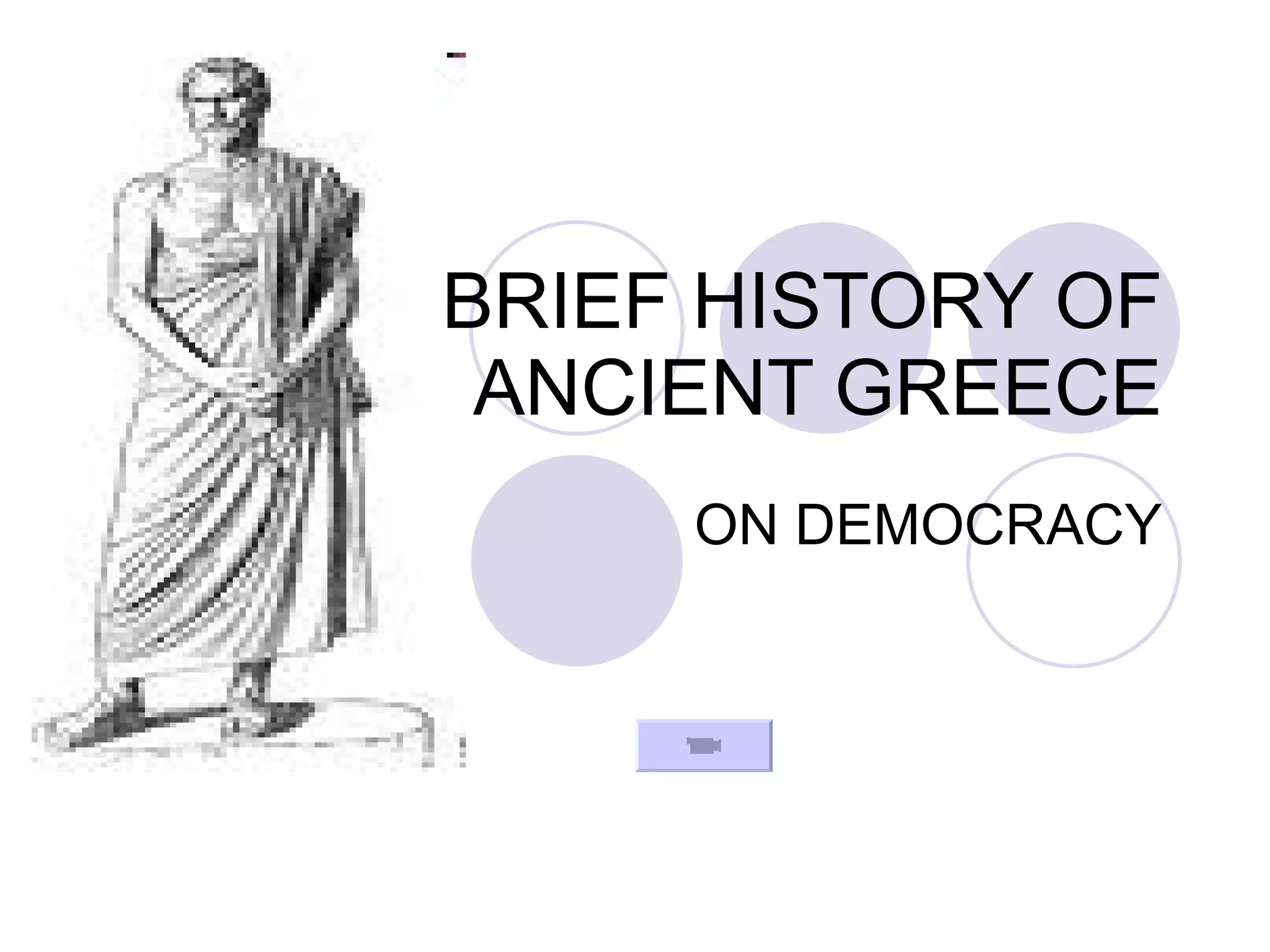
BRIEF HISTORY OF ANCIENT GREECE ON DEMOCRACY
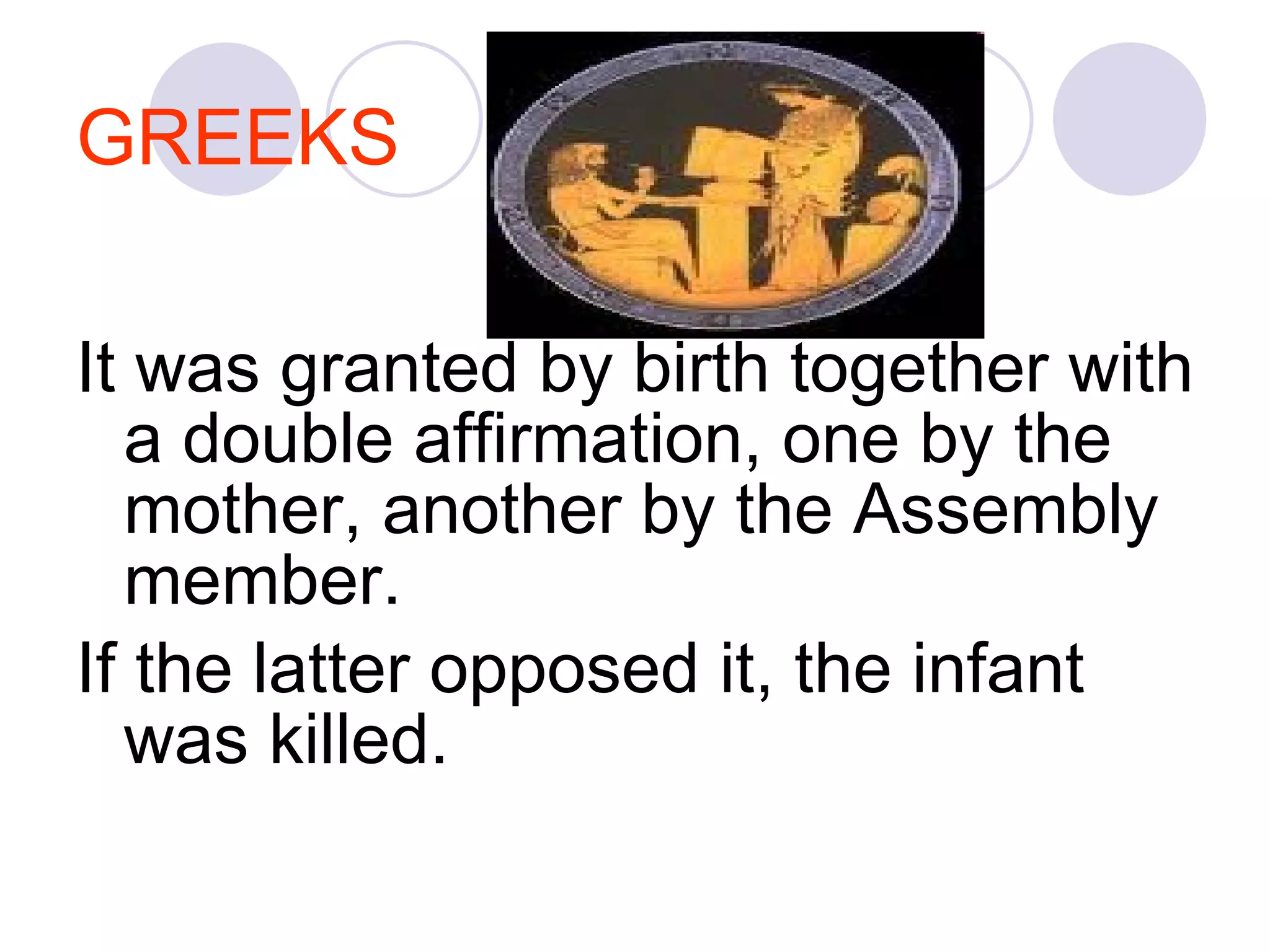
GREEKS It was granted by birth together with a double affirmation, one by the mother, another by the Assembly member.  If the latter opposed it, the infant was killed.
451 BC- a law which proposed that offspring between Greek male citizens and foreign women could not become citizens,  Reason: help curb the numbers of the exploding population numbers.
ARISTOTLE - defines citizenship as "he who has the power to take part in the deliberative or judicial administration of any state.“ Greeks enjoyed the privilege of being governed by democracy; their government was made up of commoners, and they were allowed freedom of speech to a large extent through public speaking rights.
ROMANS -  developed  on the concept of  citizenship  to distinguish their  original citizens (Romans) from the citizens of their conquests.  Roman citizens enjoyed the right to vote, the right to serve in the civil service and the right for military service.
All who were born to Roman fathers, even if they had foreign mothers, were acknowledged to be Roman citizens. Citizenship could also be granted by generals and emperors.
Expansion of the Roman Empire -  brought Roman citizenship to extend over the people of their provinces as well. Those who lived in autonomous regions could claim citizenship, but still lacked the right to vote.
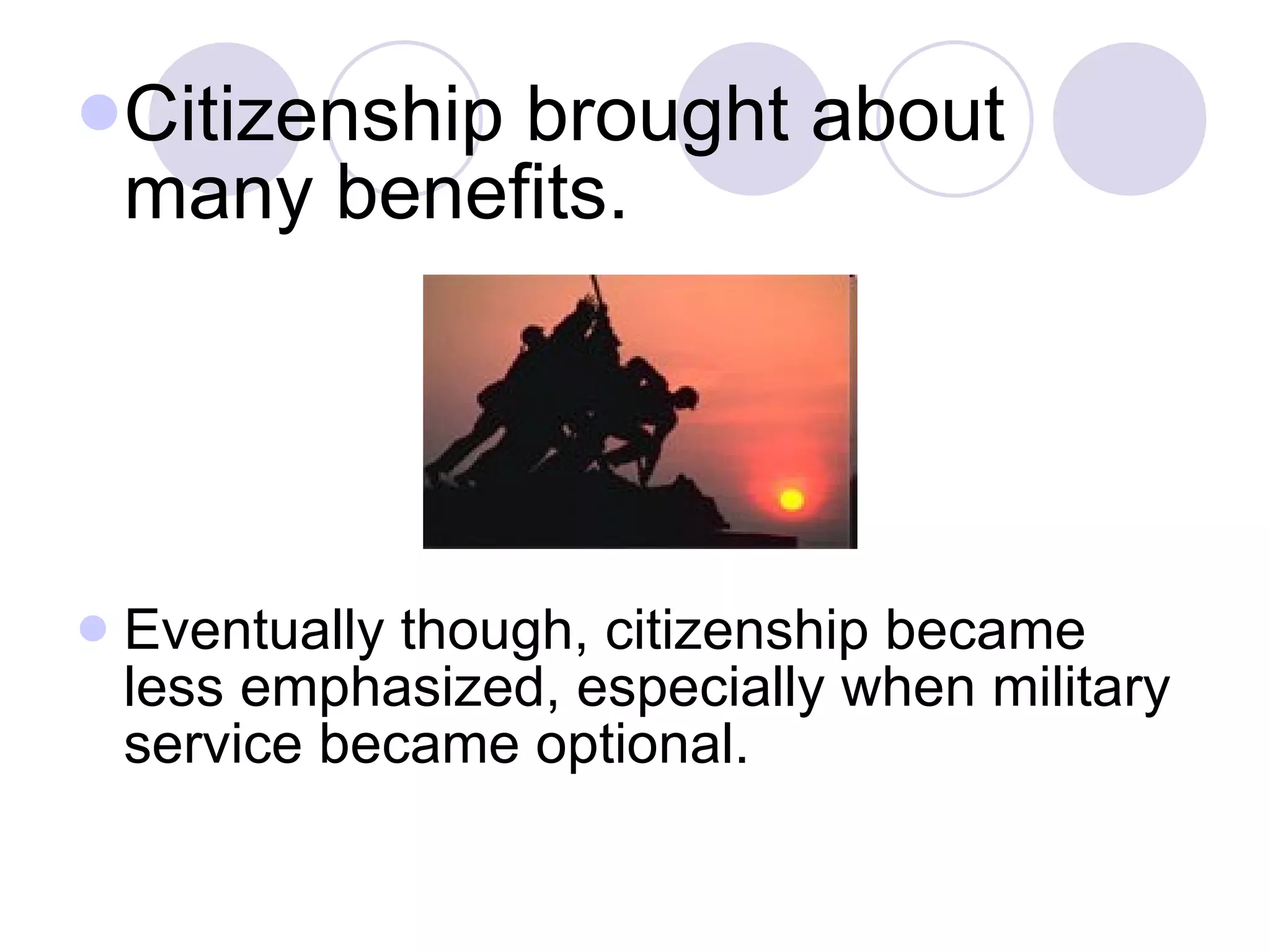
Citizenship brought about many benefits.  Eventually though, citizenship became less emphasized, especially when military service became optional.
MODERN CONCEPT OF CITIZENSHIP in a  DEMOCRATIC SOCIETY is the state of being a citizen of a  particular  social, political, or national community. In a democracy, the source of all authority -- the legitimate basis of all power -- is the collective body of the people, the citizens of the polity. There is popular sovereignty of the citizens and thereby government by consent of the governed. A citizen is a full and equal member of a polity, such as a democratic nation-state (Mouffe 1995, 217). 
CRITERIA FOR CITIZENSHIP In some states or countries, citizenship, the condition of being a citizen, is based on the place of a person's birth, which is known as "jus soli" citizenship.
CRITERIA FOR CITIZENSHIP In other places, the status of citizen is based on the citizenship of one's parents, which is known as "jus sanguinis" citizenship.
CRITERIA FOR CITIZENSHIP Some countries use both bases for ascribing citizenship. Further, most democratic states have established legal procedures by which people without a birthright to citizenship can become naturalized citizens. 
DUTIES OF RESPONSIBLE CITIZENSHIP   Paying taxes,  Serving in the country's armed forces when called upon,  Obeying laws enacted by one's representatives in government,
DUTIES OF RESPONSIBLE CITIZENSHIP Demonstrating commitment and loyalty to the democra tic political  community and state,  Constructively criticizi ng   the  conditions of political  and civic  life, and  Participating to improve the quality of political and civic life.
HOW CITIZENS TAKE RESPONSIBILITY FOR THEIR RIGHTS Respect the rights of others.  Defend their own rights and the rights of others against those who would abuse them.  Exercise their rights in order to make democracy work.
HOW TO TEACH ABOUT CITIZENSHIP IN A DEMOCRACY The concept of citizenship is a key to comprehension of what democracy is and how it works.
WHAT TO FOCUS: Students involved in education for democracy need to know: what citizenship is, how it is acquired or lost in various political systems, what rights, responsibilities, and duties are entailed by it, and how it is connected to the institutions of particular nation-states, especially their own. 
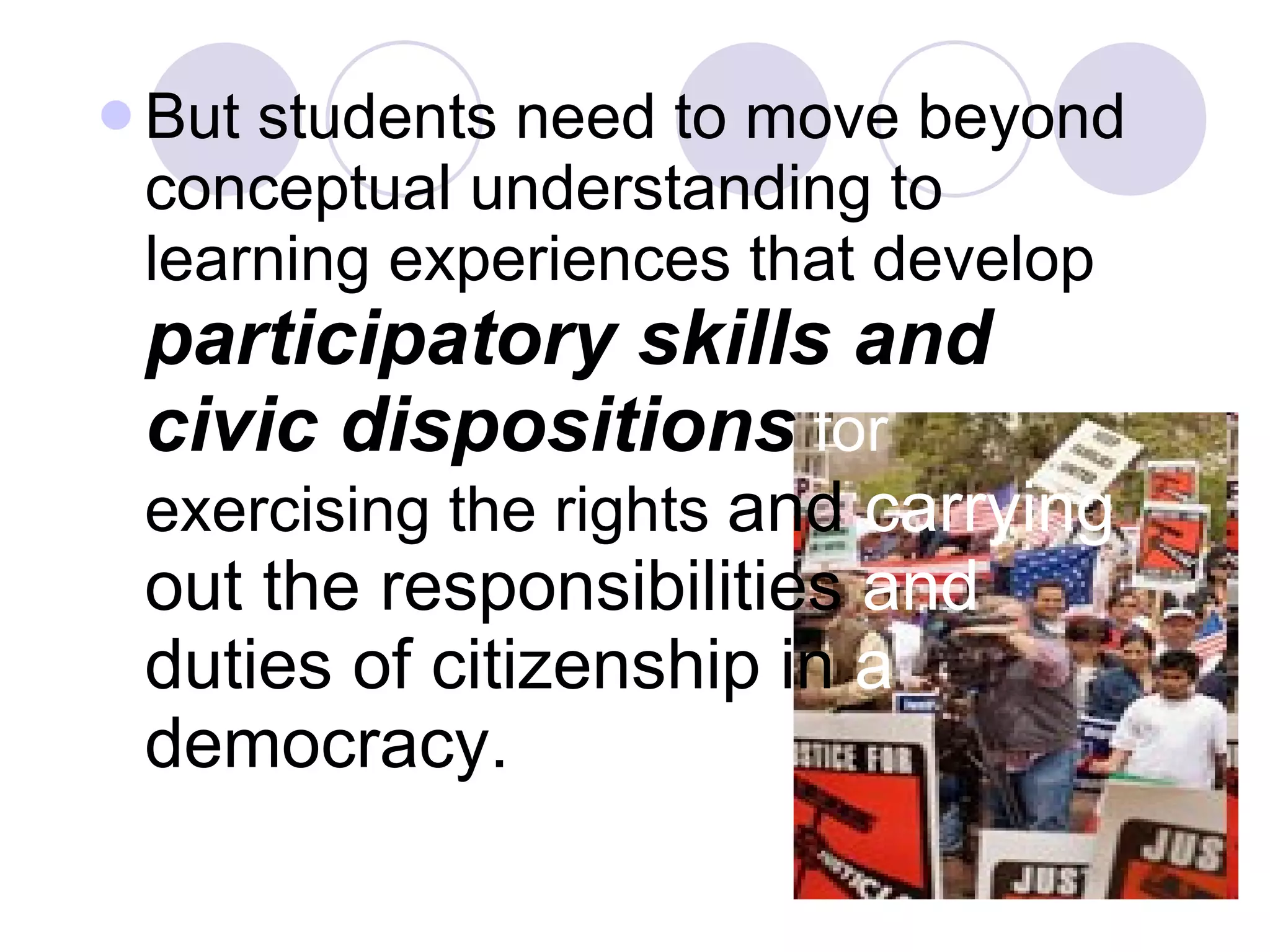
But students need to move beyond conceptual understanding to learning experiences that develop   participatory skills and civic dispositions   for  exercising the rights  and  carrying   out the responsibilities   and   duties of citizenship   in  a   democracy.
Three types of participatory skills: Interacting  Monitoring Influencing
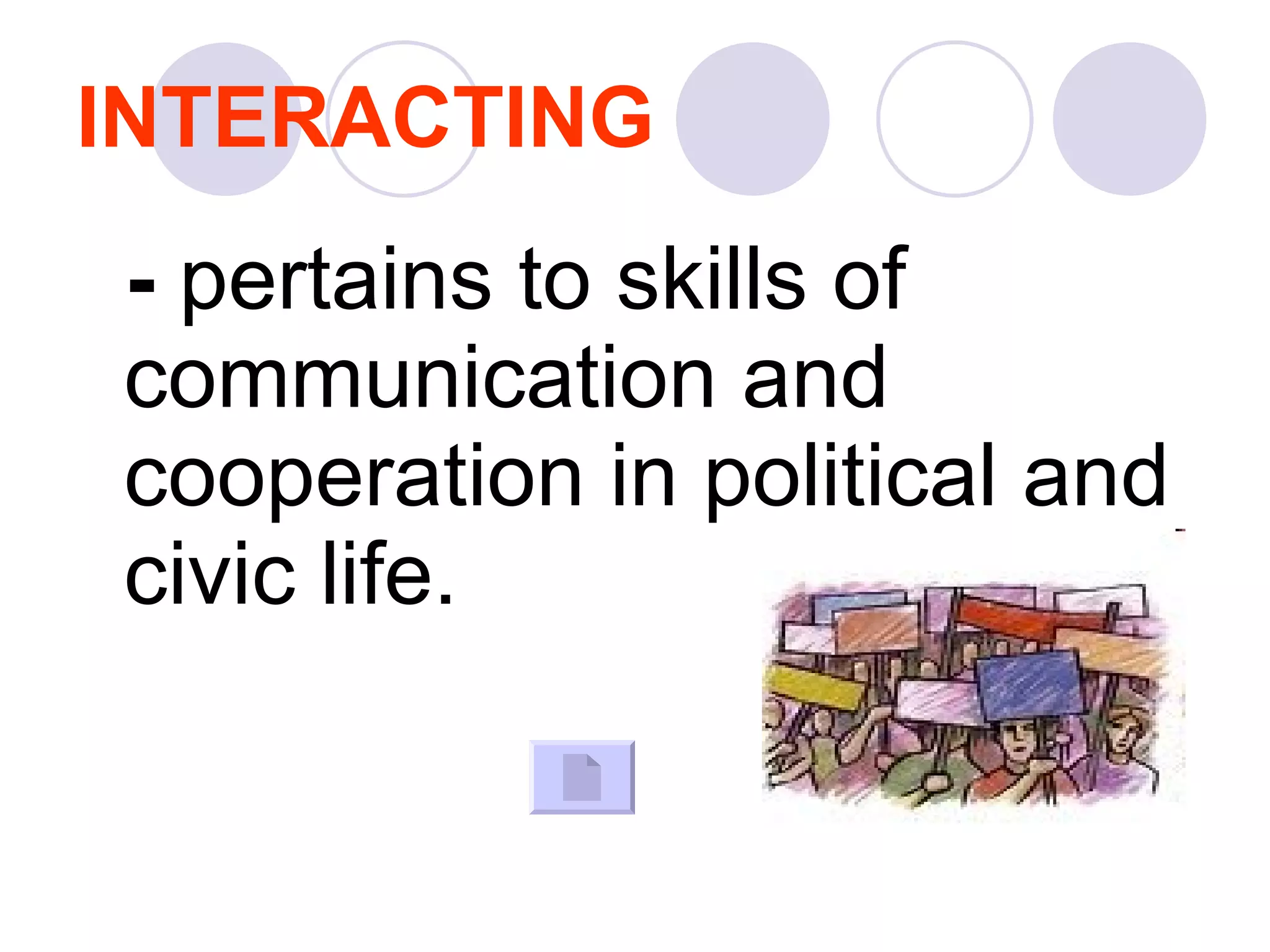
INTERACTING -  pertains to skills of communication and cooperation in political and civic life.
MONITORING -  involves skills needed to track the work of political leaders and institutions of government.  Party Lists
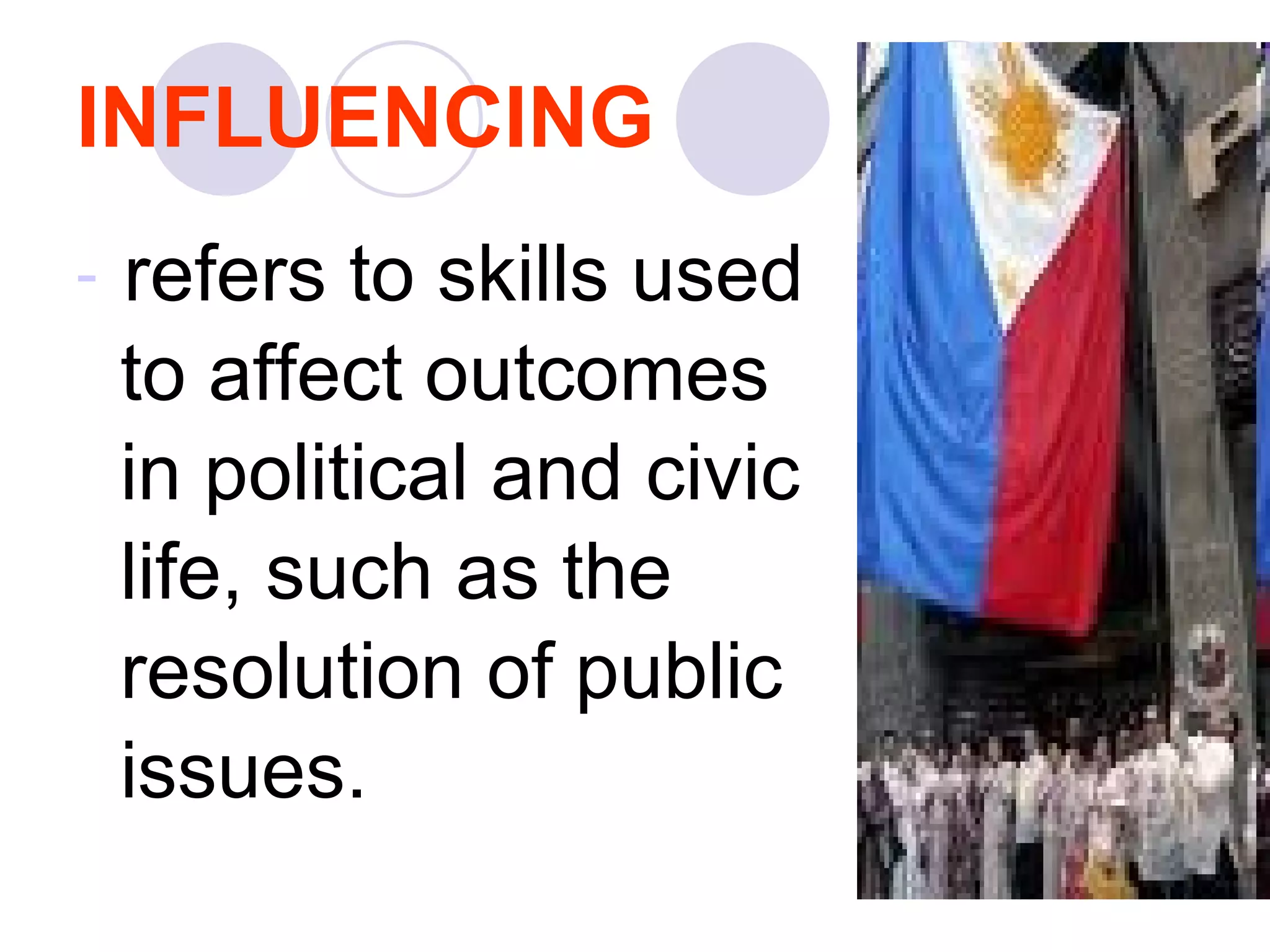
INFLUENCING refers to skills used  to affect outcomes  in political and civic  life, such as the  resolution of public  issues.
CIVIC DISPOSITIONS Traits of character: Civility  Sociability  Self-restraint  Trust Honesty
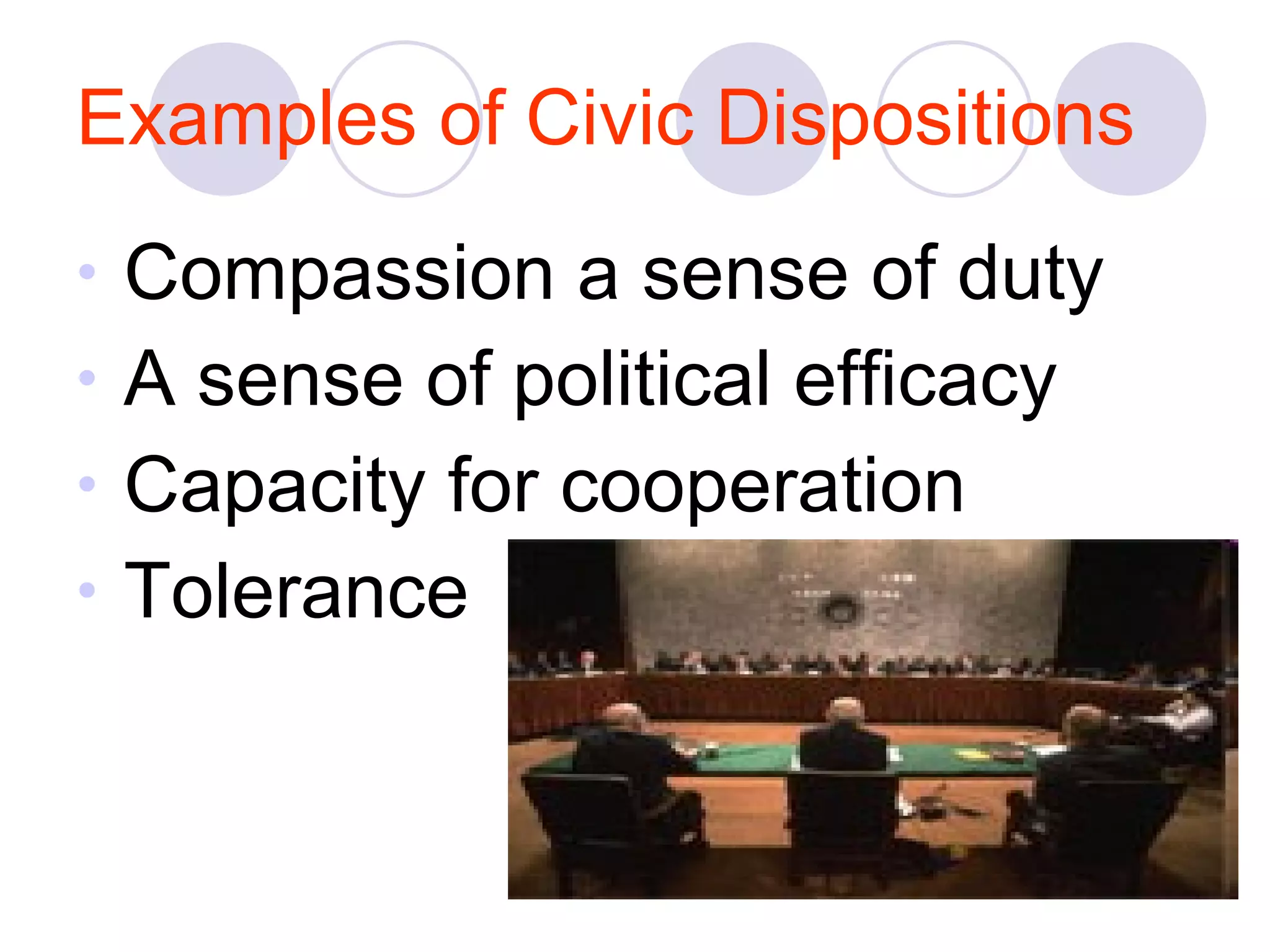
Examples of Civic Dispositions Compassion a sense of duty A sense of political efficacy Capacity for cooperation Tolerance
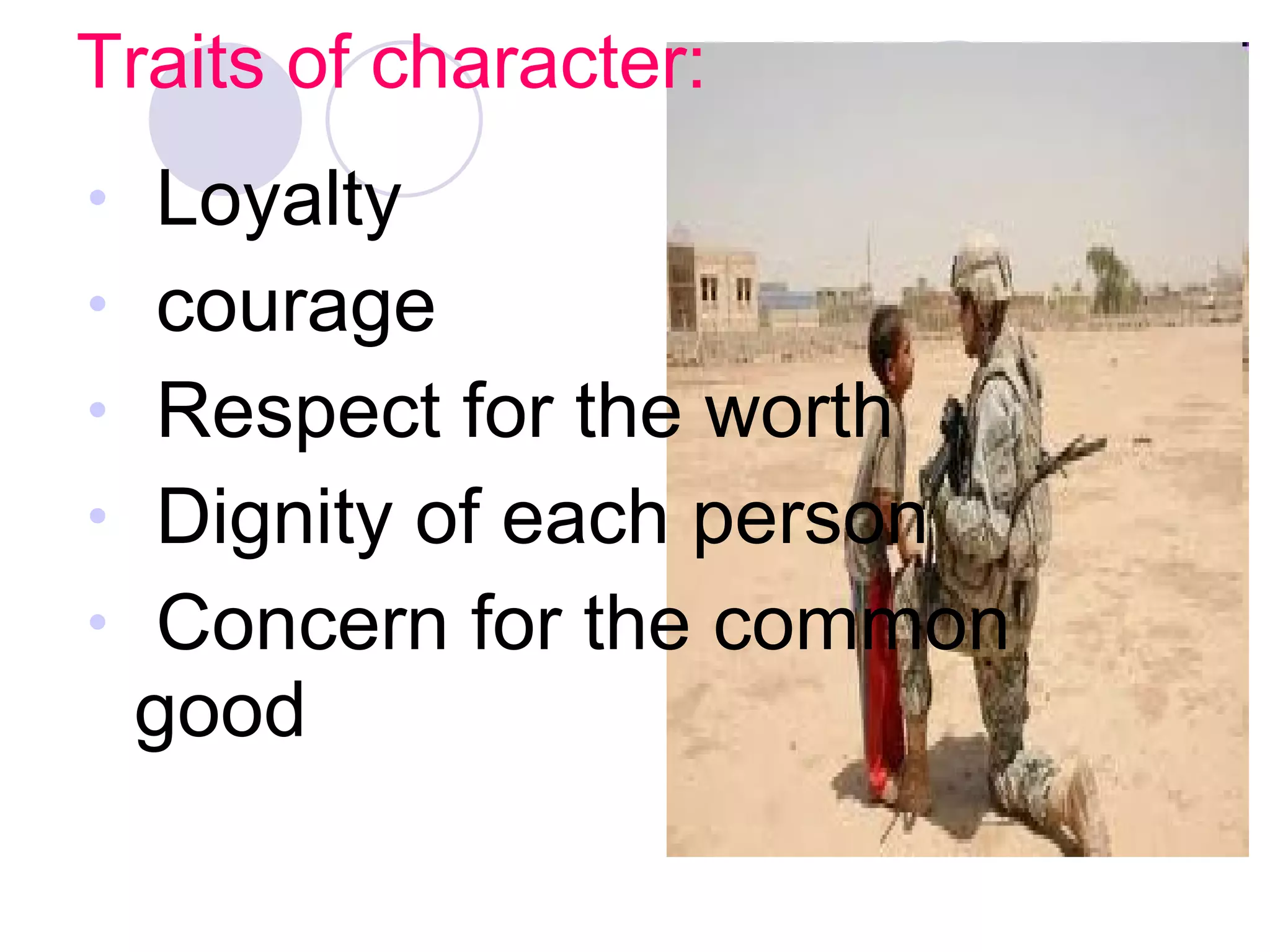
Traits of character: Loyalty  courage Respect for the worth Dignity of each person Concern for the common good
HOW TO DEVELOP PARTICIPATORY SKILLS AND CIVIC DISPOSITIONS NEEDED FOR EFFECTIVE AND RESPONSIBLE CITIZENSHIP   Student participation in democratically conducted student organizations. 
HOW TO DEVELOP PARTICIPATORY SKILLS AND CIVIC DISPOSITIONS NEEDED FOR EFFECTIVE AND RESPONSIBLE CITIZENSHIP School-based community service that is connected systematically to the school's curriculum and classroom  instruction.
HOW TO DEVELOP PARTICIPATORY SKILLS AND CIVIC DISPOSITIONS NEEDED FOR EFFECTIVE AND RESPONSIBLE CITIZENSHIP Cooperative learning activities in which groups of students cooperate to pursue a common goal, such as inquiring about a public issue  or  respo nding   to a   com munity   problem.  
DEFICIENCIES OF YOUNG PEOPLE IN LEARNING ABOUT RESPONSIBLE CITIZENSHIP
DEFICIENCIES OF YOUNG PEOPLE IN LEARNING ABOUT RESPONSIBLE CITIZENSHIP A rudimentary knowledge of government and citizenship. Fail to demonstrate knowledge needed for responsible participation in the political system.
DEFICIENCIES OF YOUNG PEOPLE IN LEARNING ABOUT RESPONSIBLE CITIZENSHIP Weak orientation by adolescents toward voluntary service for the community  Express low levels of political interest and efficacy  Violations of civic laws
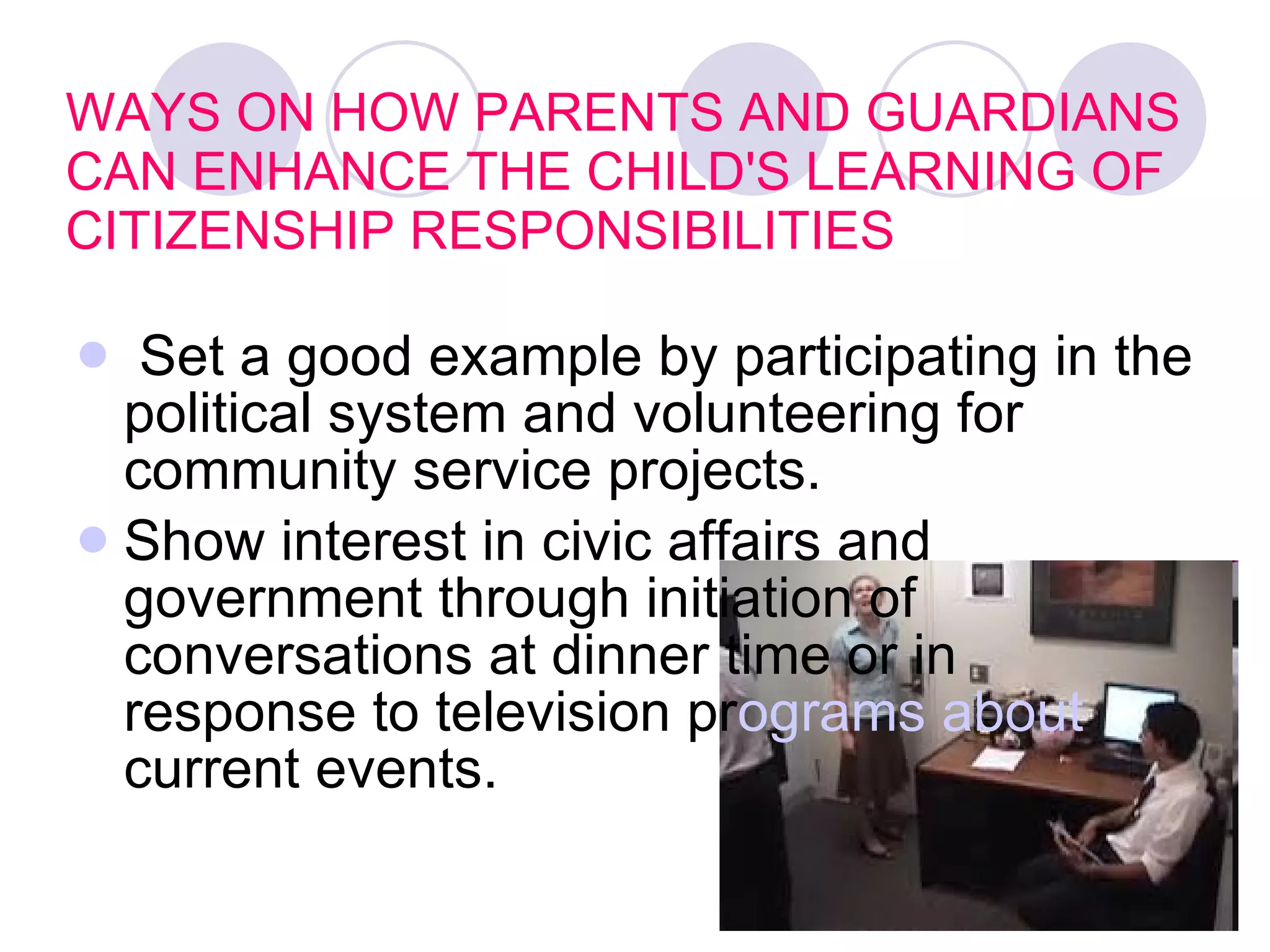
WHAT CAN BE DONE AT HOME?   “ Parents and guardians are the child's first and most influential teachers of civic values and attitudes.”
WAYS ON HOW PARENTS AND GUARDIANS CAN ENHANCE THE CHILD'S LEARNING OF CITIZENSHIP RESPONSIBILITIES  Set a good example by participating in the political system and volunteering for community service projects.   Show interest in civic affairs and government through initiation of conversations at dinner time or in response to television pr ograms about  current events. 
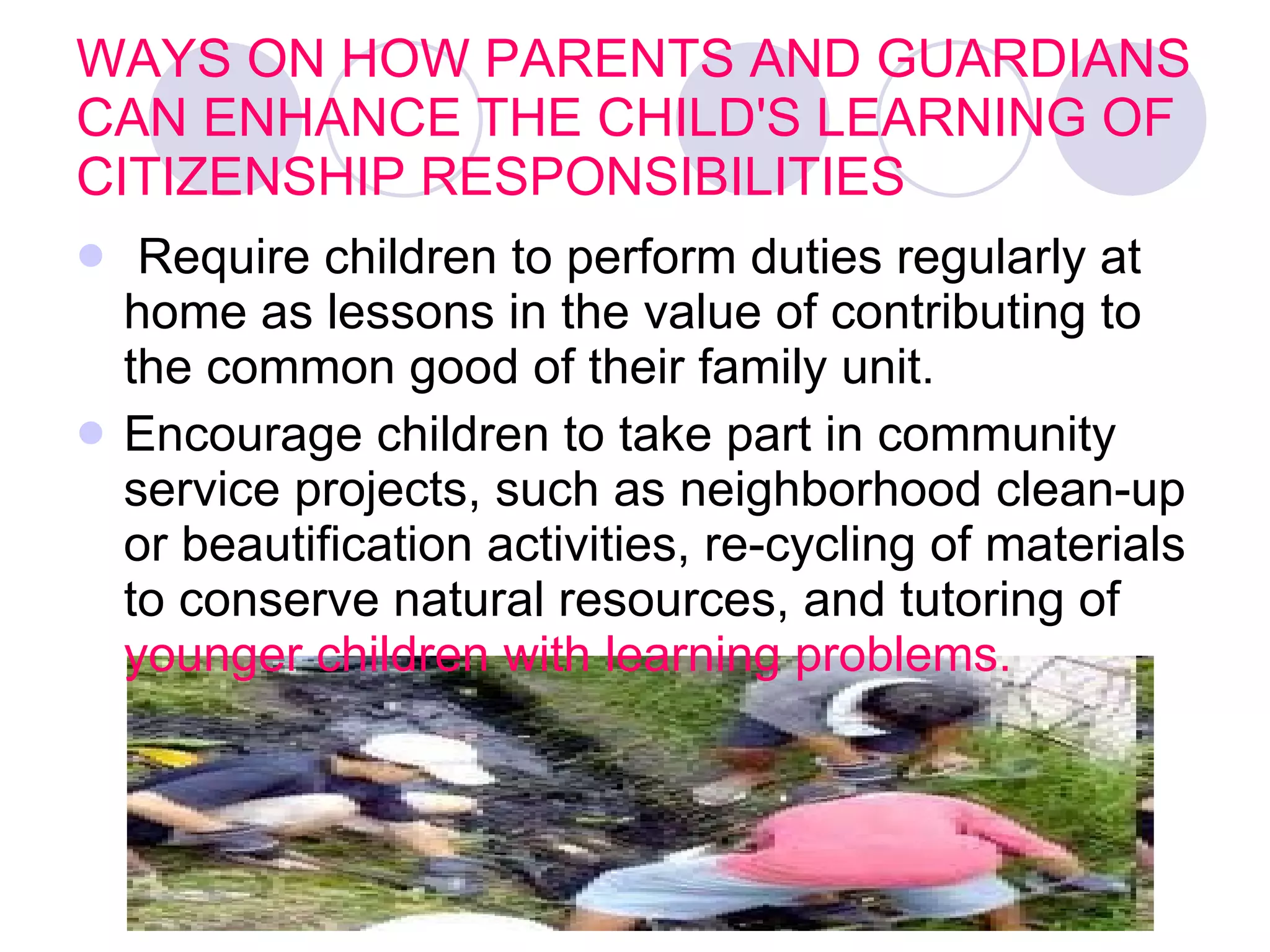
WAYS ON HOW PARENTS AND GUARDIANS CAN ENHANCE THE CHILD'S LEARNING OF CITIZENSHIP RESPONSIBILITIES Require children to perform duties regularly at home as lessons in the value of contributing to the common good of their family unit.   Encourage children to take part in community service projects, such as neighborhood clean-up or beautification activities, re-cycling of materials to conserve natural resources, and tutoring of  younger children with learning problems.
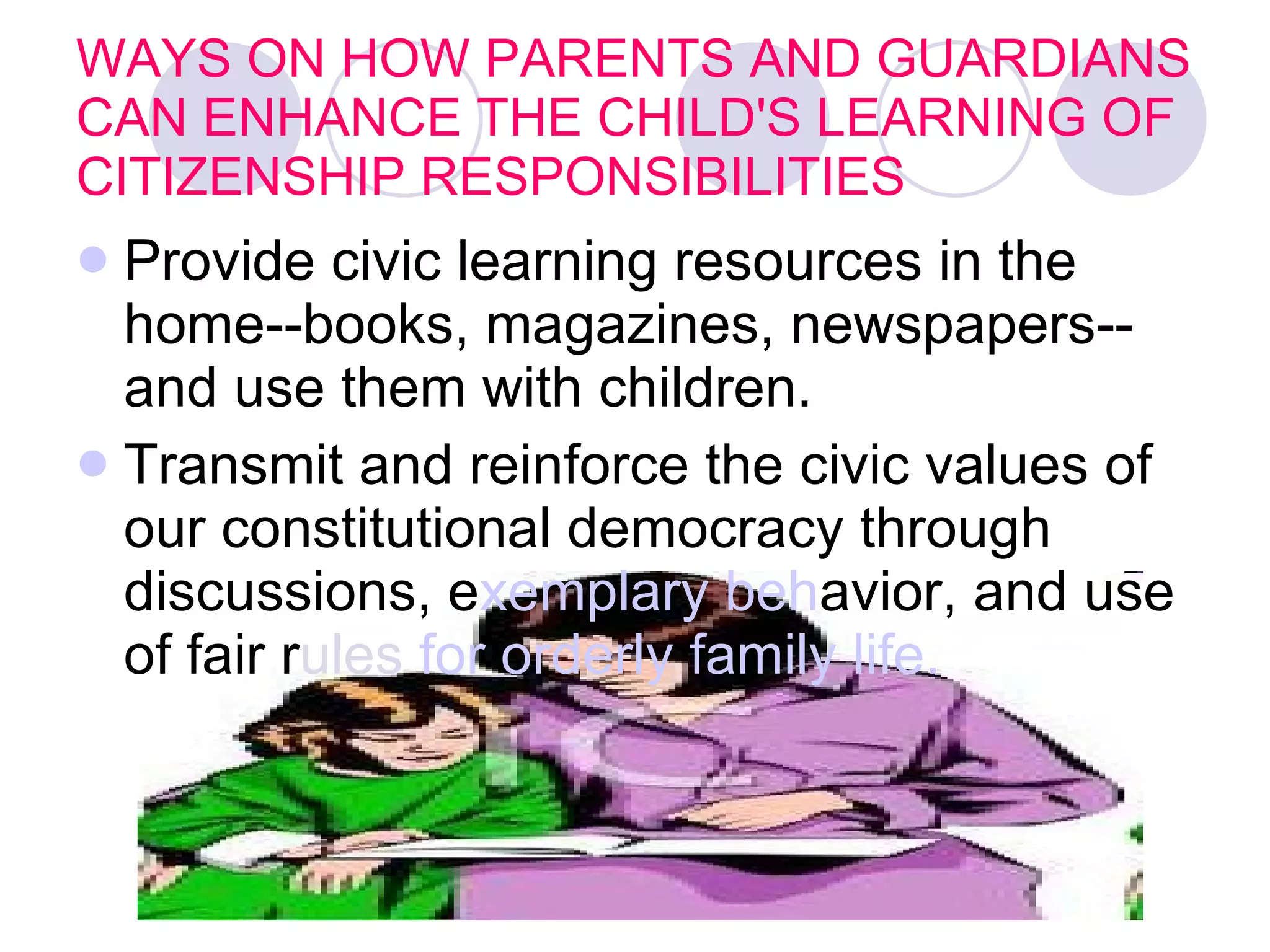
WAYS ON HOW PARENTS AND GUARDIANS CAN ENHANCE THE CHILD'S LEARNING OF CITIZENSHIP RESPONSIBILITIES Provide civic learning resources in the home--books, magazines, newspapers--and use them with children.   Transmit and reinforce the civic values of our constitutional democracy through discussions, e xemplary beh avior, and use of fair r ules  for orderly family life.  
WAYS ON HOW PARENTS AND GUARDIANS CAN ENHANCE THE CHILD'S LEARNING OF CITIZENSHIP RESPONSIBILITIES Monitor and reinforce at home lessons in school about the responsibilities of citizenship. 
WHAT CAN BE DONE AT SCHOOL?   After the family, the school has a major effect on the civic attitudes of children. It is the primary agency for teaching knowledge about politics and government.
WAYS ON HOW TO ENHANCE EDUCATION ABOUT CITIZENSHIP RESPONSIBILITIES AT SCHOOL    Increase the amount of time that all students are involved in civic education at all levels of school.   Infuse lessons about the responsibilities of citizenship into all subjects of the curriculum at all levels of schooling, with special emphasis in the social studies and literature courses. 
WAYS ON HOW TO ENHANCE EDUCATION ABOUT CITIZENSHIP RESPONSIBILITIES AT SCHOOL Require students to read, analyze, and discuss cases and stories about people involved in the civic life of their communities in the past and present.   Establish cooperative learning experiences in which groups of students take responsibility for their own achievement of educational objectives. 
Involve students in simulations and role playing activities about various aspects of civic responsibilities.   Emphasize lessons about the civic values of our constitutional democracy at all levels of schooling through role modeling, reading and writing assignments, and open discussion of public issues and current events. 
WAYS ON HOW TO ENHANCE EDUCATION ABOUT CITIZENSHIP RESPONSIBILITIES AT SCHOOL Establish school-based programs for performance of community service as a regular part of the civics curriculum.  Make assignments that require students to write letters to government officials or newspapers to advocate opinions about public issues and policies. 
WAYS ON HOW TO ENHANCE EDUCATION ABOUT CITIZENSHIP RESPONSIBILITIES AT SCHOOL Make assignments that require students to participate in political activities outside the classroom. 
THE  END THANK YOU!

Concepts of citizenship 2010

  • 1.
    CONCEPTS OF CITIZENSHIPPresented by: MARIA WENDY MENDOZA-SOLOMO
  • 2.
    THE MEANING OFCITIZENSHIP
  • 3.
    Ancient Concepts ofCitizenship Citizenship is being touted to have originated in Greece, which originated from the concept of democracy.
  • 4.
    BRIEF HISTORY OFANCIENT GREECE ON DEMOCRACY
  • 5.
    GREEKS It wasgranted by birth together with a double affirmation, one by the mother, another by the Assembly member. If the latter opposed it, the infant was killed.
  • 6.
    451 BC- alaw which proposed that offspring between Greek male citizens and foreign women could not become citizens, Reason: help curb the numbers of the exploding population numbers.
  • 7.
    ARISTOTLE - definescitizenship as "he who has the power to take part in the deliberative or judicial administration of any state.“ Greeks enjoyed the privilege of being governed by democracy; their government was made up of commoners, and they were allowed freedom of speech to a large extent through public speaking rights.
  • 8.
    ROMANS - developed on the concept of citizenship to distinguish their original citizens (Romans) from the citizens of their conquests. Roman citizens enjoyed the right to vote, the right to serve in the civil service and the right for military service.
  • 9.
    All who wereborn to Roman fathers, even if they had foreign mothers, were acknowledged to be Roman citizens. Citizenship could also be granted by generals and emperors.
  • 10.
    Expansion of theRoman Empire - brought Roman citizenship to extend over the people of their provinces as well. Those who lived in autonomous regions could claim citizenship, but still lacked the right to vote.
  • 11.
    Citizenship brought aboutmany benefits. Eventually though, citizenship became less emphasized, especially when military service became optional.
  • 12.
    MODERN CONCEPT OFCITIZENSHIP in a DEMOCRATIC SOCIETY is the state of being a citizen of a particular social, political, or national community. In a democracy, the source of all authority -- the legitimate basis of all power -- is the collective body of the people, the citizens of the polity. There is popular sovereignty of the citizens and thereby government by consent of the governed. A citizen is a full and equal member of a polity, such as a democratic nation-state (Mouffe 1995, 217). 
  • 13.
    CRITERIA FOR CITIZENSHIPIn some states or countries, citizenship, the condition of being a citizen, is based on the place of a person's birth, which is known as "jus soli" citizenship.
  • 14.
    CRITERIA FOR CITIZENSHIPIn other places, the status of citizen is based on the citizenship of one's parents, which is known as "jus sanguinis" citizenship.
  • 15.
    CRITERIA FOR CITIZENSHIPSome countries use both bases for ascribing citizenship. Further, most democratic states have established legal procedures by which people without a birthright to citizenship can become naturalized citizens. 
  • 16.
    DUTIES OF RESPONSIBLECITIZENSHIP Paying taxes, Serving in the country's armed forces when called upon, Obeying laws enacted by one's representatives in government,
  • 17.
    DUTIES OF RESPONSIBLECITIZENSHIP Demonstrating commitment and loyalty to the democra tic political community and state, Constructively criticizi ng the conditions of political and civic life, and Participating to improve the quality of political and civic life.
  • 18.
    HOW CITIZENS TAKERESPONSIBILITY FOR THEIR RIGHTS Respect the rights of others. Defend their own rights and the rights of others against those who would abuse them. Exercise their rights in order to make democracy work.
  • 19.
    HOW TO TEACHABOUT CITIZENSHIP IN A DEMOCRACY The concept of citizenship is a key to comprehension of what democracy is and how it works.
  • 20.
    WHAT TO FOCUS:Students involved in education for democracy need to know: what citizenship is, how it is acquired or lost in various political systems, what rights, responsibilities, and duties are entailed by it, and how it is connected to the institutions of particular nation-states, especially their own. 
  • 21.
    But students needto move beyond conceptual understanding to learning experiences that develop participatory skills and civic dispositions for exercising the rights and carrying out the responsibilities and duties of citizenship in a democracy.
  • 22.
    Three types ofparticipatory skills: Interacting Monitoring Influencing
  • 23.
    INTERACTING - pertains to skills of communication and cooperation in political and civic life.
  • 24.
    MONITORING - involves skills needed to track the work of political leaders and institutions of government. Party Lists
  • 25.
    INFLUENCING refers toskills used to affect outcomes in political and civic life, such as the resolution of public issues.
  • 26.
    CIVIC DISPOSITIONS Traitsof character: Civility Sociability Self-restraint Trust Honesty
  • 27.
    Examples of CivicDispositions Compassion a sense of duty A sense of political efficacy Capacity for cooperation Tolerance
  • 28.
    Traits of character:Loyalty courage Respect for the worth Dignity of each person Concern for the common good
  • 29.
    HOW TO DEVELOPPARTICIPATORY SKILLS AND CIVIC DISPOSITIONS NEEDED FOR EFFECTIVE AND RESPONSIBLE CITIZENSHIP Student participation in democratically conducted student organizations. 
  • 30.
    HOW TO DEVELOPPARTICIPATORY SKILLS AND CIVIC DISPOSITIONS NEEDED FOR EFFECTIVE AND RESPONSIBLE CITIZENSHIP School-based community service that is connected systematically to the school's curriculum and classroom instruction.
  • 31.
    HOW TO DEVELOPPARTICIPATORY SKILLS AND CIVIC DISPOSITIONS NEEDED FOR EFFECTIVE AND RESPONSIBLE CITIZENSHIP Cooperative learning activities in which groups of students cooperate to pursue a common goal, such as inquiring about a public issue or respo nding to a com munity problem.  
  • 32.
    DEFICIENCIES OF YOUNGPEOPLE IN LEARNING ABOUT RESPONSIBLE CITIZENSHIP
  • 33.
    DEFICIENCIES OF YOUNGPEOPLE IN LEARNING ABOUT RESPONSIBLE CITIZENSHIP A rudimentary knowledge of government and citizenship. Fail to demonstrate knowledge needed for responsible participation in the political system.
  • 34.
    DEFICIENCIES OF YOUNGPEOPLE IN LEARNING ABOUT RESPONSIBLE CITIZENSHIP Weak orientation by adolescents toward voluntary service for the community Express low levels of political interest and efficacy Violations of civic laws
  • 35.
    WHAT CAN BEDONE AT HOME? “ Parents and guardians are the child's first and most influential teachers of civic values and attitudes.”
  • 36.
    WAYS ON HOWPARENTS AND GUARDIANS CAN ENHANCE THE CHILD'S LEARNING OF CITIZENSHIP RESPONSIBILITIES Set a good example by participating in the political system and volunteering for community service projects.  Show interest in civic affairs and government through initiation of conversations at dinner time or in response to television pr ograms about current events. 
  • 37.
    WAYS ON HOWPARENTS AND GUARDIANS CAN ENHANCE THE CHILD'S LEARNING OF CITIZENSHIP RESPONSIBILITIES Require children to perform duties regularly at home as lessons in the value of contributing to the common good of their family unit.  Encourage children to take part in community service projects, such as neighborhood clean-up or beautification activities, re-cycling of materials to conserve natural resources, and tutoring of younger children with learning problems.
  • 38.
    WAYS ON HOWPARENTS AND GUARDIANS CAN ENHANCE THE CHILD'S LEARNING OF CITIZENSHIP RESPONSIBILITIES Provide civic learning resources in the home--books, magazines, newspapers--and use them with children.  Transmit and reinforce the civic values of our constitutional democracy through discussions, e xemplary beh avior, and use of fair r ules for orderly family life.  
  • 39.
    WAYS ON HOWPARENTS AND GUARDIANS CAN ENHANCE THE CHILD'S LEARNING OF CITIZENSHIP RESPONSIBILITIES Monitor and reinforce at home lessons in school about the responsibilities of citizenship. 
  • 40.
    WHAT CAN BEDONE AT SCHOOL? After the family, the school has a major effect on the civic attitudes of children. It is the primary agency for teaching knowledge about politics and government.
  • 41.
    WAYS ON HOWTO ENHANCE EDUCATION ABOUT CITIZENSHIP RESPONSIBILITIES AT SCHOOL   Increase the amount of time that all students are involved in civic education at all levels of school.  Infuse lessons about the responsibilities of citizenship into all subjects of the curriculum at all levels of schooling, with special emphasis in the social studies and literature courses. 
  • 42.
    WAYS ON HOWTO ENHANCE EDUCATION ABOUT CITIZENSHIP RESPONSIBILITIES AT SCHOOL Require students to read, analyze, and discuss cases and stories about people involved in the civic life of their communities in the past and present.  Establish cooperative learning experiences in which groups of students take responsibility for their own achievement of educational objectives. 
  • 43.
    Involve students insimulations and role playing activities about various aspects of civic responsibilities.  Emphasize lessons about the civic values of our constitutional democracy at all levels of schooling through role modeling, reading and writing assignments, and open discussion of public issues and current events. 
  • 44.
    WAYS ON HOWTO ENHANCE EDUCATION ABOUT CITIZENSHIP RESPONSIBILITIES AT SCHOOL Establish school-based programs for performance of community service as a regular part of the civics curriculum.  Make assignments that require students to write letters to government officials or newspapers to advocate opinions about public issues and policies. 
  • 45.
    WAYS ON HOWTO ENHANCE EDUCATION ABOUT CITIZENSHIP RESPONSIBILITIES AT SCHOOL Make assignments that require students to participate in political activities outside the classroom. 
  • 46.
    THE ENDTHANK YOU!