MACHIAVELLI’S POLITICAL PHILOSOPHY
1. Historical Context of Machiavelli’s time:
A. Renaissance vs. Middle Ages.
B. Italy and Florence.
C. Basic characteristics of the Humanism.
2. Philosophical context:
A. Political philosophy in Greek times: Plato, Aristotle.
B. Political philosophy in Middle Ages: Augustine of Hippo and Tomas
of Aquinas.
3. Machiavelli’s Political Philosophy:
1. Biography of a politician in Renaissance times: Machiavelli and the
Medici.
2. Political Realism
3. State’s Reason: main goal of the Prince.
4. Good laws and a good army
5. Political science and Machiavelli.
RENAISSENSE VS. MIDDLE AGES
The Renaissance (XIV and XV centuries) is considered the start
of Modern times because it is more like today. Medieval life was
kind of a dark life. In the Middle Ages, life was just a short
interlude until death, and poverty was respected. Human lives
revolved around God and The Catholic Church had a strong
influence in politics.
By the time of the Renaissance, big changes had occurred:
Barbarians, the Vikings, and Magyars were gone. Now there
were strong central monarchies throughout most of Europe.
Papacy and feudalism had declined. People were getting sick of
the old attitudes.
Renaissance" means "rebirth" because it was believed that the
human spirit had to be reawakened as it was in the classical
(Greco-Roman) times.
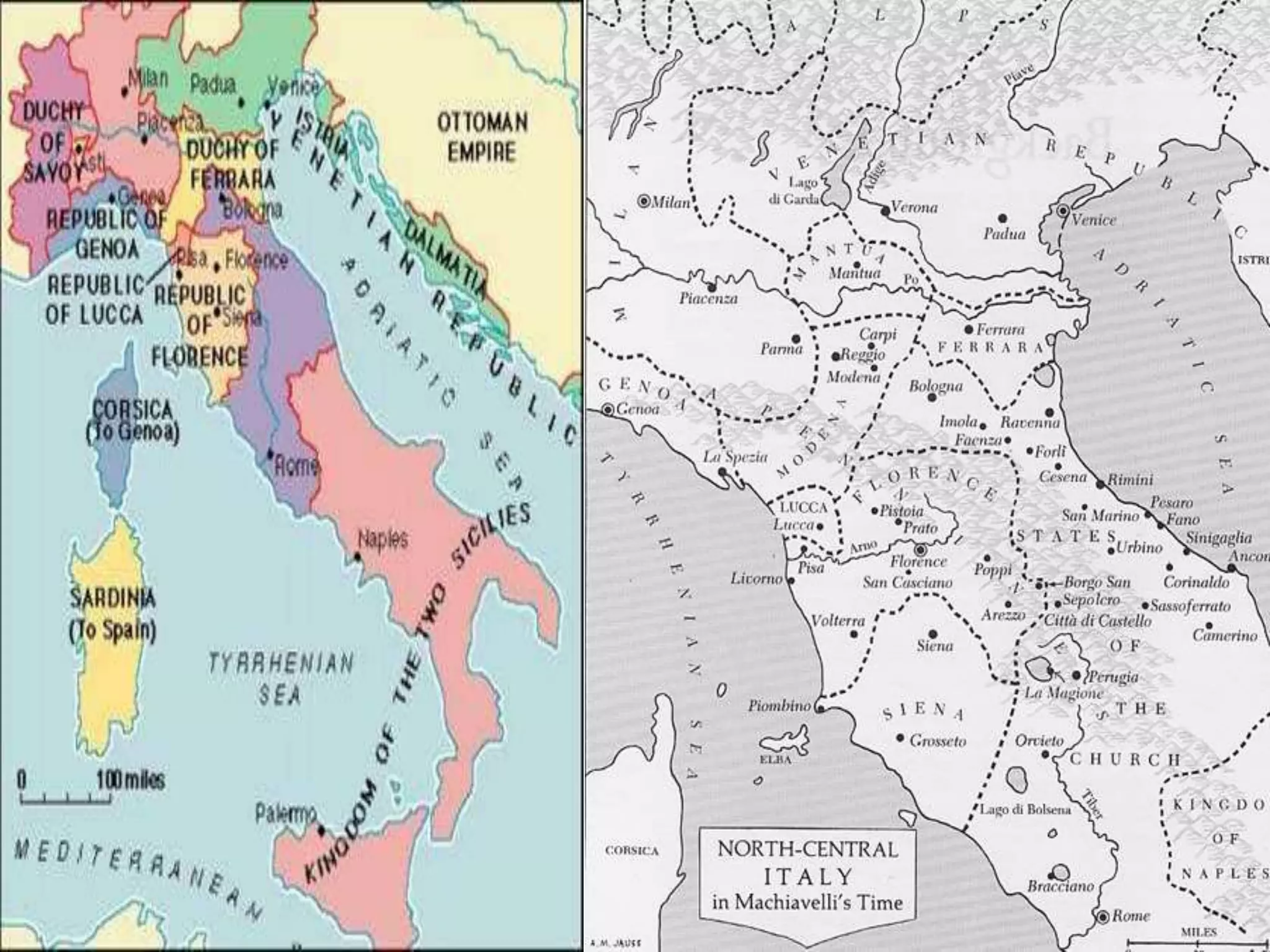
ITALY AND FLORENCE
 Five big states (Venetia, Florence, Milan,
Vatican e Naples) and four small ones
(Piamonte, Siena, Geneva e Lucas)
 1454 (Maquiavelli 1469-1527) Peace of
Lodi: after years of war conflicts among
the Italian states, Lorenzo de Medici got a
peace agreement in between Italian
territories with the help of Foreign
mercenary armies (France, Germany,
Spain)
 Italy then gets to be the center of the
disputes between the risings absolute
monarchies of Europe
 Italy heads the new economical situation
in Europe as well, leading Europe to
capitalism and the rising of a new social
class that takes the place of the old
nobility: the bourgeoisie
 Long government: that which includes
the participation of new social class.
 Narrow government: that which not
includes such participation.
 The nobility is not any more the only
POLITICAL SUBJECT.
Florence prospered during the
Renaissance because it was a crossroads
for traders, for finance, thanks to
banking, and for ideas. The city was
opened up to the ideals and philosophies
of distant lands, and absorbed these
into the writing and art it produced;
that art then flowed freely outward to
the rest of Italy and the European
continent. The Medici maintained the
stability of these connections through
financial and political means.
A NEW CONCEPTION OF HUMAN
BEINGS
Individualism. People thought it right to be themselves - the great
man can shape his own destiny
Humanism. Humans are the centre of the universe and the
"measure of all things.“
Well-Roundness. Humans could do well at many things: "The
Renaissance Man“ as a whole educated man in all the arts.
Classicism. People revived an interest in ancient Greece and Rome.
 Neo- Platonism: coming back to Plato’s and Neo – Platonism's
philosophies, with a new interest in magical and mystical elements in
them.
 ANTHROPOCENTRISM: Humankind as the central element of
existence, especially as opposed to God or animals.
INDIVIDUALISM
“His life was gentle; and the elements. So mixed in him, that
nature might stand up, And say to all the world, THIS WAS A
MAN” William Shakespeare
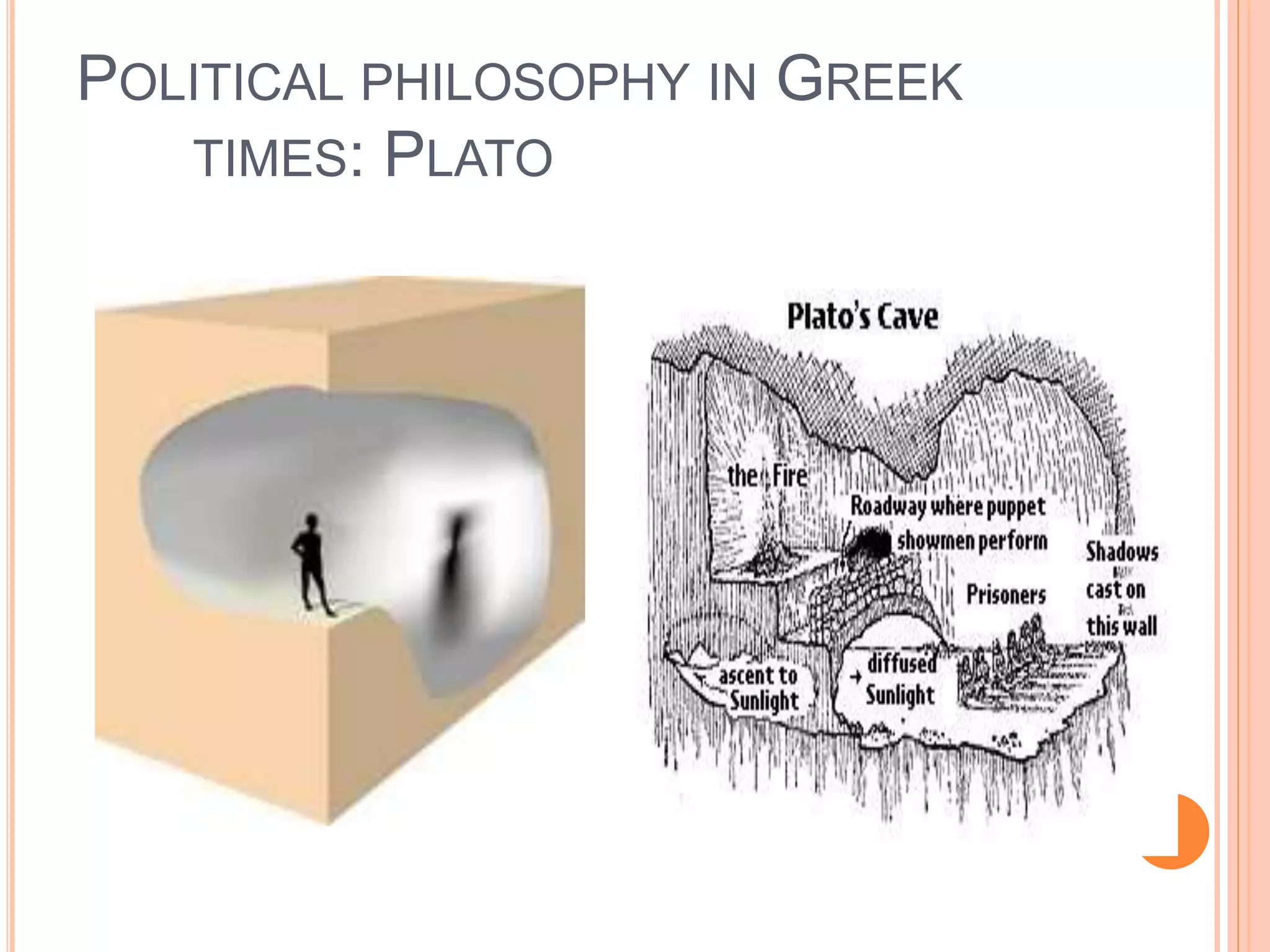
POLITICAL PHILOSOPHY IN GREEK
TIMES: PLATO
ARISTOTLE.
Form of government Finality Sovereign
Licit forms
of
governme
nt. Pursuit
of Justice
1
st
Republic / politeia Common
Good
Majority
2
n
d
Monarchy Common
Good
An
individual
3
r
d
Aristocracy Common
Good
Minority
(elite)
Illicit forms
of
governme
nt.
Despotism
and
degradatio
n forms
4
t
h
Tyranny Monarch
interest
An
individual
5
t
h
Oligarchy Rich
interest
Minority
(Rich)
6
t
h
Democracy or
Demagogy
Poor
interest
Majority
 "Man is by nature a political animal.“ Politics
 “Every tate is a community of some kind, and
every community is established with a view to
some good; for mankind always act in order
to obtain that which they think good. But, if all
communities aim at some good, the state or
political community, which is the highest of
all, and which embraces all the rest, aims at
good in a greater degree than any other, and
at the highest good.
Some people think that the qualifications of a
statesman, king, householder, and master
are the same, and that they differ, not in kind,
but only in the number of their subjects. For
example, the ruler over a few is called a
master; over more, the manager of a
household; over a still larger number, a
statesman or king, as if there were no
difference between a great household and a
small state. The distinction which is made
between the king and the statesman is as
follows: When the government is personal,
the ruler is a king; when, according to the
rules of the political science, the citizens rule
and are ruled in turn, then he is called a
statesman.
But all this is a mistake; for governments
differ in kind, as will be evident to any one
who considers the matter according to the
method which has hitherto guided us. As in
other departments of science, so in politics,
the compound should always be resolved
into the simple elements or least parts of the
whole. We must therefore look at the
elements of which the state is composed, in
order that we may see in what the different
kinds of rule differ from one another, and
whether any scientific result can be attained
about each one of them” Politics, part I.
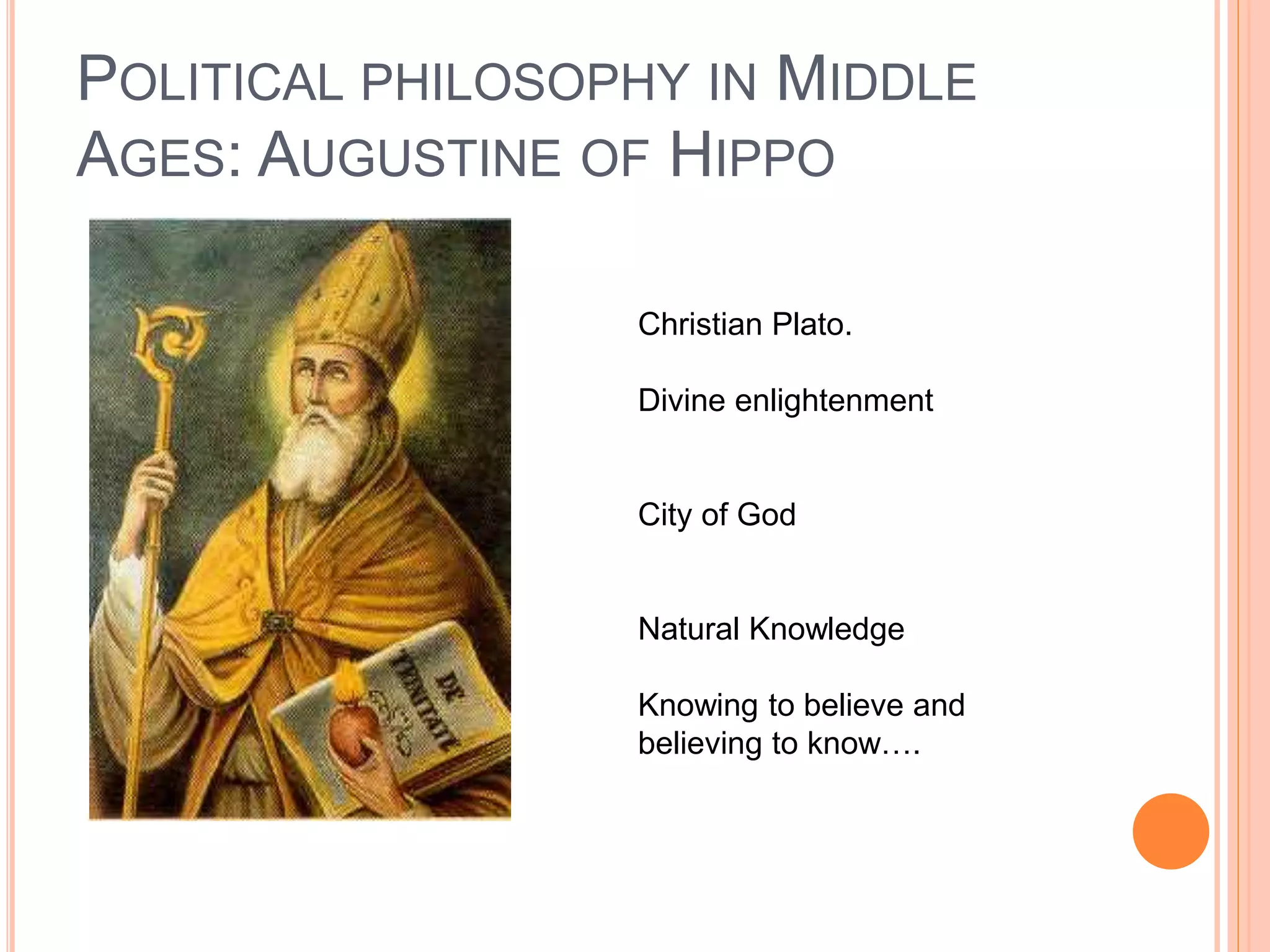
POLITICAL PHILOSOPHY IN MIDDLE
AGES: AUGUSTINE OF HIPPO
Christian Plato.
Divine enlightenment
City of God
Natural Knowledge
Knowing to believe and
believing to know….
POLITICAL PHILOSOPHY IN MIDDLE
AGES: TOMAS OF AQUINAS.
Summa Theologica.
Christian Aristotle
Five paths to
demonstrate god
existence: empirical
theology.
Faith and Reason:
perfect
complementary, with
the Bible as natural
guide.
MACHIAVELLI AND THE MEDICI.
 “Machiavelli was a proper man and a good citizen;
but, being attached to the court of the Medici, he
could not help veiling his love of liberty in the midst
of his country's oppression. The choice of his
detestable hero, Cesare Borgia, clearly enough
shows his hidden aim; and the contradiction
between the teaching of the Prince and that of the
Discourses on Livy and the History of Florence
shows that this profound political thinker has so far
been studied only by superficial or corrupt readers.
The Court of Rome sternly prohibited his book. I
can well believe it; for it is that Court it most clearly
portrays”.—Rousseau, The Social Contract, Book
III.
 The evening has come, I return home and go to my study; at the
entrance I pull off my peasant- clothes, covered with dust and dirt,
and put on my noble court dress, and thus becomingly re-clothed I
pass into the ancient courts of the men of old, where, being lovingly
received by them, I am fed with that food which is mine alone; where
I do not hesitate to speak with them, and to ask for the reason of their
actions, and they in their benignity answer me; and for four hours I
feel no weariness, I forget every trouble, poverty does not dismay,
death does not terrify me; I am possessed entirely by those great
men.
And because Dante says, “Knowledge doth come of learning well
retained, Unfruitful else”
I have noted down what I have gained from their conversation, and
have composed a small work on 'Principalities,' where I pour myself
out as fully as I can in meditation on the subject, discussing what a
principality is, what kinds there are, how they can be acquired, how
they can be kept, why they are lost: and if any of my fancies ever
pleased you, this ought not to displease you: and to a prince,
especially to a new one, it should be welcome …
(A letter to Francesco Vettori, dated 13 December 1513, Machiavelli
describes his life at this period, which elucidates his methods and his
motives in writing The Prince)
POLITICAL REALISM
 “. . . no prince is ever benefited by making himself
hated”. Discourses Book III, Chapter XIX
 “Men ought either to be indulged or utterly
destroyed, for if you merely offend them they take
vengeance, but if you injure them greatly they are
unable to retaliate, so that the injury done to a man
ought to be such that vengeance cannot be feared.
” The Prince
 “Whosoever desires constant success must change
his conduct with the times.” The Prince
STATE’S REASON: CRITERION
 “A prince never lacks legitimate reasons to break
his promise”. The prince.
 FORTUNE: “Entrepreneurs are simply those who
understand that there is little difference between
obstacle and opportunity and are able to turn both
to their advantage.” The Prince
 “It is better to be feared than loved, if you cannot
be both”.
 “When neither their property nor their honor is
touched, the majority of men live content”. Niccolo
Machiavelli, The Prince
GOOD LAWS
 “The main foundations of every state, new states as
well as ancient or composite ones, are good laws
and good arms you cannot have good laws without
good arms, and where there are good arms, good
laws inevitably follow. ” The Prince
 “It is necessary for him who lays out a state and
arranges laws for it to presuppose that all men are
evil and that they are always going to act according
to the wickedness of their spirits whenever they
have free scope. ” The Prince
GOOD ARMIES
 “Before all else, be armed.” The Prince
 “For among other evils caused by being disarmed,
it renders you contemptible; which is one of those
disgraceful things which a prince must guard
against. ” The Prince
REPUBLIC
 “A return to first principles in a republic is
sometimes caused by the simple virtues of one
man. His good example has such an influence that
the good men strive to imitate him, and the wicked
are ashamed to lead a life so contrary to his
example. ” The Prince
POLITICAL SCIENCE
 “Unlike many before him, Machiavelli provided examples to
back up his arguments about government and leadership. He
influenced other political scientists, including Sir Francis
Bacon (1561-1626), who praised Machiavelli for being such
an honest creature, and Thomas Hobbes (1588-1679), author
of Leviathan (1651), who agreed with Machiavelli that all
people were weak, and needed a strong ruler, else society run
to complete decay. Machiavelli’s work is still debated today by
philosophers, students and theorists everywhere. His name
has even taken on special meaning; “Machiavellian” is a term
used to describe rulers who use deceit to impose their will”.
http://weuropeanhistory.suite101.com/article.cfm/niccolo_mac
hiavelli#ixzz0JQRIDcUh&D
BIBLIOGRAPHY /WIKIGRAPHY
 Wikipedia (english)
 Britannica
 The Prince
 Discourses.

machiavellis_political_philosophy.ppt

  • 1.
    MACHIAVELLI’S POLITICAL PHILOSOPHY 1.Historical Context of Machiavelli’s time: A. Renaissance vs. Middle Ages. B. Italy and Florence. C. Basic characteristics of the Humanism. 2. Philosophical context: A. Political philosophy in Greek times: Plato, Aristotle. B. Political philosophy in Middle Ages: Augustine of Hippo and Tomas of Aquinas. 3. Machiavelli’s Political Philosophy: 1. Biography of a politician in Renaissance times: Machiavelli and the Medici. 2. Political Realism 3. State’s Reason: main goal of the Prince. 4. Good laws and a good army 5. Political science and Machiavelli.
  • 2.
    RENAISSENSE VS. MIDDLEAGES The Renaissance (XIV and XV centuries) is considered the start of Modern times because it is more like today. Medieval life was kind of a dark life. In the Middle Ages, life was just a short interlude until death, and poverty was respected. Human lives revolved around God and The Catholic Church had a strong influence in politics. By the time of the Renaissance, big changes had occurred: Barbarians, the Vikings, and Magyars were gone. Now there were strong central monarchies throughout most of Europe. Papacy and feudalism had declined. People were getting sick of the old attitudes. Renaissance" means "rebirth" because it was believed that the human spirit had to be reawakened as it was in the classical (Greco-Roman) times.
  • 4.
    ITALY AND FLORENCE Five big states (Venetia, Florence, Milan, Vatican e Naples) and four small ones (Piamonte, Siena, Geneva e Lucas)  1454 (Maquiavelli 1469-1527) Peace of Lodi: after years of war conflicts among the Italian states, Lorenzo de Medici got a peace agreement in between Italian territories with the help of Foreign mercenary armies (France, Germany, Spain)  Italy then gets to be the center of the disputes between the risings absolute monarchies of Europe  Italy heads the new economical situation in Europe as well, leading Europe to capitalism and the rising of a new social class that takes the place of the old nobility: the bourgeoisie  Long government: that which includes the participation of new social class.  Narrow government: that which not includes such participation.  The nobility is not any more the only POLITICAL SUBJECT. Florence prospered during the Renaissance because it was a crossroads for traders, for finance, thanks to banking, and for ideas. The city was opened up to the ideals and philosophies of distant lands, and absorbed these into the writing and art it produced; that art then flowed freely outward to the rest of Italy and the European continent. The Medici maintained the stability of these connections through financial and political means.
  • 5.
    A NEW CONCEPTIONOF HUMAN BEINGS Individualism. People thought it right to be themselves - the great man can shape his own destiny Humanism. Humans are the centre of the universe and the "measure of all things.“ Well-Roundness. Humans could do well at many things: "The Renaissance Man“ as a whole educated man in all the arts. Classicism. People revived an interest in ancient Greece and Rome.  Neo- Platonism: coming back to Plato’s and Neo – Platonism's philosophies, with a new interest in magical and mystical elements in them.  ANTHROPOCENTRISM: Humankind as the central element of existence, especially as opposed to God or animals. INDIVIDUALISM “His life was gentle; and the elements. So mixed in him, that nature might stand up, And say to all the world, THIS WAS A MAN” William Shakespeare
  • 6.
    POLITICAL PHILOSOPHY INGREEK TIMES: PLATO
  • 7.
    ARISTOTLE. Form of governmentFinality Sovereign Licit forms of governme nt. Pursuit of Justice 1 st Republic / politeia Common Good Majority 2 n d Monarchy Common Good An individual 3 r d Aristocracy Common Good Minority (elite) Illicit forms of governme nt. Despotism and degradatio n forms 4 t h Tyranny Monarch interest An individual 5 t h Oligarchy Rich interest Minority (Rich) 6 t h Democracy or Demagogy Poor interest Majority  "Man is by nature a political animal.“ Politics  “Every tate is a community of some kind, and every community is established with a view to some good; for mankind always act in order to obtain that which they think good. But, if all communities aim at some good, the state or political community, which is the highest of all, and which embraces all the rest, aims at good in a greater degree than any other, and at the highest good. Some people think that the qualifications of a statesman, king, householder, and master are the same, and that they differ, not in kind, but only in the number of their subjects. For example, the ruler over a few is called a master; over more, the manager of a household; over a still larger number, a statesman or king, as if there were no difference between a great household and a small state. The distinction which is made between the king and the statesman is as follows: When the government is personal, the ruler is a king; when, according to the rules of the political science, the citizens rule and are ruled in turn, then he is called a statesman. But all this is a mistake; for governments differ in kind, as will be evident to any one who considers the matter according to the method which has hitherto guided us. As in other departments of science, so in politics, the compound should always be resolved into the simple elements or least parts of the whole. We must therefore look at the elements of which the state is composed, in order that we may see in what the different kinds of rule differ from one another, and whether any scientific result can be attained about each one of them” Politics, part I.
  • 8.
    POLITICAL PHILOSOPHY INMIDDLE AGES: AUGUSTINE OF HIPPO Christian Plato. Divine enlightenment City of God Natural Knowledge Knowing to believe and believing to know….
  • 9.
    POLITICAL PHILOSOPHY INMIDDLE AGES: TOMAS OF AQUINAS. Summa Theologica. Christian Aristotle Five paths to demonstrate god existence: empirical theology. Faith and Reason: perfect complementary, with the Bible as natural guide.
  • 10.
    MACHIAVELLI AND THEMEDICI.  “Machiavelli was a proper man and a good citizen; but, being attached to the court of the Medici, he could not help veiling his love of liberty in the midst of his country's oppression. The choice of his detestable hero, Cesare Borgia, clearly enough shows his hidden aim; and the contradiction between the teaching of the Prince and that of the Discourses on Livy and the History of Florence shows that this profound political thinker has so far been studied only by superficial or corrupt readers. The Court of Rome sternly prohibited his book. I can well believe it; for it is that Court it most clearly portrays”.—Rousseau, The Social Contract, Book III.
  • 11.
     The eveninghas come, I return home and go to my study; at the entrance I pull off my peasant- clothes, covered with dust and dirt, and put on my noble court dress, and thus becomingly re-clothed I pass into the ancient courts of the men of old, where, being lovingly received by them, I am fed with that food which is mine alone; where I do not hesitate to speak with them, and to ask for the reason of their actions, and they in their benignity answer me; and for four hours I feel no weariness, I forget every trouble, poverty does not dismay, death does not terrify me; I am possessed entirely by those great men. And because Dante says, “Knowledge doth come of learning well retained, Unfruitful else” I have noted down what I have gained from their conversation, and have composed a small work on 'Principalities,' where I pour myself out as fully as I can in meditation on the subject, discussing what a principality is, what kinds there are, how they can be acquired, how they can be kept, why they are lost: and if any of my fancies ever pleased you, this ought not to displease you: and to a prince, especially to a new one, it should be welcome … (A letter to Francesco Vettori, dated 13 December 1513, Machiavelli describes his life at this period, which elucidates his methods and his motives in writing The Prince)
  • 12.
    POLITICAL REALISM  “.. . no prince is ever benefited by making himself hated”. Discourses Book III, Chapter XIX  “Men ought either to be indulged or utterly destroyed, for if you merely offend them they take vengeance, but if you injure them greatly they are unable to retaliate, so that the injury done to a man ought to be such that vengeance cannot be feared. ” The Prince  “Whosoever desires constant success must change his conduct with the times.” The Prince
  • 13.
    STATE’S REASON: CRITERION “A prince never lacks legitimate reasons to break his promise”. The prince.  FORTUNE: “Entrepreneurs are simply those who understand that there is little difference between obstacle and opportunity and are able to turn both to their advantage.” The Prince  “It is better to be feared than loved, if you cannot be both”.  “When neither their property nor their honor is touched, the majority of men live content”. Niccolo Machiavelli, The Prince
  • 14.
    GOOD LAWS  “Themain foundations of every state, new states as well as ancient or composite ones, are good laws and good arms you cannot have good laws without good arms, and where there are good arms, good laws inevitably follow. ” The Prince  “It is necessary for him who lays out a state and arranges laws for it to presuppose that all men are evil and that they are always going to act according to the wickedness of their spirits whenever they have free scope. ” The Prince
  • 15.
    GOOD ARMIES  “Beforeall else, be armed.” The Prince  “For among other evils caused by being disarmed, it renders you contemptible; which is one of those disgraceful things which a prince must guard against. ” The Prince
  • 16.
    REPUBLIC  “A returnto first principles in a republic is sometimes caused by the simple virtues of one man. His good example has such an influence that the good men strive to imitate him, and the wicked are ashamed to lead a life so contrary to his example. ” The Prince
  • 17.
    POLITICAL SCIENCE  “Unlikemany before him, Machiavelli provided examples to back up his arguments about government and leadership. He influenced other political scientists, including Sir Francis Bacon (1561-1626), who praised Machiavelli for being such an honest creature, and Thomas Hobbes (1588-1679), author of Leviathan (1651), who agreed with Machiavelli that all people were weak, and needed a strong ruler, else society run to complete decay. Machiavelli’s work is still debated today by philosophers, students and theorists everywhere. His name has even taken on special meaning; “Machiavellian” is a term used to describe rulers who use deceit to impose their will”. http://weuropeanhistory.suite101.com/article.cfm/niccolo_mac hiavelli#ixzz0JQRIDcUh&D
  • 18.
    BIBLIOGRAPHY /WIKIGRAPHY  Wikipedia(english)  Britannica  The Prince  Discourses.