Types of Government Civics Morgan Kratovil
What Is Government? Government is a system for giving leadership and direction to a group. More specifically, government is the person or persons who have the power or authority to rule.
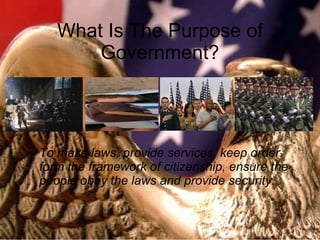
What Is The Purpose of Government? To make laws, provide services, keep order, form the framework of citizenship, ensure the people obey the laws and provide security.
Types of Government Nearly every country in the world today has a system of government Many different definitions and classifications of government Anthropologists divide governments into five groups: “ Big Man” government Chiefdoms Complex Chiefdoms States Empires
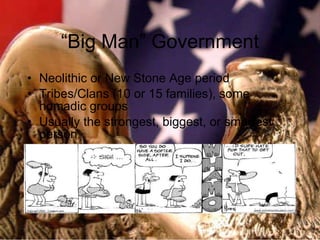
“Big Man” Government Neolithic or New Stone Age period Tribes/Clans (10 or 15 families), some nomadic groups Usually the strongest, biggest, or smartest person
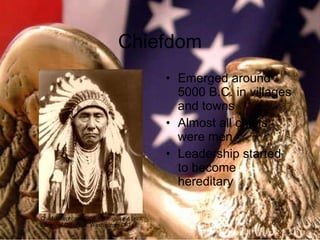
Chiefdom Emerged around 5000 B.C. in villages and towns Almost all chiefs were men Leadership started to become hereditary Chief Joseph. ca. 1900. Photographic print. Library of Congress, Washington, D.C.
Complex Chiefdoms Middle Bronze Age Towns & Cities (1,000+ people) Super-chief who ruled several chiefs Distribution and division of power
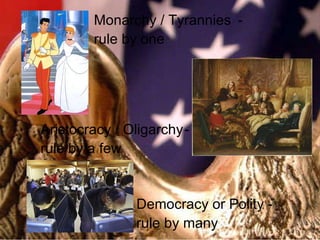
States Sumer first state (3500 B.C.) 4-5 levels of government (king, generals, governors, mayor, mayor assistants) Monopoly over the legitimate use of force Aristotle identified three types of states:
Aristocracy / Oligarchy -  rule by a few Democracy or Polity -  rule by many Monarchy / Tyrannies -  rule by one
Empires Five levels of government Usually controls several states Akkadians first empire, then Babylonians & Assyrians (Middle East)
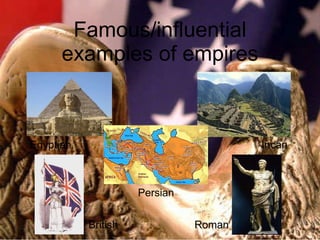
Famous/influential examples of empires Egyptian Incan British Roman Persian
Three Ways to Describe Governments Economy What provides the goods and services that are bought, sold, and used? Politics How is the government run? Authority Who picks the government?
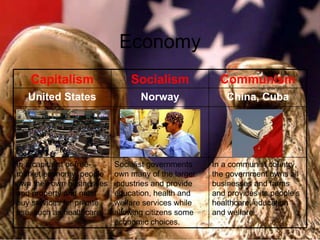
Economy In a communist country, the government owns all businesses and farms and provides its people’s healthcare, education and welfare Socialist governments own many of the larger industries and provide education, health and welfare services while allowing citizens some economic choices. In a capitalist or free-market economy, people own their own businesses and property and must buy services for private use, such as healthcare. China, Cuba Norway United States Communism Socialism Capitalism
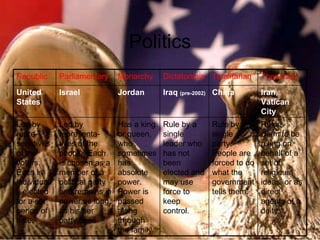
Politics Rulers claim to be ruling on behalf of a set of religious ideas, or as direct agents of a deity. Rule by a single party. People are forced to do what the government tells them. Rule by a single leader who has not been elected and may use force to keep control. Has a king or queen, who sometimes has absolute power. Power is passed along through the family Led by representa- tives of the people. Each is chosen as a member of a political party and remains in power as long as his/her party does. Led by repre- senatives of the voters. Each is individually elected for a set period of time. Iran, Vatican City China Iraq  (pre-2002) Jordan Israel United States Theocracy Totalitarian Dictatorship Monarchy Parliamentary Republic
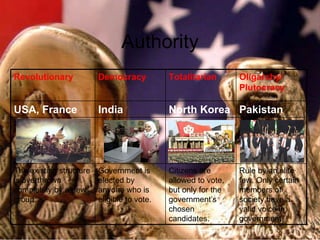
Authority Rule by an elite few. Only certain members of society have a valid voice in government. Citizens are allowed to vote, but only for the government’s chosen candidates. Government is elected by anyone who is eligible to vote. The existing structure is overthrown completely by a new group. Pakistan North Korea India USA, France Oligarchy/ Plutocracy Totalitarian Democracy Revolutionary
Aristotle Revisited Two Main Categories Monarchy Dictatorship Theocracy Oligarchy Aristocracy Republic Parliamentary Confederacy Rule by one Rule by the few Rule by many Totalitarian Democratic
Fair Use This presentation was created using the fair use guidelines.
Sources Carr, Karen. History for Kids. January 15, 2009. Retrieved June 15, 2010, from:  http://www.historyforkids.org/learn/government/index.htm   Central Intelligence Agency. World Fact Book. Retrieved June 15, 2010, from:  https://www.cia.gov/library/publications/the-world-factbook/fields/2128.html http://www.stutzfamily.com/mrstutz/WorldAffairs/typesofgovt.html Library of Congress. Prints and Photographs Division. Retrieved June 15, 2010, from:  http://www.loc.gov/index.html

Government

  • 1.
    Types of GovernmentCivics Morgan Kratovil
  • 2.
    What Is Government?Government is a system for giving leadership and direction to a group. More specifically, government is the person or persons who have the power or authority to rule.
  • 3.
    What Is ThePurpose of Government? To make laws, provide services, keep order, form the framework of citizenship, ensure the people obey the laws and provide security.
  • 4.
    Types of GovernmentNearly every country in the world today has a system of government Many different definitions and classifications of government Anthropologists divide governments into five groups: “ Big Man” government Chiefdoms Complex Chiefdoms States Empires
  • 5.
    “Big Man” GovernmentNeolithic or New Stone Age period Tribes/Clans (10 or 15 families), some nomadic groups Usually the strongest, biggest, or smartest person
  • 6.
    Chiefdom Emerged around5000 B.C. in villages and towns Almost all chiefs were men Leadership started to become hereditary Chief Joseph. ca. 1900. Photographic print. Library of Congress, Washington, D.C.
  • 7.
    Complex Chiefdoms MiddleBronze Age Towns & Cities (1,000+ people) Super-chief who ruled several chiefs Distribution and division of power
  • 8.
    States Sumer firststate (3500 B.C.) 4-5 levels of government (king, generals, governors, mayor, mayor assistants) Monopoly over the legitimate use of force Aristotle identified three types of states:
  • 9.
    Aristocracy / Oligarchy- rule by a few Democracy or Polity - rule by many Monarchy / Tyrannies - rule by one
  • 10.
    Empires Five levelsof government Usually controls several states Akkadians first empire, then Babylonians & Assyrians (Middle East)
  • 11.
    Famous/influential examples ofempires Egyptian Incan British Roman Persian
  • 12.
    Three Ways toDescribe Governments Economy What provides the goods and services that are bought, sold, and used? Politics How is the government run? Authority Who picks the government?
  • 13.
    Economy In acommunist country, the government owns all businesses and farms and provides its people’s healthcare, education and welfare Socialist governments own many of the larger industries and provide education, health and welfare services while allowing citizens some economic choices. In a capitalist or free-market economy, people own their own businesses and property and must buy services for private use, such as healthcare. China, Cuba Norway United States Communism Socialism Capitalism
  • 14.
    Politics Rulers claimto be ruling on behalf of a set of religious ideas, or as direct agents of a deity. Rule by a single party. People are forced to do what the government tells them. Rule by a single leader who has not been elected and may use force to keep control. Has a king or queen, who sometimes has absolute power. Power is passed along through the family Led by representa- tives of the people. Each is chosen as a member of a political party and remains in power as long as his/her party does. Led by repre- senatives of the voters. Each is individually elected for a set period of time. Iran, Vatican City China Iraq (pre-2002) Jordan Israel United States Theocracy Totalitarian Dictatorship Monarchy Parliamentary Republic
  • 15.
    Authority Rule byan elite few. Only certain members of society have a valid voice in government. Citizens are allowed to vote, but only for the government’s chosen candidates. Government is elected by anyone who is eligible to vote. The existing structure is overthrown completely by a new group. Pakistan North Korea India USA, France Oligarchy/ Plutocracy Totalitarian Democracy Revolutionary
  • 16.
    Aristotle Revisited TwoMain Categories Monarchy Dictatorship Theocracy Oligarchy Aristocracy Republic Parliamentary Confederacy Rule by one Rule by the few Rule by many Totalitarian Democratic
  • 17.
    Fair Use Thispresentation was created using the fair use guidelines.
  • 18.
    Sources Carr, Karen.History for Kids. January 15, 2009. Retrieved June 15, 2010, from: http://www.historyforkids.org/learn/government/index.htm Central Intelligence Agency. World Fact Book. Retrieved June 15, 2010, from: https://www.cia.gov/library/publications/the-world-factbook/fields/2128.html http://www.stutzfamily.com/mrstutz/WorldAffairs/typesofgovt.html Library of Congress. Prints and Photographs Division. Retrieved June 15, 2010, from: http://www.loc.gov/index.html

Editor's Notes

  • #7 Artist (last name, first name), artist 痴 role (in parentheses i.e. Artist, Architect), title, the work type, in brackets [Painting, Cathedral, Chair], country of origin or city, and state, and repository.